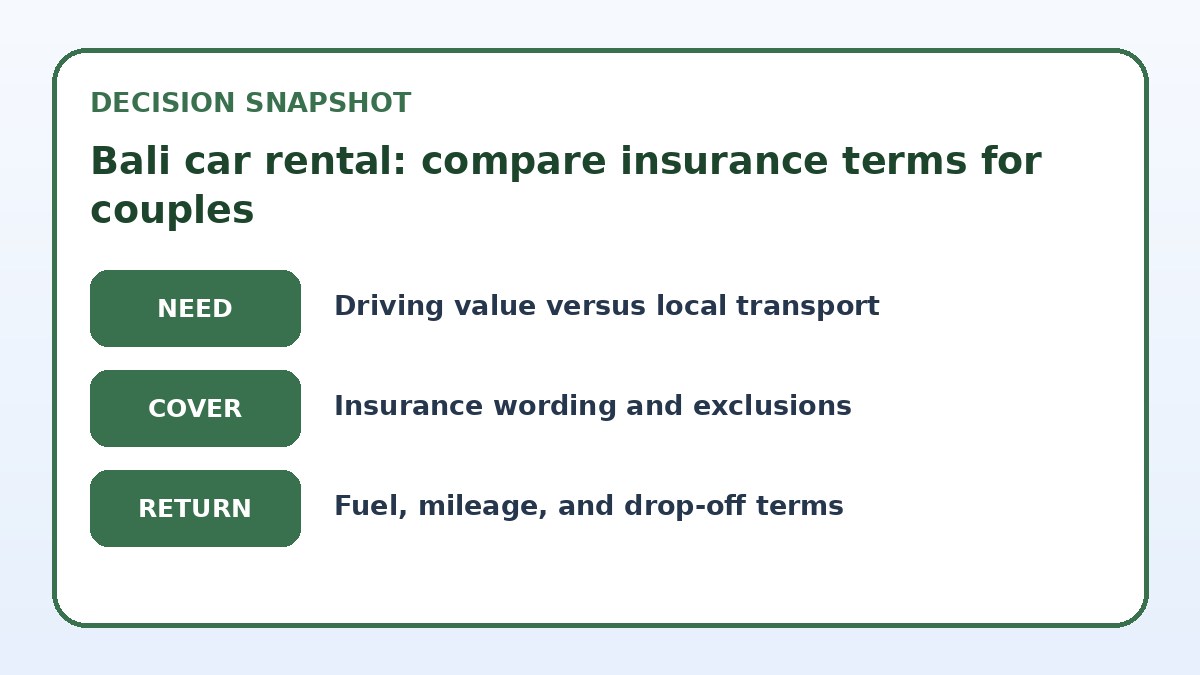
Practical answer up front: when renting a car in Bali as a couple, focus on the rental agreement’s liability limits, damage and theft definitions, named drivers and passenger coverage, and the exact conditions for collision damage waivers (CDW) and excess reduction products. Ask for every insurance term to be shown in writing—wording about “third-party liability,” “own damage,” and “exclusions” changes how much you might pay after an accident. Before you hand over a credit card, confirm which driver(s) are listed, whether scooters or remote roads are excluded, and whether local traffic fines are covered or charged separately. If you compare options, bring print or screenshots and verify the final policy text on the provider’s booking page or contract at pickup.
See current options before you compare the details
Availability and final conditions change. Open Trip.com now or keep reading for the practical comparison.
Why insurance wording matters more than price
Price is easy to compare on listing pages, but the wording in the policy determines your real risk. Two rentals may look identical in rate but differ substantially in what they exclude: one contract might cover windshield damage and theft with a reduced excess, while another treats windshield cracks as an excluded item that leaves you fully liable. For couples, different drivers, occasional short trips to remote beaches, or carrying luggage and child seats can intersect with exclusions. The specific language around “authorized driver,” “personal belongings,” and “use limitations” defines whether a seemingly minor incident becomes an expensive claim.
Take time to read the small-print clauses that address procedures too — how to report damage, whether police reports are required, and how quickly you must inform the company. These procedural requirements are often buried in wording but can determine whether a valid claim is accepted. If a clause requires a police report and you don’t get one at the scene, coverage could be denied even if the core risk would otherwise be covered. For couples who want a low-stress holiday, clarifying these operational points before you drive away prevents disputes at the return desk.
Key terms couples should watch for
Collision Damage Waiver (CDW), excess (or deductible), and third-party liability are the terms you’ll see most often — but their definitions vary. CDW often reduces or eliminates your financial responsibility for vehicle damage, yet it may not cover tyres, windscreens, or undercarriage damage unless explicitly stated. Excess is the amount you are responsible for on a claim; some providers offer “excess reduction” for an added fee, but that product’s wording may restrict coverage by driver age, experience, or location.
Also check who is a covered driver and whether spouses are automatically included or must be added. Many contracts stipulate that additional drivers incur a fee or must be registered in writing; unauthorized drivers can void coverage. Passenger injury coverage and personal effects coverages are separate items: the rental company’s wording might only cover liability to others, not medical costs for occupants, so couples should confirm whether their travel or health insurance supplements these gaps.
| Approach | Best for | Tradeoff to check |
|---|---|---|
| Pay minimal rate and accept full standard excess | Couples seeking lowest upfront cost who can tolerate higher post-incident liability | Lower daily price but significant out-of-pocket risk if damage or theft occurs |
| Buy provider’s excess reduction/CDW upgrade | Couples who prefer predictable, lower financial exposure at the time of an incident | Higher rental cost; read exclusions because some upgrades don’t cover tyres, windscreens, or off-road damage |
| Use credit-card or travel-insurance coverage | Couples who have strong third-party benefits and want to avoid duplicating cover | Coverage conditions can be restrictive—may require declining provider CDW or have limits on vehicle types and countries |
| Purchase an independent rental-insurance policy | Couples wanting a middle ground: lower excess without vendor lock-in | You must verify policy wording closely and follow claim procedures or you risk denial; some insurers don’t cover certain countries or short-term rentals |
Ready to check the option that fits your plan?
Use your exact dates and traveler details so the provider page can show the current total and conditions.
How to compare provider wording and third-party benefits
Put contracts side by side instead of relying on price or a single sentence summary. Copy key clauses into a notes file — excess amount, exclusions list, required reporting steps, and whether theft requires keys to be left in the vehicle. If an aggregator lists a “full cover” option, request the provider’s exact wording; many online summaries simplify or omit the exclusions that matter. When comparing, treat each checkbox (CDW, theft cover, third-party liability) as an independent decision point backed by wording, not a marketing label.
Don’t forget to examine external insurance you already have: some credit cards and travel policies provide secondary or primary cover for car rentals, but this cover can be conditional. For example, card-based coverage may exclude motorbikes or certain countries, and its wording may require you to decline the rental company’s CDW at the counter. Cross-check the card or travel insurer’s wording against the rental contract and confirm on the provider’s booking page whether the rental company requires you to register the cardholder or decline their CDW to activate the card’s benefits.
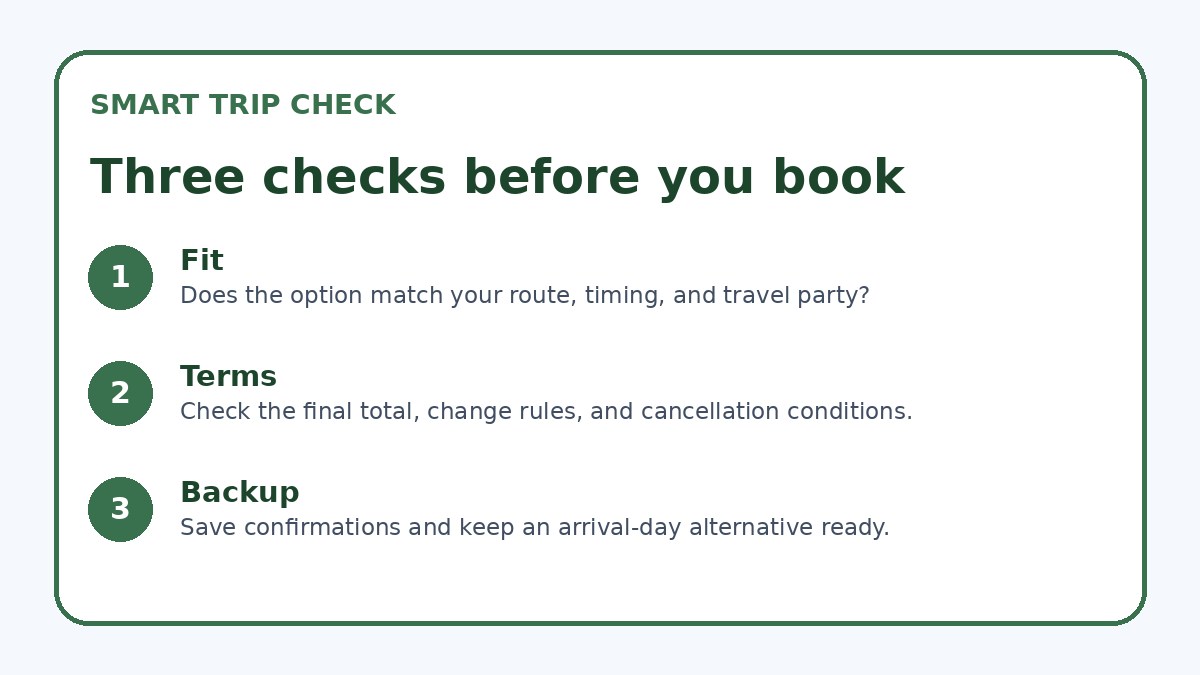
Before you book
- Photograph the vehicle inside and out at pickup, timestamp images, and email them to yourself so there’s an external record.
- Confirm in writing which drivers are covered and add your partner to the contract if not automatically included.
- Request the full insurance wording or policy PDF and read exclusions for tyres, windscreens, undercarriage, key loss, and off-road use.
- Ask the rental rep how to report an accident or theft and whether a police report is required; note emergency contact details on your phone.
- Compare the rental contract wording with any credit-card or travel insurance wording, and verify conditions on the provider’s final booking page.
- Keep all return paperwork, receipt copies, and claim reference numbers until any potential charge window has passed.
Practical steps at pickup and return
At pickup, read and photograph the full contract — every page and all signatures. Ask staff to point out any handwritten amendments and confirm which drivers are listed. Verify the vehicle condition with a written checklist or photos that show pre-existing damage, including tyres, mirrors and underbody if accessible. Get the local emergency contact and the procedure for reporting incidents spelled out: do they require a police report, an on-site assessor, or immediate notification via phone or app?
On return, request a final condition form and keep copies until any potential damage window closes. If there’s a disagreement, having timestamps and photos helps resolve it faster. If you file a claim, insist on a clear reference number and a written timeline for resolution. For couples sharing the driving, keep a copy of the contract that shows driver names and any additional driver fees paid — it’s common for disputes to arise when one partner isn’t listed despite having driven.
Frequently asked questions
Do married couples get automatic coverage under Bali rental contracts?
Not necessarily. Many Bali contracts treat driver coverage the same regardless of marital status — the named renter is usually the default insured driver, and additional drivers (including spouses) often must be registered and may incur a fee. The wording will state whether spouses are automatically included or need to be added; if it’s ambiguous, ask for written confirmation and add your partner as an authorized driver at pickup. Keep that signed contract page as proof in case of a claim.
Will my credit card cover a Bali car rental claim or collision?
Possibly, but coverage varies widely and depends on the card’s terms. Some credit cards provide primary or secondary collision damage coverage for rental cars, but they often exclude specific vehicle types (scooters, large vans) or activities (off-road driving). Crucially, card benefits frequently require you to decline the rental company’s CDW at the counter and use the card to pay for the rental. Before relying on card coverage, print the card benefits wording, verify limitations and claim procedures, and compare that wording with the rental contract and pickup requirements on the provider’s booking page.
What wording indicates theft is covered rather than excluded?
Look for explicit language that states “theft of the rental vehicle” or “theft cover” and reads clearly whether keys left unattended, unlocked vehicles, or negligence void the cover. A theft cover that applies only when the renter complied with security obligations (locked doors, keys not left in the ignition) is common. If the contract mentions “theft where the renter was negligent,” that may reduce or remove coverage in many practical scenarios. Ask the provider to clarify examples of negligence and get the answer in writing before driving away.
Final planning note
For couples renting a car in Bali, the words in the insurance clauses determine real financial risk far more than the headline rate. Read the full policy, confirm who’s an authorized driver, and flag common exclusions such as tyres, windscreens, key loss and off-road use. Cross‑check any credit‑card or travel insurance benefits against the rental wording and get verbal assurances in writing at pickup. Photograph the vehicle, keep paperwork, and clarify reporting procedures so a small incident doesn’t escalate into a major billing dispute. If you need an extra resource for comparing current offers and provider terms, Trip.com can be a place to view availability and then verify the exact policy text on the rental company’s final booking page.
Continue planning
Check current options and final conditions
Use the provider page to confirm live availability, the final total, cancellation terms, and every condition that matters to your trip.
This evergreen planning guide was created with AI-assisted drafting and a structured quality review. It does not display live prices, schedules, availability, visa guidance, or provider rankings. Verify current details before booking. Some links are affiliate links; we may earn a commission at no additional cost to you.