
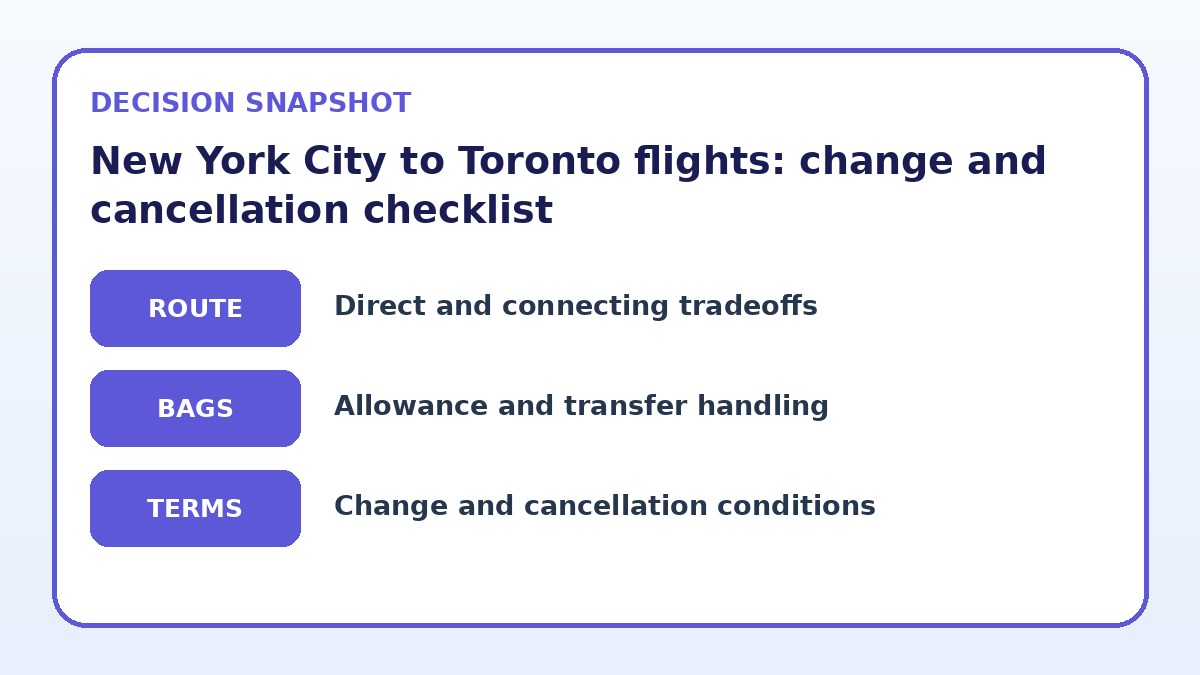
If you and your partner are planning travel between New York City and Toronto, start by prioritizing flexibility: verify the change, cancellation, and refund rules before you pay. Different fare families, booking channels and whether the ticket is non-refundable, partially refundable, or fully refundable will determine how easy it is to change dates or recover money if plans shift. Also check whether fees are per ticket or per passenger and how name changes, schedule changes, and missed connections are handled. For cross-border trips, confirm any rebooking rules for international travel specifically and whether the airline’s published policy differs for US- and Canada-issued tickets. Use the carrier’s final booking page to confirm exact penalties, fare conditions, and the timeline for refunds—Trip.com can be one option to compare policies but always verify directly with the airline before finishing payment.
Understand the basic fare types and what they allow
Airlines generally sell a range of fares from the cheapest non-refundable basic fares to fully refundable business-class tickets. For couples, the practical difference is whether the fare allows free date changes, credits toward future travel, or a cash refund. Basic economy-style fares often limit seat selection and prevent ticket changes or refunds entirely; slightly higher fare buckets usually permit changes for a fee or provide travel credits instead of refunds. When comparing options, read the fare rules that appear on the purchasing page and in the email confirmation—they’re the legal terms that define what’s possible if you need to change plans.
Because fare names and inclusions differ by carrier, focus on the specific conditions: amount of the change fee, whether a fare difference is due, whether refunds are issued to the original form of payment, and what constitutes a ‘major change’ that triggers free rebooking. For international trips like New York City to Toronto, additional rules may apply for cross-border taxes, and refund timelines can be longer. Save screenshots of the rule text at purchase and request written confirmation of any promised waiver or exceptional handling if you negotiate with an agent.
Compare direct versus connecting itineraries on flexibility grounds
Direct flights are often simpler to change because there’s only one segment to alter, and some airlines treat same-plane rebookings more leniently. However, a direct flight that’s non-refundable still carries the same cancellation risk; you won’t automatically get more flexibility just because it’s nonstop. Connecting itineraries booked on one ticket may provide protection if a delay on the first carrier causes a missed connection, since the airline or alliance is responsible for rerouting. But if your trip uses separate tickets or different carriers, protection evaporates: missed connections on independently booked legs usually become the passenger’s responsibility.
When evaluating options as a couple, ask whether the tickets are on the same booking reference and whether both legs are protected by the same ticketing airline or alliance. If you anticipate schedule changes or want maximum control, buying a single itinerary with a protected connection is often safer than two separate discount legs. Balance that protection against potential higher change fees or stricter refund rules on the single-ticket option—sometimes two flexible one-way tickets can provide easier rebooking than a discounted round trip.
| Approach | Best for | Tradeoff to check |
|---|---|---|
| Book refundable or fully flexible fares | Couples who prioritize refundability and minimal stress | Higher upfront cost compared with non-refundable options |
| Buy basic fares and add travel insurance | Couples seeking low base fares with contingency cover | Insurance has exclusions and may not cover simple changes of mind |
| Purchase semi-flex fares with change-fee waivers | Couples wanting middle ground between cost and flexibility | May still require paying fare differences on rebooking |
| Book separate one-way tickets for each partner | Couples who want staggered flexibility or different return plans | Lossof protection for missed connections and possible higher combined cost |
How to read and verify waivers, credits, and refund timelines
Airlines may advertise waivers or travel credits for certain circumstances; these are not all equal. A fee waiver might allow a free date change but still require you to pay any fare difference. Travel credits often have an expiration date and may not be refundable. If a policy promises a cash refund under specific conditions, check whether refunds are processed immediately or after an administrative period. For couples planning a flexible holiday, a travel credit with a short expiration can be riskier than a slightly more expensive refundable fare.
At booking, identify where a potential refund would be paid—back to your card, as a voucher, or as a future travel credit—and confirm the timeline. If you purchase through a third-party site, confirm whether refunds or credits are issued by the airline or by the reseller; reseller refunds can take longer. When in doubt, click through to the airline’s final checkout page and open the fare rules link. If language is unclear, call the airline’s customer service and request written confirmation of the policy that applies to your exact itinerary and passenger names.
Before you book
- Before paying, open and save the full fare rules and change/cancellation policy displayed on the airline’s final checkout page.
- Confirm whether change or cancellation fees are charged per passenger and whether fare difference applies to date changes.
- If booking through a third party, verify whether refunds and credits are processed by the airline or the reseller and note contact details.
- Check how schedule changes are handled: what qualifies as a major change and whether rebooking is offered without penalty.
- Decide which date-change deadline you’ll accept and mark it on your calendar so you can act before stricter penalties apply.
- If considering insurance, read exclusions carefully to ensure it covers your likely reasons to cancel or rebook for a cross-border trip.
Practical decision criteria for couples planning contingencies
Start by listing your priorities: lowest price, maximum refundability, or the ability to change dates freely. If avoiding financial loss is most important, lean toward refundable fares or flexible bundles even if the upfront cost is higher. If your dates are tentative but you want the lowest possible price, choose a basic fare and add travel insurance that explicitly covers cancellation for specified reasons. Remember that many travel insurance policies exclude simple change of mind; read policy exclusions carefully and ensure the insurer covers cross-border cancellations.
Also weigh logistics: are you both traveling on the same itinerary and payment method, and do you share the same risk tolerance for lost value? For couples willing to split risk, one partner might book a flexible outbound while the other takes a cheaper return, or you could stagger purchases to keep options open. Finally, set a clear change deadline—decide how close to travel you’re willing to accept change fees or use credits—and build that deadline into your planning to avoid rushed, expensive choices.
Frequently asked questions
If one partner needs to cancel and the other still wants to travel, how do change and cancellation rules work?
Rules depend on whether you booked a single reservation or separate tickets. On one shared booking, changes often affect the whole record: splitting the booking might incur change fees for both passengers or require reissuing tickets. If your trip is on one PNR and one passenger cancels, some airlines allow a partial refund or credit for the canceled passenger but may still charge administrative fees. If you expect asymmetric plans, consider booking separate tickets to preserve one traveler’s flexibility; verify whether the fare conditions allow name changes, partial refunds, or voluntary passenger cancellations on the airline’s policy page before booking.
Does a schedule change announced by the airline always allow a free rebooking?
Not always. Airlines commonly permit free rebooking when a schedule change meets the carrier’s threshold for ‘significant’ changes, but what qualifies varies by airline and by whether the ticket was issued in the U.S. or Canada. Minor timetable shifts may not trigger waivers. When a schedule change occurs, check the airline’s notification carefully: it should describe your options and deadlines for rebooking or refund. Keep documentation of the notification and, if needed, contact the airline’s customer service or your booking agent to confirm the remedies available for your exact itinerary.
Can you transfer or change passenger names on a booked ticket if plans shift between partners?
Most airlines restrict name changes and do not permit transferring tickets to unrelated passengers; some allow minor corrections for spelling errors. Changing the primary passenger to someone else is usually not permitted except in limited corporate or group situations. If you think you might need to swap passengers, check the fare rules for name-change allowances before purchase. For couples, the safer approach is to book separately if you expect possible substitution; otherwise plan for potential penalties or repurchase if a passenger must be replaced.
Final planning note
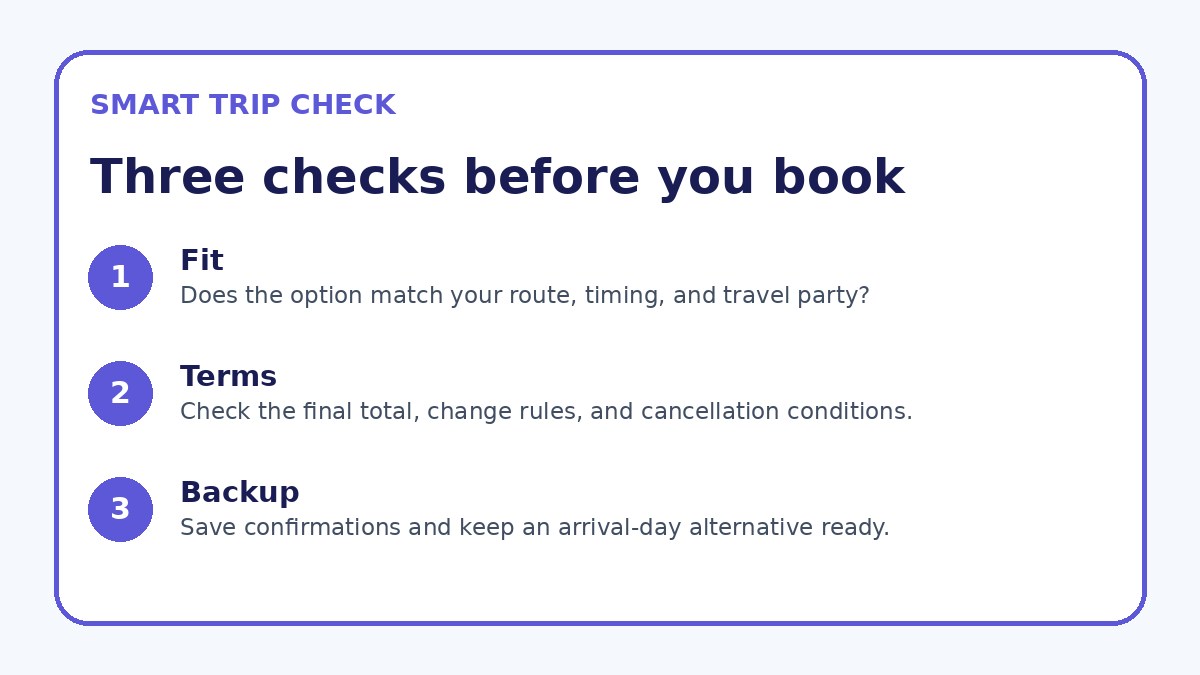
For couples traveling between New York City and Toronto, the right booking choice balances price, flexibility, and the risk you’re willing to accept. Start by reading the airline’s full fare rules on the final booking page and confirming how changes, refunds, and credits are handled for your exact itinerary and passenger names. Decide whether refundable fares, semi-flex options, or insurance best match your needs and weigh the cost of fees versus the convenience of stress-free rebooking. If you use a third-party site like Trip.com to compare availability, use it only as a comparison tool and confirm the final policy details directly with the airline before paying.
Continue planning
Check current options and final conditions
Use the provider page to confirm live availability, the final total, cancellation terms, and every condition that matters to your trip.
This evergreen planning guide was created with AI-assisted drafting and a structured quality review. It does not display live prices, schedules, availability, visa guidance, or provider rankings. Verify current details before booking. Some links are affiliate links; we may earn a commission at no additional cost to you.