If you need a practical answer right away: for most solo travelers the high-speed train is the easiest balance of convenience, city-center arrival, and low hassle — but your choice should hinge on priorities: time, comfort, cost, and luggage. Trains usually mean fewer transfers, predictable boarding, and access to central stations; flying can save clock time for long-distance itineraries but adds airport transfers and extra steps; buses are the lowest-friction option when budget is the overriding concern, yet travel time and onboard comfort vary. Driving offers flexibility for multi-stop trips, but solo drivers should weigh fatigue, parking and tolls. This guide explains the tradeoffs you’ll actually feel during the trip, the decision criteria to use when comparing options, and the exact items to check on provider booking pages before you finalize anything.
Why trains are typically the practical default
Trains are the practical default for many solo travelers because they start and end in city centers, which reduces time spent on transfers and taxis. For someone traveling light it’s easy to walk or take a short public transit ride to the station, keep luggage in sight, and settle into a seat without strict carry-on scanning or long security lines. The onboard environment tends to be more spacious than buses or economy flights, and you can use travel time productively: work, read, or rest with straightforward access to toilets and refreshments.
When you’re comparing train options, focus on direct vs. connecting services and total door-to-door time rather than advertised speed alone. Verify connection terminals and transfer windows if a change is listed—missing a timed connection can change plans significantly. On provider booking pages, confirm the exact station names for departure and arrival, baggage allowances, seat reservation requirements, and refund or change rules before you buy. If you’re planning to book through an aggregator such as Trip.com, use it to compare schedules but always confirm the final ticket conditions on the operator’s page.
When flying makes sense — and what you give up
Flying can make sense for solo travelers who are combining international legs or who must reach Amsterdam faster because of a tight onward connection. A flight’s advertised airborne time often looks short, but airport procedures—arriving early, security queues, bag drops, and ground transfers—add significant real-world minutes. You also change from city-center to airport-to-city transport, which can mean extra cost or planning for public transit or rideshares. For some, the time saved door-to-door still justifies the airport hassle; for others, the logistics tip the balance back to surface options.
Before booking a flight, check and compare the full door-to-door timeline: time to the airport from your Paris location, minimum recommended arrival, potential for delays, and onward transfer options at Amsterdam. On the booking page, confirm exact airports used, whether carry-on includes a personal item, checked-baggage policies, change fees and refund rules, and whether the fare includes a seat assignment. If your itinerary includes connections, pay special attention to minimum connection times and whether an airline issues protections for missed connections versus separate tickets where you accept more risk.
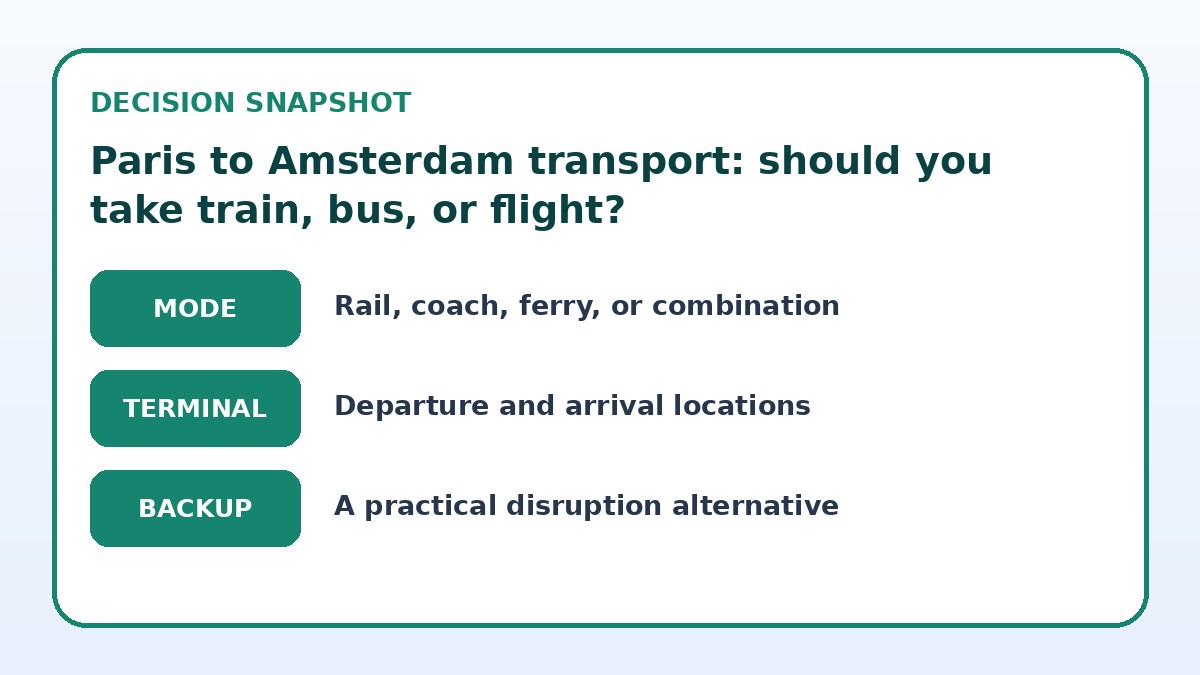
| Approach | Best for | Tradeoff to check |
|---|---|---|
| High-speed train | Travelers valuing comfort, city-center arrivals, and straightforward journeys | Potentially higher fare than buses; check seat reservations and connection details |
| Flight | Those needing the fastest airborne leg or combining long-distance segments | Extra airport transfers and procedures increase actual door-to-door time |
| Long-distance bus | Budget-conscious solo travelers willing to trade time for lower cost | Longer journey time and variable onboard comfort; verify luggage policies |
| Driving or mixed modes | Travelers who want flexibility, detours, or large luggage | Parking, tolls, fatigue and rental policies can offset perceived convenience |
Buses and coach services: economy with caveats
Long-distance buses are often the lowest-cost option and can be straightforward for solo travelers who prioritize budgeting over speed. Modern coaches may offer power outlets, Wi-Fi, and restrooms, but comfort levels vary and scenic breaks can extend the trip. Bus routes typically run between major coach stations or transport hubs and sometimes to peripheral terminals, so you’ll want to confirm precise pickup and drop-off points. For solo travelers who are on flexible schedules and traveling light, a direct coach can be an efficient tradeoff.
When evaluating buses, verify luggage allowances and fees, seat reservation rules, onboard facilities, and refund or change policies on the operator’s site before you book. Check estimated journey times in real-world conditions—roadworks and peak-season traffic can add hours. If you’re booking from an aggregator, cross-check the coach operator’s page for boarding procedures and the terminal address to avoid last-minute confusion. Finally, consider personal comfort and safety: choose daytime departures if you prefer to travel awake and avoid long overnight rides alone.
Before you book
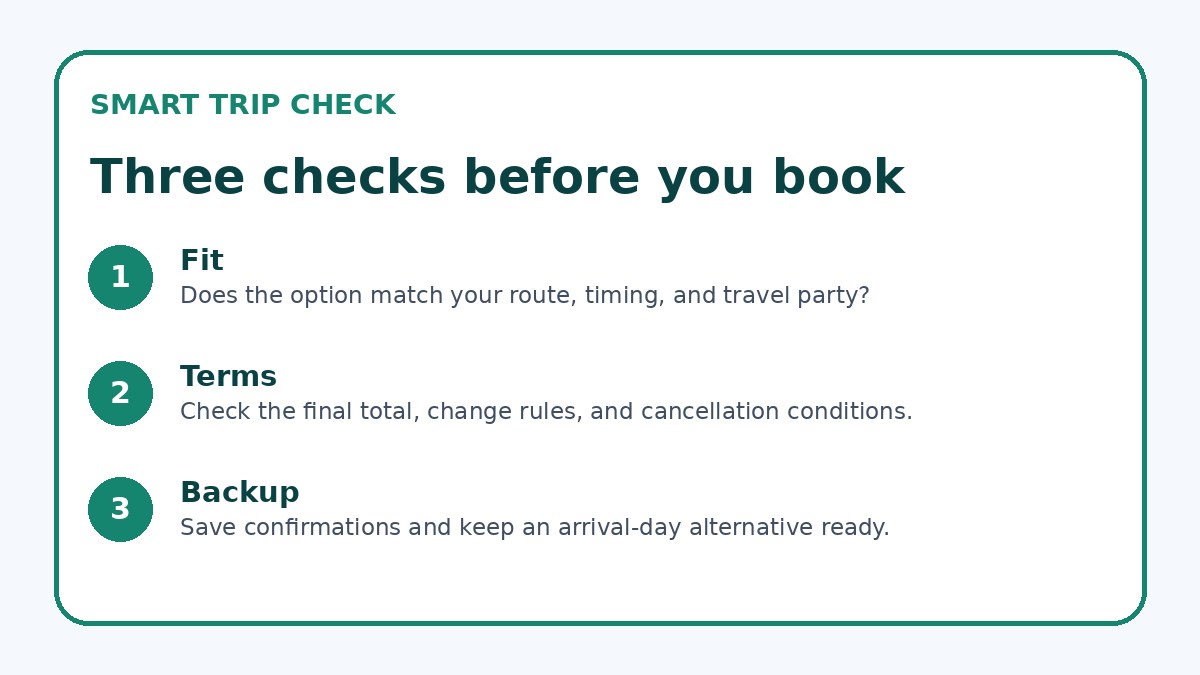
- Confirm exact departure and arrival locations (station names, airport terminals, or coach terminals) on the provider’s booking page before paying.
- Compare total door-to-door time including transfers, recommended airport arrival time, and local transit to your final address.
- Check baggage allowances, fees for extra or oversized items, and whether a seat reservation is required or optional.
- Review change and cancellation policies and any travel protections offered for missed connections or delays.
- If driving or renting, verify cross-border permissions, insurance coverage, tolls, and where you can legally park or return the vehicle.
- Read recent traveler notes or operator boarding procedures and have a backup plan (later service or alternative mode) in case of disruptions.
Driving and mixed modes: control versus effort
Driving gives unmatched control: pick your schedule, stop where you like, and carry more gear without worrying about baggage fees. For a solo traveler considering a road trip with detours—small towns, countryside stops, or scenic photo breaks—driving can create a different style of trip than a straight point-to-point transfer. However, the convenience comes with responsibilities: navigating unfamiliar roads, possible tolls, city parking constraints in both Paris and Amsterdam, and dealing with fatigue when you’re the only driver.
If you plan to drive, compare door-to-door time against other options including time needed for parking or car return. Review rental terms carefully on the provider’s booking page: cross-border rules, insurance coverage, fuel policy, mileage limits, and fees for drop-off at a different country. For mixed-mode choices—drive to a nearby high-speed station or park-and-ride—check timetable coordination and station parking availability. Solo drivers should plan realistic driving shifts and have contingency plans if they need to hand over driving or switch to public transport.
Frequently asked questions
Is the train always the fastest door-to-door option between Paris and Amsterdam?
Not always. Trains often offer fast city-center to city-center travel, but the fastest door-to-door option depends on where in Paris you start and where in Amsterdam you need to finish. Flights have a shorter airborne time but add time for airport transfers, security, and check-in; buses remove airport steps but are slower on the road. To decide, estimate the full journey from your exact start address to final destination and compare realistic transfer times for each mode. Verify schedules and transfer connections on provider pages before booking.
How should I handle luggage as a solo traveler when choosing between train, bus, or flight?
Consider how much you can comfortably manage without assistance. Trains allow easier access to luggage stored near seats and rarely impose strict weight limits for carry-on, but some services may require reservations for large items—check the operator’s policy. Buses usually have underfloor compartments with limits and potential fees; verify dimensions and handling rules. Flights have clearly defined carry-on and checked-baggage rules and possible charges for extras. Whatever mode you choose, check the exact baggage allowances and fees on the booking page and plan for comfortable, lockable luggage you can manage solo.
What should I verify on the booking page to avoid last-minute surprises?
Before you finalize any booking, confirm the precise pickup and drop-off locations, baggage allowances and fees, seat reservation rules, change and cancellation terms, and what forms of ID or documents are required at boarding. For flights, check airport terminals and whether your ticket is on a single itinerary or separate legs; for trains, confirm whether a reservation is included or needed; for rentals, read cross-border and insurance clauses. If anything on an aggregator’s page seems ambiguous, open the operator’s own site to verify the conditions and small-print.
Final planning note
For many solo travelers the high-speed train offers the most practical mix of convenience, comfort, and city-center arrival for the Paris to Amsterdam route, but the right choice depends on your priorities. If saving cash is the main goal, coaches deserve a close look; if combining longer international legs or tight schedules matters, flights can still be sensible with careful timing. Driving is best for flexible, multi-stop trips but adds effort and costs that erase some of its benefits. Use the decision criteria here—total door-to-door time, baggage handling, cost tradeoffs, and cancellation terms—and confirm all critical details on the provider’s booking pages before you commit.
Continue planning
Check current options and final conditions
Use the provider page to confirm live availability, the final total, cancellation terms, and every condition that matters to your trip.
This evergreen planning guide was created with AI-assisted drafting and a structured quality review. It does not display live prices, schedules, availability, visa guidance, or provider rankings. Verify current details before booking. Some links are affiliate links; we may earn a commission at no additional cost to you.