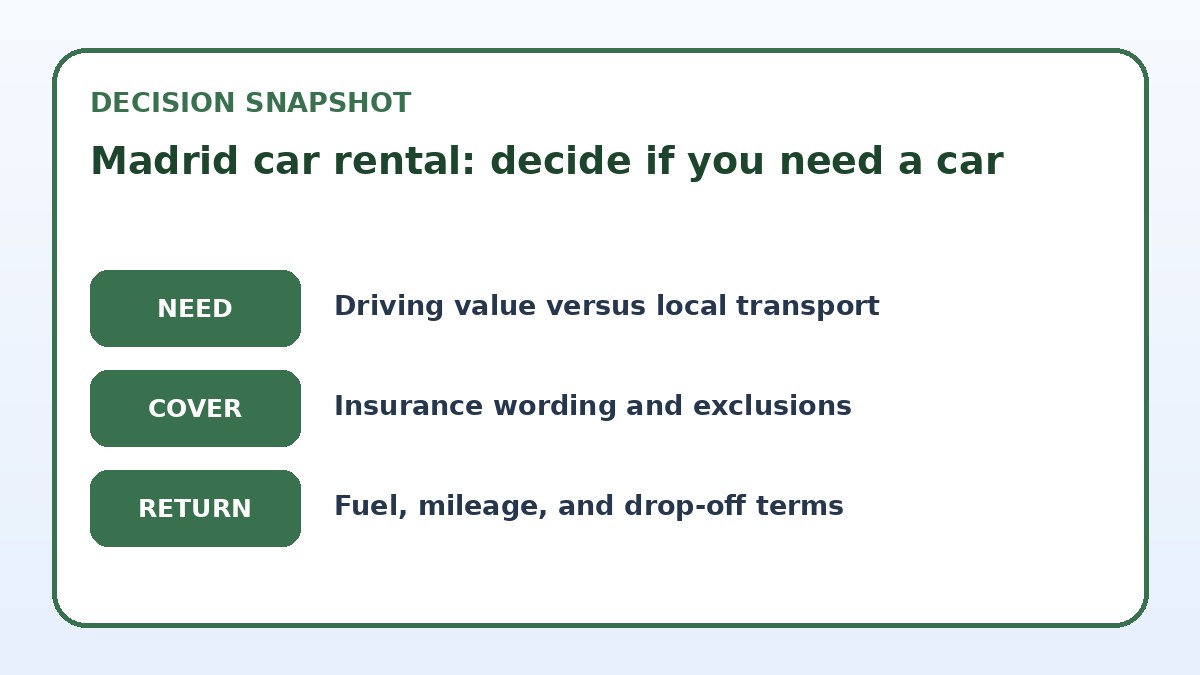
Practical answer first: for most first-time visitors who plan to stay mainly within central Madrid and use the metro, buses and walking, a rental car is unnecessary and often more trouble than it's worth. However, if your itinerary includes multi-day day trips to smaller towns, rural wine regions or an itinerary that starts or ends outside the city, renting a car can be the most flexible option. This guide explains the tradeoffs—cost, traffic, parking, convenience, timing and what you must verify before booking—so you can match a decision to your priorities. Read the short decision checklist, then the deeper comparisons to make a confident choice before you reserve.
City travel: why Madrid’s public transport often beats a car
Madrid has a dense, easy-to-navigate central area where walking and the metro will usually get you faster to major sights than driving. The core neighborhoods—Sol, Gran Vía, Plaza Mayor, La Latina, Salamanca and Malasaña—are built for pedestrians and short metro rides. Frequent service, relatively low fares and intermodal transfers make public transit practical for museum days and evening tapas crawls. Taxis and app-based ride-hailing are likewise easy to use for late nights or when public transit is less convenient.
Driving in central Madrid brings tradeoffs that first-time visitors notice quickly: narrow streets, restricted traffic zones, one-way systems and time spent hunting for parking. Many central streets are limited to residents or have low-emission restrictions; confirm that your planned routes are allowed before driving. If your stay is focused on exploring the city’s cultural pockets, you’ll likely spend more time managing a car than enjoying the places you came to see.
When renting makes sense: day trips, flexibility and family travel
A rental car shines when your itinerary goes beyond Madrid’s well-served day-trip network. Places such as small medieval towns, dispersed wineries, natural parks and rural villages often require driving to reach conveniently. If you plan multiple day trips with early starts or late returns, a car lets you set your own schedule, carry picnic gear or swap between towns in a single day without depending on regional train or bus timetables.
Travelers with children, lots of luggage, or mobility needs frequently find a car more comfortable even inside Madrid, because it removes the hassle of transfers and carrying gear. Evaluate driving distances and road types on your intended routes—motorways are straightforward, but some rural approaches can be narrow or winding—and factor in fatigue and parking logistics at each stop when deciding whether to rent.
| Approach | Best for | Tradeoff to check |
|---|---|---|
| No car — public transit, walking, taxis | Sightseeing within central Madrid, museum-focused itineraries, short stays | Less flexibility for remote day trips; dependent on timetables and service hours |
| Rent for day trips only | Base in Madrid but take two or three day trips to rural towns or parks | Extra booking steps and cost for short rental windows; must manage pick-up/drop-off logistics |
| Rent for whole trip | Multi-stop itineraries, traveling with family or heavy luggage, starting/ending outside city | Handles flexibility but increases parking difficulty and urban driving stress |
| Combine transit + occasional taxi or guided tours | Travelers who want minimal driving but still reach specific sites without renting | May be costlier per trip and less spontaneous than having your own car |
Costs, parking and restrictions you must check before booking
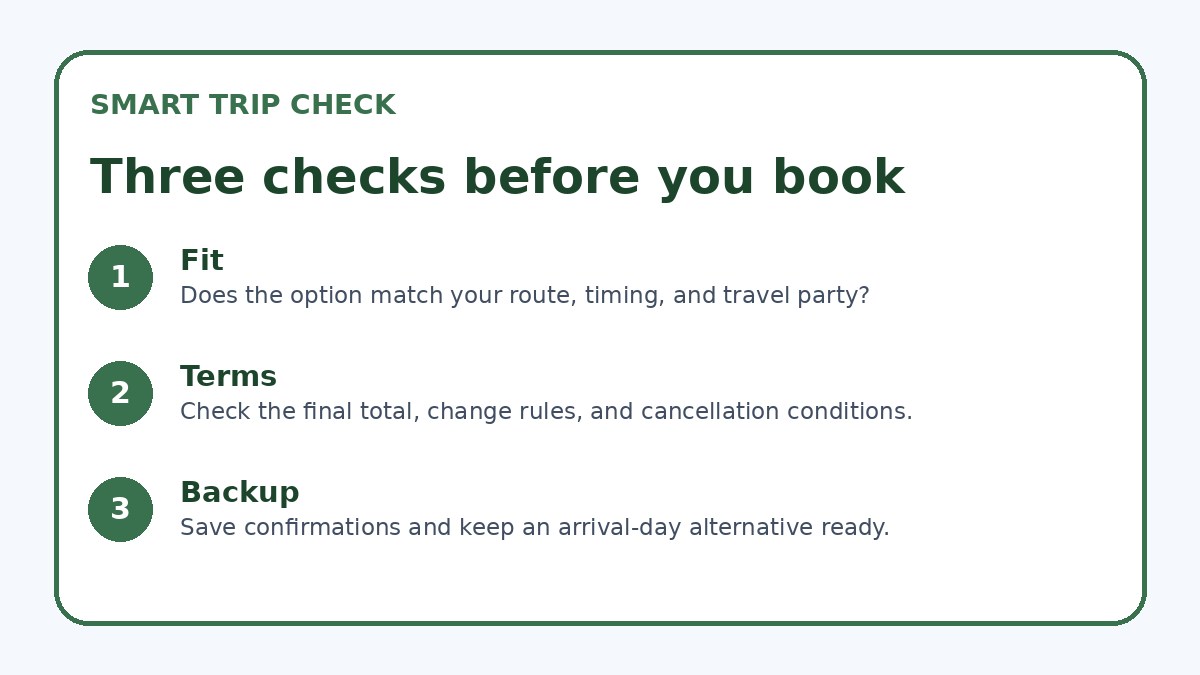
Total cost goes beyond the headline rental rate. Add fuel, insurance options, parking fees, congestion or low-emission zone charges and potential one-way or airport surcharges. Verify the rental company’s fuel policy (full-to-full is usually fairer), the insurance excess amount and whether third-party damage protection is included or optional. If you plan to cross international borders, check cross-border rules and whether additional fees or documentation are required.
Parking in Madrid varies by neighborhood and is often the main hidden cost. Many hotels in the center have limited private parking and may charge for spaces; street parking is regulated by ORA zones with time limits and fees. Research parking garages near your accommodations and sights, and check opening hours. For long-term parking during day trips, identify reliable lots at your route’s start points to avoid last-minute searches.
Before you book
- Map your full itinerary and highlight every stop outside central Madrid to see if public transport covers them conveniently.
- Check your hotel’s exact address for parking availability and costs; ask about guest-only spaces or nearby garages.
- On the rental page, confirm fuel policy, mileage limits, insurance excess amounts, and any one-way or airport surcharges.
- Search for low-emission or restricted traffic zones on planned driving routes and verify whether rentals are allowed there.
- Compare the total estimated cost of car rental plus fuel and parking with public transit, taxis and guided day trips for the same days.
- Document vehicle condition at pick-up with photos and record fuel level and mileage to avoid disputes at drop-off.
Practical booking advice and how to compare options
Compare alternatives before you book: run a mock itinerary with public transit times, taxi estimates and the rental-car total cost for the same days. When comparing car quotes, look beyond the daily rate. Confirm exact pick-up and drop-off locations, mileage limits, additional drivers, child-seat availability and the company’s fuel and cancellation policies. Trip.com can be used as one place to compare current availability and terms, but always verify the provider’s final booking page for exact fees and requirements.
If you decide to rent, book a category that fits your needs rather than the smallest available model—space for luggage and comfort for longer drives are worth upgrading. Photograph vehicle condition at pick-up and keep records of fuel level and mileage. Reserve a car with flexible pickup hours if your arrival time is uncertain, and plan a route that avoids Madrid’s restricted zones unless you have explicit authorization or a hotel-space arrangement.
Frequently asked questions
Is driving in Madrid hard for someone used to other European cities?
Driving in Madrid is manageable but requires attention. The city center has narrow streets, one-way routes and traffic restrictions that can be unfamiliar. Motorways and ring roads are well signed and similar to other European highways, so intercity driving is straightforward once you’re out of the core. For first-time visitors, navigating central parking, restricted zones and busy rush hours is where stress accumulates. If you prefer to focus on sightseeing instead of reading signs and hunting parking, using transit or taxis in the city is a calm alternative.
Can I park near major attractions like the Prado or Retiro Park?
Parking close to major central attractions is possible but limited and often regulated. The Prado and Retiro areas are within regulated parking zones with time limits and paid spots; many visitors find it easier to use a nearby parking garage or to park at a suburban lot and take public transit into the center. If parking at or near an attraction is a priority, contact garages in advance to check availability and opening hours or ask your hotel whether they can reserve a guest space.
How should I plan day trips from Madrid if I don’t rent a car?
You can reach many popular day-trip destinations by regional train, bus or organized tour. Start by checking train and coach timetables for your target towns and compare journey times and number of transfers. For places with limited public transport, consider booking a guided day trip that covers transport and stops, or use a taxi for the final leg if feasible. Estimate door-to-door time and cost for public options against a car rental to see which matches your comfort level and schedule needs.
Final planning note
Deciding whether to rent a car for Madrid hinges on where you’ll spend most of your time. If your trip stays within central neighborhoods and uses museums, restaurants and nightlife as main activities, skip the rental: public transit, walking and taxis will keep your schedule simple and avoid parking headaches. If your plan includes multiple rural day trips, traveling with family or starting an itinerary outside the city, a car can provide valuable freedom. Whatever you choose, run the numbers for total cost, check parking and low-emission zone rules, and verify all rental terms on the provider’s final booking page before you commit.
Continue planning
Check current options and final conditions
Use the provider page to confirm live availability, the final total, cancellation terms, and every condition that matters to your trip.
This evergreen planning guide was created with AI-assisted drafting and a structured quality review. It does not display live prices, schedules, availability, visa guidance, or provider rankings. Verify current details before booking. Some links are affiliate links; we may earn a commission at no additional cost to you.