Traveling solo from Seoul to Jeju can be quick and low-stress if you organize baggage and airport time before you leave. The most efficient approach is to decide first whether you’ll travel with only carry-on luggage or check a bag, then plan your arrival at the Seoul airport (Gimpo or Incheon) to match that choice. Carry-on-only travelers can shave off time on both ends by skipping check-in counters and baggage reclaim, while people with checked bags need extra buffer for drop-off and collection. Also factor in whether you choose a direct flight or an itinerary with connections — direct options remove transfer uncertainty, but connecting itineraries sometimes give more schedule choices. Below you’ll find concrete timing rules of thumb, packing tradeoffs, and a checklist that helps solo travelers make practical decisions and verify the details the airline requires on its booking page.
Decide baggage strategy first
The single most influential decision for a fast Seoul–Jeju trip is whether to travel carry-on only or check luggage. Carry-on travel lets a solo passenger skip the queue at the check-in counter and head straight to security after online check-in, saving 20–45 minutes depending on queues. It also removes the worry of missed connections to the same degree: no checked bag means fewer items to collect and less dependence on timely baggage transfers. Fit everything you need into a compliant carry-on bag and a personal item — clothes for the length of stay, toiletries within liquid limits, chargers, and any essential medication.
Checked luggage is sensible when you need more than what fits comfortably in a carry-on or when your itinerary includes activities that require extra gear. If you check a bag, build in time for drop-off before security and for baggage reclaim after landing — and remember that smaller local airports can have shorter reclaim times, while busy departure periods may lengthen drop-off queues. Verify the airline’s checked-bag policy, allowed weight, and fees on the booking page; these rules and prices change more often than schedules.
Airport timing: how early to arrive
Which Seoul airport you use matters. Flights to Jeju operate from more than one airport in the Seoul metro area; check whether your ticket is from Gimpo or Incheon and plan travel time accordingly. For carry-on-only travelers who have completed online check-in and have a mobile boarding pass, arriving 45–60 minutes before departure can be enough at smaller domestic terminals, but if you expect peak-hour crowds or want to pick a preferred seat, add 15–30 minutes. For travelers checking baggage, aim to arrive at least 90–120 minutes before departure to allow time for counter queues and security lines.
Also add extra buffer if you need ground transport to the airport, want to clear special security lanes, or are new to the terminal layout. Solo travelers should map the route from drop-off or parking to the airline’s check-in area and security checkpoint the night before — many terminals publish maps on their airline pages. If you plan to stop for food, purchase duty-free or handle last-minute changes, extend your arrival window by another 15–30 minutes to avoid rushing through security.
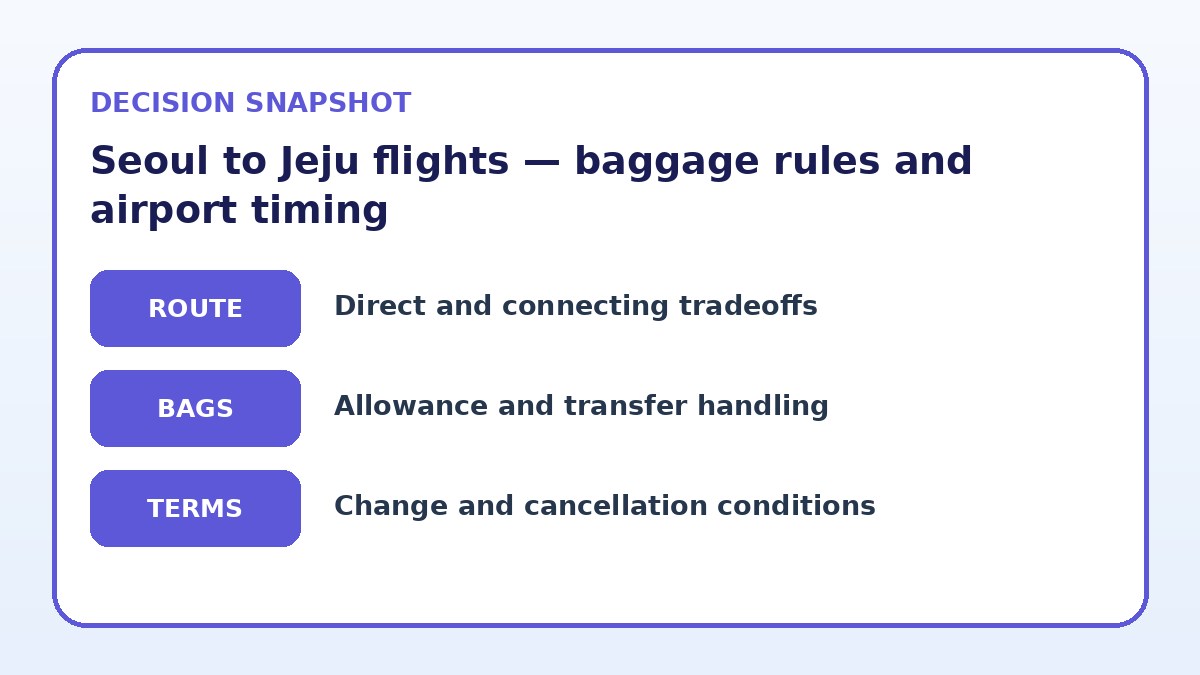
| Approach | Best for | Tradeoff to check |
|---|---|---|
| Carry-on only | Solo travelers prioritizing speed and ease | Limited clothing and gear capacity; stricter liquid rules |
| Checked baggage | Travelers needing more outfits or equipment | Longer airport time and potential baggage delays |
| Direct flight | Lowest transfer risk and simplest itinerary | Fewer departure time choices at peak periods |
| Connecting itinerary | More schedule options or lower fare flexibility | Higher complexity and greater risk of missed connections |
Packing priorities for solo travelers
When packing for a domestic Seoul–Jeju flight, prioritize items that speed up transit: an easy-to-open carry-on with a dedicated laptop or tablet sleeve, a small toiletry bag that meets liquids rules, and a lightweight change of clothes. Keep one outfit and essential toiletries in your carry-on in case a checked bag is delayed. Noise-cancelling earbuds or earplugs, a compact power bank, and a printed or screenshot copy of your boarding confirmation and ID make transitions smoother. Use packing cubes to compress clothing and make security checks quicker because you can remove only what’s necessary for inspection.
Think about what you’ll do once you land: beachwear and day hikes require different kit than city exploration. If you’ll check a bag, pack heavier items and souvenirs there and keep valuables, documents, and electronics in your carry-on. Solo travelers should also include a small travel lock and luggage tag with contact information. Before you leave, confirm any size and weight limits on the airline’s booking page and check whether your fare includes checked baggage to avoid surprises at the counter.
Before you book
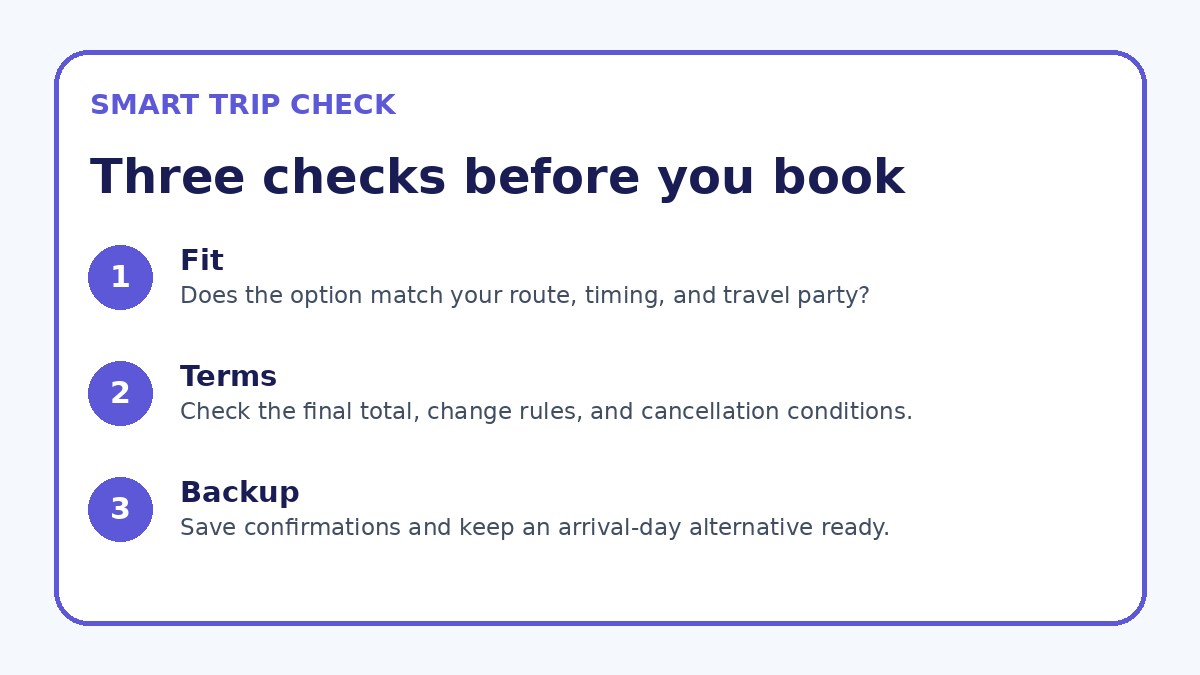
- Confirm which Seoul airport your ticket departs from (Gimpo or Incheon) and plan ground travel time accordingly.
- Check the airline’s carry-on size/weight rules and any checked-bag allowances or fees on the final booking page.
- Complete online check-in within the airline’s allowed window and download or screenshot your mobile boarding pass.
- Pack essential items (documents, medication, chargers) in your carry-on and one outfit in case checked baggage is delayed.
- Set an alarm to leave early enough for your airport arrival target: 45–60 minutes for carry-on, 90–120 minutes if checking bags.
- Verify terminal maps and gate information the night before; note any terminal transfers or additional security steps.
Comparing direct and connecting itineraries
Most travelers prefer direct Seoul–Jeju flights for simplicity: they reduce the number of touchpoints where delays or misrouted bags can occur. When comparing direct to connecting itineraries, focus on total door-to-door time (including ground transfers and minimum connection time), not only flight hours. For solo travelers with carry-on luggage, a tight connection can sometimes be manageable, but if you need to check a bag, choose longer layovers to protect yourself from missed connections and baggage transfer issues.
If direct flights are limited at your desired times, consider a connecting itinerary only if the schedule still fits comfortably within your plans and the carrier’s minimum connection windows are realistic given the airports involved. Verify connection details thoroughly on the booking page: terminal changes, minimum connection times, whether you need to recheck baggage, and if you must pass through immigration or additional security. Trip.com can be a place to compare current availability, but always confirm transfer rules with the operating carrier.
Frequently asked questions
How much time should a solo traveler allow for baggage drop and security when flying from Seoul to Jeju?
Allow at least 20–40 minutes for baggage drop at busy counters, but plan 60–90 minutes total before departure if you need seat selection, to pay baggage fees, or expect queues. Security processing time varies with peak travel periods; adding an additional 15–30 minute buffer reduces stress. If you have completed online check-in and travel with carry-on only, you can typically shorten this to 45–60 minutes before departure at domestic terminals. Always check recent airport advisories and the airline’s recommended arrival times on the booking page.
Can I save time by using only a personal item instead of a carry-on on Seoul to Jeju flights?
Yes — traveling with only a personal item can speed things up because you will not need to stow a carry-on in overhead bins and you can move through security and the gate area more nimbly. Make sure the personal item meets the airline’s dimensions and contains essentials like your ID, mobile boarding pass, wallet, medication, and a change of clothes if possible. Evaluate comfort: if you’ll be carrying the bag all day or using public transit, a slightly larger carry-on with wheels might be worth the extra minutes at the gate.
What should I verify on the airline page before leaving for the airport?
Before you depart for the airport, confirm these items on the airline’s final booking page: baggage allowances and fees, online check-in open/close times, boarding gate and terminal assignments (which can change), and any ID or document requirements. Also check whether your booking includes seat selection and if there are special procedures for oversized sports equipment or musical instruments. If your reservation includes a connection, verify minimum connection times and whether you must collect and recheck baggage during the transfer.
Final planning note
For solo travelers, efficient Seoul–Jeju trips come down to two main choices: optimize for speed with carry-on-only travel and earlier online check-in, or accept checked luggage and the extra airport time that entails. Decide first how much luggage you really need, then plan your airport arrival to match — 45–60 minutes for prepared carry-on passengers, 90–120 minutes if you must check bags. Compare direct and connecting itineraries by total trip time and baggage handling risk, and always confirm baggage rules, check-in windows, and terminal details on the airline’s booking page before you leave. A little planning reduces time at each step and leaves more of your trip for exploring Jeju.
Continue planning
Check current options and final conditions
Use the provider page to confirm live availability, the final total, cancellation terms, and every condition that matters to your trip.
This evergreen planning guide was created with AI-assisted drafting and a structured quality review. It does not display live prices, schedules, availability, visa guidance, or provider rankings. Verify current details before booking. Some links are affiliate links; we may earn a commission at no additional cost to you.