Practical answer up front: families should compare packages and separate bookings by aligning the exact same dates, number and ages of travelers, hotel room types, flight routing (direct versus connections), baggage and any transfers or car hire. If a package bundles identical elements and includes firm cancellation or change terms you need, it can save time and reduce stress. If flexibility, picking specific accommodation or optimizing seat assignments matters more, separate bookings often win. Start by listing what matters most — price certainty, flexible changes, room layout, flight times, or on-the-ground extras — then compare like-for-like. Below you’ll find a focused framework for families planning Brisbane travel deals so you can spot real savings, avoid false discounts, and know what to verify on the provider’s final booking page.
Test package value fairly
| Booking approach | Best for | Tradeoff to check |
|---|---|---|
| Pre-packaged family holiday (flight + hotel + transfers) | Families wanting one purchase and simpler logistics with fewer supplier contacts | May limit flexibility and hide separate-component fees—verify exact inclusions and change/cancellation rules |
| Build-your-own bundle via an OTA | Families who want some convenience combining components but still choose options individually | Savings depend on chosen components; bundled rules can vary—confirm component-level terms and baggage/seat rules |
| Separate bookings for flights and hotel | Families prioritizing flexibility, specific rooms, or flight times and seat selection | Requires more management and possible higher costs if you add baggage, transfers or protection separately |
| Hybrid approach (locked flight + flexible hotel) | Families who must secure flights early but want to shop hotel options or change dates | Can protect core travel dates yet still risk hotel rebooking fees; check change policies on both components |
Check current package and separate options
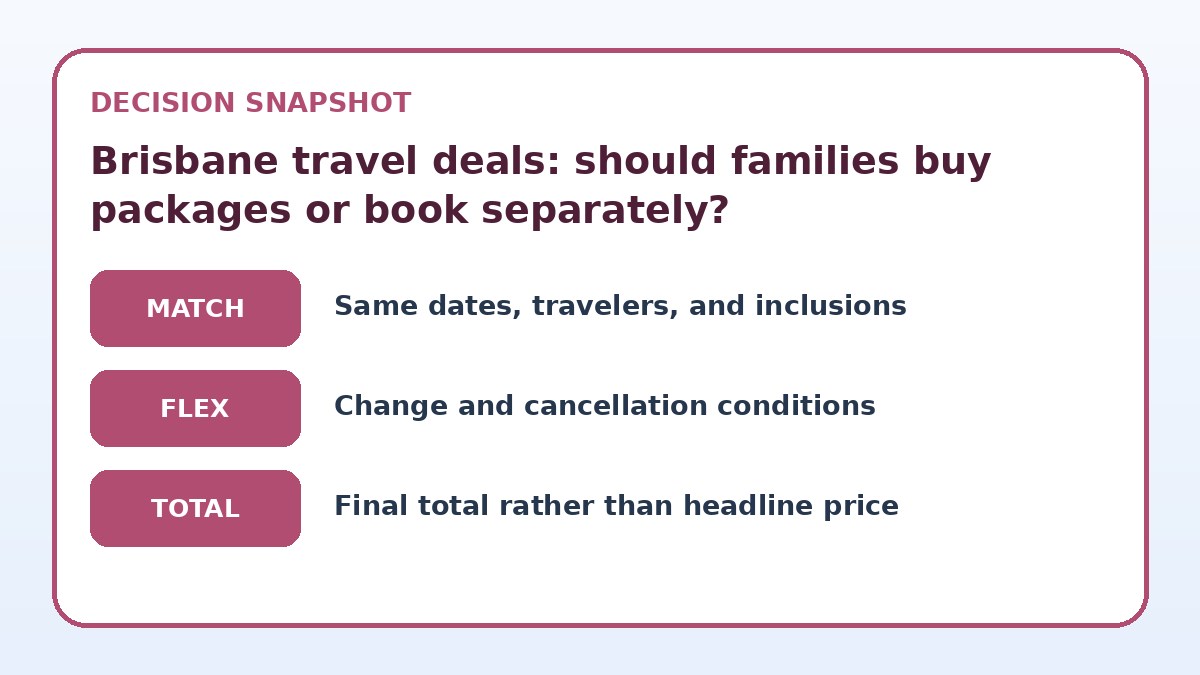
Use identical dates, travelers, room needs, baggage, and flexibility so the comparison stays meaningful.
Inclusions: make an itemized checklist first
Start by listing every component you would buy separately: flights (not just carrier but whether seats and baggage are included), hotel room type and board basis, airport transfers, car hire, and any attraction tickets. For families this also means noting child fares, infant seats, family rooms or adjoining rooms, cot requests and meal arrangements. A package that looks cheaper may simply omit baggage or seat selection that you would normally add when booking separately, erasing the apparent saving. Build a side-by-side matrix so you can compare exactly the same deliverables.
When you review a package’s inclusions, read the fine print for limits and conditions. Note whether transfers are private or shared, whether attraction vouchers have blackout dates, and whether the hotel’s ‘family room’ description matches the sleeping arrangements you need. If a package includes ‘meals’ check whether that means breakfast only or a full board option; for kids, family dining credits are sometimes limited. When anything is ambiguous, plan to verify the exact inclusions on the provider’s final booking page or call customer service for confirmation.
Flexibility: who needs it and what it costs
Flexibility matters more for families than solo travelers. Changes in school schedules, illness, or an extended stay can force you to alter flights or hotels. Compare how easily each option allows date changes, name corrections, and cancellations, and whether those options carry fixed fees or loss of fare. Packages sometimes bundle travel insurance or flexible terms, but they can also lock all components to one supplier’s policy. Separate bookings can offer targeted flexibility—flexible fares for flights combined with a non-refundable hotel might be cheaper, but that’s a calculated risk.
Calculate worst-case change or cancellation costs for both approaches before you book. For example, if you must reschedule, will changing the flight also void a hotel portion of a package or generate reissue fees? Check whether the package requires full cancellation of all components or allows swapping dates independently, and whether insurance covers specific family risks like illness. Always verify change fees and refund timelines on the provider’s final booking page; written policy language on that page is what governs your rights.
Look past the headline total
Compare inclusions and change conditions before deciding whether a package is genuinely useful for this trip.
Deal comparison checklist
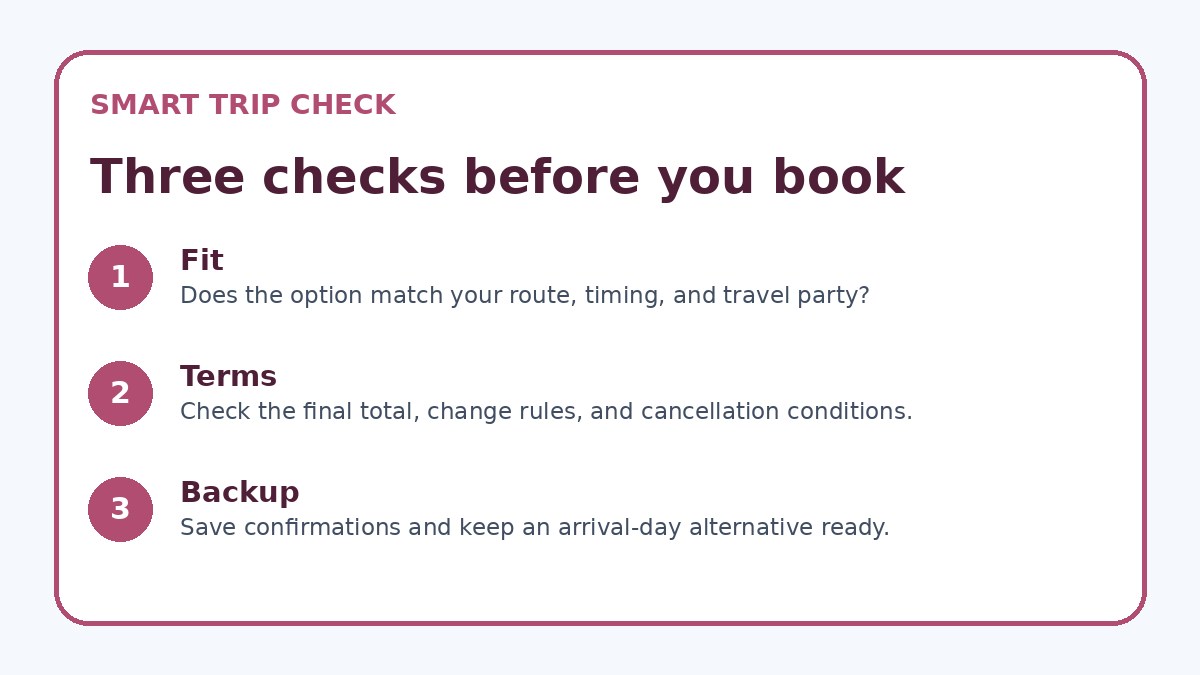
- List exact travel dates, number of adults, children and infants, and preferred room layout before hunting for deals.
- Compare the same flight routing, baggage allowance and seat selection options when evaluating package vs separate fares.
- Confirm hotel room type, board basis, and child policy on the seller’s final booking page or confirmation email.
- Add up potential extras (transfers, attraction vouchers, resort fees, city taxes) to calculate a true total cost.
- Check change and cancellation rules for each component and calculate worst-case replacement cost before booking.
- Save or print the booking confirmation and provider policies; contact customer service for any unclear inclusions in writing.
Traveler-specific value: what families should prioritize
Families should prioritize room layout, sleep arrangements, and child-friendly amenities over marginal headline savings. A cheap package that puts you in a twin room with extra bedding charges may be less convenient and costlier than booking a proper family suite or two connecting rooms separately. Also consider airport transfers—door-to-door private transfers can be a small premium that pays off with tired kids, whereas shared transfers might require long waits. Don’t overlook baggage policies and seat assignments: each child seat, stroller allowance and seat selection fee adds up quickly.
Think about on-the-ground convenience too: proximity to kid-friendly attractions, supermarket access for snacks, or kitchenette facilities that reduce meal costs. Some hotels offer free meals or kids-eat-free policies that change the value equation. Compare whether the package’s hotel actually offers those perks or whether they’re available only with a particular room type, and check age cutoffs for child rates. If you have specific needs—mobility equipment, infant cots, or allergy-friendly rooms—confirm them explicitly in writing before relying on a bundled promise.
Final terms: what to verify on the booking page
Before you click confirm, verify the final booking page carefully: exact flight times and routing (and whether the fare allows changes), full hotel name and room description, baggage and seat selection fees, upgrade options, cancellation policies for each component, and whether travel insurance is included or offered. If a package mentions transfers or attraction tickets, ensure the booking confirmation lists pickup times, redemption instructions and any blackout conditions. The provider’s booking page and confirmation email are your contract—screenshots or saved PDFs help if disputes arise later.
Don’t assume package summaries are exhaustive. Look for hidden or optional fees like local city taxes, resort charges, or mandatory service fees and whether they’re collected at booking or on arrival. For flights, check the fare family and what it includes rather than only the carrier name; for hotels, confirm the payment, deposit and no-show policies. If anything is unclear, contact the seller for written clarification. Trip.com can be a place to compare availability and conditions, but always rely on the final terms shown by the seller before you pay.
Travel Deals & Booking Strategy questions travelers ask
Can a package ever be cheaper than booking flights and hotels separately for a family?
Yes, packages can be cheaper in some cases because suppliers negotiate group inventory or include lower-cost transfer arrangements. The key is to compare a true apples-to-apples set of items: same dates, identical flight routing and class, the same hotel room type and board basis, and equivalent baggage and seat selection. Also factor in child fares and whether transfers or attraction tickets are included. If the package omits elements you need and you add them later, its initial saving may disappear. Always verify the final itemized charge on the booking page before committing.
How do I evaluate flexibility when one component is non-refundable?
Treat each component’s flexibility separately and model scenarios where you change dates or cancel one element. If the flight is non-refundable but the hotel is flexible, changing your travel dates could be prohibitively expensive; conversely, a flexible hotel and locked flight may be acceptable if flight changes are unlikely. Check whether a package imposes a combined policy that treats all components as a unit, which can increase risk. Consider travel insurance that specifically covers family disruptions, and verify what the insurer requires for claims documentation before you rely on a policy.
What red flags should families watch for on a package booking page?
Watch ambiguous language about inclusions (for example, ‘meals included’ without specifying which meals), unspecified room types, or references to ‘standard baggage’ without details. Also be cautious of mandatory local fees not included in the headline price, blackout dates on attraction tickets, and transfer descriptions that don’t state private versus shared service. If cancellation or change terms are difficult to locate or written in vague terms, request clarity in writing. Only the explicit terms on the final booking page and confirmation govern your reservation.
Final decision note
When planning Brisbane travel deals for a family, the decision between a package and separate bookings comes down to matching what you truly need with the terms that protect you. Build a like-for-like comparison that aligns dates, traveler counts, room types and all extras; then price both routes including likely add-ons and worst-case change costs. Packages can simplify logistics and occasionally save money, but separate bookings offer more targeted flexibility and choice. Verify final inclusions and change rules on the seller’s booking page—only the written terms there will be enforceable. If you prefer a third-party comparison, consider checking availability on Trip.com, but rely on the provider’s final confirmation before you pay.
Continue planning
Check current options and final conditions
Use the provider page to confirm live availability, the final total, cancellation terms, and every condition that matters to your trip.
This evergreen planning guide was created with AI-assisted drafting and a structured quality review. It does not display live prices, schedules, availability, visa guidance, or provider rankings. Verify current details before booking. Some links are affiliate links; we may earn a commission at no additional cost to you.