If you’re a first-time visitor moving from Bangkok to Chiang Mai with suitcases or bulky gear, the practical choice isn’t only about speed — it’s about how your bags move from door to door. Start by deciding whether you want fewer transfers (room-to-room simplicity) or lower effort at each handover (easier handling at stations). Trains give space to stretch but require getting to and from stations; express coaches often stop closer to city centers but can cram luggage into underfloor bays; flights save time but add airport transfers and security handling. This article lays out how to compare rail, coach, air and mixed itineraries through the lens of luggage friction, terminal fit, timing flexibility, and realistic disruption backups so you can pick the option that actually works for your gear and patience.
How to choose between train, coach, plane or hybrid
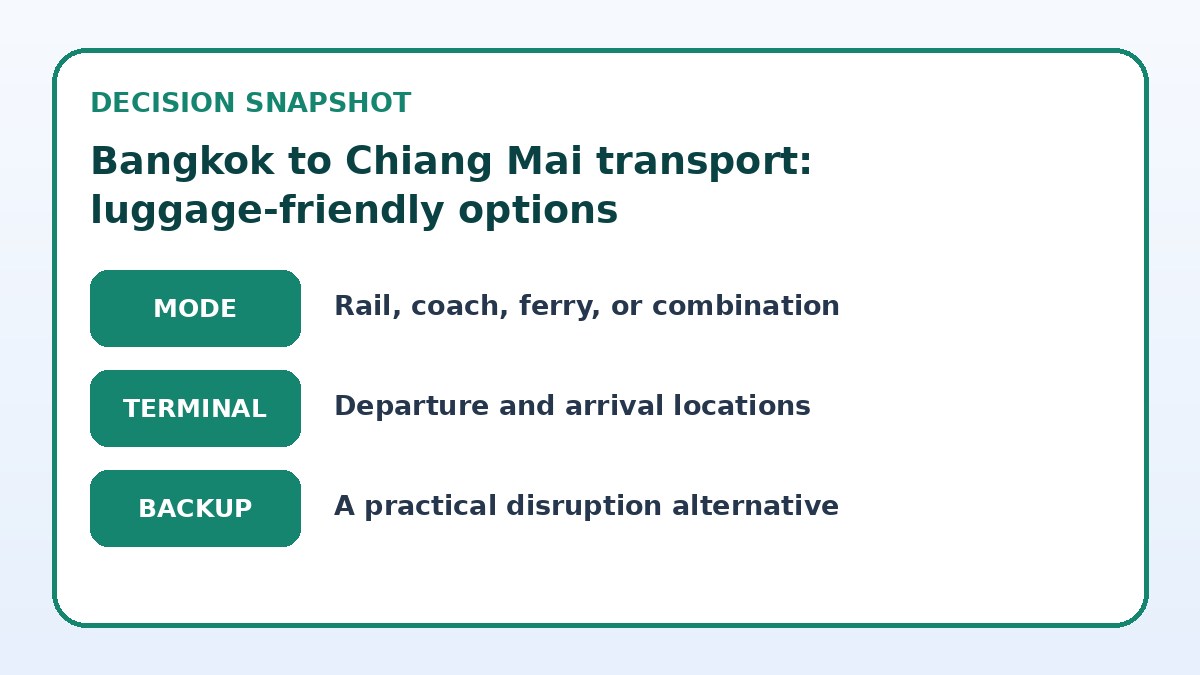
Start by mapping out what “door to door” means for you: hotel-to-hotel travel time, number of transfers, and how often you’re willing to handle your luggage. Trains typically allow more space for carry-on access during the trip and are friendlier if you want to keep bags nearby, but they require reaching the right station on time. Coaches often load luggage into underfloor bays — convenient if you prefer not to carry bags through stations, but you’ll have limited access to your items en route. Flights reduce transit time in the air but add security screening, checked baggage queues, and airport transfers that can multiply handling steps.
When considering hybrids (for example, a flight one way and a night train back), think about where your luggage will be stored and how many transfers that plan introduces. A mixed itinerary may balance speed and comfort: fly out to save time, return by train to avoid airport bustle and enjoy extra luggage control. Also weigh total door-to-door time, not just the scheduled vehicle duration—transfer waits, check-in windows, and peak-hour traffic can easily change what seems like the quickest option on paper into the slowest in practice.
Choose the end-to-end journey plan
| Journey approach | Best for | Friction to check |
|---|---|---|
| Single-mode train | Travellers who prefer spacious onboard storage and fewer mid-trip pickups. | Requires station transfers; large checked suitcases may be awkward during boarding and at crowded platforms. |
| Single-mode coach | Those wanting direct city-center pickup and underfloor luggage handling. | Limited access to belongings en route and variable comfort for long journeys. |
| Flight plus ground transfers | Passengers prioritizing the shortest time in transit between cities. | More luggage handoffs, security lanes and potentially longer door-to-door time due to airport transfers. |
| Hybrid (mix of modes) | Travelers balancing speed and luggage control, or splitting journey by convenience. | Adds handoffs and coordination; you must manage more connections and terminal changes. |
Check live intercity options
Look beyond the ride itself and compare terminals, transfers, luggage, and arrival fit.
Terminal fit and luggage transfer friction
Not all Bangkok or Chiang Mai terminals are the same distance from central neighborhoods; being close to your accommodation lowers overall friction. Consider taxis, rideshare availability, and how easy it is to wheel your suitcase from curb to check-in or platform. Trains usually have station platforms where you can step on and off with carry-on luggage, though moving large suitcases up stairs or along crowded platforms can be awkward. Coaches can be friendlier for large suitcases because staff handle loading, but that also means you won’t have access to the bag until everyone disembarks.
For flights, confirm how many times your bags will be handled: check-in counter, aircraft hold, transfer conveyors, and final baggage claim. Each handoff increases the chance of delay or misplacement, so if your luggage is essential, prefer options that let you keep it with you or that minimize transfers. Whatever mode you choose, plan the short local transfer legs—short rides with lots of stairs or unpaved surfaces can make rolling luggage difficult; a compact duffel or backpack may be preferable in those cases.
Timing flexibility and when to book
If your schedule is flexible, choose the service that gives buffer time around connections and the most reliable frequency. Trains and frequent coach services let you shift to the next departure with minimal fuss if you miss one, which is useful when dealing with late check-outs or morning traffic in Bangkok. Flights have fewer daily departures and stricter check-in windows; if you miss a flight you may face longer waits or higher rebooking effort. Consider how critical it is to arrive at a specific time in Chiang Mai — if the arrival slot is flexible, pick a slower but lower-handling option.
Advance booking helps secure space for your luggage needs, especially on popular trains and overnight services where cabin space and storage racks are limited. For flights and coaches, check provider baggage rules on the final booking page so you know allowances and oversized item procedures. If you plan to travel during festivals or public holidays, allow extra time and pick itineraries with multiple alternatives during the day so you can switch without losing the entire day to disruptions.
Compare the practical alternatives
Use the final page to confirm what is actually offered on your dates and save a workable fallback.
Intercity travel checklist
- Weigh door-to-door time, not just ride duration—map local transfers from your accommodation to terminals before booking.
- Measure your luggage and compare it to the provider's carry and checked baggage policies on their booking page.
- Plan for at least one later departure option on the same route as a backup in case of missed connections.
- Pack a small accessible bag with essentials and valuables to carry onboard or keep with you through transfers.
- Confirm terminal addresses and typical transfer times from each terminal to your hotel; save taxi and rideshare contact options.
- If travelling during busy dates, reserve accommodations or a nearby night before/after travel to reduce rush and handling.
Disruption backup: what to prepare before you go
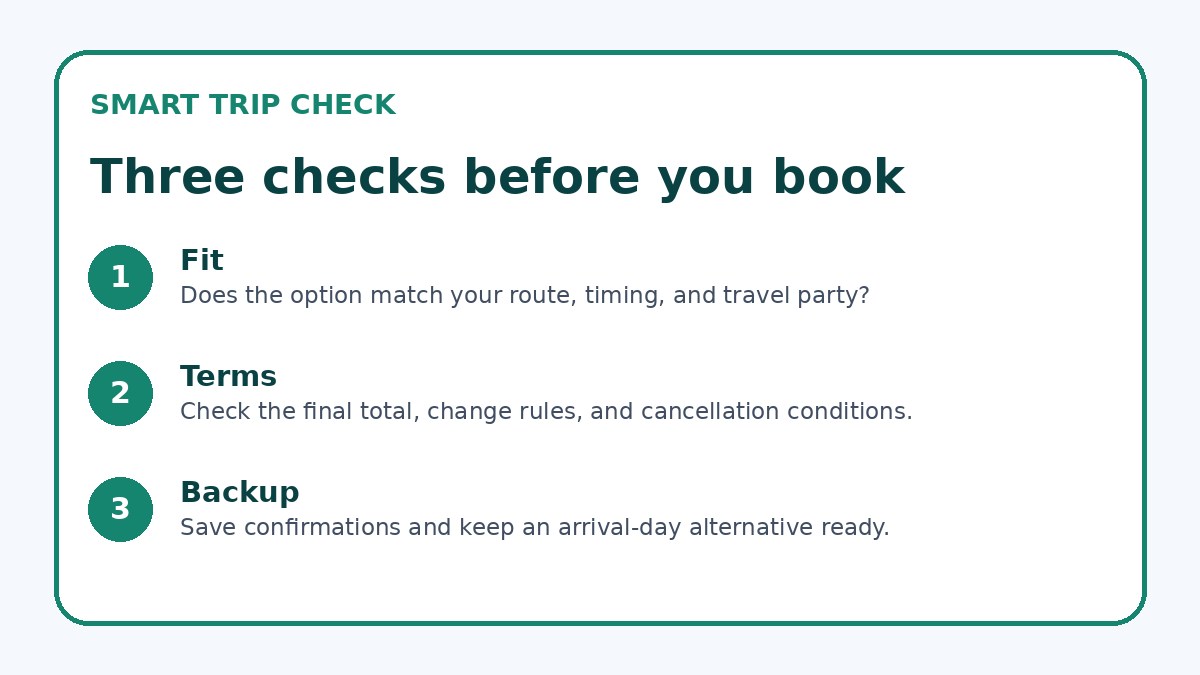
Prepare a simple backup plan that covers common scenarios: missed connection, late arrival, or unscheduled cancellations. Identify at least one later departure on the same route and one alternative mode (for example, a later train plus an overnight coach option). Keep digital copies of tickets, proof of ID, and essential contacts on your phone and in a printed note. If your journey depends on a single tight connection across modes, build a cushion of several hours and know the local taxi or rideshare options for emergency transfers.
Also designate where to store or repack items quickly if a disruption forces an overnight stay: a small lockable bag with toiletries and a change of clothes can save a lot of time. For sensitive or expensive gear, consider taking it as carry-on when allowed. Finally, before booking, verify baggage rules, check-in and boarding deadlines, and terminal addresses on the provider’s final booking page; if you want current availability or alternate itineraries, you can compare options on Trip.com but confirm all operational details with the operator.
Rail & Intercity Transport questions travelers ask
Can I keep my luggage with me on trains between Bangkok and Chiang Mai?
Many intercity trains allow passengers to keep a reasonable amount of luggage near your seat or in overhead racks, but space varies by carriage type and crowding. Large suitcases may need to be placed in designated luggage areas or left at platform staff areas at certain stations—verify exact policies on the operator’s booking page. If keeping items in your immediate space is essential, consider traveling outside peak travel times or choosing a carriage class that specifies more cabin room. Bring straps or a lock if you must leave bags unattended briefly.
Is it easier to travel with sports equipment or oversized bags on coaches or trains?
Coaches frequently load oversized items into underfloor compartments handled by staff, which reduces carrying but also means you won’t have access during the trip. Trains may allow oversized items but could require lifting them onto racks or into baggage areas, and access during the journey can be limited. For fragile or valuable equipment, prioritize options that let you supervise handling—pack items in protective cases, check the operator’s oversized-bag rules, and bring photos and documentation in case you need to claim damage or loss.
What should I check about airports, stations and terminals before booking?
Confirm terminal locations relative to your lodging, check typical transfer options and travel times, and read the provider’s baggage handling and check-in requirements on the final booking page. Look for details such as check-in windows, required ID, and whether staff assist with heavy items. If you plan to use an airport or station shuttle, verify schedules and capacity. When comparing alternatives, include the time and cost of local transfers and potential traffic or peak-hour delays to get a realistic door-to-door estimate.
Final decision note
Choosing the right Bangkok to Chiang Mai transport when you have luggage means prioritizing how many times you want to handle your bags and how much transfer stress you can tolerate. Trains offer roomier onboard storage and a relaxed pace, coaches simplify ground handling at the cost of in-trip access, and flights cut airtime but add airport logistics. Hybrid plans can balance these factors but require extra coordination. Before you book, check baggage policies and terminal details on the operator’s final page, plan a realistic backup, and pack a small essentials bag for quick access—this approach ensures your luggage travels nearly as smoothly as you do.
Continue planning
Check current options and final conditions
Use the provider page to confirm live availability, the final total, cancellation terms, and every condition that matters to your trip.
This evergreen planning guide was created with AI-assisted drafting and a structured quality review. It does not display live prices, schedules, availability, visa guidance, or provider rankings. Verify current details before booking. Some links are affiliate links; we may earn a commission at no additional cost to you.