For most business travelers in Osaka the practical first question is simple: will driving actually cut travel time or add useful flexibility? The short answer: choose public transport when your schedule sticks to central business districts and major stations; consider an Osaka car rental when meetings scatter across the wider Kansai region, you carry bulky equipment, or you need early/late access to locations poorly served by trains. This guide gives a decision-first recommendation, then steps through route value, insurance wording you'll need to check, pickup and return friction at airports and city locations, and a reliable non-driving fallback plan. Read with your itinerary in hand and use the checklists to verify the specifics on provider pages before booking.
Route value: when driving improves your schedule
Start by mapping where your meetings actually are. Driving adds clear value when appointments spread across multiple cities in Kansai—such as Osaka to Kobe, Nara, or parts of Wakayama—or when you must reach industrial zones, suburban corporate campuses, or ports that sit off major rail lines. Also weigh whether you transport samples, equipment, or marketing materials that are awkward on trains. If travel between venues would otherwise require multiple transfers, long walks from stations, or taxi legs that add up, an Osaka car rental may save time and reduce the hassle of carrying gear.
Conversely, driving rarely helps when meetings are clustered in central Osaka because trains here are frequent, direct, and often faster than a driving route that faces congestion or complex one-way streets. Factor in rush-hour traffic windows, scheduled evening networking events, and parking availability at each meeting location. Create a simple time-budget: estimated on-road time plus parking and walking time versus public-transport transfers and first/last-mile taxis. That comparison usually makes the decision obvious.
Decide whether driving earns its place
| Mobility strategy | Best for | Cost or friction to check |
|---|---|---|
| Full Osaka car rental for entire trip | Travelers with multiple suburban or regional commitments and heavy equipment. | Adds parking hassles, potential traffic delays and insurance complexity versus station-based speed. |
| Public transport only (rail + subway) | Meetings concentrated in central Osaka and travelers prioritizing predictable travel time. | Less door-to-door flexibility and awkwardness with bulky items, but avoids parking and rental paperwork. |
| Taxis and ride-hail for every trip | Short business visits with unpredictable schedules or late-night travel needs. | Higher per-trip cost and variable wait times, though it removes driver responsibility and parking concerns. |
| Hybrid: rent locally for specific days | Itineraries that mix central meetings with occasional regional site visits. | Requires careful planning of pickup/return windows and may incur one-way or daily-owner fees. |
Check live rental choices only after the route test
Use the exact driver, dates, pickup point, and return plan to compare current conditions.
Insurance wording and coverage: the fine print that decides cost
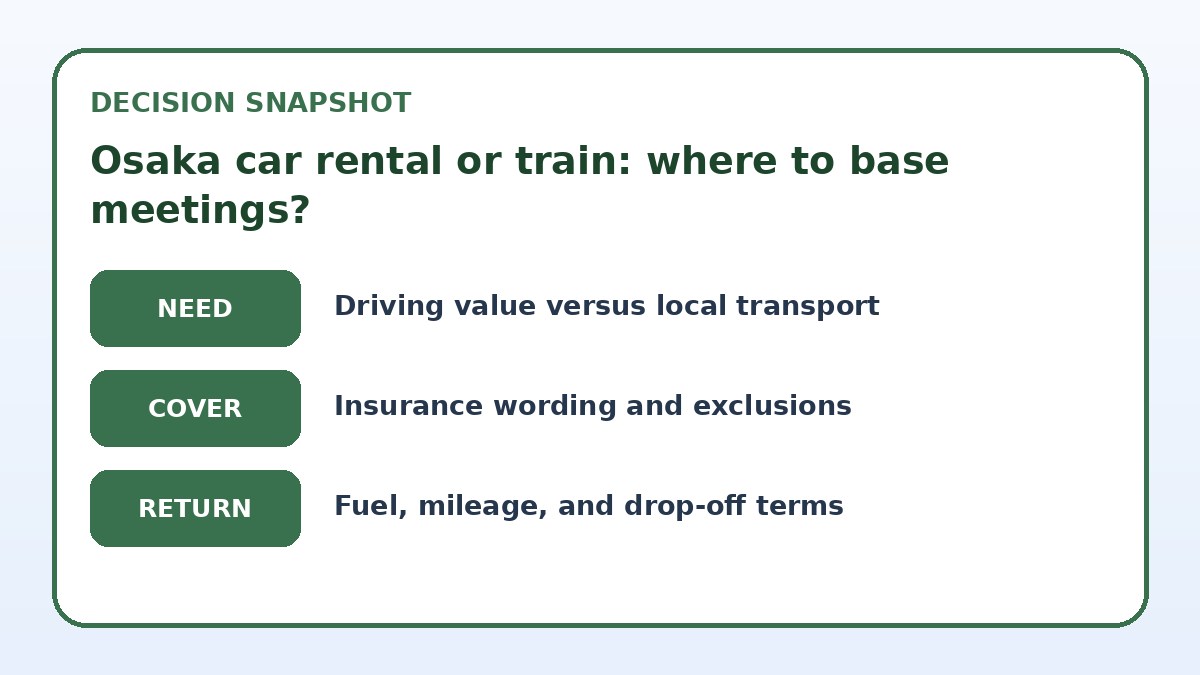
Insurance language varies and alters the real cost of an Osaka car rental. Look for clear definitions of liability limits, what constitutes a ‘collision’ or ‘damage’, whether a theft protection plan is separate, and how insurance treats third-party claims. Pay attention to exclusions—driving on unpaved roads, entering toll-only lanes incorrectly, or allowing additional drivers may change coverage. If you rely on a credit-card car rental benefit or your employer’s policy, confirm the interaction between the rental company’s waivers and any external coverage before signing.
Also confirm roadside assistance scope and response expectations; in a foreign country, rapid help saves hours. When renting, request the exact contractual wording or policy code and compare it to your corporate travel insurance or card benefits. Don’t accept verbal assurances—get the clause text or a direct link to policy terms to verify limits, deductibles, and the process for filing claims and reporting incidents. This is essential to avoid unpleasant surprises after an incident.
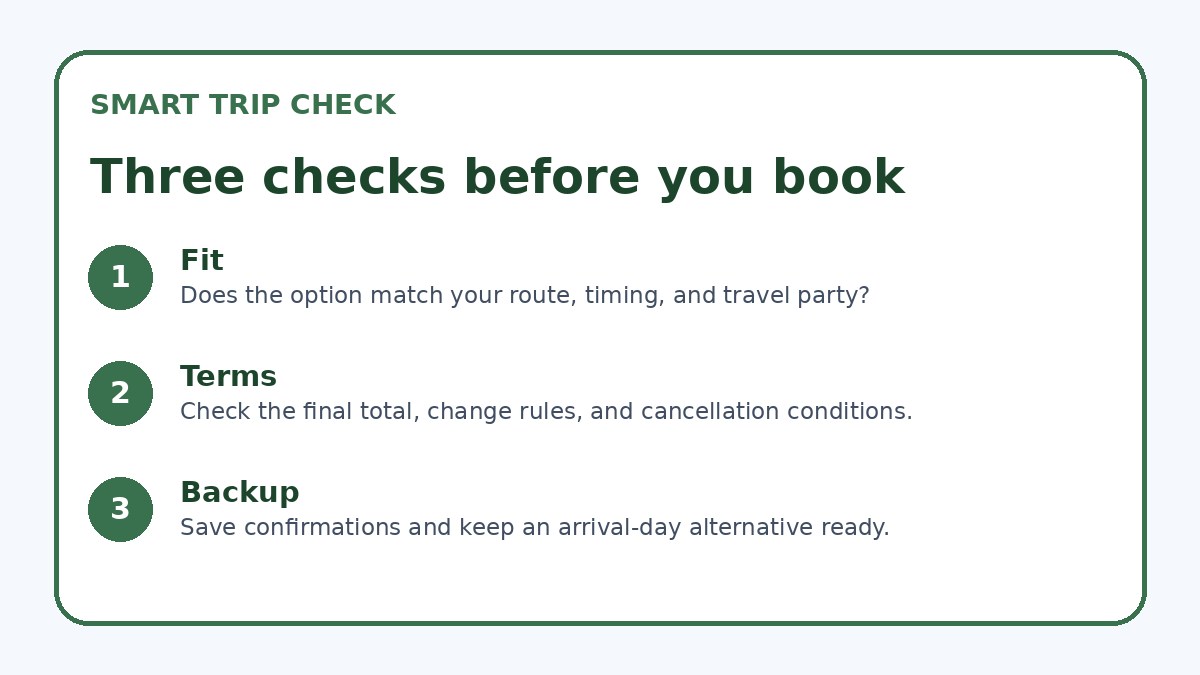
Compare the full rental conditions
Confirm insurance wording, exclusions, deposit, fuel, mileage, and return terms on the final page.
Pickup and return friction: airports, downtown desks and one-way drop-offs
Pickup and return logistics can make or break the convenience of an Osaka car rental. Airport counters at Kansai International (KIX) and Osaka Itami (ITM) may offer extended hours and one-way drop options, but downtown offices can be smaller, require shuttle rides, or have limited opening times. Calculate the time from your arrival terminal to the rental desk—especially if you land late—and whether a one-way rental fee applies for returning the car at a different location. Also verify the vehicle handover process: mobility providers may require extra ID, an international driving permit (if applicable), and a credit card for the security hold.
Pay attention to city parking norms where short-term parking can be expensive or restricted by permit zones; this affects daily costs and meeting punctuality. Some business hotels have valet or secured parking but ask ahead about height limits and reservation requirements. For downtown pickups, confirm whether the provider offers vehicle delivery to your hotel or conference venue; this saves time but often includes extra fees and precise time windows you must honor. Check the provider’s final booking page for explicit pickup hours, required documents, and any shuttle arrangements.
Car rental terms to verify
- Map every appointment address and calculate door-to-door times for driving versus rail transfers to identify true time savings.
- Request and save the rental company’s full insurance policy wording; compare limits and exclusions with corporate or card coverage.
- Confirm pickup and return hours, one-way options, and required documents on the provider’s final booking page before reserving.
- Check parking availability and expected costs at each meeting location and your hotel; reserve hotel parking if possible.
- Plan a non-driving fallback: list nearest stations, last train times for critical nights, and reliable taxi phone numbers.
- If driving, secure roadside assistance details and local emergency contact numbers in writing from the rental operator.
Non-driving fallback: a dependable plan if you skip renting
Design a non-driving fallback early: pick a hotel near the main cluster of meetings or a major transit hub (Umeda, Namba, or Tennoji) and build an itinerary around station-to-station travel. Use rapid commuter trains and subways for predictable travel times; reserve taxis for first/last mile trips and late-night returns when trains have stopped. Keep an on-call ride-hail or local taxi company number for tight schedules and confirm whether the venues have easy taxi access or need a short walk from the drop-off point.
Also prepare for luggage or sample transport: arrange hotel delivery services, use locker storage at major stations for interim stops, or ship bulky items ahead to your hotel. For after-hours meetings, note train last-departure times and the cost of overnight taxis. Finally, test a mock route the day before important meetings—time the walk from station exits to meeting addresses—to avoid surprises and to validate that the non-driving option delivers buildable itineraries without a rental car.
Car Rental & Road Trip questions travelers ask
Do I need an international driving permit to rent a car in Osaka?
Whether you need an international driving permit (IDP) depends on your country of licensing and rental company policy. Many renters from certain countries must present an IDP alongside their home license; other national licenses may be accepted with specific documentation. Always check the rental provider’s eligibility requirements on their final booking page and verify whether your employer or corporate travel policy imposes additional rules. Bring original physical documents—your passport, home license, and an IDP if required—and allow extra time at pickup for staff to review paperwork.
How should I compare insurance offered by rental firms to my corporate coverage?
Start by obtaining the exact policy wording or code from the rental firm that describes liability limits, damage waivers, deductibles, and exclusions. Then request confirmation from your corporate travel or risk manager detailing what the company policy covers for rental vehicles abroad—liability, collision, theft, and roadside assistance. Look for overlaps and gaps: if the corporate policy excludes certain incidents or has high deductibles, consider purchasing the rental firm’s loss-damage waiver. Never rely on a verbal summary—have both documents and confirm how claims would be handled in Japan.
What are the main reasons business travelers still choose not to rent in Osaka?
Many business travelers forgo an Osaka car rental because central Osaka’s rail and subway network is dense, frequent, and usually faster door-to-door during business hours. Parking at meeting venues and hotels can be costly or limited, and navigating unfamiliar city driving rules and signage adds stress. Additionally, if meetings are within station clusters, the time penalty for train transfers is small, and taxis can cover occasional first/last-mile needs. Travelers also avoid rental paperwork and insurance complexity by using public transport and on-demand taxis.
Final decision note
Choose an Osaka car rental when your itinerary requires true door-to-door flexibility across the wider Kansai area, you transport bulky items, or meeting locations sit far from major stations. Otherwise, base yourself near a major transit hub and use public transport plus occasional taxis for predictable, stress-free travel. Whatever you decide, verify insurance wording, pickup/return details and any one-way fees on the rental provider’s final booking page before committing, and prepare a non-driving fallback so you’re never stuck if plans shift. A short planning session with the checklist above usually reveals the clear, cost-effective choice for your trip.
Continue planning
Check current options and final conditions
Use the provider page to confirm live availability, the final total, cancellation terms, and every condition that matters to your trip.
This evergreen planning guide was created with AI-assisted drafting and a structured quality review. It does not display live prices, schedules, availability, visa guidance, or provider rankings. Verify current details before booking. Some links are affiliate links; we may earn a commission at no additional cost to you.