Short answer: for many family itineraries on Jeju a rental car significantly simplifies logistics and opens more child-friendly options, but it isn’t always the best choice. If your plan is concentrated around Jeju City, Seogwipo, or a handful of nearby attractions served by buses, you can manage comfortably with public transport, taxis and occasional transfers. If your family prefers flexible timing, rural beaches, mountain hikes, or dining stops away from bus routes, driving usually improves the experience enough to justify the hassle of rental pickup and parking. This article walks through the specific value driving adds for family routes, what to verify in insurance wording, practical pickup and return pain points, and a realistic non-driving fallback so you can book with confidence.

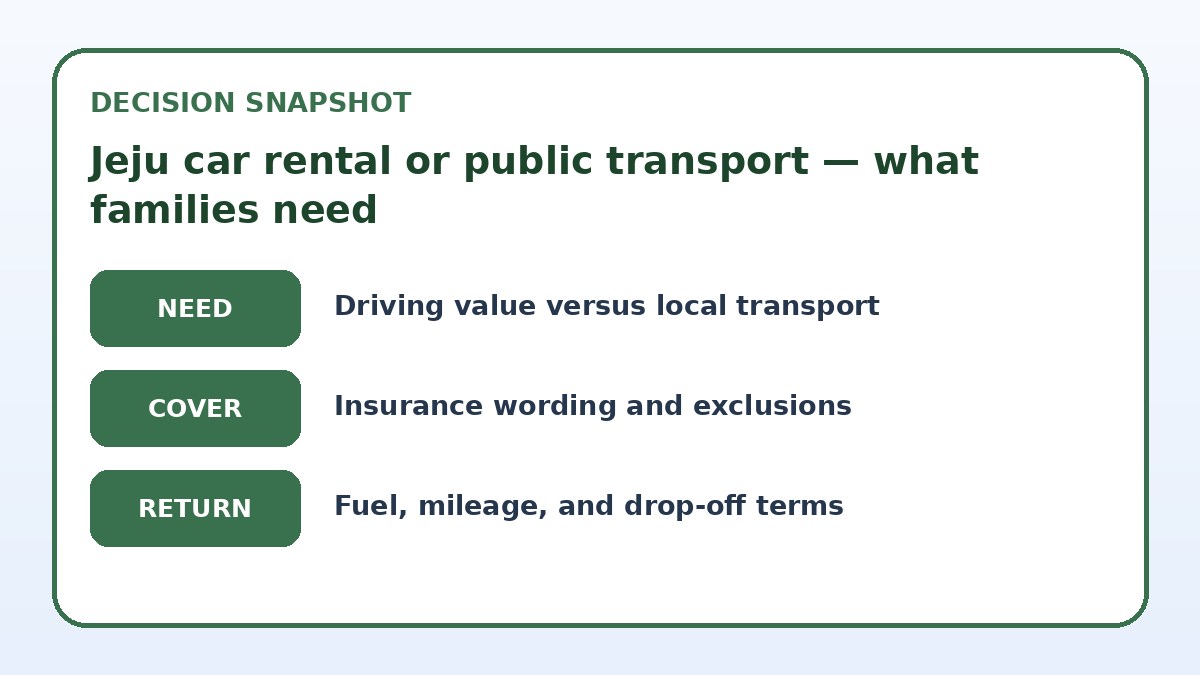
When driving genuinely improves your family itinerary
Ask what you want to see and how you want to spend your days. Driving raises the value of itineraries that include multiple dispersed stops—secluded beaches, scenic coastal roads, inland waterfalls, or farms and museums with poor bus links. For families with small children, the convenience of door-to-door travel, flexible meal and nap timing, and easier luggage management often outweigh transit cost differences. If every day starts with a single, central activity within walking distance of accommodation, the practical gains from a car shrink.
Consider travel rhythms and energy. A relaxed day with a single destination, plenty of stroller-friendly pedestrian routes, and an emphasis on city cafes or markets can be smoothly handled without driving. But if your plan includes sunrise drives, late dinners after museum closures, or swapping beaches across the island in one day, a car removes transfer stress. Balance how much free-wheeling exploration you want against your group’s tolerance for navigating local roads, parking, and narrow country lanes.
Decide whether driving earns its place
| Mobility strategy | Best for | Cost or friction to check |
|---|---|---|
| Full-time rental car for the whole stay | Families wanting maximum schedule flexibility and access to remote sites | Higher parking and fuel management plus pickup/return logistics and insurance checks |
| Public buses and taxis only | Families staying in Jeju City or Seogwipo with mainly urban activities | Less flexibility, more transfer time, potential difficulty with strollers or multiple bags |
| Hybrid: short rental days plus public transport | Families who want a few remote outings without driving every day | Extra planning to book rentals only on needed days and manage two transport modes |
| Private transfers or tour-based day trips | Families preferring guided logistics without driving responsibilities | Higher per-trip cost and limited on-the-fly itinerary changes |
Check live rental choices only after the route test
Use the exact driver, dates, pickup point, and return plan to compare current conditions.
Insurance wording: what to read and what to verify
Insurance coverage shapes whether a rental makes sense for peace of mind. Don’t rely on summary phrases; read the rental contract sections that name coverage limits, deductible amounts, and what triggers exclusions. Key items to verify are whether collision damage waiver (CDW) is included or optional, the size of the security deposit, whether third-party liability limits meet your expectations, and any clauses that exclude specific drivers, certain roads, or damage from negligent use.
Also check rules about child seats, tolls, and cross-rental policies (if you plan to pick up or drop off at different locations). If you intend to add a third-party insurance or use a card benefit, compare exact wording against the rental’s contract—most conflicts arise when the card benefit requires prior authorization or the rental company’s loss report to be filed in a narrow window. Before booking, note the contact details and steps the provider requires for claims and roadside assistance.
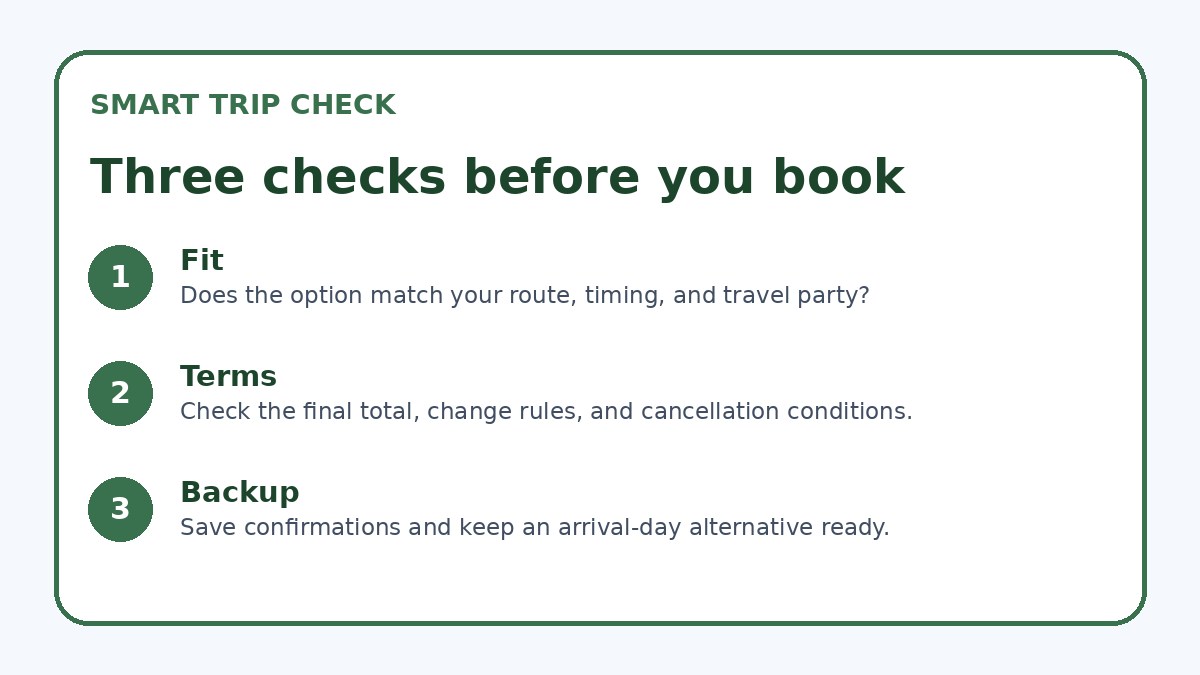
Compare the full rental conditions
Confirm insurance wording, exclusions, deposit, fuel, mileage, and return terms on the final page.
Pickup, return friction, and how to keep stress low
Pickup and return are where time and patience are spent. Airports, ferry ports, and city counters differ: some have a short walk or shuttle to the vehicle lot, others place staff desks directly in arrivals. With kids, small delays magnify; plan buffer time for queues, paperwork checks, vehicle inspection, and getting familiar with local controls. Before you commit, check exactly where the lot is, whether there’s a shuttle, the typical counter closing time, and what forms of ID and payment are required for the security deposit.
At return, expect an inspection and the potential to be held for unresolved tolls or fines. Photograph the car inside and out with timestamps and keep a copy of the fuel level and mileage. If your itinerary includes late flights or ferries, verify the rental’s after-hours return procedure and whether night returns incur fees. For families, aim to align pickup with the calmest point in your travel day—after a nap or lunchtime—so the group isn’t managing a tired handover.
Car rental terms to verify
- Confirm driver eligibility and age limits on the rental contract and have the correct driver’s license and ID at pickup.
- Read the insurance and CDW wording in the rental agreement; note deductible amounts and what situations are excluded.
- Photograph the vehicle (interior and exterior) with timestamps on pickup and keep a copy of the fuel gauge and mileage.
- Plan pickup and return times with at least an hour buffer around ferries or flights and verify after-hours return procedures.
- Identify nearby bus stops and local taxi numbers for each accommodation in case you decide not to drive that day.
- Reserve or prebook child seats and confirm installation rules with the rental provider to ensure compliance and safety.
A realistic non-driving fallback and hybrid options
Plan the fallback before you cancel your driving option. Good non-driving strategies combine regional buses, intercity express routes, taxis for first/last miles, and occasional private transfers for excursions where buses are sparse. Map each day’s door-to-door journey: note nearest bus stops to your accommodation, typical taxi wait times for families (and whether larger taxis are available), and the last bus times for key legs. Having a shortlist of taxi companies and a rideshare app, if available, reduces stress when plans shift.
Hybrid approaches are common: rent a car for a few days that include remote outings, then switch to public transport while staying in town centers. This reduces parking costs and driving fatigue while keeping the freedom to reach off-grid spots. Whatever you choose, keep a tested backup—identified bus routes, phone numbers for local taxi firms, or a trusted transfer operator—so that bad weather, a tired child, or a delayed ferry doesn’t force an improvised, expensive solution.
Car Rental & Road Trip questions travelers ask
Is driving on Jeju safe for families who don’t usually drive abroad?
Jeju’s main roads are generally straightforward, but suburban and rural lanes can be narrower and include blind turns. If your family group includes a driver who isn’t comfortable with unfamiliar traffic conditions, consider limiting driving to daytime and avoiding steep or winding mountain roads. New drivers should build confidence with a short circuit around the city before attempting long coastal or inland routes. Regardless of experience, read the rental’s emergency contact procedures and ensure you have roadside assistance details and local emergency numbers stored.
How should families handle child seats and other car-safety needs?
Child seat rules vary between providers—some include seats, others rent them for an additional fee, and some require you bring a compliant seat. Always request child seats in advance, confirm the seat category for your child’s age and weight, and note any installation assistance or liability clauses in the rental contract. If you bring your own, check the rental company’s policy for using customer-supplied seats. Keep a spare blanket or towel, and consider a sunshade and a small first-aid kit for longer drives.
What exactly should I check on the rental provider’s final booking page?
On the provider’s final booking page, verify driver eligibility rules, the stated insurance coverage and deductible amounts, fuel policy, exact pickup and return locations and their hours, any additional fees for young drivers or child seats, and the process for reporting damage. If you plan to cross regional borders, confirm restrictions. Also check accepted payment methods for the security deposit and whether roadside assistance is included or available as an add-on. If you use a credit card benefit for coverage, confirm any required pre-authorization steps described on that page.
Final decision note
For most family trips that include time in both towns and the countryside, renting a car on Jeju provides clear benefits: faster transfers between distant attractions, easier luggage and stroller handling, and the freedom to tailor days to children’s rhythms. If your stay is compact—centered on urban areas with good bus coverage—or if drivers in your group are uncomfortable with unfamiliar roads, a public-transport-plus-taxi plan or a hybrid approach often makes more sense. Whatever you decide, read insurance and contract wording carefully, plan pickup and return with buffers, and have a mapped non-driving fallback. That preparation keeps the family stress low and ensures your days are about enjoying the island, not firefighting logistics.
Continue planning
Check current options and final conditions
Use the provider page to confirm live availability, the final total, cancellation terms, and every condition that matters to your trip.
This evergreen planning guide was created with AI-assisted drafting and a structured quality review. It does not display live prices, schedules, availability, visa guidance, or provider rankings. Verify current details before booking. Some links are affiliate links; we may earn a commission at no additional cost to you.