If you’re traveling from London to Barcelona with extra suitcases, sports gear, or oversize items, the most practical decision is to choose the combination of routing and fare that minimizes handling risk and airport stress. That usually means prioritizing a direct flight where possible, or a single connection on a carrier whose baggage rules match your needs. Before you search, have exact travel dates, the number of checked pieces, their weight and dimensions, and whether any items need special handling. With those details in hand you can compare fare classes, checked-bag allowances, and minimum connection times. This article gives a short practical answer up front, then walks through routing and baggage risk, schedule fit, fare conditions, and step-by-step checks to finalize your booking confidently.

See live routes for your exact travel day
Compare direct and connecting choices with the same baggage and traveler details.
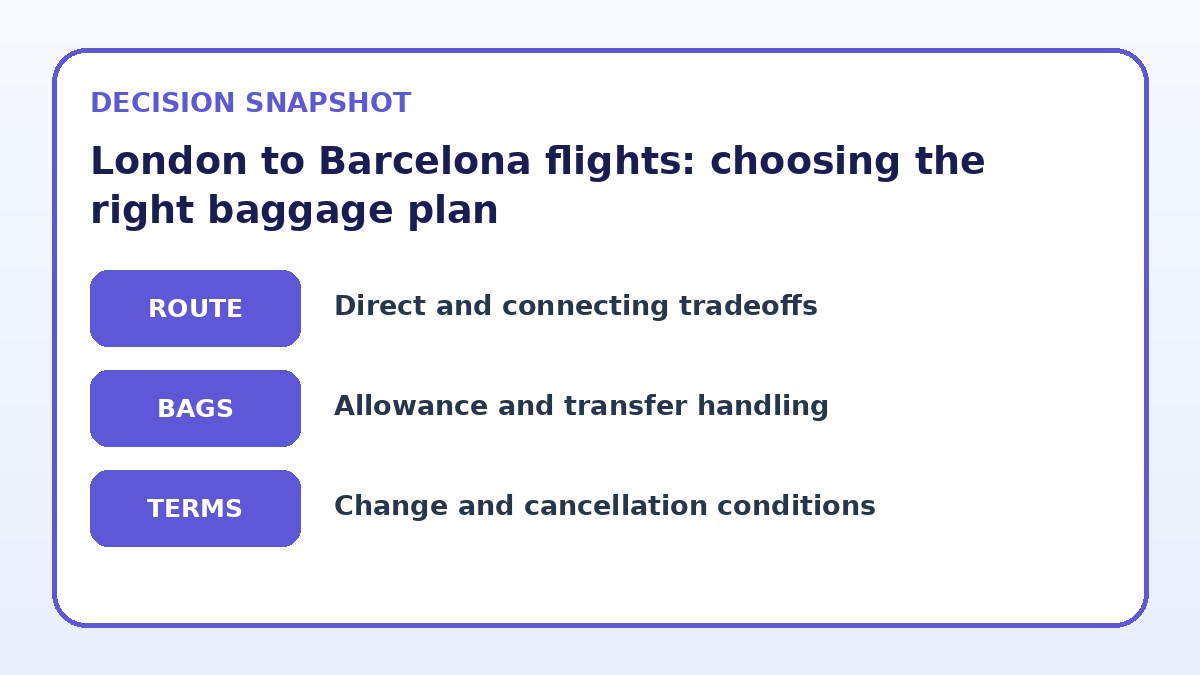
Routing: direct versus connecting choices
For travelers with extra luggage, routing choices are the highest-impact variable. Direct flights (nonstop) eliminate the need to recheck or transfer bags between flights and generally reduce the touchpoints where luggage can be delayed. When checking routing options, view both nonstop and one-stop itineraries and note whether a carrier will transfer baggage automatically between legs. Also watch for airport pairs: London has multiple airports and Barcelona's main airport is on the city’s outskirts—factor transfer time to and from airports when comparing overall journey time.
Connecting flights can be attractive when they lower fares or provide better departure/arrival times, but connections introduce baggage transfer risk. If considering a connection, prioritize itineraries where both segments are on the same ticket and operated by the same alliance or carrier; these are more likely to offer through-checked baggage. Also check minimum connection times published by the airline and the connecting airport layout—tight connections with lots of luggage increase the chance you’ll be separated from a checked piece if the first flight is delayed.
Baggage and connection risk: what to verify
Before you book, collect exact baggage details: number of pieces, per-piece weight, and dimensions for any oversize items. On the airline’s booking page, verify the allowance for your selected fare class and whether the site allows you to add extra pieces online (often cheaper than airport rates). Look for rules on overweight and oversize charges, sports equipment handling, and whether specialized items require advance reservations. If a quote or booking flow is unclear, use the airline’s baggage policy page or customer service to confirm — keep a screenshot or PDF of the baggage allowance shown at checkout.
For connections, confirm whether the carrier offers through-checked baggage for your itinerary and whether you will need to clear customs or recheck bags at the transfer airport. On itineraries that combine separate tickets, recognize the higher risk: you may need to collect and recheck luggage yourself, so allow plenty of buffer time and plan for extra transfer logistics. If you are carrying fragile or high-value items, consider carrying them as hand luggage if feasible or adding insurance and protective packing.
Compare flight-selection strategies
| Flight strategy | Best for | Risk to check |
|---|---|---|
| Book a nonstop flight with checked-bag included | Travelers who want minimal handling and shortest door-to-door risk | Often higher base fare but fewer transfer points and simpler logistics |
| Choose a one-stop ticket on same carrier/alliance | Those balancing price with lower transfer risk and through-checked baggage | Requires confirmed through-baggage and longer travel time than direct flights |
| Buy a low-cost fare and add baggage separately | Budget-conscious travelers who are flexible and precise about bag count | Risk of higher airport fees and stricter size/weight limits if miscalculated |
| Separate tickets with long connection buffers | Experienced planners needing cheapest segments while managing baggage themselves | Higher risk of needing to recheck bags and losing protection if flights are delayed |
Recheck the complete itinerary
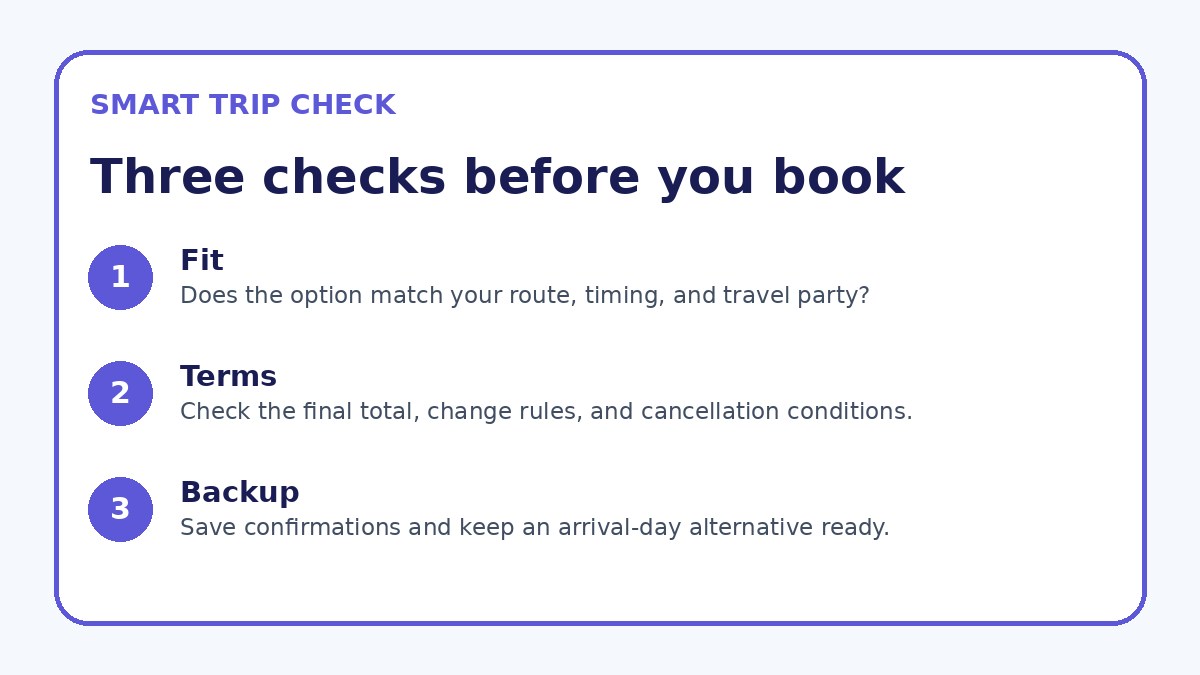
Confirm airports, connection handling, baggage, and change conditions before deciding.
Schedule fit and airport time: how early to arrive
Airport arrival timing for extra-luggage travelers should be more generous than the standard recommendation. Baggage drop counters can get busy, additional screening for oversized items takes time, and some airlines have earlier cutoffs for checking oversized or special items. On departure day, plan to arrive at the airport earlier than the airline’s minimum recommended time—especially if you need to pay for added pieces at the desk or require assistance. Check the airline’s stated baggage check-in cutoff and add at least 30–60 minutes to allow for queues and any unexpected paperwork.
Don’t forget ground transfer time to the London airport you’re using—Heathrow, Gatwick, Stansted, Luton and London City have different travel profiles and transport links. If you’re transferring from central London or changing airports, build extra margin. At Barcelona, think about arrival logistics: reclaiming multiple bags can take longer, and if you’re meeting ground transport or catching onward connections, factor in baggage carousel waits. For connections through other airports, verify whether you’ll need to re-clear security or customs which increases required layover time.
Flight details to verify
- Record exact travel dates, passenger names, number of checked pieces, and each item’s weight and dimensions before searching fares.
- Search for both nonstop and one-stop itineraries and note which options show through-checked baggage on the booking page.
- Open the fare conditions for the selected itinerary and confirm checked-bag allowances, overweight/oversize fees, and change/refund rules.
- If booking multi-carrier or separate tickets, plan at least double the minimum connection time and confirm baggage recheck requirements.
- Buy checked-bag allowance during initial booking if possible, and save receipts or screenshots of the allowance displayed at purchase.
- Prepare oversized or fragile items with protective covers and labels, and check special-equipment handling rules with the airline in advance.
Fare conditions and booking checklist
Fare conditions determine whether the ticket you choose actually supports the baggage plan you need. Low-cost fares often exclude checked baggage or limit pieces and weight, while higher fare classes include allowances and more generous change rules. When comparing fares, open the detailed conditions for the precise itinerary and fare code shown before payment. Check refundability, change fees, and whether purchased checked-bag allowances are transferable or refundable; if anything on the page contradicts the airline’s policy page, seek clarification and retain written confirmation before completing the purchase.
Before you finalize payment, confirm the total price for the exact baggage configuration you need — that includes any fees for additional pieces, overweight charges, and special handling fees. Note whether purchasing baggage during booking is cheaper than buying it later and whether third-party travel sites or the airline portal displays the same baggage options. Trip.com can be used to compare current availability and fare conditions, but always verify the final baggage allowance and rules on the airline’s booking page before you pay.
Flight Guide questions travelers ask
How much extra time should I allow at the airport in London if I have multiple checked bags?
Allow more time than standard recommendations: plan for extra queueing at check-in and oversized-item screening. Aim to arrive early enough to complete baggage drop and security with a comfortable margin—this might mean arriving 60–120 minutes before departure for short-haul London departures depending on your airport, the day of week, and whether you need to purchase extra allowance or complete special handling requests. Check the airline’s stated baggage cutoff time and add buffer for transport delays, parking, or long luggage drop queues.
If my itinerary has a connection, how can I confirm my luggage will be transferred through to Barcelona?
Verify through-baggage by checking the booking summary and the airline’s baggage policy for the specific ticket combination. If the itinerary is on the same ticket and the carrier or its alliance partner lists through-checked baggage for connections, your bags are usually tagged to the final destination. For separate tickets, assume you must collect and recheck luggage. If the booking page is unclear, contact the airline (or the primary operating carrier) and get written confirmation before travel; keep screenshots of any assurances shown during booking.
What should I check if I need to carry sports equipment or an oversize item from London to Barcelona?
Start by noting exact dimensions and weight of the item and check the airline’s special-item policy for the selected fare and carrier. Some equipment requires advance reservations or special packaging and may incur different fees than ordinary checked bags. Confirm whether the item is permitted in the cargo hold, whether it must be gate-checked, and whether additional handling services are available at departure and arrival airports. If in doubt, obtain written confirmation about acceptance and any extra charges before you travel and consider insurance for high-value gear.
Final decision note
Travelers carrying extra luggage on London to Barcelona routes should prioritize choices that reduce handling and uncertainty: prefer a direct flight when convenient, or a single-ticket connection with through-checked baggage when necessary. Before booking, gather precise baggage dimensions and weights, compare fare conditions for baggage inclusions and fees, and verify connection transfer rules shown on the booking page. Allow extra time at your chosen London airport for baggage drop and special-item checks, and keep documentation of allowances and confirmations. Following these steps will make the trip smoother and reduce the chance of paying surprise fees or dealing with delayed bags.
Continue planning
Check current options and final conditions
Use the provider page to confirm live availability, the final total, cancellation terms, and every condition that matters to your trip.
This evergreen planning guide was created with AI-assisted drafting and a structured quality review. It does not display live prices, schedules, availability, visa guidance, or provider rankings. Verify current details before booking. Some links are affiliate links; we may earn a commission at no additional cost to you.