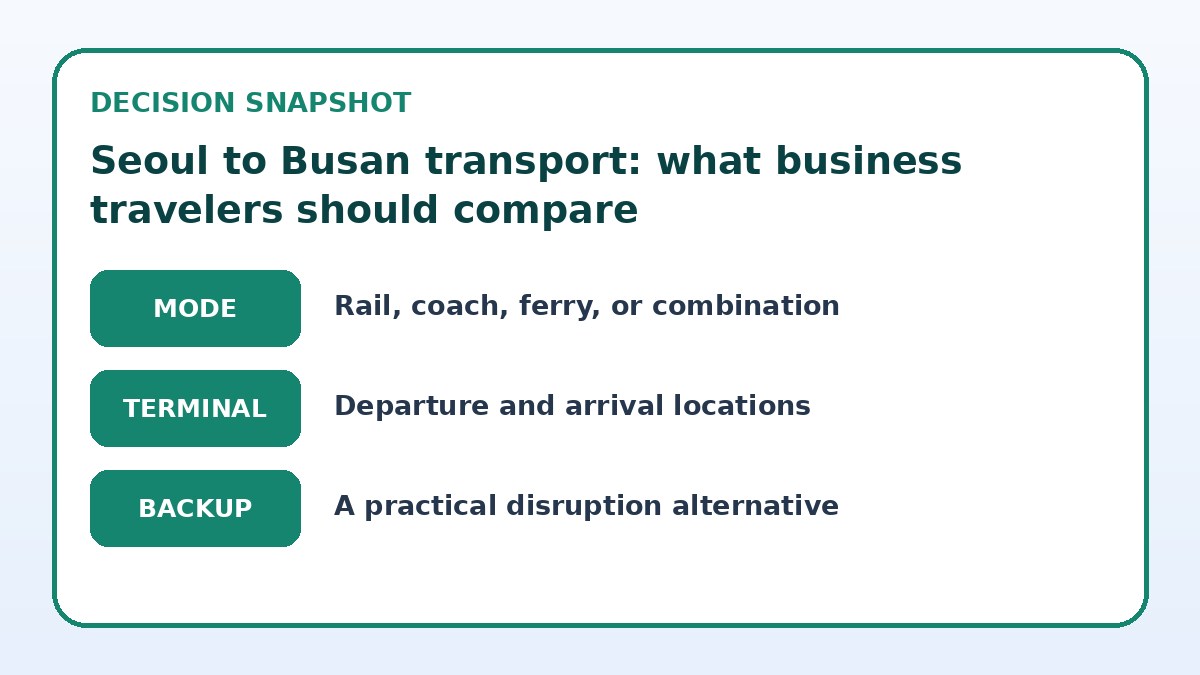
Choose the mode that saves the most door-to-door time and minimizes transfer friction. For most business trips between Seoul and Busan you’ll decide among high-speed rail, intercity coach, a long-distance ferry (used mainly for certain multi-leg routes), or a hybrid plan that mixes modes to match meetings and overnight needs. Start by estimating true door-to-door time: time to your departure station or port, check-in or boarding procedures, ride duration, arrival transfer to the office or hotel, and any baggage handling. Match that against how flexible you need to be with schedule changes, how much luggage or tech gear you carry, and whether you need a quiet workspace en route. Below you’ll find clear tradeoffs, terminal-fit notes, luggage/transfer friction guidance, and disruption backups so you can choose the most practical option for a business day, an overnight trip, or a last-minute change.
Terminal fit: where you start and finish matters most
Look beyond the advertised ride time and map exactly where each mode arrives and departs. Seoul’s major rail terminal(s) and long-distance coach terminals are located in different districts; your choice should depend on proximity to your office or hotel and the cost and time of the first-mile transfer. For example, a high-speed train that saves an hour on the track can lose that advantage if its terminal requires long metro rides or heavy traffic-prone taxi trips during peak hours. Identify which terminal aligns with your calendar: a station adjacent to a business district or a bus terminal a short cab ride from your meeting venue will reduce stress and protect the schedule.
If you require a quiet environment to prepare for meetings, check where waiting areas, business lounges, or private seating are likely (and whether they are accessible with your ticket class). Some modes offer smoother boarding flows that reduce waiting in crowded concourses; others allow you to reach a taxi rank or ride-hail pickup immediately on arrival. Before booking, list precise street addresses for departure and arrival and simulate the full route at the expected travel time. That way you can measure door-to-door time instead of relying on published journey durations alone.
Choose the end-to-end journey plan
| Journey approach | Best for | Friction to check |
|---|---|---|
| High-speed rail (single-mode) | Travelers prioritizing predictable journey times and the ability to work en route | Requires convenient station proximity or extra transfer time to match office locations |
| Intercity coach (single-mode) | Those starting or ending near coach terminals who want a simple point-to-point option | May have less onboard working space and longer baggage retrieval times than trains |
| Ferry (single or combined legs) | Overnight planners or those combining passenger travel with vehicle transport needs | Longer transit and terminal walking times make it less suited to tight business schedules |
| Hybrid (train plus taxi/metro or coach plus local transit) | Travelers optimizing door-to-door time and minimizing transfer friction | More moving parts to coordinate; requires contingency plans for missed connections |
Check live intercity options
Look beyond the ride itself and compare terminals, transfers, luggage, and arrival fit.
Luggage and transfer friction: what you can realistically carry
Business travelers vary from light carry-on commuters to those hauling equipment or sample cases. Assess each mode’s handling: trains typically have overhead racks and some dedicated luggage spaces, while coaches may require dropping bags in a hold with slower retrieval. Ferry terminals may involve longer boarding ramps and more walking between vehicle decks and passenger lounges. Consider how luggage affects your transfer choices—if you or a colleague will need to move quickly between terminals and offices, prioritize modes that minimize curb-to-seat handoffs or allow easy access to taxis and ride-hailing.
Also factor in tech gear and presentation materials—if you need to work on a laptop en route, choose options with reliable seats, power outlets, and stable Wi-Fi when available. If door-to-door time is critical, prefer stations with short, weather-protected transfer routes to taxis or local transit. When booking, verify the provider’s luggage policy on their final booking page and confirm whether station staff assist with oversized or heavy items; this avoids surprises on the travel day.
Timing flexibility and scheduling: matching trips to business needs
Decide if you need a fixed departure time or flexibility to shift plans. High-frequency rail services offer many departures and therefore schedule resilience, while some coach or ferry options run less frequently and require stricter adherence to schedules. If your meeting windows are tight or may shift, choose services that run often enough that a missed connection is recoverable on the same day without severe delay. For overnight travel, consider whether you prefer to arrive the previous evening or make a morning express trip, and how each option affects your readiness for meetings.
When evaluating options, include the local transfer time to and from terminals and the realistic time required to disembark and get into a cab or subway. For business travelers booking at short notice, check updated availability and cancellation or change conditions before purchase—confirm these on the provider’s booking page. If you rely on a company travel policy, cross-check allowed modes and required approvals so you can book within rules while still minimizing travel risk.
Compare the practical alternatives
Use the final page to confirm what is actually offered on your dates and save a workable fallback.
Intercity travel checklist
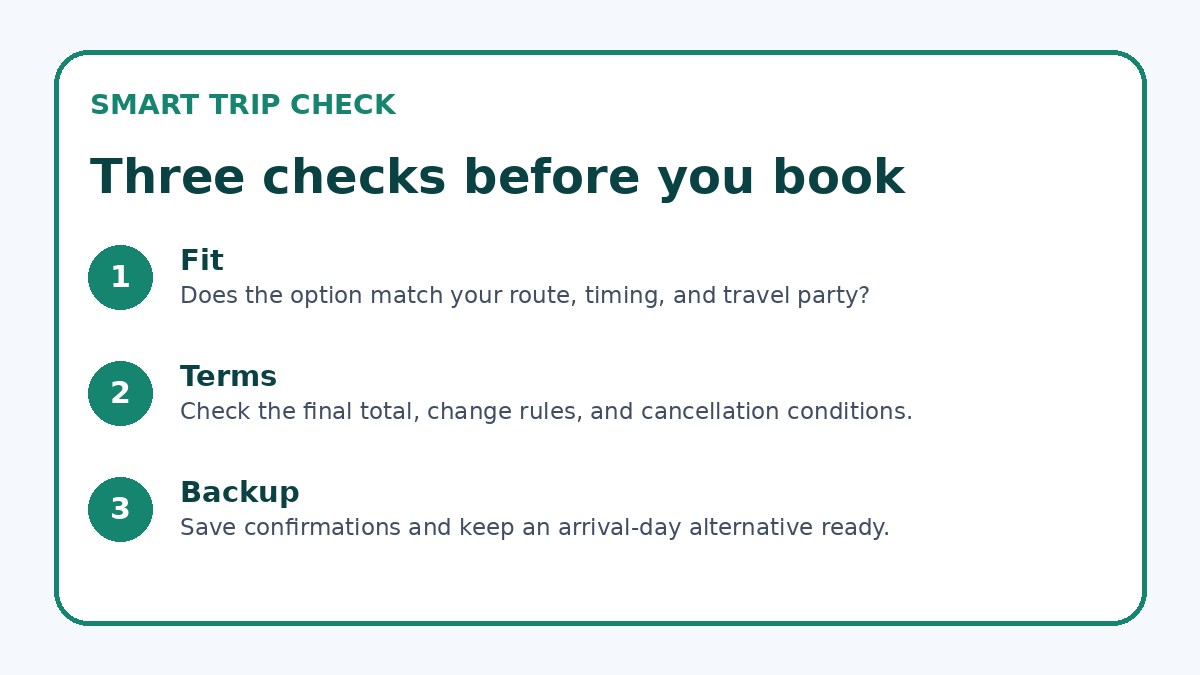
- Map the exact street addresses of departure and arrival terminals and estimate door-to-door time including transfers and buffer time for traffic.
- Verify luggage allowances and boarding procedures on the provider’s official booking page before finalizing reservations.
- Choose departures with enough frequency to allow recovery from a missed connection without arriving extremely late.
- Pre-save local ride-hail apps or taxi numbers and a short list of nearby hotels for quick overnight changes.
- Confirm your company’s travel policy on allowable modes, change fees, and expense reporting before booking.
- Carry digital and printed copies of tickets and booking references; note refund/change rules and emergency contact numbers from the provider.
Disruption backups: plans if something goes wrong
Every itinerary needs a practical backup. For rail, know the alternative departures later the same day or feasible coach routes that run to the same arrival area. For coaches, identify nearby rail services or a domestic flight corridor you could switch to. If you use mixed modes, design the plan so a single delay doesn’t cascade—avoid tight connections with no recovery options. For important meetings, consider booking refundable transfers or options with modest change fees to allow last-minute swaps.
Also prepare small contingency steps: keep a list of local taxi companies and ride-hail apps, pre-saved hotel options near arrival terminals for last-minute overnighting, and digital copies of tickets and booking references for quicker exchanges at service desks. If weather or regional events could affect your trip, have a contact at the office who can be updated without needing real-time connections, and verify the provider’s disruption policies on their booking page so you understand rebooking or refund procedures.
Rail & Intercity Transport questions travelers ask
Which mode usually gives the shortest door-to-door time between Seoul and Busan for business travelers?
Short door-to-door time depends on where you start and end. High-speed rail often offers fast on-track time combined with frequent departures, which helps if the stations are near your origin or destination. However, if a coach terminal or an alternate station is literally next door to your meeting venue, a coach or taxi-first-mile plan can beat rail overall. Always calculate the full route: time to the terminal, boarding, ride duration, disembarkation, and transfer to the office or hotel. Verify terminal locations and connection times before booking on the provider’s final page.
How much luggage is practical on each mode for a business trip?
If you travel light with one carry-on bag and a briefcase, every mode is practical, with trains generally the most comfortable for accessing items during the journey. Coaches work well for standard suitcases but often stow them in a hold that slows retrieval. Ferries can handle larger luggage and vehicles but involve more walking and ramps between decks. If you need to transport bulky equipment or samples, check each provider’s specific luggage policy on their booking page and factor in staff assistance availability at terminals when choosing the mode.
What should I verify on booking pages to avoid surprises before traveling?
On provider pages confirm departure and arrival terminal addresses, baggage allowances and any oversized-item rules, ticket change and cancellation policies, and boarding/check-in windows. Also check frequency of departures and options for same-day alternative trips in case of delays. If you need onboard amenities like power outlets or Wi-Fi to work en route, confirm those as well. For mixed-mode itineraries, ensure transfer times are realistic and note local transit or taxi options for the first and last mile.
Final decision note
For a business traveler, the best Seoul to Busan transport choice is the one that minimizes true door-to-door time and transfer friction while matching schedule flexibility needs and luggage demands. High-speed rail is often the sensible backbone of a business trip when stations align with meeting locations; coaches can win where terminals are closer to your start or end points; ferries are a niche option for overnight or vehicle-inclusive travel; and hybrid plans combine strengths where needed. Before booking, map terminals, verify luggage rules and change policies on the provider’s booking page, and build a simple disruption backup. If you want a quick comparison of current options, Trip.com can be used to check availability and conditions, but always confirm details on the operator’s official page before finalizing bookings.
Continue planning
Check current options and final conditions
Use the provider page to confirm live availability, the final total, cancellation terms, and every condition that matters to your trip.
This evergreen planning guide was created with AI-assisted drafting and a structured quality review. It does not display live prices, schedules, availability, visa guidance, or provider rankings. Verify current details before booking. Some links are affiliate links; we may earn a commission at no additional cost to you.