If your trip to Kyoto is driven by meetings, site visits, or tight multi-destination days, a rental can be a genuine time-saver — but only if pickup and return terms fit business rhythms. The practical answer: rent a car only when driving materially cuts travel time between appointments or when you need direct access to suburban client sites that are poorly served by trains. Otherwise, reliable public transit and taxis usually beat the overhead of airport pickups, fueling rules, and liability questions. This article helps you make that decision by focusing on route value, the exact insurance wording you must verify, pickup and return friction that eats time, and a concrete non-driving fallback you can use if renting looks risky. Read this before you click through to compare providers (including Trip.com if you want another availability check), and check the provider’s final booking page for any changing terms.
Route value: when driving in Kyoto actually helps
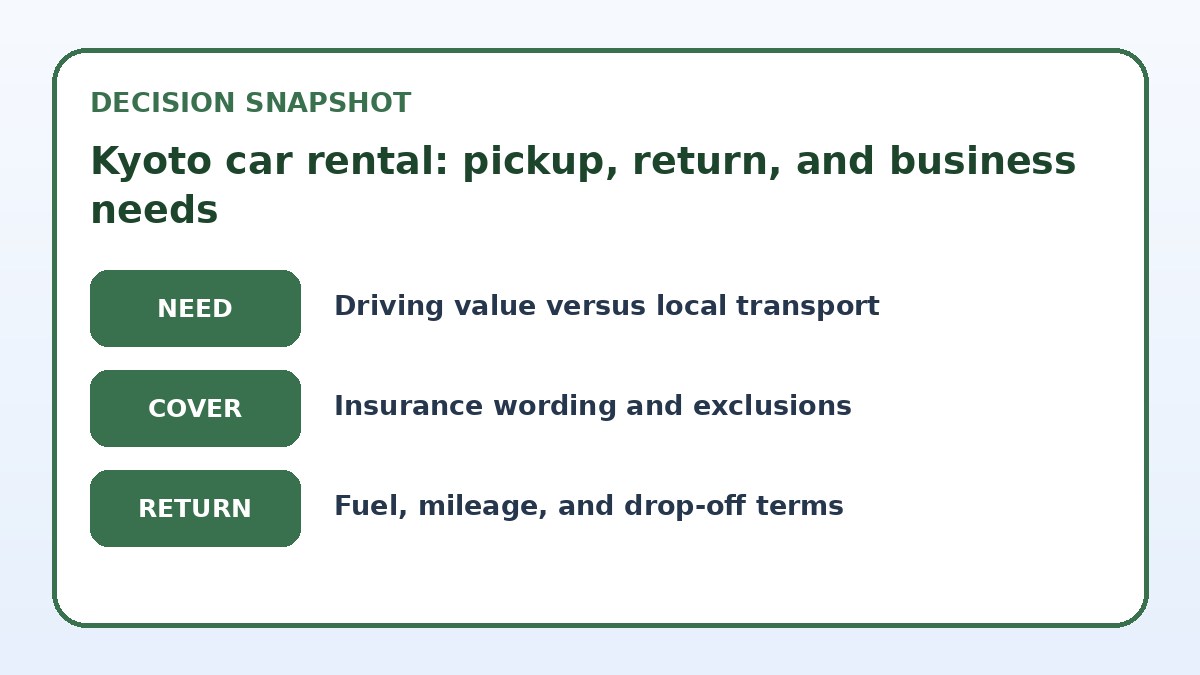
Kyoto’s compact central area and excellent rail links mean most downtown-to-downtown business travel is faster by train or taxi than by car. Driving becomes attractive when your itinerary includes multiple suburban client visits, industrial parks near the outskirts, or meetings spread across different rural valleys where train lines are sparse. To evaluate route value, map door-to-door travel times during the local rush hours you’ll face. Include parking walk times at each stop: Kyoto’s central parking can be limited and time-consuming to locate, erasing potential speed gains from driving.
Also factor in morning and evening congestion around highway interchanges and key arteries leading into Kyoto city center; those bottlenecks can add unpredictable minutes. If your appointments cluster near major stations or you can schedule blocks of meetings in the same neighborhood, a car adds little advantage. Conversely, if you need equipment, product samples, or frequent site visits that require restricted area access, a rental may be the only practical option. Decide by comparing a realistic itinerary-driven schedule with and without the car rather than assuming mobility equals flexibility.
Decide whether driving earns its place
| Mobility strategy | Best for | Cost or friction to check |
|---|---|---|
| Drive yourself (standard rental) | Control over schedule, carrying samples, and rural client visits. | Time lost in pickups, parking, insurance complexities, and potential excess fees. |
| Chauffeur or corporate car service | Stress-free travel with predictable arrival times and no parking responsibility. | Higher hourly cost and less flexibility for spontaneous side trips or heavy cargo. |
| Public transit with taxis for last mile | Fast, reliable downtown transfers and lower overall travel overhead. | Inconvenient for dispersed sites, and tight connection windows increase risk of delays. |
| Mixed approach: short rental days only | Use a car only on days with multiple suburban visits; otherwise rely on transit. | Requires careful scheduling and increases pickup/return frequency, with potential fees. |
Check live rental choices only after the route test
Use the exact driver, dates, pickup point, and return plan to compare current conditions.
Insurance wording: the exact phrases to verify
Insurance sections in rental contracts matter more than headline coverage amounts. On the provider’s final booking page, verify three things: whether Collision Damage Waiver (CDW) is included or optional; what the specified excess or deductible amount is; and whether the policy explicitly covers business use or professional drivers. Look for clear language about 'business use' exclusions, penalties for third-party drivers, and whether cross-prefecture travel (for example, leaving Kyoto into neighboring prefectures) is permitted. If the contract references local mandatory insurance, confirm the supplement you’re offered actually reduces your financial exposure to the stated excess figure.
Also check for specific exclusions: driving on unpaved roads, remote area recovery, and coverage when towing. If you plan to drive at night after late meetings, verify whether roadside assistance is included or available 24/7 and whether after-hours callout fees apply. If the wording is ambiguous, contact the provider before booking and request written confirmation; do not assume verbal promises will appear on the rental agreement at pickup.
Compare the full rental conditions
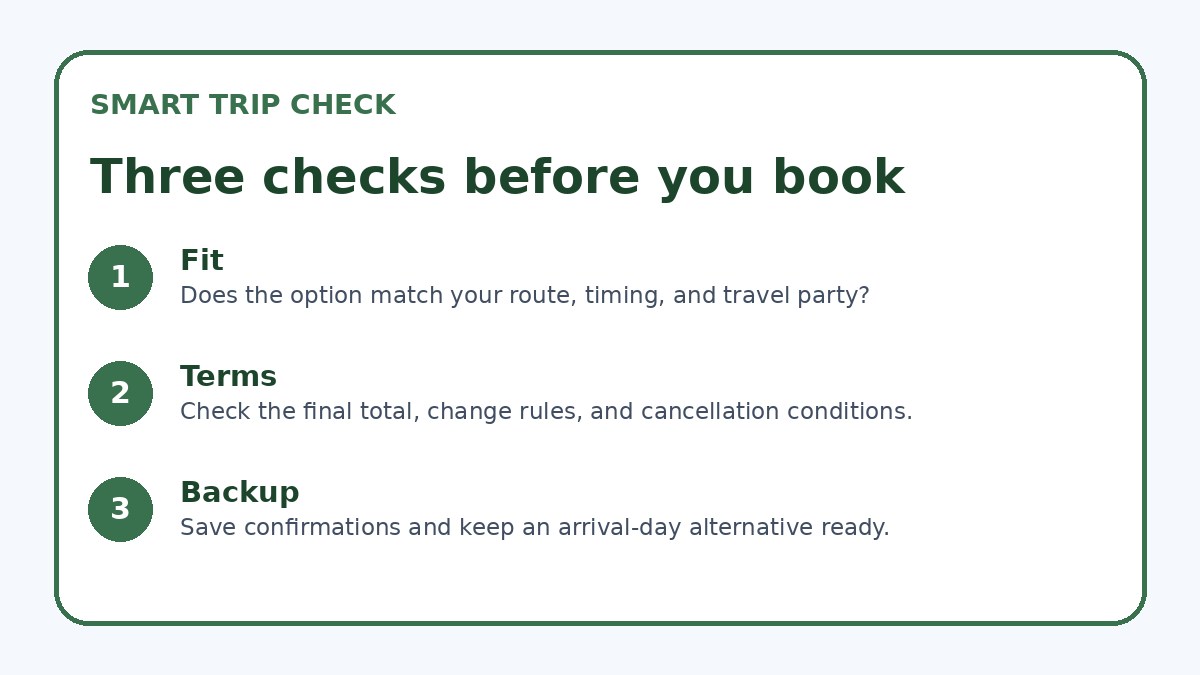
Confirm insurance wording, exclusions, deposit, fuel, mileage, and return terms on the final page.
Pickup and return friction: what eats a business day
Pickup friction includes airport or station location, required documentation, payment holds on corporate cards, and the time to walk from counters to the car park. Some airport desks shuttle customers to offsite lots; that adds 20–45 minutes. Verify whether the provider accepts company credit cards without additional ID, whether they place a hold that could affect other corporate spending, and whether express lanes or precheck options exist. For early or late flights, confirm after-hours pickup options and whether a key dropbox or staffed return is available to avoid waiting in a queue after a long journey.
Return friction can create hidden costs in time and stress: look for one-way return fees if you intend to hand the car back at a different office, fuel policy wording that spells out penalties for missing the fill level, and fines for late return windows. Understand the company’s vehicle inspection process and whether you receive a signed condition report at both ends. If you must be on a tight schedule the day you return the car, prefer providers with quick, digital checkouts or that allow photographic proof of condition to avoid disputes that could delay your travel to the airport or a meeting.
Car rental terms to verify
- Map your exact door-to-door itinerary with realistic walking and parking times to test whether driving saves time.
- On the booking page, confirm CDW inclusion, stated excess amount, and explicit wording about business use coverage.
- Verify pickup logistics: desk location, shuttle needs, required IDs, and whether corporate cards trigger extra holds.
- Confirm return rules: specified fuel policy, late return grace period, one-way fees, and photographic damage procedures.
- Ask the provider to document any verbal assurances about after-hours service, cross-prefecture travel, or additional drivers.
- Prepare a non-driving fallback: train/taxi schedule, chauffeur contact, and a contingency budget for same-day trips.
Non-driving fallback: a workable plan if you skip the car
A non-driving fallback should be a ready-to-implement plan that keeps your itinerary intact without penalizing you for a canceled rental. Build a schedule that relies on Kyoto’s rail network for high-volume transfers between major business hubs, supplemented by short taxi rides where train stations aren’t near client sites. Pre-identify a list of taxi apps or local dispatch numbers and factor average taxi times and likely surge conditions into your calendar. Keep your meeting buffer times slightly larger than usual to accommodate transfers across different modes.
Also establish a backup for last-mile and off-hour needs: identify a reliable chauffeur or corporate car service you can call for same-day bookings, and set a modest contingency budget for those trips. If you use a coworking space or hotel meeting room as an alternate meeting point, confirm its booking flexibility in advance. These steps let you cancel a rental without scrambling and maintain professional punctuality without relying on uncertain local driving conditions or unfamiliar parking systems.
Car Rental & Road Trip questions travelers ask
Can I use a standard rental for business meetings in Kyoto without special business insurance?
You can often use a standard rental for business travel, but the rental contract may exclude 'commercial' or 'business use' unless explicitly allowed. Always read the policy wording on the final booking page to see if business use is permitted or if an extra policy endorsement is required. Verify whether any damage excess applies, whether additional drivers are permitted, and whether your company’s corporate credit card or travel insurance provides secondary or primary coverage. If wording is unclear, request written confirmation before pickup to avoid surprise liability.
How much extra time should I budget for pickup and return at Kyoto’s transport hubs?
Budget for more time than the desk’s quoted window: allow an extra 20–45 minutes for shuttle transfers from remote lots and up to an hour for paperwork queues during peak times. For returns, add buffer time for the inspection process and any paperwork that confirms vehicle condition to avoid disputes. If your schedule has tight connections or late flights, choose providers that offer express check-in/out or digital inspection records, and verify these options on the booking page so you can plan realistic meeting-to-travel transitions.
What should I do if my company card is declined or a large hold is placed at pickup?
If a corporate card is declined or a sizeable deposit hold appears, remain calm and request the provider’s written policy on deposits and acceptable payment methods. Some companies restrict holds on corporate cards; confirm whether a personal card or alternative verification is allowed and whether the hold amount can be reduced with additional insurance. Escalate to your company’s travel or finance contact immediately, and take a photo of any written notices. To avoid the situation, verify card acceptance and hold amounts on the provider’s final booking page before arrival.
Final decision note
For business travel in Kyoto, the right decision hinges on clear route value and clean pickup/return terms. If your meetings are clustered around stations and downtown locations, the time and liability overhead of a rental rarely justify itself. Drive only when you gain measurable time, need cargo capacity, or must reach poorly served outskirts. When you do rent, insist on explicit contract language about business use, excess limits, after-hours procedures, and the fuel and return inspection process. Finally, set a non-driving fallback — transit plus taxi or a prearranged chauffeur — so you can cancel or shorten a rental without jeopardizing meetings. Check the provider’s final booking page for exact fees, insurance wording, and operational details before you confirm.
Continue planning
Check current options and final conditions
Use the provider page to confirm live availability, the final total, cancellation terms, and every condition that matters to your trip.
This evergreen planning guide was created with AI-assisted drafting and a structured quality review. It does not display live prices, schedules, availability, visa guidance, or provider rankings. Verify current details before booking. Some links are affiliate links; we may earn a commission at no additional cost to you.