Practical answer up front: if you’re travelling from Sydney to Melbourne with luggage, choose the mode that matches how much you carry, how flexible you need to be, and how hands-on you want transfers to be. Trains and coaches handle moderate luggage with fewer transfers; combining rail with local taxis or rideshares can make door-to-door moves easier if you have bulky suitcases or valuable items. Ferry options are not a direct Sydney–Melbourne route but could appear for coastal side trips and add extra transfers. Before you book, list the exact bags, check the transport provider’s luggage rules on their booking page, and plan the first and last-mile transfers (hotel to terminal and terminal to accommodation) so you know exactly who moves each bag and when.
Choosing between rail, coach, or mixed routes
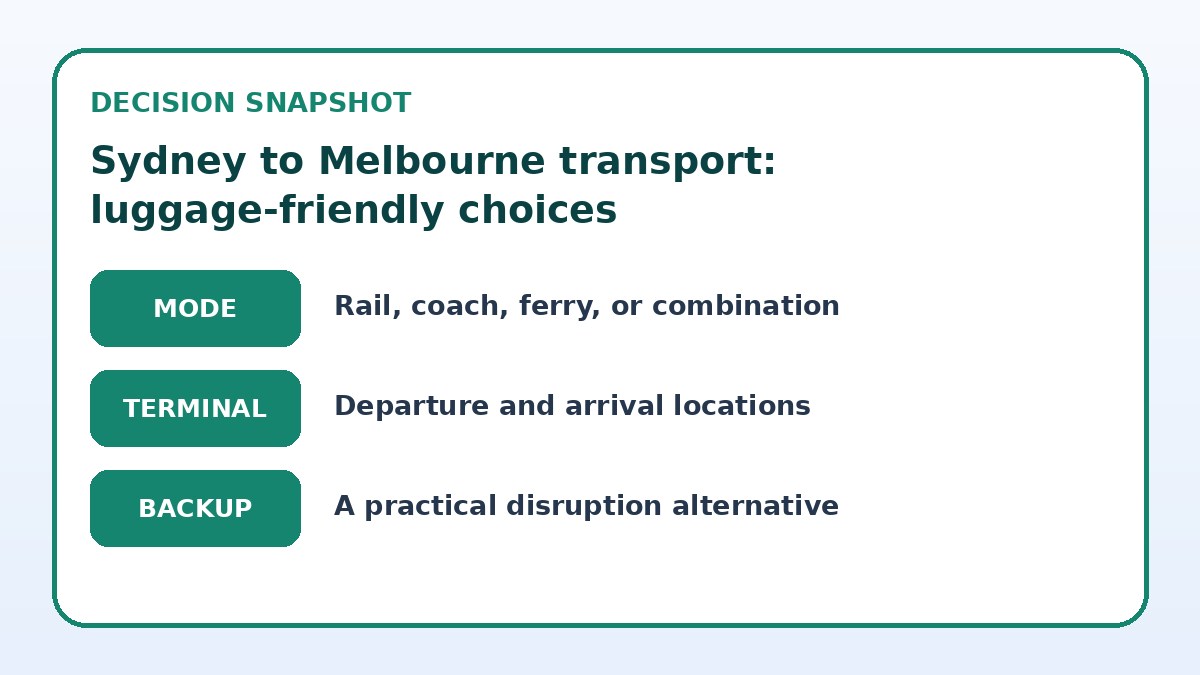
Start by mapping the whole door-to-door journey, not just the leg between Sydney and Melbourne. Rail and coach are the primary overland choices: trains can be roomier and allow you to keep a small bag with you while larger suitcases go in designated areas; coaches typically load larger hold luggage under the vehicle which reduces what you carry during stops. A mixed plan—train for comfort plus a short coach or rideshare at either end—can reduce walking and multiple lifts if your accommodation is far from a station. When service options include direct and connecting itineraries, compare the number of times you must move bags and whether transfers require stairs, long platform walks, or tight connection windows.
Deciding between options often comes down to luggage volume and tolerance for transfers. If you have many cases, or very heavy items, a coach with hold storage can be simpler because staff handle loading. If you carry a single medium suitcase and prefer space to sit and move, a train gives more legroom and easier access to on-board facilities. For first-time visitors, the simplest practical test is to simulate the trip with your luggage at home: load everything in, lift the bags into a car boot or onto a trolley, and note whether you’d want assistance at each transfer point. Use that to filter realistic transport modes before comparing schedules.
Choose the end-to-end journey plan
| Journey approach | Best for | Friction to check |
|---|---|---|
| Direct train with minimal transfers | Travelers with one or two medium suitcases who prefer comfort and fewer lifts | May require walking between station exits and accommodation or arranging a taxi for final leg |
| Coach with hold luggage service | People with several large bags who want staff to handle loading and unloading | Involves dependance on terminal staff and potential delays during loading at stops |
| Mixed mode: train plus short taxi/rideshare | Those who want on-board comfort but prefer door-to-door convenience for bulky items | Higher cost and need to coordinate driver size and timing with arrival |
| Multiple short hops with luggage storage | Travelers combining sightseeing with staged luggage drops at safe storage facilities | More handling events and risk if storage hours or availability change unexpectedly |
Check live intercity options
Look beyond the ride itself and compare terminals, transfers, luggage, and arrival fit.
Terminal fit and first/last-mile logistics
Terminal fit means how well your bags move through the places you’ll pass: from hotel to terminal, between platforms, and from arrival terminal to accommodation. Look at the distance between platform and station exits, the availability of elevators, and whether stations have staff or trolleys. For city-center terminals that are walkable from hotels, you may prefer to carry smaller bags and avoid paid transfers. For accommodations further from terminals, factor the cost and ease of a taxi or rideshare that can take larger items directly to your door. Always confirm luggage size rules, any limits on trolleys, and elevator availability on provider pages or station maps.
If door-to-door convenience is your priority, pre-booking a vehicle that fits your luggage count often saves time and reduces the number of lifts. Some travellers arrange a pickup to drop luggage at the terminal early and then return empty to park or sightseeing, but that adds coordination. Alternatively, luggage storage at central stations can bridge timing gaps, letting you drop a bag for a few hours while you explore with minimal items. Verify opening hours and fees on the station’s official site before relying on storage as a plan B.
Timing flexibility and scheduling with luggage
When you travel with luggage, allow extra time at each end of the journey. Arrive earlier to load hold luggage or to find luggage racks on trains, and build buffer time for check-in to overnight accommodation after arrival. Flexible tickets or services with generous connection times reduce stress when a transfer requires moving bags across platforms or through busy terminals. If your schedule is tight, prefer services with fewer changes. For long-distance daytime travel, consider trains for a steadier, less bouncy ride that makes managing bags easier on board.
Also evaluate arrival time relevance: arriving very late or very early can complicate last-mile transfers because taxis and some support services may be less available. If you must travel at an awkward hour, check whether the transport provider and the station have staff on duty for baggage assistance and what safety options exist for moving bulky items. For first-time visitors unfamiliar with local public transport patterns, choose a timetable that gives you daylight for transfers and time to resolve unexpected issues without rushing.
Compare the practical alternatives
Use the final page to confirm what is actually offered on your dates and save a workable fallback.
Intercity travel checklist
- Weigh total door-to-door time including transfers, station walks, and pickup/drop-off rather than comparing only in-vehicle travel time.
- Measure and photograph each bag; record dimensions and weight to check against provider luggage policies before booking.
- Confirm elevator/escalator locations at departure and arrival stations and plan routes that avoid stairs with heavy suitcases.
- Reserve a taxi or rideshare that lists vehicle size or van options for the first/last mile if you need guaranteed space.
- Check station luggage storage availability and opening hours as a contingency for timing mismatches between legs.
- Save operator baggage terms, claim procedures, and contact numbers from the official booking page in one accessible document.
Backup plans and what to verify before booking
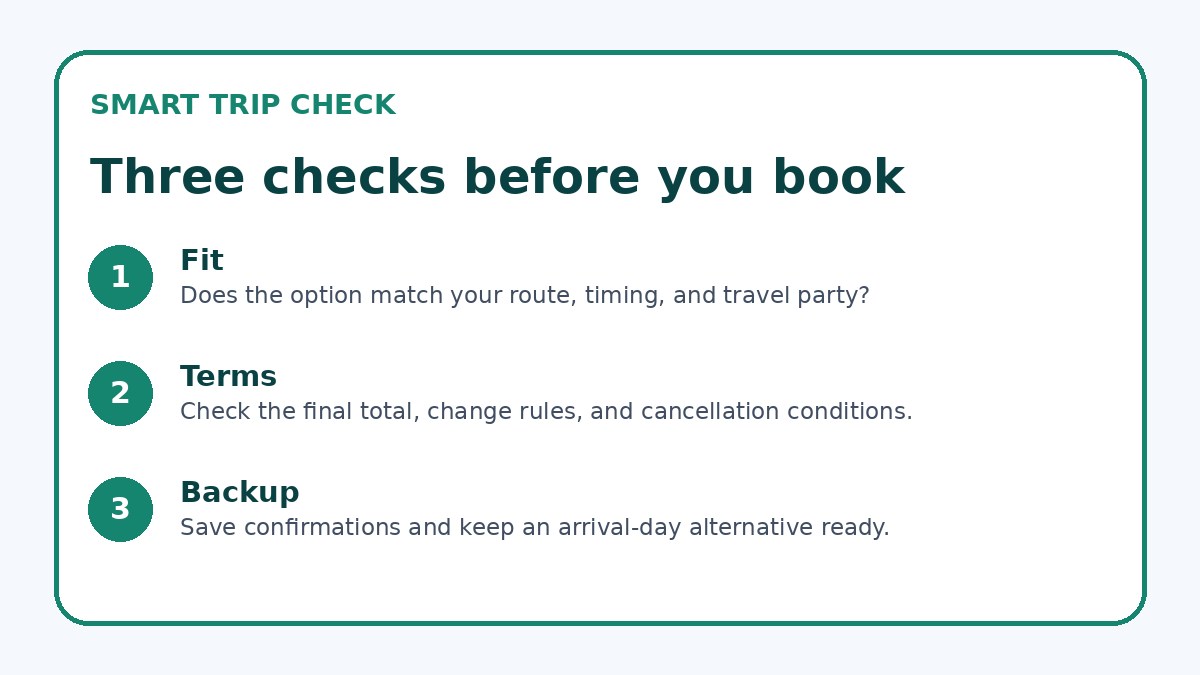
Prepare at least one disruption backup: a later train or coach on the same day, a rideshare able to carry your luggage, or a nearby hotel that lets you check in early if you’re delayed. If you plan multiple legs, identify an alternative route that avoids small-connection dependencies—for example, a single longer coach leg instead of multiple short hops that multiply transfer risks. Keep digital copies and photos of important items in case luggage is delayed or mishandled, and know the operator’s baggage claims process; check the provider’s final booking page for the exact steps to report lost or damaged luggage.
Before you commit, verify four practical items on the provider’s site: luggage allowances and dimensions, whether holds are supervised, how many pieces are permitted per passenger, and the provider’s process for oversized or special items. Also check station entrance and exit maps for elevator locations, and confirm last-mile options from arrival terminus to your accommodation. Trip.com can be used to compare current availability and conditions, but always finalize luggage-specific details on the operator’s official booking page so you’re not surprised by restrictions or handling procedures.
Rail & Intercity Transport questions travelers ask
How much luggage can I reasonably bring on a train from Sydney to Melbourne?
The reasonable amount varies with the operator’s allowance and the type of service. For planning, assume you can bring one small bag into the passenger area and place larger suitcases in specified storage zones or racks. If you have multiple or oversized items, treat the trip like moving: plan a coach with hold storage or a mixed-mode journey that includes a taxi at either end. Always check the provider’s official baggage policy on their booking page for maximum pieces, size limits, and any charges before finalising tickets.
Is it safer to use luggage storage at stations rather than carrying bags between stops?
Luggage storage can be a practical option when you have a long layover or want to explore without heavy bags, but it depends on the station’s security, opening hours, and terms. Use only staffed storage with a receipt or tracked system and confirm hours to avoid being locked out. Storage adds an extra hand-off, so weigh that against carrying your items or pre-booking a pickup. For high-value items, consider keeping them with you and using storage only for non-valuable bulkier pieces.
What should I do if my arrival time is very early or late with a lot of luggage?
If arrival is outside typical service hours or during low-traffic times, pre-arrange a taxi or rideshare that can accommodate your luggage count and check that the driver knows the pickup point at the terminal. Alternatively, consider booking a nearby hotel for the night to avoid moving bags across empty streets. Confirm station staffing and luggage handling options for off-peak hours on the operator’s site. Carry essentials in a small bag in case you need immediate access while larger items wait or are transferred later.
Final decision note
Choosing the best Sydney to Melbourne transport when travelling with luggage is a practical exercise in tradeoffs: comfort versus hands-off handling, cost versus door-to-door convenience, and schedule rigidity versus flexibility. First-time visitors should prioritise mapping the entire route from hotel door to final accommodation, then match that map to options that minimise lifts and awkward transfers. Verify luggage allowances, elevator access, and last-mile vehicle size on the provider’s official pages before booking. With a clear picture of your bag count and a simple backup for disruptions, you’ll reduce stress and make the journey itself part of the travel experience rather than the logistical hassle.
Continue planning
Check current options and final conditions
Use the provider page to confirm live availability, the final total, cancellation terms, and every condition that matters to your trip.
This evergreen planning guide was created with AI-assisted drafting and a structured quality review. It does not display live prices, schedules, availability, visa guidance, or provider rankings. Verify current details before booking. Some links are affiliate links; we may earn a commission at no additional cost to you.