If you need to travel Bangkok to Chiang Mai for work, choose the option that keeps your meeting schedule intact and your cargo secure. For many business travelers, flexibility matters more than shaving minutes off a journey. That means assessing not only the on-board experience but also terminals, luggage handling, transfer complexity and how easy it is to rebook or get a refund. This guide compares four practical planning approaches—train-centric, flight-first, overnight coach, and multimodal door-to-door—so you can match flexibility priorities to your calendar, risk tolerance and company policy. Read on to learn the decision criteria and what to verify on provider booking pages before you commit.
How to choose between train, coach, flight or a mix
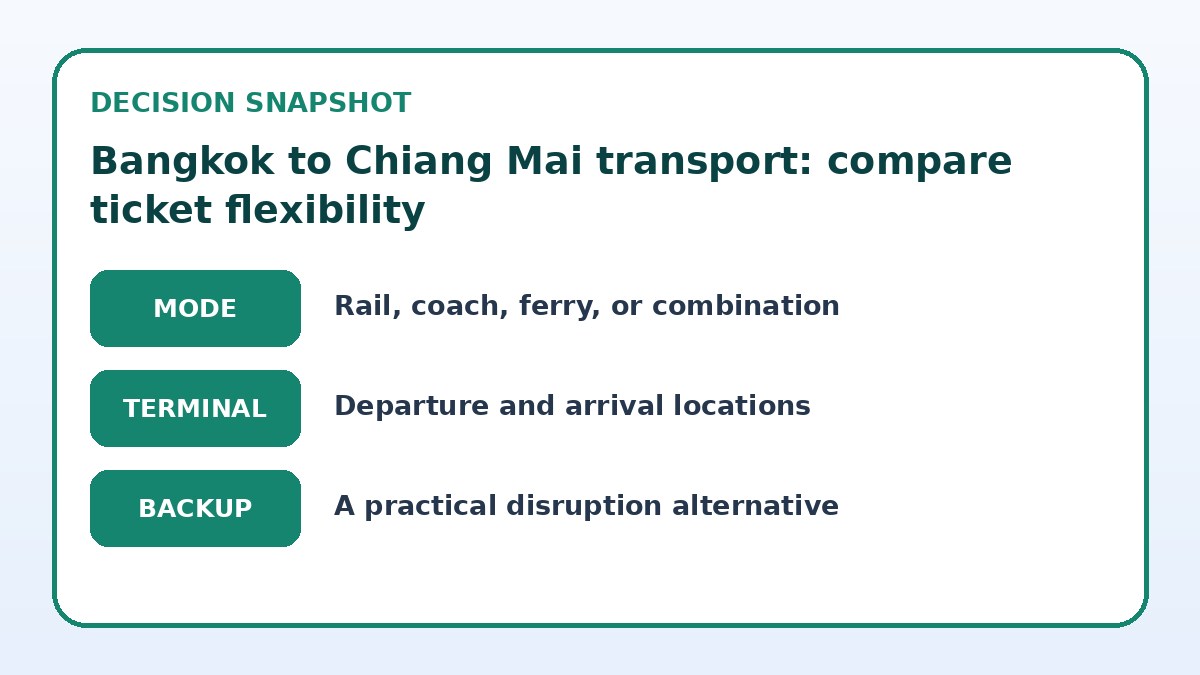
Start by listing your non-negotiables: meeting start time, how soon you can leave, luggage and presentation equipment needs, and whether you require privacy or power for work en route. Trains often offer stable work spaces and fewer transfer steps if they depart from centrally located stations; flights may save daytime hours but add airport transfers. Coaches or night services can be simpler for flexible plans if you can work offline. A mixed plan—for example, a daytime flight out and a train return—can split the risk and keep options open but increases coordination for transfers and luggage handling.
Run a quick time-cost-risk check: compare total door-to-door time, not just in-vehicle travel; assess how easy it is to change or cancel each ticket; and factor in the likely stress of last-minute changes. Business travelers should also match reimbursement rules and company booking policy when choosing a mode. For each candidate mode, check the provider’s specific rebooking and refund policy on the final booking page, and confirm terminal addresses, luggage rules and connection advice before you buy.
Choose the end-to-end journey plan
| Journey approach | Best for | Friction to check |
|---|---|---|
| Train-centric (day train or overnight sleeper) | Travelers needing stable workspace, easy luggage access, and central stations | Slower than flying; fewer departures may limit schedule flexibility |
| Flight-first (daytime flights with airport transfers) | When minimizing daytime travel time is essential | Airport transfers and security add uncertainty; ticket change rules vary widely |
| Overnight coach or sleeper bus | Those who prefer to travel outside working hours and save daytime availability | Less onboard privacy and fewer power/desk resources for productive work |
| Multimodal door-to-door (mix of flight, rail, taxi) | Maximising contingency options and tailoring each leg for convenience | More transfers increase baggage handling and coordination complexity |
Check live intercity options
Look beyond the ride itself and compare terminals, transfers, luggage, and arrival fit.
Terminal fit and last-mile practicality
Terminal fit means whether the departure and arrival points put you near your hotel, office, or meeting venue. A centrally located train station can cut a lot of door-to-door time compared with an airport that requires long transfers. Conversely, an airline offering departures from a city domestic terminal connected to rapid transit could still be efficient. Consider peak-hour road congestion between your accommodation and the terminal, and whether reliable public transport, ride-hail or hotel transfers are available at the times you need them.
Also think about check-in procedures and how they affect your schedule: trains and coaches typically have shorter pre-departure lead times than flights, while airports usually require earlier arrivals. Verify where luggage drop-off and pick-up are located and whether you can check or store briefcases and equipment. If you rely on taxis or app-based cars, confirm where drivers can legally and safely drop you off at each terminal to avoid delays that could cascade into missed connections or late arrivals to meetings.
Luggage, transfer friction and in-transit workability
List every item you carry for work: laptop, presentation materials, samples, or large carry-ons. Compare how each mode handles bulky or fragile items and whether items can stay with you or must be gate-checked or stored. Trains generally let you keep gear within reach and often have power outlets and table space; flights require security screening and baggage handling steps that add friction. Coaches may have generous hold space but less on-board privacy and fewer outlets for continuous work.
Transfer friction happens when you change modes or terminals. If you plan a mixed itinerary, build margin into transfer times to account for traffic, baggage retrieval and security procedures. Evaluate whether platforms or boarding areas have elevators or escalators for wheeled luggage and whether transfers require rides through congested city centres. For each booking option, confirm luggage allowances and transfer recommendations on the provider’s booking page to avoid surprises.
Compare the practical alternatives
Use the final page to confirm what is actually offered on your dates and save a workable fallback.
Intercity travel checklist
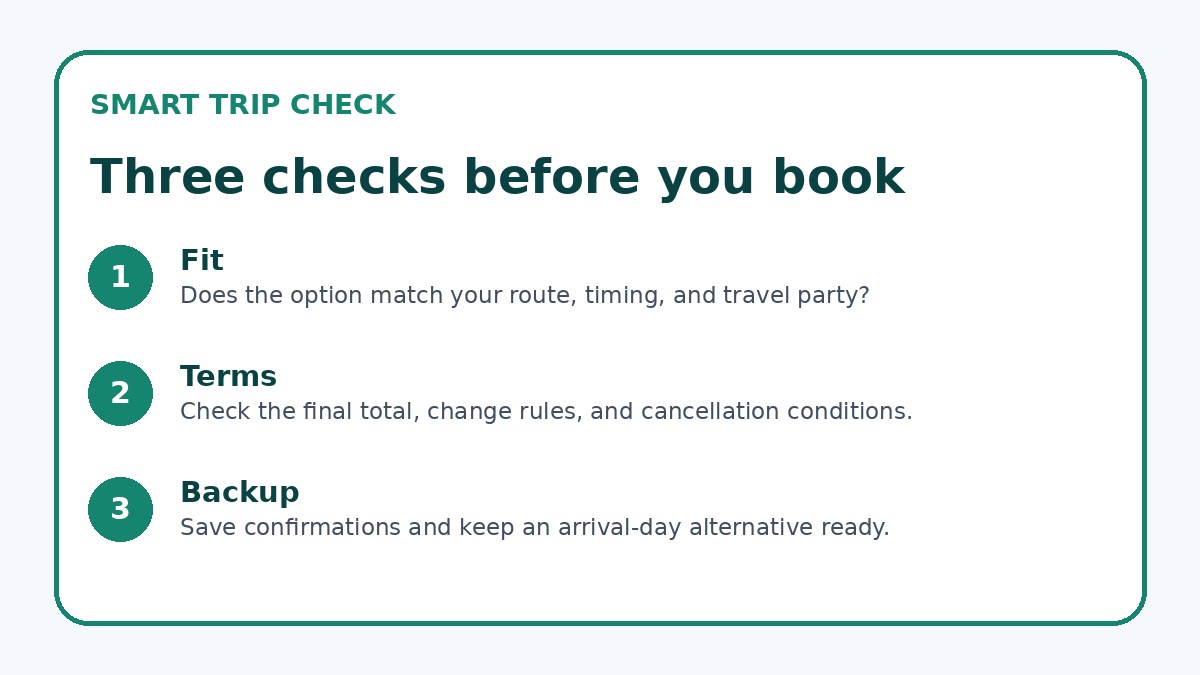
- Check the provider’s final booking page for specific rebooking and refund rules before purchase.
- Estimate total door-to-door time including transfers, security, and typical traffic at your travel hours.
- Confirm luggage allowances and whether large or fragile items require advance notice or special handling.
- Identify at least one same-day alternative service for your chosen mode and save its booking reference patterns.
- Arrange last-mile transport in advance or confirm reliable ride-hail options near departure and arrival terminals.
- Keep mobile booking confirmations and a local data plan to rebook or coordinate quickly if plans change.
Timing flexibility and disruption backups
Timing flexibility covers ticket change rules, how close to departure you can change bookings, and whether seats are reassignable. For business trips, look for fares that permit name changes, flexible rebooking with small fees, or clear refund windows. If your company requires advance approval for non-refundable fares, choose a ticket type that balances lower administrative friction with the ability to adapt to schedule shifts. Always verify the provider’s change and refund policy on the final booking page before payment.
Develop layered backups: if you take a scheduled train, note the next available services and how easy it is to switch; if you fly, identify nearby same-day flights or a train option that could substitute. Keep contacts for platform or airport service desks and screenshot booking reference numbers for quick rebooking. Consider travel insurance that covers business disruption if your company permits it, and have a mobile plan or local SIM so you can quickly coordinate alternative transport or extended meetings without losing connectivity.
Rail & Intercity Transport questions travelers ask
How do I compare flexibility between cheap and flexible fares?
Cheap fares often come with restrictive change and refund terms, while flexible fares permit rebooking closer to departure. To compare, look beyond headline price: read the exact rules on the provider’s final booking page, checking change fees, blackout dates, and how far in advance you can alter a reservation. Consider indirect costs—time lost in transfers, penalties for missed meetings, or the administrative burden of company expense claims—when weighing a higher flexible fare against a lower restrictive one.
Is it safer to book a same-day flight or train for urgent return travel?
Safety depends on connectivity and transfer reliability rather than mode alone. Trains from central stations can be quicker door-to-door when airport transfers are long or traffic is heavy. Flights can be time-saving if terminals are well connected to your locations and you have minimal check-in time. Always verify the provider’s rebooking options on the booking page, check the frequency of alternative services, and choose the option with the simplest and fastest backup that fits your schedule.
What should I verify on the booking page to avoid surprises?
On any booking page check rebooking and cancellation rules, exact luggage allowances and any special-handling requirements, terminal names and recommended arrival times, and how changes are processed online or by phone. Also confirm contact details for customer service, whether seat changes or upgrades are permitted, and any company-invoice or billing options you need. If unsure, screenshot the booking terms or save the confirmation email so you can reference them quickly during disruptions.
Final decision note
For business travel between Bangkok and Chiang Mai, prioritise the combination of door-to-door practicality and ticket flexibility over marginal in-vehicle speed. Choose the approach that aligns with your primary constraint—whether that is minimizing daytime travel, preserving workspace en route, or allowing last-minute schedule changes—and verify change, refund and luggage rules on the provider’s final booking page before paying. Keep a simple disruption backup—an alternative same-day service or a nearby terminal option—and prepare your last-mile transfers in advance. If you want a quick place to compare current availability and booking conditions, Trip.com is one option to check, but always verify policies on the provider’s official pages.
Continue planning
Check current options and final conditions
Use the provider page to confirm live availability, the final total, cancellation terms, and every condition that matters to your trip.
This evergreen planning guide was created with AI-assisted drafting and a structured quality review. It does not display live prices, schedules, availability, visa guidance, or provider rankings. Verify current details before booking. Some links are affiliate links; we may earn a commission at no additional cost to you.