If you need a clear decision for Seoul to Gangneung transport on your first trip, start by deciding whether you want speed, flexibility, or the simplest door-to-door logistics. The most common choices are intercity rail, express coach, private car or taxi transfers, and mixes of those modes when a station or terminal doesn’t match your hotel location. For a single sensible rule: pick the option that minimizes transfers and luggage handling for your comfort level. After that, check terminal fit (how close the departure and arrival points are to your lodging), how much time you can spare for contingencies, and what backup you’ll use if your first choice is delayed or full. This article helps you weigh those tradeoffs, plan your travel day timeline, and build a realistic disruption plan so your first Seoul-to-Gangneung day goes smoothly.
Choosing between rail, coach, private transfer, or a combination
Start by mapping where you begin in Seoul and where you need to finish in Gangneung. Intercity rail often provides a predictable timetable and a comfortable onboard experience, but the value depends on how far the stations are from your accommodation. Coaches sometimes serve different terminals with stops closer to tourist zones, and private transfers remove transfers entirely at the expense of potential cost and availability. A combination — for example, rail to a nearby hub then a short taxi or local bus — can balance speed and door-to-door convenience.
To choose, list priorities: minimize walking with luggage, reduce total door-to-door time, or save money. From that list, eliminate options that force extra transfers or awkward terminal changes. Check where each mode terminates in Gangneung and Seoul, and evaluate the last-mile transit options from those points to your lodging. That simple terminal-fit check often decides the sensible option faster than comparing advertised travel times.
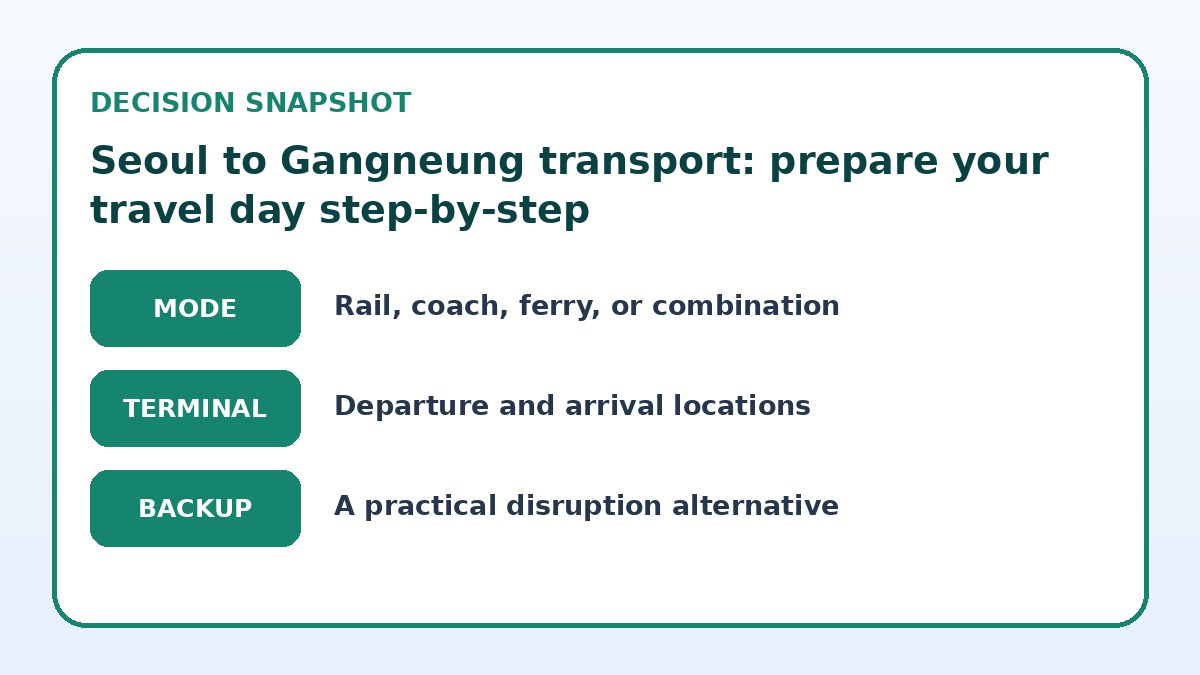
Choose the end-to-end journey plan
| Journey approach | Best for | Friction to check |
|---|---|---|
| Rail-first (train as primary) | Travelers who want a comfortable, predictable onboard experience and can reach stations easily. | May require extra last-mile transfers and luggage handling if stations are not near your hotel. |
| Coach-first (express bus as primary) | Visitors who want fewer transfers and possible direct drops closer to local neighborhoods. | Coach stops and terminals vary; check luggage space and whether the stop is actually convenient for your lodging. |
| Private transfer (door-to-door car or taxi) | Groups, families, or travelers prioritizing zero-transfer convenience and minimal luggage hassle. | Typically less flexible with availability and potentially higher cost; verify booking and cancellation rules. |
| Combination (rail or coach + short local taxi/bus) | Those balancing speed and doorstep practicality when no single mode lands close to the final address. | Requires coordination and extra transfers, increasing the chance of small delays or luggage handling. |
Check live intercity options
Look beyond the ride itself and compare terminals, transfers, luggage, and arrival fit.
Terminal fit and luggage/transfer friction
Terminal fit is how well the departure and arrival points match your start and end addresses. A fast train is less useful if the stations are far from your rooms, require multiple subway changes, or have steep stairs with heavy luggage. Consider the physical effort and time to move bags, whether you’ll need porter help, and whether your chosen departure terminal has direct subway or taxi access. If you have oversized suitcases or mobility needs, prioritize routes with simple, short transfers.
Luggage rules differ by mode: coaches and trains may limit the size or number of bags you can store onboard, and private cars usually handle anything that fits in the vehicle. Factor in transfer friction: multiple handoffs between vehicle and station add time and stress. If minimizing friction is a priority, pick the option that reduces the number of hand-carried transfers, even if that means a slightly longer in-vehicle time.
Timing flexibility and building your travel day timeline
Plan a realistic timeline that includes getting to the Seoul departure point, buffer time for queues or ticketing, and arrival-to-hotel transfer time in Gangneung. Leave extra time around known pinch points — morning rush-hour exits in Seoul, or festival days in Gangneung — and remember you’ll often need additional time for luggage retrieval and walking between platforms. If your schedule is tight, prioritize departures that leave more spare time rather than shaving minutes off the ride itself.
Decide how flexible you want to be on the travel day. If you prefer a calm, predictable day, book earlier departures with longer transfer buffers or secure a private transfer. If you’re comfortable with more moving parts, pick options that require a single short transfer at the destination. Whatever you choose, write down landmarks, terminal names, and an estimated arrival window so you and anyone meeting you are aligned.
Compare the practical alternatives
Use the final page to confirm what is actually offered on your dates and save a workable fallback.
Intercity travel checklist
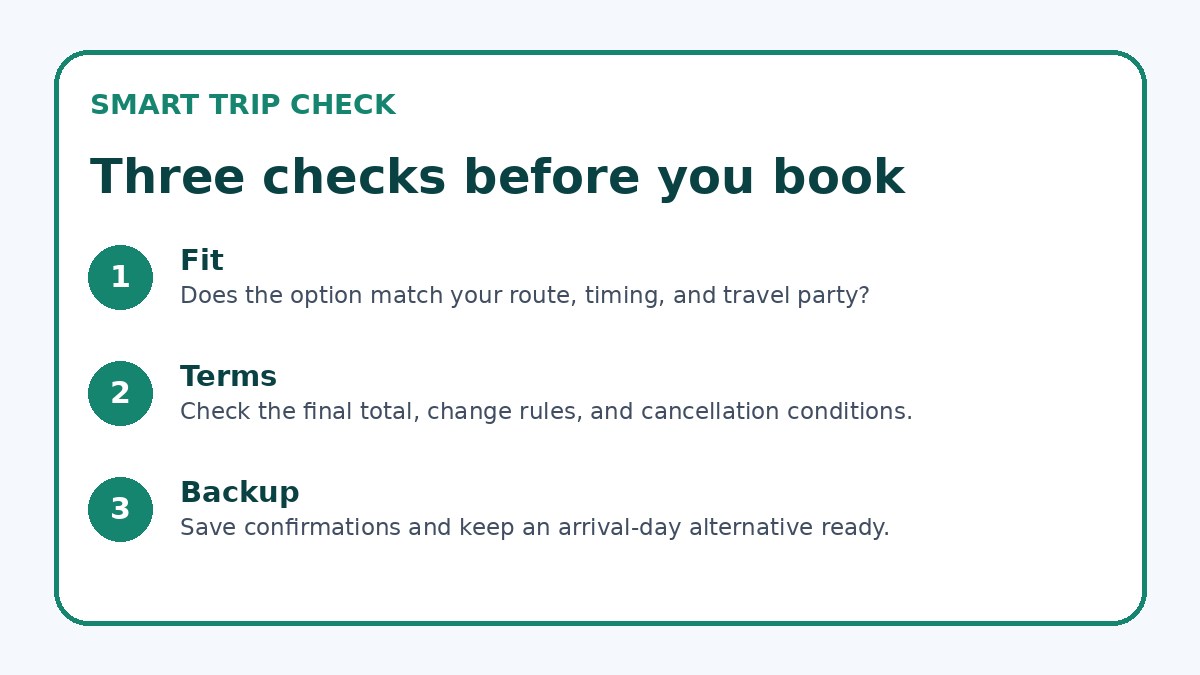
- Map the exact locations of your Seoul departure point and Gangneung arrival point, then measure door-to-door transit options and time.
- Verify luggage allowances and storage options for your chosen transport mode on the provider's final booking page before you purchase.
- Build a travel-day timeline including check-in at the departure terminal, buffers for delays, and realistic post-arrival transfer time.
- Save backup options: the next train or coach departure times, plus a taxi booking method or local number for emergencies.
- Prepare payment methods accepted locally (cash and card) and a small contingency fund for last-minute taxi rides or overnight changes.
- Download or screenshot reservation confirmations, directions, and contact numbers; keep them accessible offline during travel.
Disruption backup: practical fallback options
A disruption plan should list at least two realistic alternatives and the actions needed to switch. For example: an alternate train later that day, a coach route that uses a different terminal, or a mapped taxi route you can call if public transport is delayed. Know which booking channels let you change or cancel, and keep screenshots or reservation numbers handy. If a provider’s policies might affect your backup, verify the provider’s final booking page for change and cancellation rules before committing.
Also identify local phone numbers and apps for taxis or ride-hailing, and pin those on your phone map before departure. If language or payment methods could be an obstacle, prepare a short phrase in Korean or have a local contact who can assist. Finally, budget a small extra time buffer and money reserve for last-minute taxis or unexpected overnight stays if severe disruptions occur.
Rail & Intercity Transport questions travelers ask
How do I decide whether to pick the train or a coach for my Seoul to Gangneung trip?
Choose based on door-to-door practicality rather than advertised ride time. If the station is a short, easy transfer from your Seoul lodging and the Gangneung station sits near your hotel, the train gives a reliable onboard experience. If a coach drops you closer to your destination or requires fewer transfers with heavy luggage, it may save time and effort. Compare terminal locations, luggage rules, and the number of handoffs; those factors typically determine which mode actually gets you to your room faster and with less stress.
What should I check on the provider’s final booking page before I confirm a ticket?
On the final booking page confirm departure and arrival terminal names and addresses, luggage allowances, change and cancellation policies, and accepted payment methods. Also verify whether seats are assigned, if you need to collect physical tickets at the terminal, and any documentation required for the journey. If you plan a disruption backup, read how refunds or rebookings are handled so you aren’t surprised if you must switch services on short notice.
How much buffer time should I allow on my travel day to avoid missed connections?
Allow enough buffer to cover getting to the departure point, ticketing or check-in time, and unexpected delays like traffic or longer-than-expected transfers. For a calm travel day, plan at least 45–90 minutes extra before departure for urban transfers and station navigation; if you have heavy luggage, mobility needs, or are traveling during busy periods, increase this buffer. The goal is to minimize rushed movements and give yourself a practical cushion to use an alternate option if needed.
Final decision note
For first-time travelers, the practical choice for Seoul to Gangneung transport comes down to door-to-door fit, not just in-vehicle speed. Start by mapping where you start and finish, then eliminate options that force multiple transfers with heavy bags. Favor routes that deliver you closest to your accommodation with the fewest handoffs, and always confirm luggage policies and terminal locations on the provider’s final booking page. Build a simple disruption backup — an alternate train or coach and a taxi plan — and allow realistic buffers on the travel day. With those preparations you’ll reduce stress and make the journey a manageable part of your trip rather than a gamble.
Continue planning
Check current options and final conditions
Use the provider page to confirm live availability, the final total, cancellation terms, and every condition that matters to your trip.
This evergreen planning guide was created with AI-assisted drafting and a structured quality review. It does not display live prices, schedules, availability, visa guidance, or provider rankings. Verify current details before booking. Some links are affiliate links; we may earn a commission at no additional cost to you.