Pick the area first: choose a Bangkok neighborhood that matches how you plan to move around, and you’ll shave hours off daily travel and reduce taxi costs. For first-time visitors, the most useful question is not whether a hotel is fancy but whether it puts you near the transport you'll use most — BTS or MRT for city sights, river piers for the Old City and riverside temples, or airport rail and motorway access if you have early flights. This guide gives a practical, decision-driven approach: a quick shortlist to narrow areas before you open live hotel inventory, clear tradeoffs for each choice, what room type and party configuration to prioritize, and the final booking checks that protect you against unexpected fees, inflexible cancellation rules, or misleading transport claims.

Check live stays in the areas that fit
Use your dates and party size to compare current rooms after you narrow the neighborhood fit.
Neighborhood fit: match transport mode to your plans
Start by matching transport mode to itinerary. If your days will center on upscale shopping malls, rooftop bars, and modern museums, prioritize hotels within a short walk of BTS skytrain stations on the Sukhumvit or Silom corridors. For a first visit that targets the Grand Palace, Wat Pho, and the riverside markets, prioritize hotels with quick access to river piers or near Saphan Taksin (BTS) for a short boat connection. If you plan a mix of long-distance day trips, consider proximity to the airport rail link or to major road arteries used by metered taxis and app-based ride services.
Think about where mornings, afternoons, and evenings will be spent, and pick an area that minimizes cross-city trips. Bangkok’s traffic can turn short distances into long transfers, so two hotels an easy ride apart may not be convenient for a schedule with tight museum or market time slots. If nightlife and late returns matter, staying near areas with safe, well-lit pedestrian routes to stations is important; otherwise, expect to rely on taxis after public transport stops.
Choose an area-selection strategy
| Area approach | Best for | Tradeoff to check |
|---|---|---|
| Stay near BTS for fast city-center hops | Visitors focused on malls, skyline views, and nightlife in central districts | Can be pricier and less atmospheric for riverside or Old City temple visits |
| Stay near MRT for museum and Chinatown access | Travelers prioritizing underground connectivity and destinations like Chinatown and museum clusters | Stations are fewer in some tourist areas, so last-mile walking may be longer |
| Stay by the river for temples and scenic travel | Visitors who value scenic boat rides and direct access to the Old City and temple piers | Fewer nightlife and late-night dining options within immediate walking distance |
| Stay near the Airport Rail/major road for early flights | Travelers with very early or late flights who need a short, reliable transfer to the airport | Further from central tourist clusters, requiring longer commutes for daytime sightseeing |
Daily-route friction: walks, transfers, and luggage
Measure friction in three things: the walking distance to the nearest station or pier, the number of transfers required, and how often you’ll manage luggage during those transfers. A 5–10 minute level walk to a BTS platform is low friction; a 10–20 minute walk with stairs, uneven sidewalks, or a missing footbridge adds real fatigue. For travelers with large suitcases or mobility issues, prioritize ground-floor access, hotels with elevators that reach the lobby quickly, or ground-level transport options such as river piers or taxi stands.
Evaluate transfers—having one direct transit leg is far less tiring than two or more short legs. For example, a hotel that’s a short walk to an MRT station that connects directly to a museum stop beats a hotel requiring a bus plus a skytrain plus a walk. When checking listings, verify distance to the specific station name rather than the neighborhood label, and confirm whether the route involves steps, long escalators, or narrow platforms.
Now compare like with like
Keep the same dates, guests, room needs, and cancellation preferences while you compare the final choices.
Room and party needs: pick layout and facilities that suit travel style
Decide how many people and how much private space you need before comparing hotels. Couples and solo travelers often prioritize a compact room close to a station over extra living space. Families or multigenerational groups should prioritize suites, adjacent rooms, or family rooms with space for strollers and luggage. If you plan to bring groceries, street food, or shopping back often, look for rooms with a small fridge, a safe, or a luggage rack and enough floor space to keep bags out of the way during movement.
Also check on hotel services that reduce transport friction: an airport shuttle or a reliable 24-hour reception helps with late arrivals; luggage storage allows you to use public transport freely on arrival or departure days. If you expect to work or need quiet time, confirm whether rooms claim good sound insulation—areas near major roads or train lines can be noisy even if transit access is excellent. Always verify breakfast timing and whether it suits early departures.

Hotel booking check before payment
- Measure walking distance from hotel to the specific station or pier name on a map (in minutes and meters), not just the neighborhood label.
- Confirm whether the hotel lists shuttle services, and if so, verify pickup points and whether the shuttle is free or paid on the hotel’s booking page.
- Request or check photos of the route from the hotel to the station for stairs, uneven sidewalks, or long pathways.
- Choose a room type that accommodates your luggage and party size; request adjoining rooms or a larger suite if traveling with family.
- Verify check-in and check-out times and the hotel’s luggage storage policy for arrival or departure days.
- Read the cancellation and prepayment terms carefully and confirm which taxes or service charges are applied on the final booking page.
Final booking terms: what to verify before you click reserve
Before you book, verify cancellation policy, whether the room rate includes any mandatory local taxes or service charges, and the check-in/check-out windows if you need early arrival or late departure. Confirm what the hotel means by ‘near station’: a claimed ‘‘5-minute walk’’ can mean 400–800 metres depending on who estimates; check map measurements and street-level photos when available. When the listing mentions transfers, verify whether those are free or paid and where to meet the driver or shuttle.
Check the hotel’s transport claims against official provider pages or map apps: station names and pier names can be similar or shared across lines and river stops. If the property highlights quick access to an airport link or expressway, confirm by looking up the named station or junction. For live availability and up-to-date provider details, comparing options on Trip.com can be convenient — but always confirm fees, breakfast inclusion, and cancellation directly on the hotel’s booking page before final payment.
Hotel Guide questions travelers ask
Is it better to stay near the BTS or the river if I only have three days in Bangkok?
If your three days focus on modern malls, rooftop bars, and quick cross-city trips, staying near a BTS station will reduce travel time and taxi dependence. If your priority is the Grand Palace, Wat Pho, and experiencing river transport and markets, choose a riverside or Saphan Taksin–adjacent hotel for easy boat access. You can mix modes, but each choice saves minutes on the specific activities you plan most often; map out your daily must-sees and pick the transport hub that minimises transfers for those priorities.
How should I weigh hotel cost versus transport convenience?
Compare the total cost of a slightly more expensive hotel near transit against expected daily taxi or ride-hailing fares and the time lost to transfers. A central, transit-adjacent hotel can be worth paying more for short trips and convenience, especially with tight schedules. Conversely, if you’re on a flexible, budget-focused trip and willing to accept longer transfers, a cheaper hotel further out may work. Always calculate expected transport time and cost for typical daily routes before deciding.
What transport details on hotel pages are most important to verify?
Verify the exact named station or pier, the walking time and whether the route involves stairs or long escalators, and any shuttle terms. Check whether the hotel’s description of ‘nearby transit’ means an on-site stop, a short pathway, or a longer walk. Look for recent guest photos or map street views to confirm conditions, and confirm any shuttle booking requirements or fees on the hotel’s final booking page before paying.
Final decision note
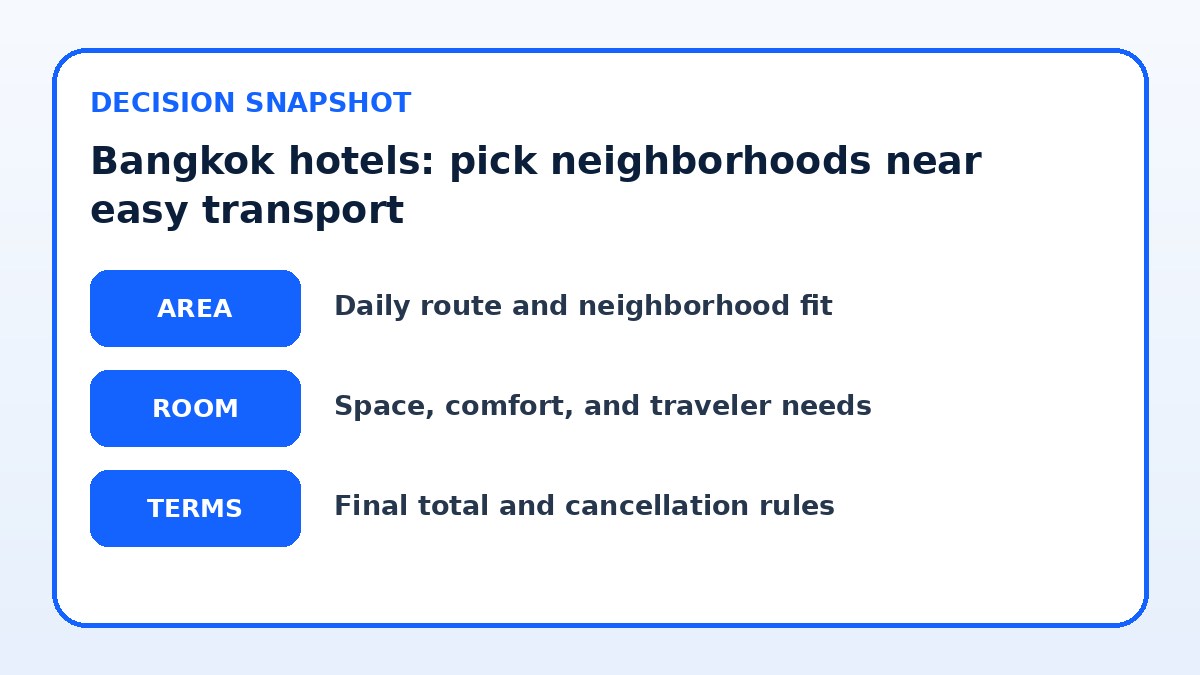
Start by choosing the area that suits how you’ll actually travel each day — BTS for malls and nightlife, MRT for museum and Chinatown access, river piers for temple-focused days, or airport-proximate zones for early flights. Narrow to two neighborhoods that minimize transfers for your planned itinerary, then open live inventory to compare rooms that suit your party and luggage needs. Before booking, verify precise station or pier names, walking routes, any shuttle details, and the hotel’s cancellation and fee terms on the provider’s final page. With area and transport fit decided first, choosing a Bangkok hotel becomes a practical, low-stress task rather than a guessing game.
Continue planning
Check current options and final conditions
Use the provider page to confirm live availability, the final total, cancellation terms, and every condition that matters to your trip.
This evergreen planning guide was created with AI-assisted drafting and a structured quality review. It does not display live prices, schedules, availability, visa guidance, or provider rankings. Verify current details before booking. Some links are affiliate links; we may earn a commission at no additional cost to you.