If you’re flying from Seoul to Hong Kong with oversized or extra bags, the single most practical choice is to pick a flight and fare that explicitly match your baggage volume, then add conservative airport time to handle check-in, security, and possible bag surcharges. Start your booking with exact travel dates, number of passengers, and each traveler’s baggage dimensions and weight so you can filter fares that include the allowance you need. When comparing itineraries, treat routing, connection length, and fare baggage rules as equally important: a cheaper fare that forces you to pay for each extra piece, or a tight connection with rechecking, often costs more time and stress than a slightly higher fare that lets you check everything once. Below you’ll find clear steps to organize your bags, choose routing that reduces transfer risk, and build a realistic airport timeline for both Incheon (ICN) and Gimpo (GMP) departures and arrivals in Hong Kong.

See live routes for your exact travel day
Compare direct and connecting choices with the same baggage and traveler details.
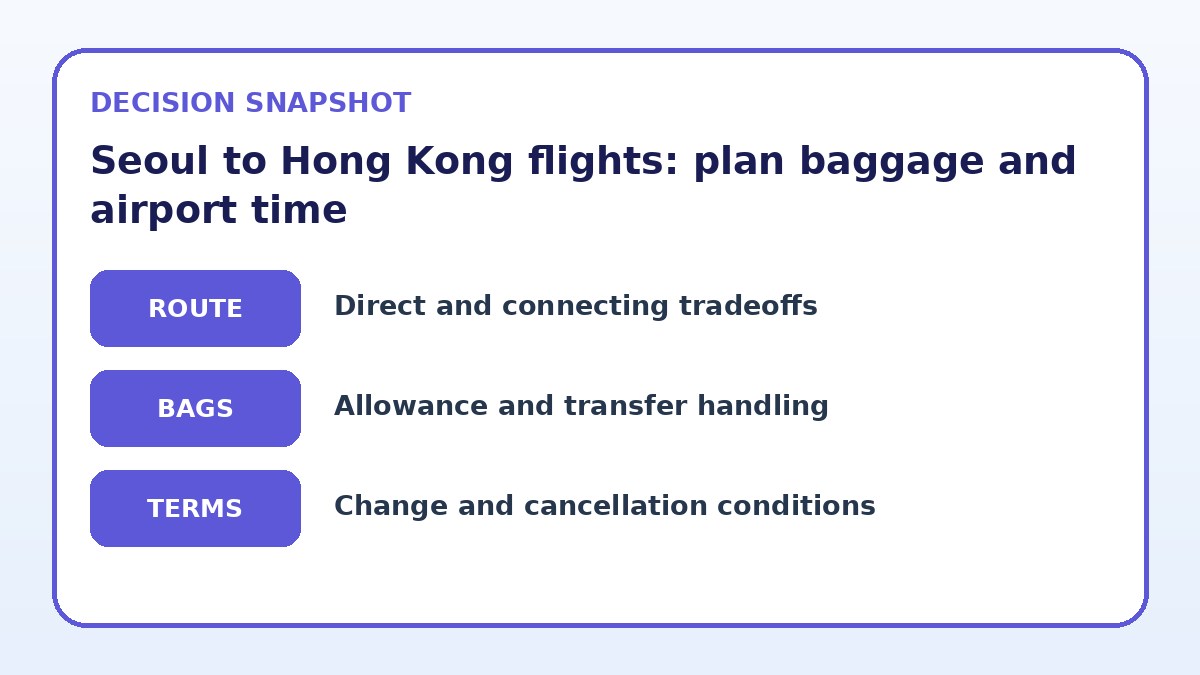
Routing: direct vs connecting with extra luggage
The routing decision matters more with excess baggage than with a light carry-on. Direct flights eliminate transfer risk: you check your luggage once and it should arrive with you, which reduces the chance of a missed connection causing delayed or lost bags. If a direct option exists on your dates, compare its baggage allowance and whether the fare class includes the size and weight you need. When direct flights are unavailable or prohibitively timed, single-carrier connections are the next best option—if the same airline handles both legs, it’s easier to have your baggage checked through to the final destination without re-tagging.
Connecting itineraries involving different carriers or low-cost regional partners increase rechecking and liability complexity. You may need to collect and re-drop bags at the transfer airport, pay separate checked-bag fees for each carrier, and report issues to multiple providers if something goes wrong. When comparing connecting routes, pay attention to minimum connection times published by the airlines and the airports involved. Factor in possible delays, immigration controls, and how long oversized-luggage or special-handling counters typically take at the transfer point when deciding whether a connection is realistically safe.
Baggage and connection risk: what to check and ask
Before booking, gather each traveler’s exact bag weights, dimensions, and quantity. Use those measurements to check the fare rules on the airline’s official booking page: does the fare include multiple pieces or only a single checked bag? Confirm maximum linear dimensions for checked items and any particular definition for oversized or overweight pieces. If your items are fragile, musical instruments, or sports gear, read the provider’s special-item policy—these often require advance notice or special booking codes. When policies are ambiguous, contact the airline’s baggage desk or customer service and save screenshots or email confirmations that specify how your items will be handled.
For connections, explicitly verify whether the airline will transfer checked baggage to the final carrier or if you must reclaim and recheck it. If the itinerary includes separate tickets, ask whether through-checking is available and under what conditions. Also check the claims process and timelines for delayed or damaged baggage; knowing the airport counters you will need to visit on arrival helps you plan time on both ends. Keep receipts for any assessed charges and photograph items before travel in case you need to document damage on arrival.
Compare flight-selection strategies
| Flight strategy | Best for | Risk to check |
|---|---|---|
| Direct flight with included higher baggage allowance | Travelers wanting minimal transfer risk and simpler baggage handling | Often fewer schedule options and potentially higher base fare compared with budget connections |
| Single-carrier connection allowing through-checked baggage | Those needing more flight times while keeping one-baggage process | Still subject to transfer delay risk; verify firm through-check guarantee on booking |
| Separate tickets to save on fare, then prepay extra pieces as needed | Flexible planners prioritizing price over seamless transfers | High recheck and missed-bag risk; baggage rules differ per carrier and must be managed |
| Low-cost carrier plus add-ons (prepaid baggage/oversize fees) | Cost-conscious travelers who can pack strategically and prebook items | Many extra fees and restrictive size/weight limits that increase complexity at the airport |
Recheck the complete itinerary
Confirm airports, connection handling, baggage, and change conditions before deciding.
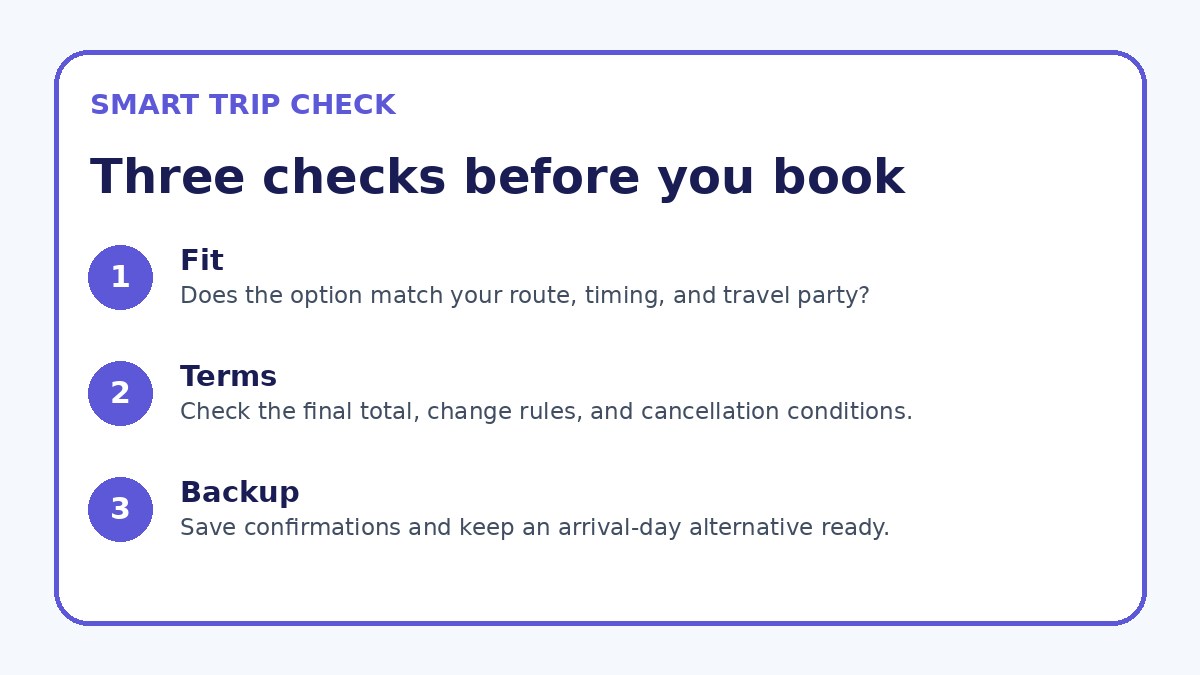
Schedule fit: building conservative airport buffers
When you have extra luggage, standard check-in recommendations aren’t enough. At departure in Seoul, add time for longer queueing at counters that handle oversized and special-item check-in. Plan for a minimum of double the usual domestic check-in buffer, and allow even more if you have fragile or complex cargo that requires special handling. If you’re leaving from Incheon (ICN) or Gimpo (GMP), check the airport’s guidance on recommended arrival time for oversized or sporting equipment—then add an additional 30–60 minutes for paperwork or inspections. Factor in travel to the airport, potential traffic, and the time needed to move multiple bags from drop-off to security checkpoints.
On arrival in Hong Kong, expect that baggage delivery can take longer when many oversized or irregular items are on the belt or routed to special handling. If you have a short onward connection or ground transfer, confirm the typical baggage wait times with your airline and leave a generous margin before any public transport or ferry departures. If you must switch airports or providers in Hong Kong, treat the transfer as a separate journey and include customs clearance time for checked items that require inspection. Conservatively planning arrival and departure buffers is often the cheapest insurance against missed connections and stress.
Flight details to verify
- Measure and weigh every checked item; record dimensions and weight in a note or photo before booking.
- Confirm included allowance, oversize and overweight limits on the final airline booking page and save screenshots.
- Decide whether to prepay extra pieces online and compare that cost against expected airport surcharge.
- If connecting, verify through-check rules and minimum connection time with the operating carrier(s) in writing.
- Label every bag externally and internally, remove prohibited items, and keep valuables and documents in carry-on.
- Plan door-to-door timing with at least double the usual check-in buffer and allow extra arrival time in Hong Kong for bag collection.
Fare conditions and what to verify before booking
Read fare rules thoroughly before purchasing. Look for explicit language about included checked pieces, overweight and oversized fees, and liabilities for items not explicitly allowed. Verify whether upgrades to higher fare classes or bundled packages include larger allowances, and whether those changes are available only during booking or can be added later at the same rate. If you plan to prepay extra pieces online, confirm whether the fee is cheaper during booking than at the airport; some airlines offer discounted pre-purchase pricing, but this varies and must be checked on the airline’s final booking page.
Also confirm change and cancellation conditions in case your travel dates or passenger details shift. If your itinerary involves multiple tickets, check each ticket’s baggage policy separately and verify whether the carriers have interline or through-check agreements that cover lost or delayed luggage. Before you finalize any purchase, use the airline’s baggage calculator (when provided) or contact customer service to confirm the exact baggage entitlements tied to the chosen fare. Save or screenshot all confirmation pages that show allowance, fees, and any prebooked baggage extras.
Flight Guide questions travelers ask
How much extra time should I allow at Seoul airports when traveling with oversized luggage?
Allow substantially more time than standard recommendations. For oversized or multiple checked items, plan for a longer check-in queue, additional screening, and possible paperwork. That typically means arriving at least two to three hours before international departure, and adding further time if you need oversized-item counters or manual inspections. Also factor in travel time to the airport for moving heavy bags; if you’re using airport express lines, baggage storage, or special assistance services, call ahead to confirm processing time and slot availability so you can adjust your arrival time accordingly.
Can I avoid rechecking bags on a connecting itinerary from Seoul to Hong Kong?
You can often avoid rechecking if both flight legs are on the same ticket and the carriers have an interline agreement that allows through-checking to the final destination. To be certain, verify on the airline’s booking page or with customer service that the ticket will be issued as a through-checked itinerary. If your connection involves separate tickets or different alliances, assume you will need to reclaim and recheck bags. Always request a baggage-through tag at check-in and keep any supporting confirmation that shows the final-destination tag for each checked item.
What documentation or preparations help if an oversized bag is delayed or damaged?
Photograph each bag and its contents before travel, and keep purchase receipts for valuable items packed inside. Retain boarding passes, baggage receipts, and any tags issued at check-in. If you notice damage or delay on arrival, report it immediately at the airline’s baggage service desk and obtain a written irregularity report; photograph the damage and save all communication. Check the airline’s stated timeline and procedures for filing claims, and verify whether any insurance (personal travel insurance or credit-card coverage) applies to delayed, damaged, or missing baggage before you depart.
Final decision note
When traveling from Seoul to Hong Kong with extra luggage, the practical path is simple: match your baggage needs to the fare and routing that minimize handling and rechecks, then build conservative time buffers at both ends. Direct flights or single-carrier connections reduce transfer complications; if you must use separate tickets or low-cost carriers, expect more hands-on management and allow extra time. Before booking, confirm exact baggage dimensions and the airline’s allowance on the final booking page, prepay extras if it proves cheaper, and document the arrangements. Taking these steps reduces surprises and makes your journey smoother even with oversized or multiple bags.
Continue planning
Check current options and final conditions
Use the provider page to confirm live availability, the final total, cancellation terms, and every condition that matters to your trip.
This evergreen planning guide was created with AI-assisted drafting and a structured quality review. It does not display live prices, schedules, availability, visa guidance, or provider rankings. Verify current details before booking. Some links are affiliate links; we may earn a commission at no additional cost to you.