If you’re traveling solo to Tokyo and want better weather, thinner crowds, and more flexible prices, plan around the shoulder seasons—late March–early April and late October–early November are the typical windows. The practical action: compare identical dates, the same number of travelers, and identical inclusions before deciding whether a bundled package or independent bookings actually save you time or money. Focus first on what’s included (baggage, transfers, rail passes, refundable fares), how easy it is to change or cancel, and whether a package’s single-contact support matters enough for you to pay for it. When checking final terms, read the supplier’s cancellation and change rules, baggage rules and whether seat selection or JR Pass–style rail benefits are covered. Use one comparison search page like Trip.com only to see current availability, then verify final policy details on each provider’s booking page before committing.
Test package value fairly
| Booking approach | Best for | Tradeoff to check |
|---|---|---|
| All-in-one package (flight + hotel + activities) | Travelers who want one-stop booking and single-provider support | May lock in stricter change rules and hide per-item exclusions that matter to solo travelers |
| Flight + hotel bundle from a major OTA | Shoppers seeking simplified checkout with some configurability | Bundles can use nonrefundable fare classes or assume double occupancy; compare the same dates and room type before trusting savings |
| Book flights, hotel, and rail separately | Travelers prioritizing flexibility, solo-room rates, and precise inclusions | Requires more time to compare multiple suppliers and manage separate cancellation rules |
| Independent bookings + a la carte local tours | Solo travelers who want maximum control and can research local operators | May lose convenience of a single point of contact; verify operator pickup details and minimum-participant policies |
Check current package and separate options
Use identical dates, travelers, room needs, baggage, and flexibility so the comparison stays meaningful.
What to compare before judging a Tokyo package
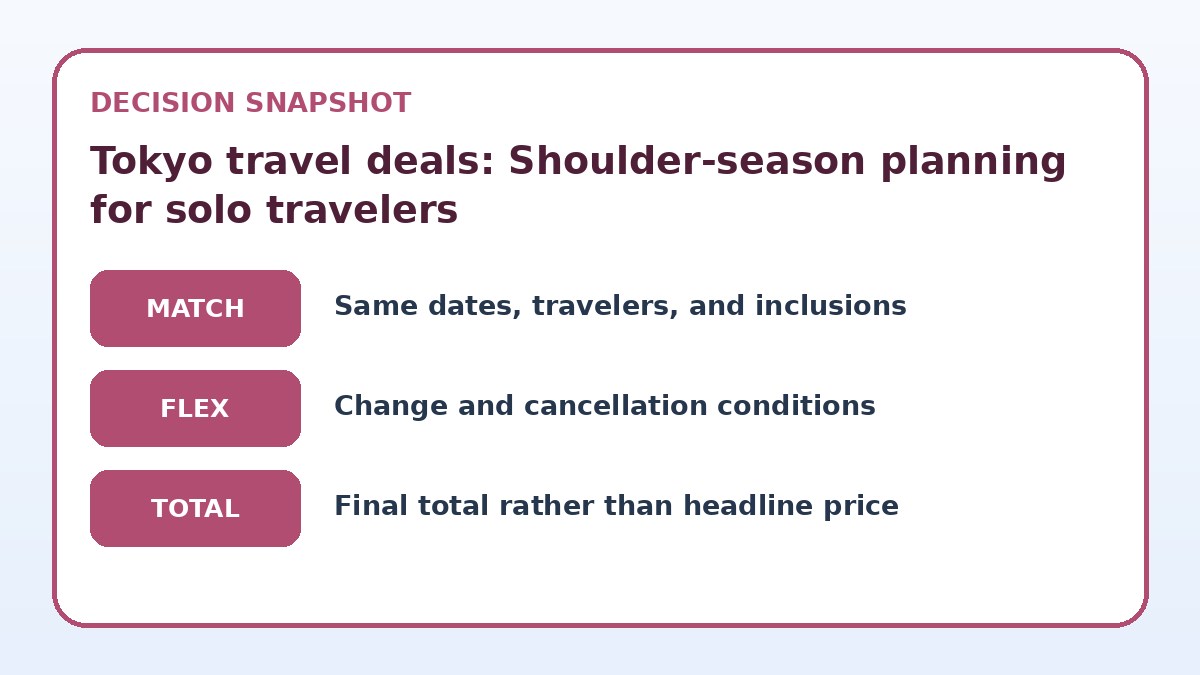
Start by lining up apples-to-apples comparisons: same arrival and departure dates, identical traveler count (one), the same number of nights, and equal room types. Check whether baggage, seat selection, airport transfers, and any rail passes are part of the package, or listed as optional add-ons. If a package advertises guided day trips, confirm the group size and meeting point; a cheap tour that requires a separate subway ticket or long walk can cost time and money. Don’t accept vague language—look for specific product names, ticket classes, and whether domestic trains are reserved seats or general admission.
Next, look at change and cancellation policies for each line item. Bundles sometimes lock nonrefundable fares to keep costs down, while separately booked refundable tickets or flexible hotel rates can reduce risk for a solo traveler. If you value a single supplier to call when something goes wrong, weigh how responsive that package provider’s customer service is versus handling changes directly with airlines, rail companies, and hotels. Finally, verify any cross-supplier connections: if your package combines an international carrier and a local rail segment, check transfer windows and whether missed connections are covered.
Inclusions and what they actually mean for solo travelers
Inclusions can look generous until you unpack them. A package might include a rail pass, but only cover certain lines or exclude seat reservations that require extra fees. Hotels listed as “central” can still be far from the stations you’ll use daily; map the hotel to the neighborhoods you plan to visit. For single travelers, pay attention to single-occupancy pricing. Some hotels add a single-supplement or limit rooms marketed to solo guests; other offers calculate the price per person assuming double occupancy, which won’t apply.
Also check what’s excluded: city taxes, resort fees, luggage forwarding, and attraction reservation fees commonly show up at checkout. If an itinerary lists guided experiences, confirm pickup details and whether those meetups are suitable for solo participants. When a package advertises “meals included,” check which meals and whether special diets are supported. For rail-based inclusions, get the exact pass name, validity dates, and whether it requires activation at a staffed counter—details that affect both cost and convenience.
Look past the headline total
Compare inclusions and change conditions before deciding whether a package is genuinely useful for this trip.
Deal comparison checklist
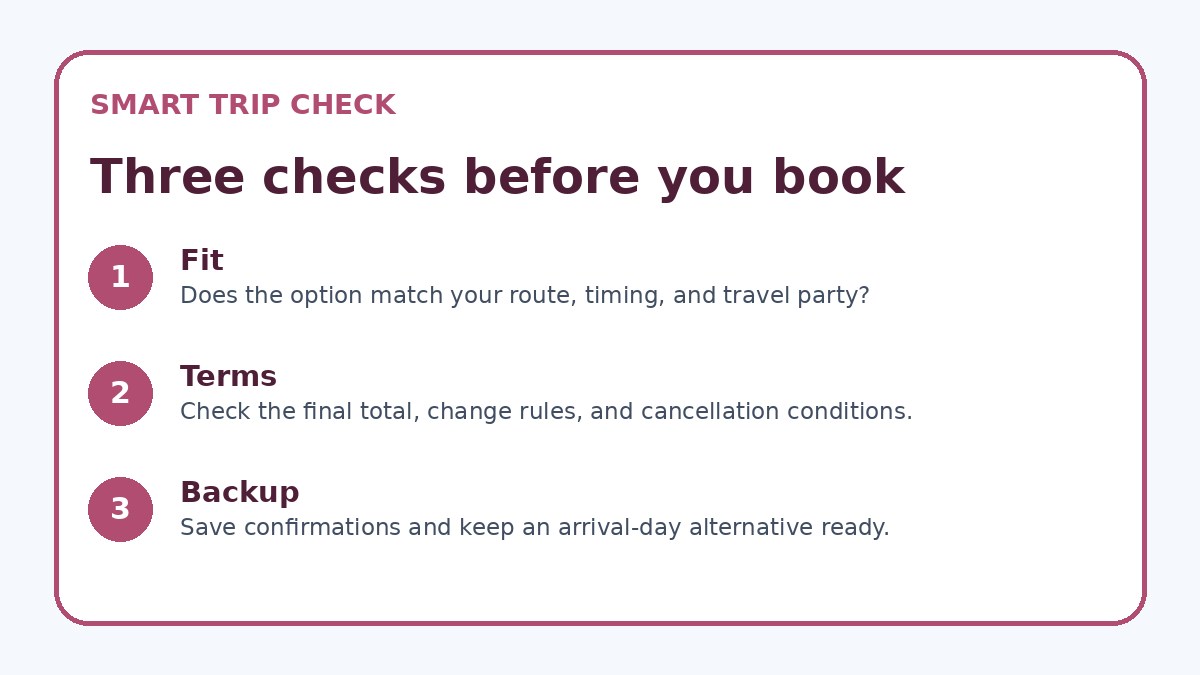
- Line up identical travel dates, single-traveler count, and room type to compare bundle vs separate offers accurately.
- Extract and list each inclusion (baggage, transfers, rail passes, meals) and confirm which are optional add-ons.
- Check change and cancellation policies for each component; note who is responsible for rebooking missed internal connections.
- Map the hotel location against your planned daily routes and nearest major stations before accepting “central” descriptions.
- Confirm whether guided activities require minimum participants, have fixed meeting points, or need advance reservations.
- Verify final baggage rules, seat selection availability, and any local taxes or resort fees on the provider’s final booking page.
Flexibility: change fees, cancellations and last-minute pivots
Solo travel often benefits from flexibility: one altered train reservation or an extra day to explore a neighborhood can change trip value more than a small price difference. When comparing deals, itemize change fees for flights, trains and hotels. Some bundled offers bundle nonrefundable charters or basic economy fares that are cheaper only if you’re sure of dates. Assess whether the package allows individual components to be changed independently or forces a full-package amendment with higher fees. If illness or an unexpected event is a real possibility, consider the value of refundable fare options even if they cost more upfront.
Look for providers that clearly state how refunds are handled across partners. If the package combines an airline and a local operator, read who is responsible for rebooking missed internal connections. Don’t assume “customer support” equals fast rebooking—confirm phone hours, languages supported, and whether changes can be made online. Finally, consider travel insurance that covers nonrefundable items; check provider policies to ensure the insurance product specifically covers the kinds of cancellation or interruption risks you worry about.
Traveler-specific value: solo advantages and bundle downsides
Some packages are great for solo travelers because they handle logistics you’d otherwise manage alone: transfers, local SIM cards, or guided orientation walks that help you get confident with Tokyo’s transit. If you’re new to Japan or want a safety net, paying a modest premium for a single point of contact can beat the time and friction of separate bookings. Evaluate whether included extras—like a meet-and-greet at the airport or a pocket Wi‑Fi—actually add convenience for you, and not just cost.
On the other hand, bundles can hide costs unfavorable to solo travelers: many group tours price per person assuming multiple travelers for shared rooms or group discounts on activities that require minimum participants. Also check whether the itinerary’s pace suits solo exploration; fast-paced group day tours can reduce the unstructured wandering that many solo travelers prize. If you prefer flexibility, booking flights and hotels separately while reserving a few guided experiences à la carte often offers the best balance of control and convenience.
Travel Deals & Booking Strategy questions travelers ask
Should I choose a package or book everything separately for a solo trip to Tokyo?
If you value a single contact for problems and want help with arrival logistics, a package can be useful—but only after you confirm the exact inclusions and change rules. Booking separately usually gives more flexible fare and room options, especially for single-occupancy pricing and refundable fares. Compare the same dates, nights and inclusions when deciding. If language or first-time logistics worry you, weigh that comfort against potential cancellation penalties; the right decision depends on how likely your plans are to change.
How do I avoid false savings when evaluating Tokyo travel deals?
Always compare like for like: same travel dates, single traveler, identical room type and identical inclusions. Watch for assumed double-occupancy pricing, excluded local taxes, or nonrefundable fare classes that reduce upfront prices but add risk. Check whether seat reservations, rail-pass activations, and airport transfers are included or require extra payments. Use an OTA such as Trip.com to view availability, but verify final cancellation rules, baggage limits, and other terms on each provider’s booking page before trusting any advertised deal.
Are shoulder seasons actually better for solo travelers in Tokyo?
Shoulder seasons offer a useful balance of milder weather and fewer crowds compared with peak times, which can make moving between neighborhoods and booking single rooms easier. However, some attractions and festivals cluster in shoulder months, so verify attraction opening times and reservation requirements. In shoulder seasons pricing may be more varied—this increases the value of comparing flexible fares and refundable hotel options. Ultimately, the shoulder-season advantage is personal: if you prefer quieter transit and more optional availability, it can be worth the planning tradeoffs.
Final decision note
For solo travelers considering Tokyo travel deals, the decisive step is an apples-to-apples comparison. Line up identical dates, a single traveler, the same room type, and a full accounting of inclusions before you judge whether a bundled package or separate bookings save time or money. Pay special attention to change and cancellation rules, single-occupancy pricing, and whether included rail or transfer items truly match your itinerary. If you value a single point of contact for peace of mind, a package can be helpful—provided you verify final terms on the provider’s booking page. Use OTA search pages like Trip.com to check availability, but always confirm policies with each supplier before committing.
Continue planning
Check current options and final conditions
Use the provider page to confirm live availability, the final total, cancellation terms, and every condition that matters to your trip.
This evergreen planning guide was created with AI-assisted drafting and a structured quality review. It does not display live prices, schedules, availability, visa guidance, or provider rankings. Verify current details before booking. Some links are affiliate links; we may earn a commission at no additional cost to you.