If you’re traveling from Seoul to Taipei with more than standard carry-on or checked baggage, your two immediate decisions are routing and how much extra airport time to build into your itinerary. Practically, that means comparing direct versus connecting flights, checking airline baggage policies and fees, and deciding whether to buy additional baggage allowance or ship items in advance. For many travelers the simplest win is a direct flight where available, because it minimizes handling and transfer risk, but direct may cost more or have limited schedules. Connecting itineraries can save money and open more departure times, yet they introduce risks: missed connections, longer minimum connection times, and rechecking baggage at transfer airports. This guide gives the on-the-ground checklist and decision criteria you need before you check live fares: prepare exact travel dates, passenger ages, itinerary flexibility, and realistic baggage weights and dimensions.
See live routes for your exact travel day
Compare direct and connecting choices with the same baggage and traveler details.
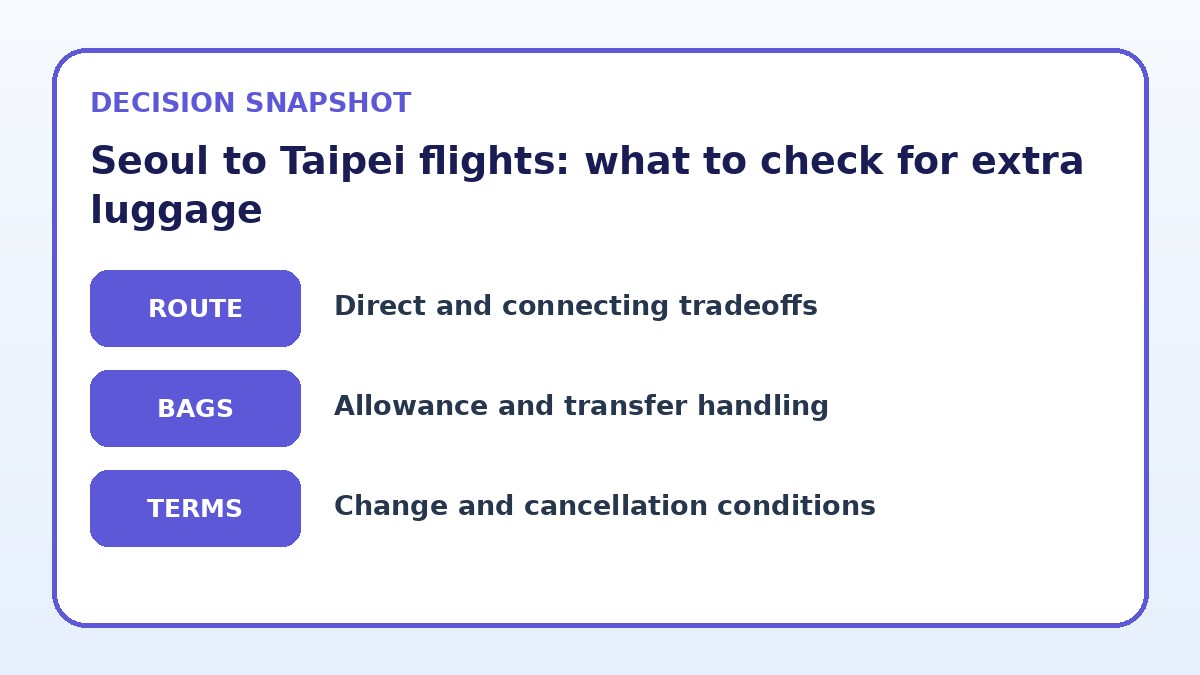
Routing: direct vs connecting choices
The core routing decision shapes every other step. A nonstop flight between Seoul and Taipei simplifies logistics: one check-in, one security screening, and your luggage stays on the same aircraft until arrival. When direct flights are available at times that fit your schedule and budget, they remove the need to manage a transfer and reduce the number of times your baggage is handled. For travelers with bulky or fragile items, a direct option is often the lowest-risk choice even if the fare is higher or the departure time is less convenient.
Connecting routes can open more affordable or better-timed itineraries, but they require specific checks before you book. Confirm whether the airline lists your entire route on a single ticket and whether baggage is checked through to Taipei or must be claimed and rechecked at the connection airport. Also verify minimum connection times for the airports involved and remember that connections at smaller or crowded hubs can be slower. If you must connect, build a buffer for immigration, customs, and potential delays—especially when traveling with extra luggage.
Baggage and connection risk: what to verify
Before you finalize any booking, gather your exact baggage details: number of pieces, weights, dimensions, and any special-case items (sports gear, musical instruments, oversized boxes). Use those details to check the airline’s checked-bag rules for the specific fare class you’re considering. Look for per-piece limits, combined weight restrictions, and size rules—airlines differ. If you have oversized or heavy items, check special handling procedures and whether the carrier allows them in the cargo hold or requires advance notification. On multi-airline itineraries, determine which carrier’s baggage rules apply and whether interline agreements cover extra pieces.
Connection risk comes from both time and process. Even when bags are checked through, transfer handling increases the chance of damage or misrouting—particularly if the connection is short or during peak hours. If your itinerary requires passing through immigration and customs at a transit point, you may need to collect and recheck luggage, which adds both time and the physical task of moving heavy bags between terminals. For high-value or fragile items, consider shipping them ahead or paying for priority handling if available; otherwise, allow generous transfer time and pack essentials in your carry-on.
Compare flight-selection strategies
| Flight strategy | Best for | Risk to check |
|---|---|---|
| Book the direct nonstop flight | Travelers prioritizing minimal handling and fastest door-to-door time | Usually higher fare and possibly fewer schedule options |
| Choose a single-ticket connection on one carrier | Those wanting lower fare while keeping baggage checked through | Still exposes bags to extra handling and requires careful minimum connection time |
| Mix-and-match separate tickets to save money | Price-sensitive travelers willing to manage baggage and risks themselves | You must collect and recheck bags and accept no interline protection for missed connections |
| Pay for extra allowance or ship items separately | Travelers with oversized, heavy, or valuable items needing secure transit | Added cost and lead time for shipping or special handling arrangements |
Recheck the complete itinerary
Confirm airports, connection handling, baggage, and change conditions before deciding.
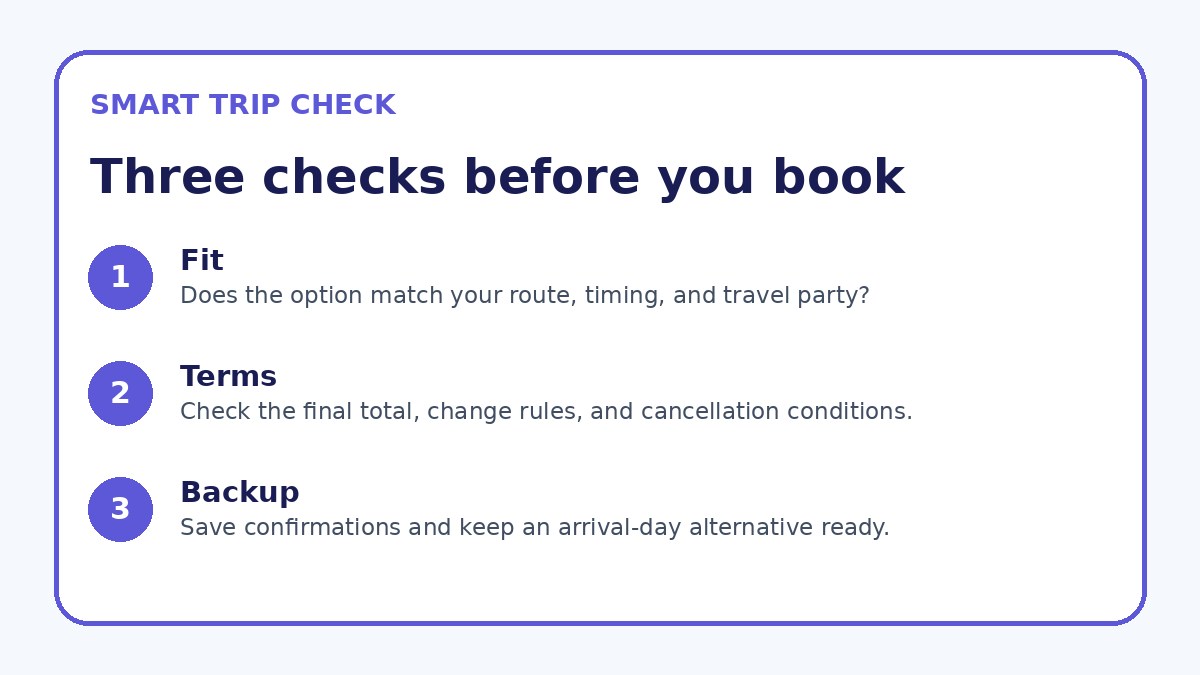
Schedule fit: airport arrival, check-in and buffers
Work backward from your first flight’s departure time to plan airport arrival. When you have extra or oversized baggage, add at least 30–60 minutes to a standard recommended arrival window to handle slower check-in, oversized-item drop-off, or extra document checks. If you need to present permits, receipts, or packing lists for specific items, arrive earlier. Also think about peak periods: early morning and evening waves can lengthen lines and conveyor wait times. If you’re using a baggage drop-off service at a cargo office instead of standard check-in, verify its opening hours and transit time requirements.
For connections, pick itineraries with realistic layovers considering terminal changes, transfer bus schedules, and potential customs inspections. Avoid back-to-back tight connections—especially those under 90 minutes—when traveling with heavy or numerous bags. If the flight times are flexible, choose routes that leave a comfortable morning or afternoon slot for departures; arriving a day before important appointments in Taipei reduces stress if bags are delayed. Finally, have a backup plan: know the carrier’s policy for delayed luggage and the local procedures for filing a report at Taoyuan or Taipei Songshan if needed.
Flight details to verify
- Weigh and measure every bag and record dimensions and weight before visiting an airline or booking page.
- Prepare exact travel dates, passenger full names, and passport details to verify fare and baggage rules on booking pages.
- Check whether your chosen itinerary issues a single ticket covering all segments or requires separate tickets.
- Confirm on the airline’s final booking page the included baggage allowance, per-piece and overweight fees for your fare class.
- Plan airport arrival with extra time for oversized-baggage processing, and verify oversized drop-off office hours if needed.
- List contents and photograph high-value or fragile items; keep a copy of receipts to simplify any lost-or-damaged baggage claims.
Fare conditions and booking details to check
When comparing fares, always read the baggage allowance embedded in the specific fare class—not just the headline price. Low-cost economy fares may exclude checked items or restrict the weight per piece; full-service fares can include one or more checked bags. Look at change and refund rules too: if you need to change dates, a more flexible fare could avoid paying steep change fees plus additional baggage charges on a new ticket. Where possible, price the ticket both with and without pre-purchased additional baggage so you know the total out-the-door cost.
On multi-carrier itineraries, confirm which carrier issues the ticket and which rules govern baggage; sometimes interline connections force you to follow the rules of the first or operating carrier. Before final payment, verify what the airline’s final booking page states about baggage fees, maximum piece size, and overweight surcharges. If you’re comparing platforms for availability, Trip.com can be used as one place to check current options and confirm baggage conditions, but always cross-check on the airline’s official booking page to verify final allowances and any necessary documentation.
Flight Guide questions travelers ask
How much extra time should I allow at Seoul airport when traveling with oversized or many bags?
Allow at least 30–60 additional minutes beyond the airline’s standard recommendation when you have extra or oversized bags. This accounts for slower check-in counters, oversized-item drop-off procedures, and potential measurements and weigh-ins. If you need to use a cargo office or special handling counter, confirm its opening time in advance and add more margin around its operating hours. Also factor in peak traffic to the airport and time to move heavy bags from curbside to the check-in desk.
If I book a connecting itinerary, how can I ensure my luggage will be checked through to Taipei?
Verify at booking whether the itinerary is issued on one ticket and whether the carriers involved have an interline agreement for checked baggage. The airline’s final booking page or customer service can confirm if bags are tagged to the final destination. If the itinerary involves an overnight stop, a change of airports, or entry through immigration at the connection, you may need to claim and recheck luggage. Always ask the check-in agent at your origin to confirm the routing on your bag tags.
Should I buy extra baggage allowance online in advance or pay at the airport?
Buying extra allowance online in advance is usually more predictable and can be cheaper than paying at the airport, though exact economics vary by carrier and fare. Purchasing early also avoids the uncertainty and stress of last-minute reweighing and repacking. Before you buy, check the airline’s online baggage purchase options and confirm the maximum weight per piece and any dimensional limits. If your plans might change, weigh the value of a refundable or changeable fare that includes higher allowance.
Final decision note
For Seoul to Taipei flights with extra luggage, the most practical first choice is whether to prioritize a nonstop routing to reduce handling or to accept a connecting itinerary for cost or schedule reasons. Gather exact dates, passenger details, and precise baggage measurements before you start live fare checks. Compare the total landed cost of each option: base fare plus purchased allowances, overweight or oversize surcharges, and the value of schedule flexibility. Always confirm baggage rules and transfer procedures on the airline’s final booking page, and prepare contingency plans—photographs, receipts, and an essentials carry-on—so you can keep your trip moving smoothly even if a bag is delayed.
Continue planning
Check current options and final conditions
Use the provider page to confirm live availability, the final total, cancellation terms, and every condition that matters to your trip.
This evergreen planning guide was created with AI-assisted drafting and a structured quality review. It does not display live prices, schedules, availability, visa guidance, or provider rankings. Verify current details before booking. Some links are affiliate links; we may earn a commission at no additional cost to you.