If you need to travel between Sydney and Melbourne for work, the practical choice is rarely just the cheapest or the most convenient airport. Business travel demands balancing schedule flexibility—late changes, same-day returns, or shifting meetings—with convenience like minimal transfers, predictable baggage handling, and easy airport access. Start by clarifying fixed constraints: meeting times, the latest return you can accept, and whether you need carry-on only or checked luggage. That determines if you should prioritize flexible fare classes or direct routings and short transits. This article leads with that core tradeoff, then walks through routing, baggage and connection risk, schedule fit, and fare conditions so you can compare options efficiently and make a well-informed booking decision.
See live routes for your exact travel day
Compare direct and connecting choices with the same baggage and traveler details.
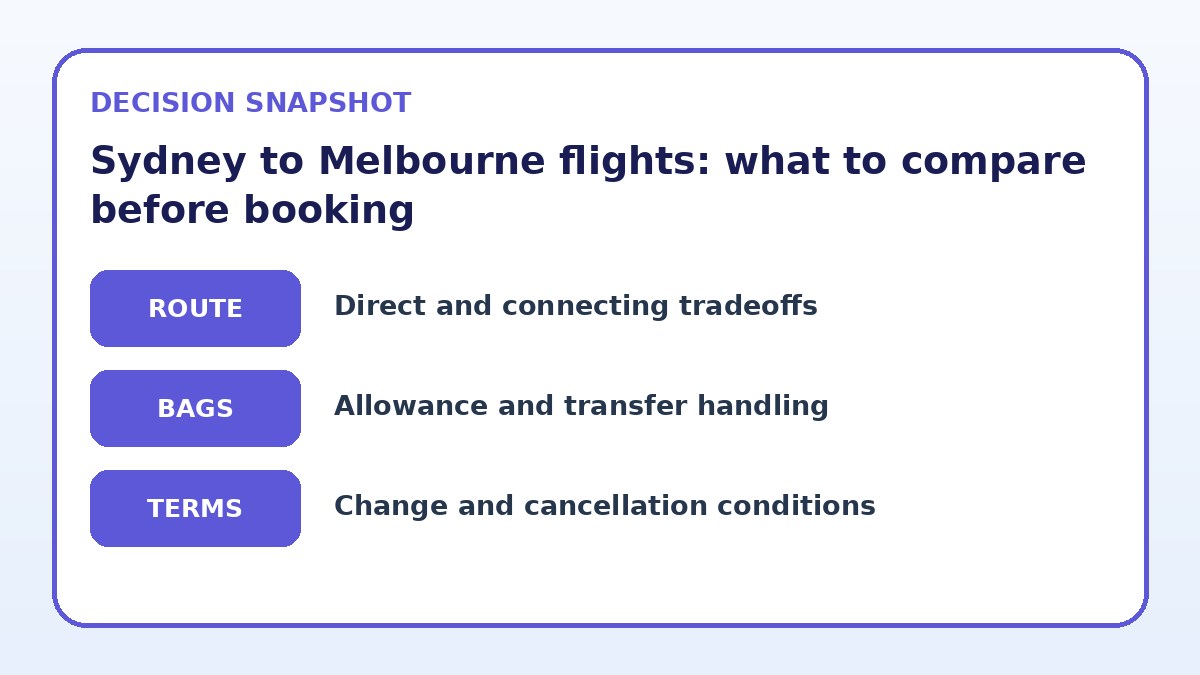
Routing: direct versus connecting options
When evaluating Sydney to Melbourne flights, treat routing as the primary convenience variable. Direct flights eliminate the stress of changing planes and usually shorten total door-to-door time, which is valuable if you have back-to-back meetings. But direct services may operate at busy times, fill up on corporate demand, or have fewer flexible fare options. Connecting itineraries can sometimes save money or open late-night/early-morning alternatives, but they introduce transfer points that add uncertainty and can complicate baggage handling.
Compare direct and connecting options on the booking page rather than assuming one is always better. Check total elapsed travel time and minimum connection times for each itinerary, and note which carrier is responsible for each segment. If the connection is on the same ticket, baggage is often through-checked; if not, you’ll have to collect and re-check baggage, which increases delay risk. For business trips where time and reliability matter, prioritize routing that minimizes transfers and gives you a consistent itinerary under one carrier when possible.
Baggage and connection risk
Business travelers often underestimate baggage handling risk when switching flights or airlines. If you travel with only a carry-on, the chance of baggage disruption falls dramatically. With checked bags, prioritize single-ticket itineraries or fare bundles that explicitly include checked baggage. On multi-operator itineraries, verify on the final provider booking page whether baggage will be checked through or must be claimed and rechecked during a connection. If the booking page doesn’t clarify, call the carrier or your corporate travel desk to confirm.
Connections add exposure to delays that can affect meeting attendance and return schedules. If you must accept a connection, build healthy buffer time between segments—long enough to handle delays, security re-screening, and terminal transfers in your airline’s minimum connection guidance. Factor ground transfers to and from the airport into your plans; an overnight city-center hotel might be cheaper than risking a missed meeting due to transit delays. Finally, consider travel insurance or corporate ticket protections if you often book at the last minute or face frequent schedule changes.
Compare flight-selection strategies
| Flight strategy | Best for | Risk to check |
|---|---|---|
| Direct flight with flexible fare | Travelers prioritizing schedule certainty and easy connections to meetings | Higher fare cost but lower disruption risk and simpler baggage handling |
| Direct flight with basic restrictive fare | Cost-sensitive travelers with fixed, low-risk itineraries | Lower upfront price but limited or costly change options if plans shift |
| Connecting itinerary on one ticket | Those seeking cheaper or less-timed departures while keeping baggage checked-through | Longer travel time and added connection risk, but better baggage protection than separate tickets |
| Separate tickets for segments | Flexible routing to access non-standard times or carriers at lower cost | Higher risk of missed connections and need to recheck baggage; requires more buffer time |
Recheck the complete itinerary
Confirm airports, connection handling, baggage, and change conditions before deciding.
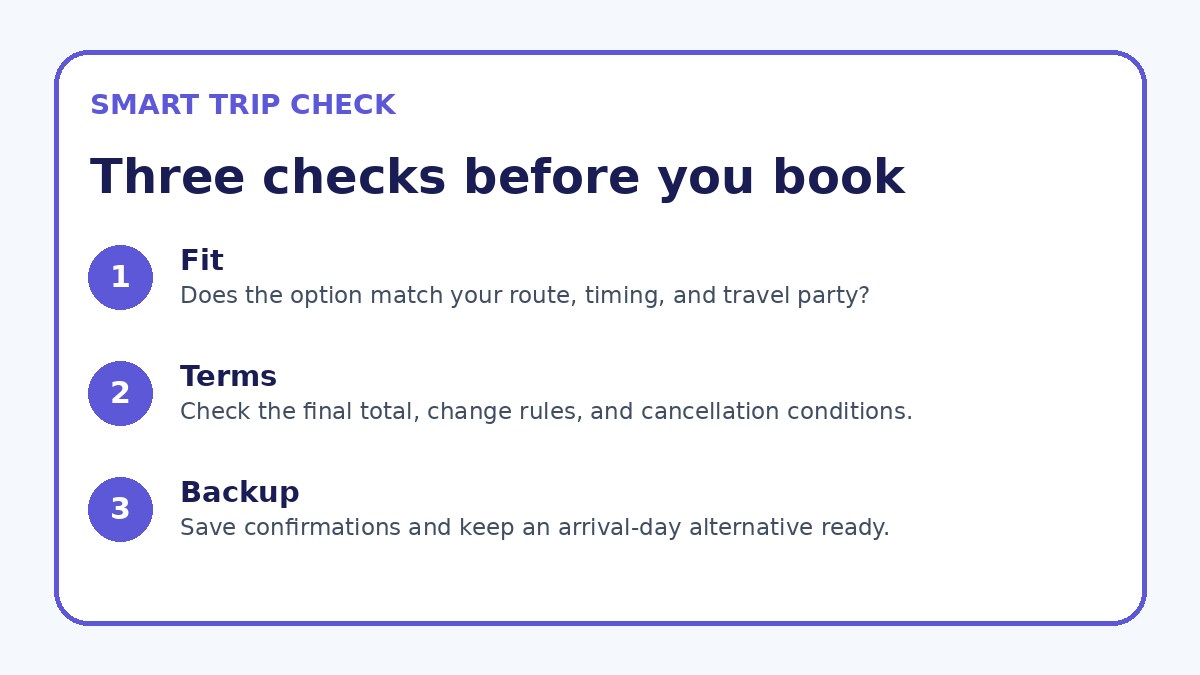
Schedule fit: timing, turnaround, and airport access
Schedule fit goes beyond flight times—think about airport access, local traffic at peak hours, and how soon you must be at your destination after landing. If an important meeting starts early, book arrivals that give you at least an hour to clear arrivals, reach your downtown meeting location, and handle any last-minute needs. For same-day return trips, prefer late-afternoon or evening departures that match likely meeting end times, but balance that against the risk of cumulative delays throughout the day.
Also weigh ground-side convenience: which terminal is closest to your usual transport options, and where will taxis or ride-shares pick up? Confirm typical peak traffic windows between the airport and your meeting locations, and allow extra margin if your schedule is inflexible. Business travelers should choose flights whose airport terminals and departure times minimize unpredictable elements, even if it means paying a bit more for a higher fare class that guarantees a specific seat and simpler logistics.
Flight details to verify
- Confirm exact travel dates, full traveler names as on ID, loyalty program numbers, and any corporate discount codes before searching fares.
- Decide whether you need carry-on only or checked baggage and verify baggage rules on the provider’s final booking page.
- Compare total door-to-door times including airport transfers and expected city traffic for both origin and destination.
- Check the fare rules for change fees, refundability, and same-day rebooking options; document the exact wording or screenshot the booking page.
- If choosing a connection, ensure minimum connection time is comfortable and verify whether baggage is through-checked on a single ticket.
- If the trip is high-risk or high-value, confirm protections with your corporate travel manager or buy refundable/flexible fare coverage.
Fare conditions: changeability, cancellations, and corporate rules
Fare conditions determine how easily you can adapt plans. Flexible fares allow changes with lower or no fees and may include refundable options, while basic or restricted economy fares often have heavy change penalties or no changes allowed. Corporate travel policies sometimes mandate purchase of certain fare types or require using preferred booking channels. Before you book, read the fare rules on the provider’s final booking page—look for exact wording about change fees, refundability, date-change windows, and whether a fare difference applies.
Don’t rely on summary labels alone. Verify baggage allowances, seat selection rules, and whether reissue or rebooking requires calling a reservations line. If using loyalty points, check the rules for award changes and cancellations. When in doubt, contact the airline or your corporate travel manager to confirm that the fare supports the level of flexibility you need. Trip.com can be used to compare current availability and conditions, but always confirm critical terms on the carrier’s official booking page before finalizing.
Flight Guide questions travelers ask
Should I always choose a direct flight between Sydney and Melbourne for business travel?
Not always. Direct flights reduce the chance of missed connections and simplify baggage handling, which is valuable when time is tight. But if your meeting schedule is outside main direct-service windows, a connecting option might offer better timing or a lower fare while still being practical. Evaluate total door-to-door time, airport transfer impact, and whether the direct option offers the fare flexibility you need. When comparing, verify on the booking page which itineraries are single-ticket and whether baggage is through-checked if you value reliability.
How much buffer should I build for connections and airport transfers?
Build a buffer that reflects your tolerance for risk and the value of the meeting. For same-airport connections, allow at least the carrier’s minimum connection time plus extra margin—often 45–90 minutes depending on terminals and whether security re-screening is needed. For transfers between city and airport, add typical peak-hour traffic time and a safety margin. If missing the outbound or return flight would be costly, increase the buffer significantly or choose a direct flexible fare. Always confirm transfer times and terminal layouts on the provider’s booking page or airport information resources.
How do I verify baggage handling and fare change rules before finalizing a booking?
On the final booking page, read the fare rules section carefully: it should list included baggage allowances, change and cancellation policies, and any fees. If the booking involves multiple carriers, confirm which carrier issues the ticket and who handles baggage—this is typically shown in the itinerary details. If the online information is ambiguous, call the airline or your corporate travel desk for written confirmation. Keep a screenshot or PDF of the fare conditions and baggage rules in case you need them later.
Final decision note
Choosing between schedule flexibility and convenience on Sydney to Melbourne flights means trading off control against simplicity. If your meetings are time-sensitive and cannot shift, favor direct flights with flexible fares and allow practical buffers for ground transfers. If you can tolerate more schedule risk to save on costs, consider connecting options but protect yourself with single-ticket itineraries and clear baggage policies. Always gather exact dates, traveler details, and corporate codes before searching, then verify fare rules and baggage handling on the carrier’s final booking page. That disciplined approach reduces last-minute surprises and keeps your business trip on schedule.
Continue planning
Check current options and final conditions
Use the provider page to confirm live availability, the final total, cancellation terms, and every condition that matters to your trip.
This evergreen planning guide was created with AI-assisted drafting and a structured quality review. It does not display live prices, schedules, availability, visa guidance, or provider rankings. Verify current details before booking. Some links are affiliate links; we may earn a commission at no additional cost to you.