Practical answer up front: if you’re traveling from Singapore to Bangkok on business, decide first whether you can travel carry-on only or need checked luggage, then choose a flight time that matches your meeting schedule with at least 90–120 minutes buffer at each airport for non-peak days and 120–180 minutes during busy periods. That tradeoff—light, quick airport processing versus having everything you need in checked bags—drives routing, fare class, and connection choices. Before you search live fares, have exact travel dates, passport details, membership numbers, and a realistic list of what you must bring. Use those details to compare baggage allowances, change fees, and minimum connection times on the airline or booking page you plan to use. If you use Trip.com to compare options, verify final baggage and schedule rules on the carrier’s official booking page before confirming.
See live routes for your exact travel day
Compare direct and connecting choices with the same baggage and traveler details.
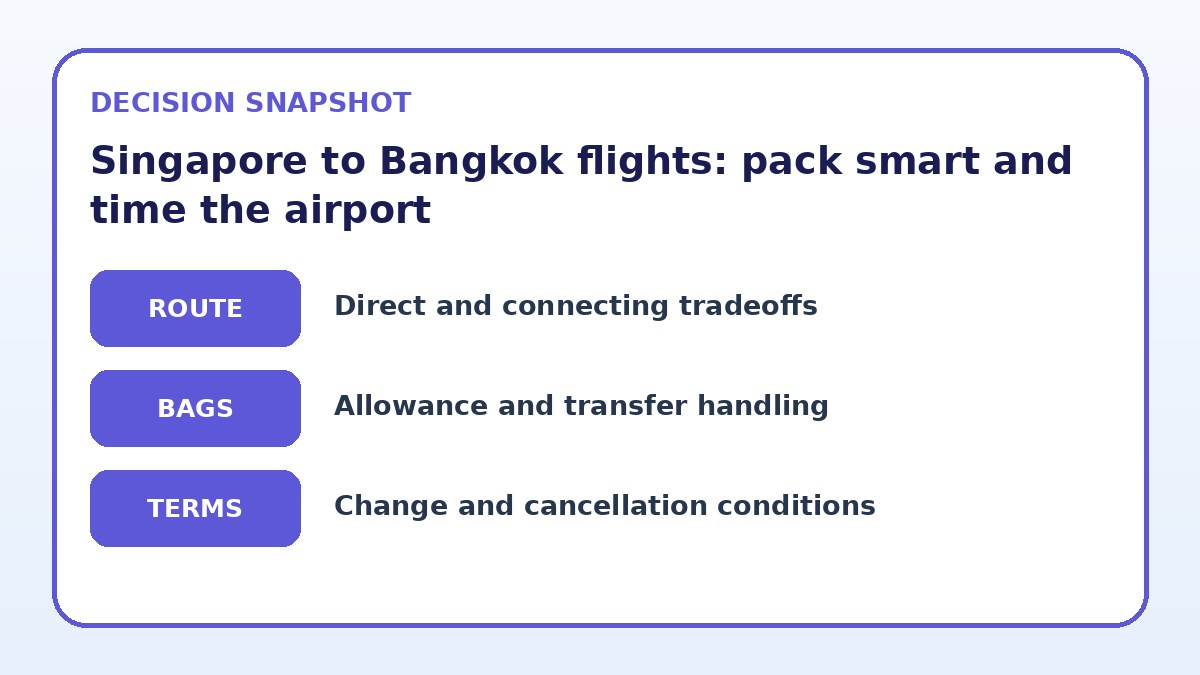
Routing and schedule fit for business priorities
When planning Singapore to Bangkok flights for business, start with schedule fit: pick departure and arrival times that align with your meetings and local workday. Morning departures from Singapore can get you into Bangkok early, but also force early wake-ups and tight morning connections at your origin airport. Evening arrivals give you time to move at a normal rhythm on the day of departure but may reduce available ground transportation or make late check-ins slower. Think in terms of how your energy affects productivity—do you need to be fresh for a morning meeting or is an evening arrival with a quiet hotel suitable?
Next consider routing complexity. If direct flights are offered on your dates, they minimize transfer risk and usually cut overall travel time, which is valuable for busy professionals. If a direct option isn’t available or fares are markedly higher, evaluate connecting itineraries by total door-to-door time and minimum connection times at the transfer airport. For transfers, check whether the connection requires changing terminals or re-clearing security and immigration; allow additional buffer if you must collect and re-check luggage or change terminals on the ground.
Baggage choices and connection risk
For business travelers, baggage choice is a tradeoff between speed and preparedness. Carry-on only reduces time in departures and arrivals, skipping checked-baggage drop and reclaim lines and eliminating the risk of delayed or lost bags. But a carry-on means stricter limits on what you can bring—suits, larger samples, or extra shoes may be impractical. If your itinerary relies on a tight connection or you prefer an express travel flow through airports, compressing to a single carry-on plus one personal item is often the fastest option.
If you need to check luggage, accept that connection risk increases: missed connections due to delays are more complicated if bags are checked into the same itinerary versus separate tickets. When booking checked baggage, prefer through-checked itineraries where the carrier handles transfers. If you must self-transfer and have checked bags, allocate substantial extra time for baggage reclaim and re-check, and consider travel insurance or refundable fares to mitigate the financial impact of missed connections.
Compare flight-selection strategies
| Flight strategy | Best for | Risk to check |
|---|---|---|
| Carry-on only, direct flight when available | Short trips and tight schedules wanting fast airport flow | Limited packing space and stricter liquid rules; may require laundry or outfit re-use |
| Checked bag, direct flight | Longer stays or presentations needing suits and samples | Extra check-in and reclaim time, slightly higher risk if flight is delayed |
| Carry-on with a tight connection | Saving time and cost while keeping transfer risk manageable | High stress if delays occur; requires precise minimum connection assessment |
| Checked bag with generous connection buffer | Maximum reliability when equipment or clothing is essential | Longer total travel time and more time spent in transit or at airports |
Recheck the complete itinerary
Confirm airports, connection handling, baggage, and change conditions before deciding.
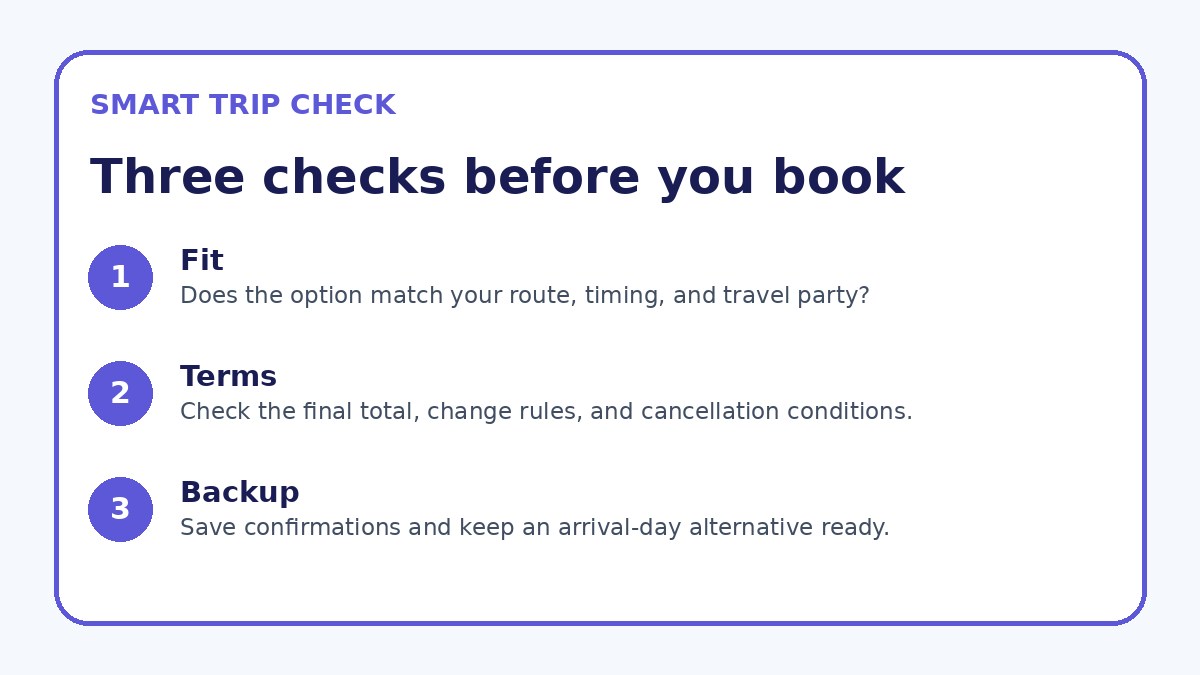
Fare conditions and what to verify before booking
Business travelers should prioritize flexible fare conditions that reflect the possibility of last-minute schedule changes. Before you book, verify the carrier’s final booking page for change and cancellation fees, free rebooking windows, standby policies, and whether seat selection or advance boarding is included. These conditions often differ between fare buckets even on the same flight; the cheapest available fare may carry strict penalties and zero checked-bag allowance, which could cost more in time and stress than a slightly higher flexible fare.
Also check baggage allowances explicitly on the booking page—carry-on size and weight, checked-bag dimensions and fees, and how baggage rules apply for codeshare or multi-operator itineraries. Confirm whether elite status or corporate contracts provide additional free baggage or priority handling. If you use a third-party site like Trip.com to search, treat it as a comparison tool and confirm the exact fare rules, baggage included, and itinerary times on the operating carrier’s official page before completing payment.
Flight details to verify
- Confirm exact travel dates, passport number, frequent flyer and corporate details before searching fares.
- Decide baggage plan (carry-on only vs checked) and note dimensions and weight limits from the carrier’s booking page.
- Compare fare terms for changes, cancellations, and baggage inclusions on the airline’s official site before payment.
- Allow realistic airport arrival windows: at least 90 minutes for carry-on direct, 120+ for checked or peak times.
- If connecting, verify terminal changes, minimum connection times, and whether luggage is through-checked.
- Pre-download boarding passes, travel documents, and meeting files; reserve lounge or ground transport aligned to arrival time.
Practical airport timing and productivity tips
Set arrival-at-airport targets using realistic buffers tied to your baggage choice and whether you need immigration or re-check. For carry-on only on a direct flight, arriving 60–90 minutes before departure often suffices on non-peak days, but business travelers should err on the conservative side and allow 90 minutes to handle check-in, security, and a short meeting prep. If you’re checking bags, add another 30 minutes to 60 minutes to that baseline. For transfers, use the minimum connection time listed by the carrier as a baseline and build at least 30–60 minutes extra where possible.
Maximise productivity by preparing a short in-air work kit: a lightweight laptop or tablet, charged battery pack, noise-cancelling earbuds, and a compact change-of-clothes or travel steamer if needed. Pre-download important documents and boarding passes, and make digital copies of travel documents. Book ground transport that syncs with arrival windows to cut waiting time. If you need quiet time at the airport, scout lounges or pay-per-use workspaces in advance and check access rules on the airline or lounge provider page.
Flight Guide questions travelers ask
How much extra time should I allow at Changi and Bangkok airports for business travel?
Aim for a flexible window rather than a fixed number—build your plan from the departure and baggage choices. For carry-on only on non-peak days, 90 minutes before departure at the origin airport is a practical balance between speed and safety. If you check bags, add 30–60 minutes for drop-off and potential queueing. For arrival into Bangkok, factor in immigration and baggage reclaim times; if you must be at a meeting immediately, leave larger buffers or arrange meet-and-greet services. Always verify recommended arrival times on the departing airline’s site because security and processing can vary by time of day and operational changes.
Should I book a refundable or flexible fare for a short business trip?
Flexible or refundable fares provide peace of mind when schedules are uncertain, but they typically cost more. Consider whether your company travel policy covers fare differences or if you have corporate credit that offsets the premium. If uncertainty is moderate and meetings could shift, flexible fares reduce the risk of expensive change fees and remove the need to repurchase. Always check the operating carrier’s change and refund terms on their final booking page—some low-fare classes impose strict limits even when sold through travel portals, so confirm the exact conditions before confirming a purchase.
How do I manage luggage if I have a same-day return to Singapore?
For a same-day roundtrip, carry-on only is often the most efficient choice because it eliminates reclaim/re-check delays and speeds transitions between airport and meetings. If you must bring additional items, consider shipping samples ahead or using minimal checked baggage with fast-track options if available. If checking luggage cannot be avoided, factor in extra time for drop-off and pick-up both ways, and verify whether the airline provides expedited baggage handling for business fares or status holders. Always confirm baggage rules and any expedited services on the carrier’s booking page before departure.
Final decision note
Organising baggage and airport time for Singapore to Bangkok flights is a series of tradeoffs between speed, preparedness, and risk tolerance. Start your planning by choosing whether you truly can travel carry-on only; that choice simplifies airport timing and reduces connection risk. Next, match flight times to your meeting schedule with conservative buffers, and verify fare rules and baggage allowances on the operating carrier’s final booking page. For transfers or checked luggage, budget extra connection time and prefer through-checked itineraries where possible. Preparing exact travel dates, traveler details, and a concise packing list before checking live options will make it far easier to pick the right flight and fare for your business needs.
Continue planning
Check current options and final conditions
Use the provider page to confirm live availability, the final total, cancellation terms, and every condition that matters to your trip.
This evergreen planning guide was created with AI-assisted drafting and a structured quality review. It does not display live prices, schedules, availability, visa guidance, or provider rankings. Verify current details before booking. Some links are affiliate links; we may earn a commission at no additional cost to you.