In the first hour after landing in Sydney, families face one clear question: use public transport, or book a private transfer? The right choice depends on who’s traveling, how much luggage you have, arrival timing and how close your accommodation is to convenient stops. This guide gives the direct answer up front—if you have a lot of luggage, young children, or arrive late, a pre-booked private transfer often reduces stress; if your party is light, budget-sensitive and confident with transfers, public transport can be faster on price and flexible for changing plans. Below you’ll find practical tradeoffs, the decision criteria to apply to your specific itinerary, and what to check on provider pages before you commit. Use this while holding your flight and hotel details; the checklist at the end is tailored for a quick, confident booking decision.
Check options for your arrival details
Use your flight, luggage, party size, and accommodation address to compare current choices.
Luggage and party size: match vehicle to need
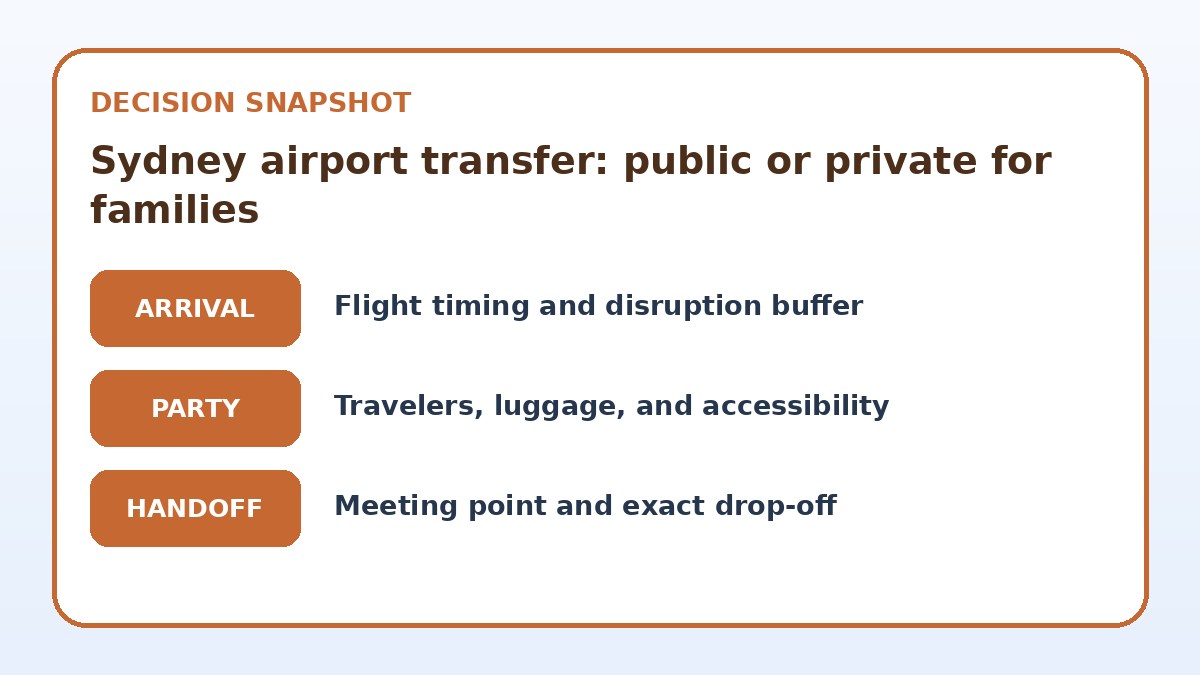
Start by counting bags, car seats and travellers. A family of four with two large suitcases, a stroller and a baby seat needs a different solution from two adults and a small backpack each. Public trains have limited space for oversized bags and steps at some platforms; you may need to fold or carry large items. Private vehicles give clearer space expectations—confirm how many suitcases fit and whether the vehicle will accommodate a stroller folded or unfolded. If you’re splitting across two taxis, coordinate arrival times and luggage distribution to avoid waiting in the terminal.
If you plan to bring multiple child seats, check both public and private options. Public transport won’t provide seats, so bring your own or a travel harness for older toddlers. Private services vary: some allow you to request seats for a fee or at booking; others do not carry them. Note that installing seats can add time to a pick-up, so factor setup into your schedule. If equal convenience matters, consider booking a larger private vehicle or a shared airport shuttle that lists child-seat policies clearly.
Arrival details to have ready
- Check which Sydney terminal you arrive at and confirm the transfer provider serves that terminal and its exact meeting point.
- Count total suitcases, strollers and child seats—book a vehicle that explicitly lists a matching luggage capacity and seat count.
- If arriving late or with an uncertain schedule, read the provider’s delay, wait-time and contact policies on the booking page before paying.
- Ask your accommodation for recommended drop-off or nearest station details and whether large vehicles can access the front entrance.
- If you require child seats, request them during booking and note any extra time for installation or extra charges on the provider page.
- Keep digital copies of flight and hotel details ready, plus a local SIM or roaming plan for driver contact and last-minute coordination.
Late or disrupted arrivals: safety and flexibility
Late-night or significantly delayed arrivals change priorities. Public transit frequency drops overnight and some bus/train routes may not run or switch to limited services; walking between distant stops with tired children isn’t ideal. Private transfers provide a single meeting point and usually operate on flexible schedules, which reduces the stress of rescheduling in a busy arrivals area. If your arrival time is uncertain, choose suppliers that explicitly explain their delay policies and how they will contact you. Keep local emergency contact numbers and the accommodation phone handy in case communications fail.
If your flight is disrupted, verify cancellation and rebooking rules before you commit. For public options, changing to a later service is straightforward but less predictable for seat availability and luggage space. For private bookings, providers often state how long they’ll wait and whether rebooking after missed flights incurs extra fees; check those details on the booking page. Whichever route you pick, have a simple backup: an app-based taxi option or an agreed meeting point and contingency plan with your accommodation.
Match the transfer to your arrival
| Arrival approach | Best for | Detail to verify |
|---|---|---|
| Pre-booked private car | Families needing door-to-door convenience with lots of luggage or young children | Higher cost and less flexibility if plans change; verify wait-time and child-seat availability on the booking page. |
| Shared airport shuttle | Medium groups wanting a balance of cost and assistance | May include stops at multiple hotels—longer travel time; check itinerary stops and luggage capacity in advance. |
| Taxi or app-based ride | Small families needing flexible, on-demand transfers without advance bookings | Variable vehicle size and availability; confirm that taxis accommodate car seats or larger suitcases if required. |
| Public train/bus/light rail | Families with light luggage staying near stations or wanting the most budget-friendly choice | Limited space for bulky items and potential walking from stops; check station accessibility and schedule frequency for your arrival time. |
Make the meeting plan clear
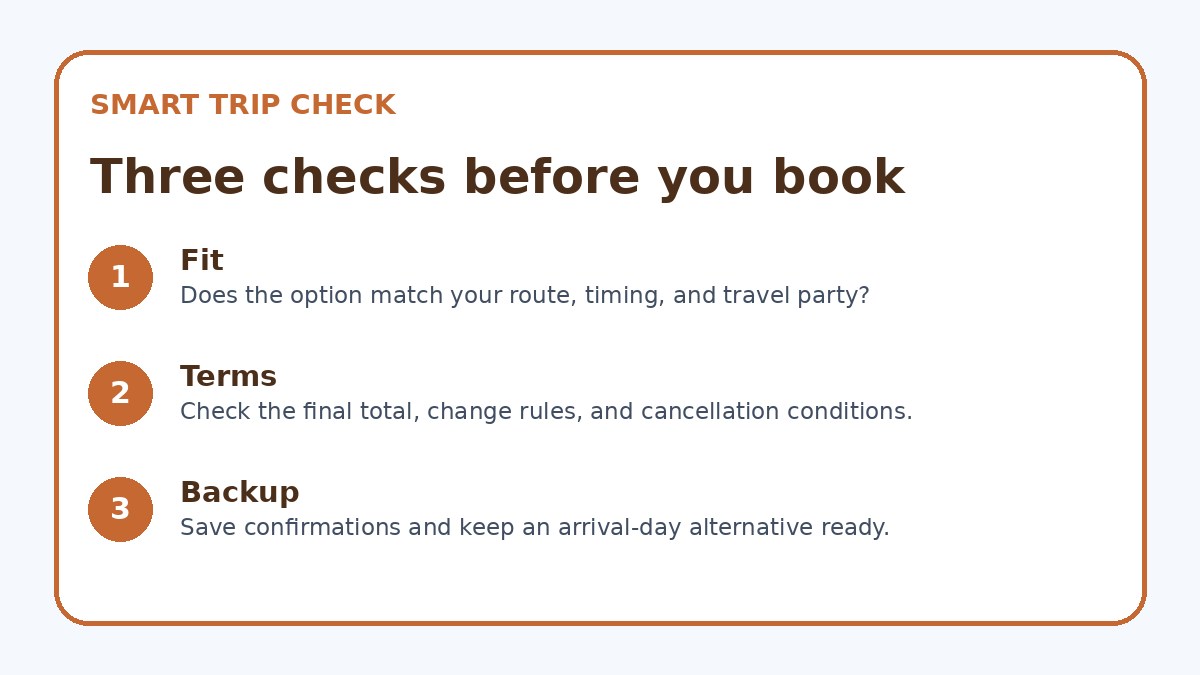
Check the final pickup instructions, waiting conditions, and exact drop-off coverage.
Meeting points and terminal logistics
Clarity about where to meet is crucial when children and luggage are involved. Sydney’s international and domestic terminals have different arrivals layouts; confirm which terminal your flight uses and which terminal the transfer serves. For private transfers, providers should show an exact meeting point (for example, 'outside Arrivals, near baggage belt X' or a specified curbside zone). On the booking page, verify where drivers wait, how they identify themselves, and the contact method they’ll use if you can’t find one another. For larger groups, choose a meeting point that avoids long walks or crowded corridors.
For public transport, check the distance from the terminal to the nearest train or bus entrance, the availability of lifts and ramps for strollers and whether you need to cross roads with traffic. Some families prefer the predictability of a single driver at curbside; others like the independence of hopping on a public train when it arrives. If you’re unsure about terminal transfers or have mobility needs, factor extra time to navigate signage and collect luggage, and consider a private option that specifies assistance or meet-and-greet services.
Destination-side drop-off: walkability and final access
Think about where the vehicle will actually drop you. Many hotels and apartments in central Sydney have curbside drop-off points within a short walk; other accommodations in narrow streets, pedestrian zones or older neighborhoods may require a short walk from the vehicle. Check with your accommodation about recommended drop-off points and whether large vehicles can approach the front door. For private transfers, confirm the likely drop-off location in advance so you can plan luggage handling and the final walk to your room.
With public transport, the ‘last mile’ is often predictable: find the nearest station or bus stop and measure the walking distance and elevation to your door. If you have small children or heavy luggage, prioritize lodgings within a short, level walk of a major station. If your accommodation provides a meet-and-greet from a nearby stop, note that on arrival. When in doubt, contact the hotel or host to ask for exact walk times and suggested exit points from stations or bus stops so you aren’t left with a difficult carry after a long flight.
Airport Transfer & Local Mobility questions travelers ask
Can I rely on public transport with young children and strollers after landing in Sydney?
Yes—many families use Sydney’s public network successfully, but plan ahead. Check whether your arrival terminal has lifts, ramps and step-free access to platforms. Train carriages have limited space for strollers; during peak times moving between carriages can be difficult. If your children are small and you prefer to avoid stairs, map the exact route from arrivals to the nearest station and confirm walking distance and slope. For added comfort, travel off-peak or use a private transfer if you want guaranteed curbside handling and no stair navigation.
How do I decide between a taxi/app ride and a pre-booked private transfer?
Decide by comparing predictability and needs. A taxi or app ride is flexible, useful for spontaneous changes and often quicker to get after you leave arrivals. Pre-booked private transfers provide guaranteed vehicle size, driver meet-and-greet and potentially child-seat options if requested at booking. If you have multiple bags, a baby seat, or arrive at an odd hour, a pre-booked vehicle reduces on-the-spot stress. Always confirm driver contact procedures, luggage limits and whether the service will wait for delayed flights on the vendor’s booking page.
What should I check with my accommodation about airport drop-off?
Ask for the simplest, safest place to be dropped off that minimizes carrying and crossing roads. Request exact walking time from the nearest station or recommended traffic-free approach if you travel by car. Some properties prefer drop-offs at a side entrance or loading zone; others can’t be approached by large vehicles. Tell the accommodation your arrival details so they can advise on access, suggest a meeting point if you get separated from your driver, and note whether luggage assistance or a porter service is available.
Final decision note
Deciding between public and private airport transfers in Sydney comes down to four practical factors: luggage and seats, arrival time, meeting-point clarity and how close your accommodation is to transit. For many families, a private transfer removes uncertainty—especially with lots of bags, young children, or late arrivals—because it provides door-to-door convenience and a single meeting point. Public transport works well when luggage is light, your accommodation sits near a station, and you want a lower-cost option with flexible timing. Before booking, verify vehicle capacity, child-seat availability, exact meeting/drop-off points and delay policies on the provider’s booking page. Compare options with your flight and hotel details open; consider checking availability on Trip.com as one of several comparison points, then choose the approach that minimizes carrying, waiting and stress on arrival.
Continue planning
Check current options and final conditions
Use the provider page to confirm live availability, the final total, cancellation terms, and every condition that matters to your trip.
This evergreen planning guide was created with AI-assisted drafting and a structured quality review. It does not display live prices, schedules, availability, visa guidance, or provider rankings. Verify current details before booking. Some links are affiliate links; we may earn a commission at no additional cost to you.