If you’re travelling solo between Toronto and Montreal, the most practical option depends on where you start and finish, how much luggage you have, and how tight your schedule is. For most solo travellers whose trip begins and ends in city-centre addresses, rail or coach offers the least door-to-door friction because both cities’ main stations are centrally located and easy to reach by public transit or a short taxi ride. Driving adds flexibility but shifts the burden of parking, tolls, and urban navigation onto you; mixed options — for example, driving to a park-and-ride then taking a train — can combine strengths. This article gives a simple decision pathway: assess terminal fit, luggage and transfer friction, timing flexibility, and a disruption backup so you can pick the option that will actually get you where you need to be with the least stress.
Terminal fit: how station location shapes your choice
For a solo traveller, the starting and ending points matter as much as the ride. A centrally located rail station or coach terminal usually beats an out-of-town airport or remote bus depot because it keeps local transfers short and predictable. Before you book, map the door-to-door route: estimate transit or taxi time, check whether your city transit has direct lines to the terminal, and note the frequency and late-night operating hours. If your trip begins at a residential address or a downtown hotel, a central departure point reduces awkward luggage transfers and the need for extra rides.
If your origin or destination is outside downtown, driving or a park-and-ride plus rail or coach might be more practical than public transit to a central terminal. Consider where you’ll be arriving in Montreal — neighborhoods across the island vary in their access to main stations — and how many hops you’ll need after the main leg. Minimizing the number of transfers reduces stress, especially when travelling alone at night or carrying heavy bags, so prefer an option where the final terminal leaves you within a short, single connection to your final address.
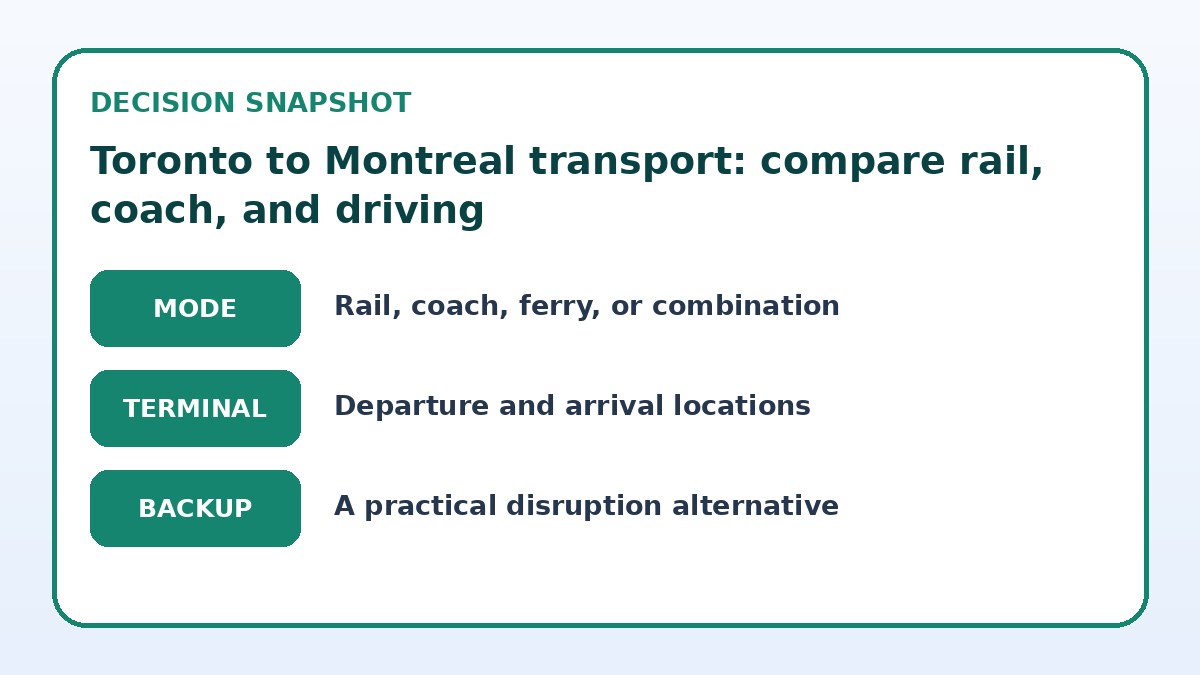
Choose the end-to-end journey plan
| Journey approach | Best for | Friction to check |
|---|---|---|
| City-centre train (single-mode) | Solo travellers prioritising low-transfer stress and luggage convenience | Less flexible on departure location; subject to train schedules and possible station crowds |
| Intercity coach (single-mode) | Those seeking direct, often budget-conscious rides with straightforward boarding | Terminal location and frequency can vary; road traffic can cause longer or unpredictable travel times |
| Drive the whole way (private car) | Travellers needing complete control over timing and multiple luggage items | You handle parking, tolls, and city driving; final urban access and parking can be inconvenient or costly |
| Mixed: drive to park-and-ride then rail/coach | Solo travellers balancing local flexibility with comfortable long-distance travel | Requires coordinating car drop-off and a clean transfer; may add small time overhead and planning steps |
Check live intercity options
Look beyond the ride itself and compare terminals, transfers, luggage, and arrival fit.
Luggage and transfer friction: keeping things simple
Solo travellers should aim to minimize heavy lifting and complex transfers. Trains typically have room for larger luggage and space where you can keep bags near your seat, which is convenient when you’re the only person handling everything. Coaches often provide underfloor storage and easier boarding for a single traveller, but check the boarding process and how close the coach stop is to your final destination. If you’re carrying fragile gear or many bags, driving lets you keep everything in one vehicle, but think about parking and carrying items from the car to your final address.
Transfers are the hidden time and energy cost. A 15–30 minute taxi or transit ride between station and final address is manageable; multiple short hops are not. If you plan to combine modes, test the transfer route in advance on a map app for elevation, stairs, and luggage-friendly connections. Also confirm luggage allowances and policies on the operator’s booking page so you know what’s included and what might require additional handling or fees. Small choices, like a compact roller bag versus a wheeled duffel, can change how many transfers you’re willing to tolerate.
Timing flexibility: matching frequency to your schedule
How strict your arrival or departure time is will often determine which mode is most practical. If you need a specific arrival time, choose services with high frequency or realistic padding: frequent trains or coaches reduce stress because you can miss one and catch the next without long waits. If you’re flexible, driving or a single early/late departure might be fine. Check typical departure cadences — midday and evening patterns differ — and leave extra time for city traffic or slower suburban access if you drive.
When planning, pay attention to peak travel windows and local events that could affect congestion at terminals and on roads. For solo travellers who prefer low-stress travel, pick a departure that avoids peak commuter rushes and major events. If your schedule includes an appointment or meeting on arrival, choose an option with proven on-time performance historically or reserve a buffer of time between arrival and your appointment to accommodate minor delays and transfers.
Compare the practical alternatives
Use the final page to confirm what is actually offered on your dates and save a workable fallback.
Intercity travel checklist
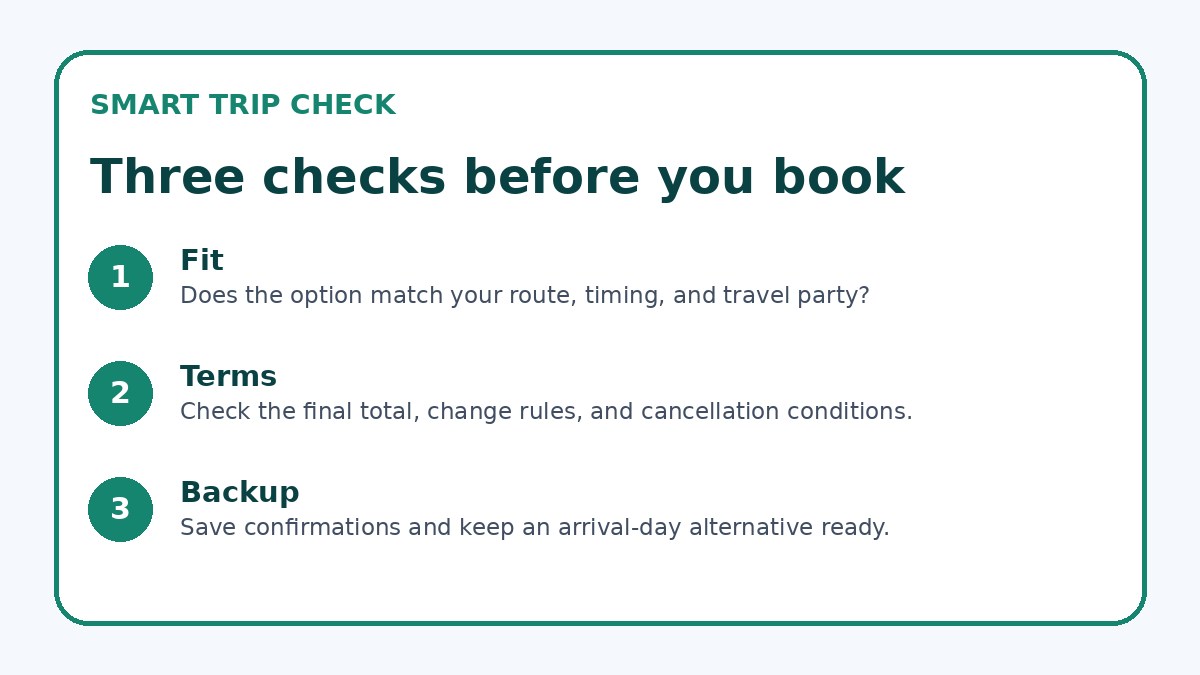
- Map your door-to-door route and estimate transit or taxi time at both ends before choosing a departure option.
- Check luggage allowances and any special handling policies on the operator’s final booking page.
- Verify frequency of departures for your chosen mode and select a departure with a time buffer for transfers.
- Identify at least two disruption backups: the next departure, a rental car location, and a reputable ride-hail option.
- Confirm how you will handle arrival-to-final-address last mile: transit lines, taxi ranks, or walking distance.
- Save PDFs or screenshots of bookings and local transit maps offline in case of limited mobile service.
Disruption backup: fallback options and what to verify
Plan a clear, simple backup before you leave: identify the next train or coach departure, the nearest car rental or ride-hail pickup point, and an alternate station if available. Keep screenshots or a screenshot of booking confirmations and local transit maps offline in case mobile service is poor. If you choose an operator-specific service, verify their real-time delay and refund/change policies on the provider’s final booking page so you know how to proceed if your booked service is cancelled or significantly delayed.
Also have a budget and plan for worst-case scenarios: a late-night arrival might require a taxi rather than transit. If your original option is cancelled, a short taxi to a different terminal or a rental car for a one-way drop could save the day for a solo traveller. Verify late-night service availability and any off-peak restrictions directly with providers, and remember that Trip.com can be used as one place to compare current availability and conditions but always confirm on the provider’s booking page before finalising.
Rail & Intercity Transport questions travelers ask
Is taking the train from Toronto to Montreal more practical than flying for a solo traveller?
Train travel tends to be more practical when both ends are city-centre addresses because it minimises airport transfers and long security queues. For a solo traveller, the train’s station-to-station simplicity often reduces the number of separate journeys, luggage handling, and coordination. Flying can be faster in travel time but requires extra time for airport transfers and check-in unless your origin or destination is near an airport. Compare door-to-door time and how many transfers each option requires before choosing.
How should I choose between a direct service and one with connections?
Direct services reduce the chance of missed connections and simplify logistics, which is helpful when travelling alone with luggage or on a tight schedule. Connecting options may offer more departure times or lower cost but introduce transfer risk and extra handling. If you pick a connecting journey, allow generous transfer time, confirm whether your luggage transfers automatically, and know the alternate later departures if a connection is missed. Always verify connection policies on the provider’s booking page before finalising.
What’s the simplest disruption backup for a solo traveller on this route?
The simplest backup is a clear hierarchy: first check for the next direct train or coach, then a nearby later departure, and finally a ride-hail or short rental car if public options are exhausted. Make sure you can reasonably afford the alternative and know pickup points and operating hours. Keep contact numbers, screenshots of alternative schedules, and a small contingency budget accessible; having these steps pre-decided avoids rushed decisions if your original service is delayed or cancelled.
Final decision note
For most solo travellers on the Toronto to Montreal route, prioritise the option that reduces door-to-door transfers and luggage handling. If your trip starts and ends near downtown addresses, a centrally located train or coach typically offers the most practical balance of convenience and comfort. Driving provides control but adds city driving and parking responsibilities; a mixed drive-plus-rail approach can work well when your origin or destination is suburban. Before you book, map the full route, check luggage rules and departure frequency on the provider’s final booking page, and set a simple disruption backup so you can adapt with minimal stress.
Continue planning
Check current options and final conditions
Use the provider page to confirm live availability, the final total, cancellation terms, and every condition that matters to your trip.
This evergreen planning guide was created with AI-assisted drafting and a structured quality review. It does not display live prices, schedules, availability, visa guidance, or provider rankings. Verify current details before booking. Some links are affiliate links; we may earn a commission at no additional cost to you.