If you need to move between Hanoi and Ho Chi Minh City, the practical choice comes down to three things: time, comfort, and how much connection risk you can tolerate. A direct flight normally saves time and reduces the stress of transfers, while a connecting itinerary can sometimes lower fares or open better departure times if direct seats don’t fit your schedule. First-time visitors should weigh airport transfer time on both ends, baggage transfer rules, and whether they prefer a single airport arrival in Ho Chi Minh City or are comfortable changing planes. Below you’ll find straightforward decision criteria, common tradeoffs, and concrete points to verify on booking pages so you can choose a flight that fits your overall trip plan.
What direct flights offer
Direct flights between Hanoi and Ho Chi Minh City are typically the fastest and simplest way to travel between Vietnam’s two largest cities. A true direct itinerary means you stay on the same aircraft or have a single non-stop flight number from departure to arrival, which reduces the number of times you need to re-check luggage and eliminates the need to navigate an unfamiliar transfer airport. For first-time visitors, that simplicity matters: one security screening at departure, one arrival process, and fewer opportunities to miss a connection or contend with a delayed inbound flight.
When evaluating direct options, think beyond just airborne time. Account for travel time to and from each airport, peak-hour traffic in both cities, and the time you want to leave for check-in and security. Also check the specific aircraft type and seat layout on the carrier’s booking page if comfort is a priority, and confirm baggage allowance on the airline’s final checkout screen—airline policies and included services can vary even on non-stop routes.
Why you might choose a connecting flight
Connecting flights can be attractive when direct seats are sold out, business schedules force non-standard departure times, or you want to split the journey to visit another city briefly. A single connection might provide earlier or later departure windows than the direct schedule and could allow you to use a carrier with a frequent-flier program you prefer. For budget-conscious travelers, a connection sometimes surfaces lower-paid fares, but any saving should be weighed against the extra time, potential overnight layovers, and the complexity of transfers.
If you consider a connecting itinerary, clarify whether the connection is protected by a single booking or involves separate tickets. Protected connections booked on one ticket typically include through-checked baggage and rebooking assistance if the first leg is delayed. Separate tickets can offer savings but transfer more responsibility to you: you may need to collect and recheck luggage, move between terminals, or allow extra cushion time to avoid missing the onward flight. Always inspect the booking conditions on the final payment page.
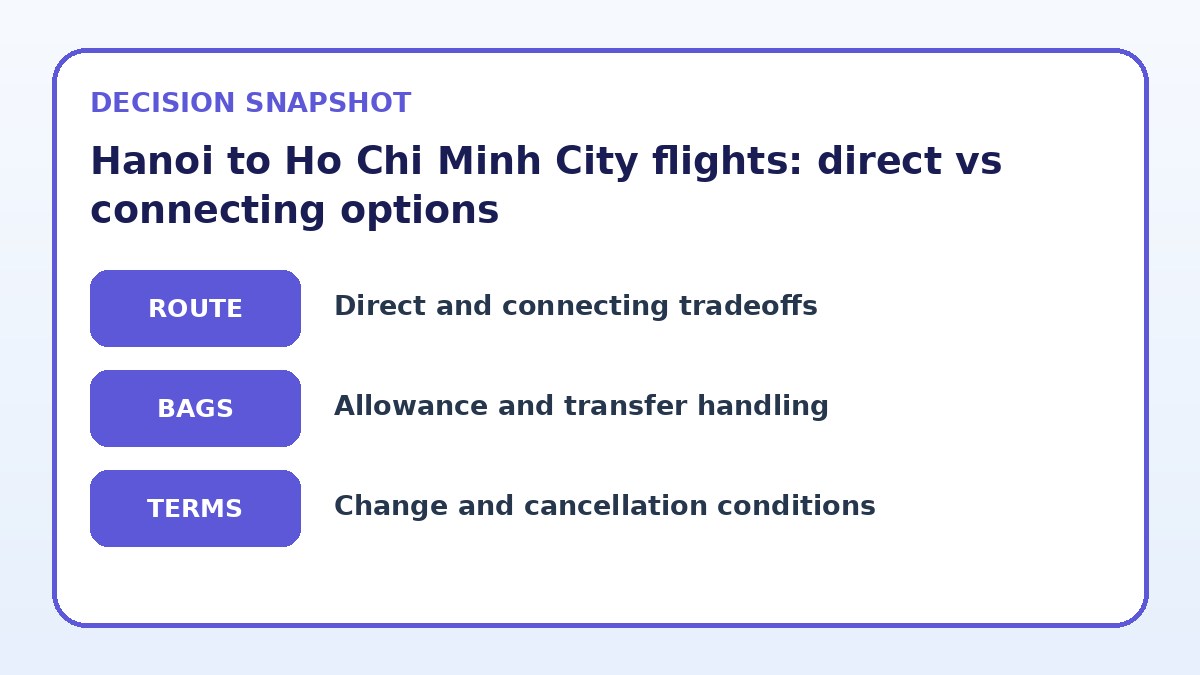
| Approach | Best for | Tradeoff to check |
|---|---|---|
| Direct flight | Travelers valuing short total travel time and simple logistics | Less schedule flexibility and sometimes higher fares during peak times |
| Single protected connection | Those needing specific departure or arrival times with reduced connection risk | Longer total travel time and more time in airports |
| Separate-ticket connection | Price-sensitive travelers willing to manage transfers and luggage themselves | Higher risk of missed connections and no guaranteed rebooking |
| Multi-city stopover | Travelers who want to add a short visit en route | Adds complexity, potential visa/entry steps, and more planning for baggage and timing |
Key tradeoffs: time, cost, and risk
The most immediate tradeoff is time versus flexibility. Direct flights minimize the number of moving parts and are usually best when your time window in Ho Chi Minh City is tight. Connecting itineraries can expand your schedule options and occasionally reduce costs, but they increase exposure to delays, missed connections, and extra ground transfers. For first-time visitors, missing a connection can mean dealing with unfamiliar terminals, language barriers, and potentially overnight accommodations if the carrier does not or cannot rebook you promptly.
Cost tradeoffs matter differently depending on your priorities. If price is the deciding factor, compare total out-of-pocket expenses: add transfer taxis, potential visa or entry requirements at layover airports, and the value of an extra night if a connection forces an overnight stay. If comfort and predictability are higher priority, direct flights typically score better. Whatever you choose, verify luggage transfer rules and whether the airline’s booking confirms through-checked bags—or if you must reclaim and re-check them during your connection.
Before you book
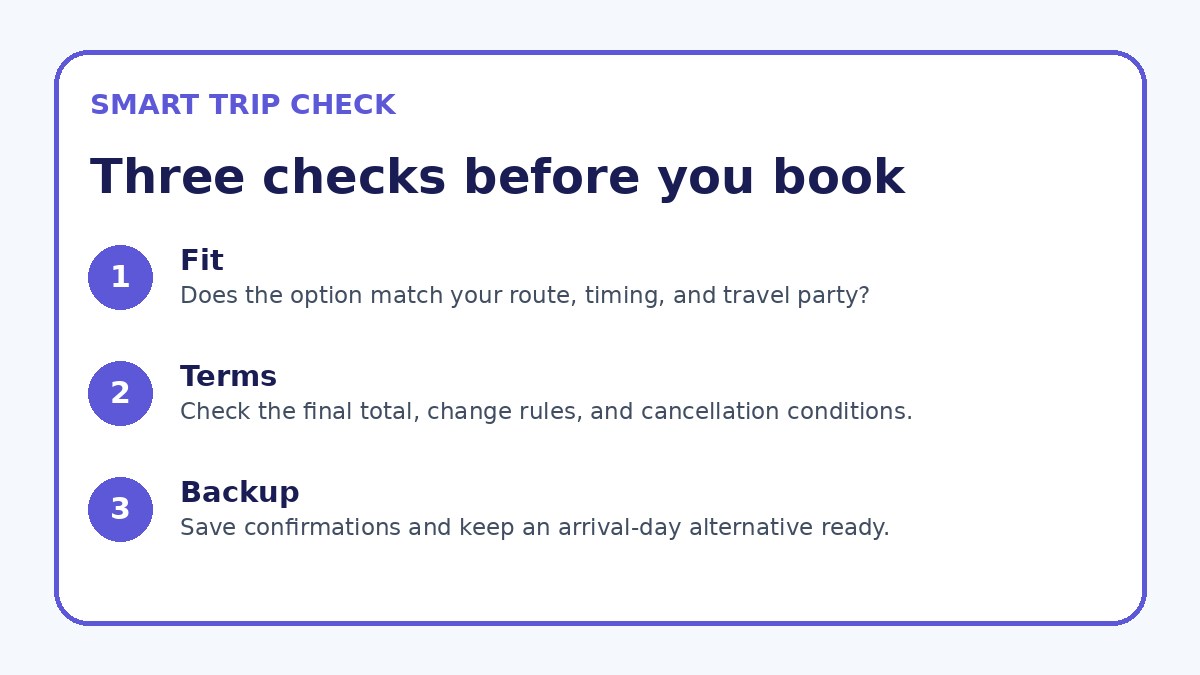
- Compare total door-to-door time, not just scheduled flight duration, before choosing an itinerary.
- Confirm on the carrier’s final booking page whether baggage is through-checked for connecting itineraries.
- Check rebooking and missed-connection policies on the airline’s terms before completing purchase.
- Allow generous layover buffers when tickets are separate or when transferring between terminals.
- Verify which terminals your flights use and plan ground transfers between terminals in advance.
- If you need predictable arrival time, prioritize direct flights or connections booked on one ticket.
How to compare options and what to verify
When shopping for flights, use the same time window across search tools so you compare equivalent itineraries. Look at total door-to-door time: travel to the airport, recommended check-in times, potential security queues, flight time, and arrival processing. Check layover length and whether terminals require an additional security check or an inter-terminal transfer. For connecting options, prefer layovers long enough to handle delays confidently but not so long they add unnecessary waiting or require spending the night.
Before you book, verify three provider-specific items on the airline or booking site’s final checkout page: baggage allowance and whether it’s through-checked, the rebooking or missed-connection policy, and the exact terminals or airports involved. If you use a third-party site, cross-check these details on the carrier’s own page. Trip.com can be used as a comparator to see current availability, but always confirm operational details and protections on the airline’s official booking pages.
Frequently asked questions
Are direct flights always faster between Hanoi and Ho Chi Minh City?
Direct flights eliminate the need to change planes, which usually reduces total travel complexity and the number of airport procedures. However, total travel time depends on where you’re departing from or arriving to in the city, traffic to airports, and check-in/security recommendations. A direct flight’s airborne time will typically be shorter than a multi-leg route’s combined flying time, but if a connecting option provides a significantly earlier departure or a better city-to-airport schedule, it can sometimes beat a later direct flight on practical door-to-door timing. Always compare the full itinerary time.
How much layover time should I allow for a connecting flight?
There’s no single correct layover length because it depends on whether your connection is on one ticket, whether you must change terminals, and whether you need to reclaim and re-check bags. For protected single-ticket connections, a shorter layover may be acceptable because airlines usually process transfers and assist with tight connections; still, aim for at least the minimum connection time the airline publishes plus a safety cushion. For separate tickets or unfamiliar airports, allow extra time to clear immigration, collect luggage, and handle inter-terminal transfers before you feel comfortable.
If I book a cheap connecting itinerary and miss my next flight, who helps me?
If both legs are booked on the same ticket with one carrier or alliance, the operating carrier typically has responsibility to rebook you onto the next available flight within the confines of their policy, though timing and options vary. If the flights are on separate tickets, each carrier treats the legs independently and generally will not be obligated to assist with missed connections. Before you book, read the rebooking and delay policies on the airline’s official site and consider buying protection or choosing a single-ticket through-connection if you need assistance options.
Final planning note
For first-time visitors deciding how to travel from Hanoi to Ho Chi Minh City, start with your priorities: speed and simplicity favor direct flights, while schedule flexibility or cost considerations may point to connecting itineraries. Assess total door-to-door time, baggage handling, and the level of connection protection you need. If you choose a connection, prefer a single-ticket protected itinerary to reduce risk, and check layover logistics closely. Use comparison tools like Trip.com to surface options, but verify baggage rules, terminals, and rebooking terms on the airline’s own checkout pages before you finalize your booking.
Continue planning
Check current options and final conditions
Use the provider page to confirm live availability, the final total, cancellation terms, and every condition that matters to your trip.
This evergreen planning guide was created with AI-assisted drafting and a structured quality review. It does not display live prices, schedules, availability, visa guidance, or provider rankings. Verify current details before booking. Some links are affiliate links; we may earn a commission at no additional cost to you.