If you need to move between Seoul and Jeonju for business, the practical choice usually comes down to balancing total door-to-door time against friction: how many transfers, how much luggage handling, and how predictable arrival times are for meetings. For many business travelers a direct intercity train (including KTX or express options where available) or a well-timed coach will win on predictability and lower transfer stress. However, shared or private road options can beat rail when your meeting location is off the main station in Jeonju, or when you must carry bulky equipment. This article gives you a decision framework to compare rail, coach, car, and mixed plans, plus what terminals mean for your schedule, how luggage and transfers affect the day, timing flexibility, and a practical disruption backup you can implement.
Terminal fit: start-to-finish access matters
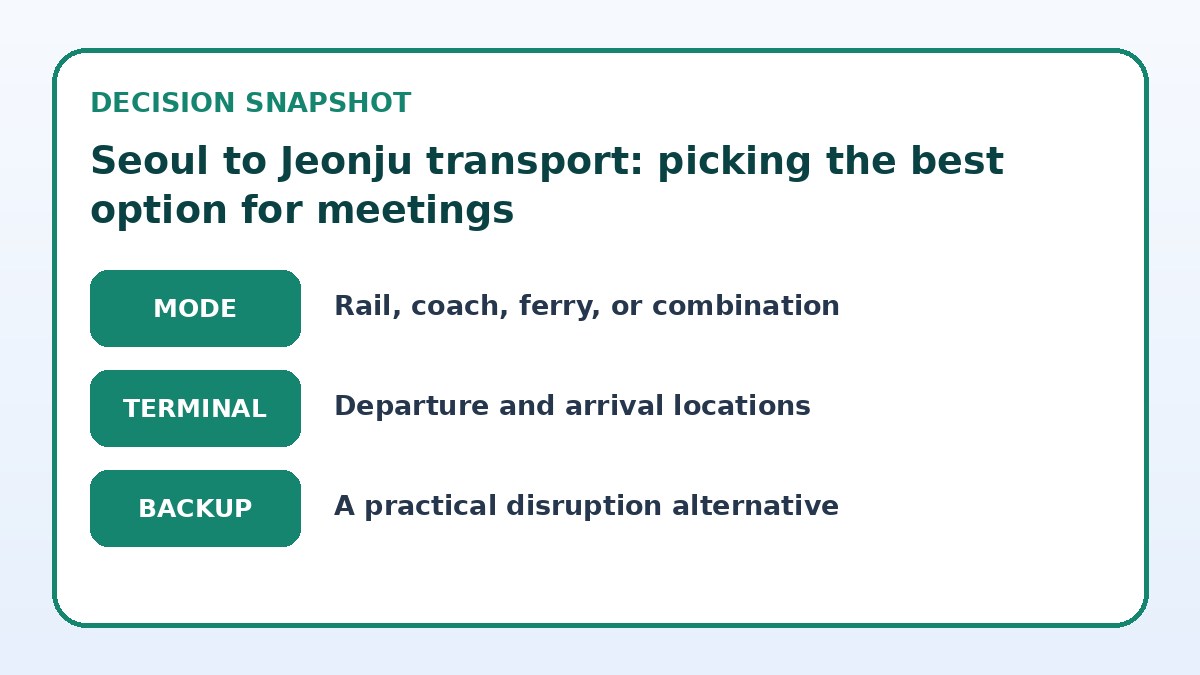
Assess how each mode connects to your start and end points. In Seoul you might depart from a central station, a coach terminal, or arrange an airport transfer; in Jeonju your meeting may be blocks away from the station or require a short taxi. Measure the walking, transfer shuttle, or taxi time and factor in hotel check-out. A central train station often offers easy access to taxis and local buses, while coach terminals sometimes sit on the city’s periphery. If your meeting location is not within a short taxi ride of the station, a private car or hybrid plan that includes a final-mile taxi will save time and stress.
For business trips, door-to-door convenience can outweigh a marginally faster ride. Map the exact addresses and estimate realistic transfer times during rush hour and off-peak periods rather than relying on off-peak assumptions. Also consider luggage drop options—many stations and terminals offer left-luggage services, but that requires extra handling that may not be worth the time if your meeting schedule is tight. Where possible, choose the option that minimizes the number of handoffs between modes and people.
Choose the end-to-end journey plan
| Journey approach | Best for | Friction to check |
|---|---|---|
| Direct intercity train (station to station) | Predictable arrival times and lower transfer complexity between major stations | May require an extra taxi for final-mile access if your meeting is away from the station |
| Intercity coach or shuttle | Simpler luggage handling and fewer platform changes when terminals line up with your route | More exposure to traffic delays; terminals can be less central than train stations |
| Private car hire or taxi (door-to-door) | Direct drop-off at meeting location and minimal luggage handling | Less predictable travel time in traffic and potentially higher overall travel fatigue |
| Hybrid (train/coach plus taxi for last mile) | Combines reliability of scheduled services with direct access to meeting place | Adds a brief transfer and requires coordination to time the connecting taxi |
Check live intercity options
Look beyond the ride itself and compare terminals, transfers, luggage, and arrival fit.
Luggage and transfer friction: protect your meeting window
If you’re traveling with a laptop, presentation materials, or bulky equipment, count every transfer. Trains and coaches usually allow carry-on items and larger bags, but transferring between platforms, buses, or taxis is where time slips away. A single direct transfer is preferable to multiple short hops; each handoff risks delay or misplacement. If you rely on rental cars, ensure the pick-up and drop-off desks are placed to avoid long queues or shuttle rides that negate the door-to-door benefit.
Consider also the cognitive load: business travel is not only physical. Handling bags, printing boarding confirmations, or coordinating meeting arrival with colleagues adds mental friction. Choose the mode with the fewest checkpoints on the day — fewer ticket scans, fewer platform changes, fewer baggage movements. If a hybrid option (train plus taxi) cuts transfers to one short taxi ride on arrival, it may be the most efficient way to preserve your energy for the meeting.
Timing flexibility and schedule risk: what to prioritize
Decide whether you need a fixed arrival time or flexibility. Trains tend to run to a published timetable, which helps if you must be in Jeonju by a set hour. Coaches can be slightly more flexible in departure frequency but are often subject to road congestion — useful if you expect to leave on short notice but less reliable around peak traffic. Conversely, renting a car or taking a taxi gives the greatest departure flexibility, but road incidents can make arrival times unpredictable. Weigh whether an earlier guaranteed arrival by train or the on-demand flexibility of road travel better suits your meeting's timing.
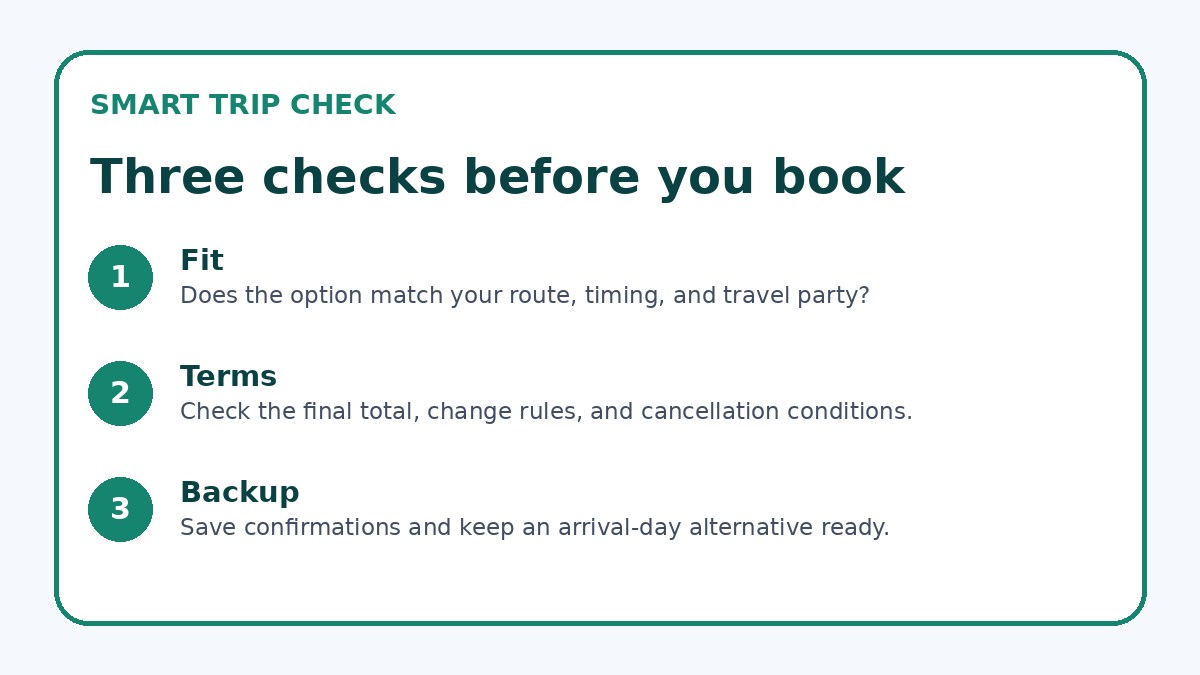
Also build margin into your plan: schedule arrival at least 30–60 minutes before the meeting for last-minute prep and unforeseen delays. For return trips, factor in peak travel times and local event days that might affect availability of taxis or increased coach loads. If you have a strict schedule, confirm the operator’s final booking page for departure frequency, transfer requirements, and boarding rules; these vendor details change more often than the broad mode characteristics discussed here.
Compare the practical alternatives
Use the final page to confirm what is actually offered on your dates and save a workable fallback.
Intercity travel checklist
- Map door-to-door time: estimate time from your pickup point in Seoul to the meeting address in Jeonju, including transfers and typical traffic.
- Confirm final-mile options: check taxi stands, rideshare coverage, and local bus schedules from Jeonju arrival points to your meeting location.
- Prepare luggage strategy: pack a compact carry-on for quick transfers or arrange left-luggage only if you have time to retrieve it before your meeting.
- Build schedule buffer: book an earlier departure or allow at least 30–60 minutes after arrival for setup and unexpected delays.
- Set a clear backup: identify a realistic alternate mode (taxi, earlier train/coach, or remote meeting link) and keep contact or app access ready.
- Verify provider details: before booking, check the operator’s official page for departure frequency, boarding procedures, and rebooking or cancellation terms.
Disruption backup: simple, actionable fallbacks
Create a straightforward backup that preserves meeting attendance. Typical backups include an earlier train or coach departure, a taxi or rideshare on short notice, or a remote participation plan to join the meeting by video if arrival becomes uncertain. When you choose a backup involving a different operator or mode, note pickup points and estimated alternative door-to-door times ahead of travel. Keep contact numbers or apps ready so you can shift plans without wasting time searching at the terminal.
If a scheduled option is canceled, prioritize solutions that minimize extra transfers: for instance, a direct taxi from Seoul to Jeonju or a car hire with a driver if available. When relying on any provider, verify cancellation and rebooking policies on their official booking page before finalizing the original reservation. You can also use comparison platforms such as Trip.com to check current availability, but always complete bookings and confirm timing on the provider’s site or app.
Rail & Intercity Transport questions travelers ask
Which mode usually gives the most predictable arrival for business meetings?
Scheduled rail services typically offer the greatest predictability because they run to published timetables and are less affected by surface traffic. That makes them a strong default for meetings with fixed start times. However, predictability depends on choosing a train that arrives close to your meeting venue; if the station is distant you will still need to budget time for a taxi or local transfer. Always verify the operator’s current timetable and platform/boarding procedures on their booking page before finalizing travel plans.
When does a private car or taxi make more sense than public transport?
Choose a private car or taxi if your meeting location in Jeonju is remote from the main station, you carry bulky equipment, or you need true point-to-point convenience. A road option avoids multiple transfers and simplifies luggage handling, which can be worth the tradeoff if traffic risk is acceptable. For short one-way trips it can also save time door-to-door when stations are poorly served by local connections. Before you commit, check expected pick-up and drop-off logistics and whether a dedicated drop at your venue is practical.
How should I plan if my meeting time is inflexible and I want contingency?
If your meeting time cannot move, prioritize earlier arrivals and at least one robust backup. Book a scheduled train or coach that arrives well before the meeting, and identify a fallback such as an earlier service, a taxi that can be booked on short notice, or the ability to join remotely. Confirm rebooking and cancellation policies on the provider’s page so you know how quickly changes can be made. Finally, inform meeting hosts of your contingency plan and share arrival expectations to avoid last-minute confusion.
Final decision note
For business travelers between Seoul and Jeonju, practical decisions hinge on door-to-door time, transfer friction, and predictability. Trains are generally the best bet for scheduled reliability; coaches simplify luggage and can be handy when terminals match your route; private cars excel for direct access to remote meeting sites; and hybrid combinations often offer the best balance. Before booking, map the exact addresses, estimate realistic transfer times, build a buffer for arrival, and choose a simple backup you can activate quickly. Verify operator timetables, boarding rules, and rebooking policies on the provider’s official page (or compare availability on Trip.com for convenience) so your travel supports the meeting, not the other way around.
Continue planning
Check current options and final conditions
Use the provider page to confirm live availability, the final total, cancellation terms, and every condition that matters to your trip.
This evergreen planning guide was created with AI-assisted drafting and a structured quality review. It does not display live prices, schedules, availability, visa guidance, or provider rankings. Verify current details before booking. Some links are affiliate links; we may earn a commission at no additional cost to you.