Practical answer first: pick the primary mode that best fits your family’s door-to-door needs—rail for roomy seats and simpler transfers, coach for direct curb-to-curb value, ferry for scenic legs where available, or a hybrid plan that mixes these to minimize walking and luggage handling. Start by mapping where you’ll be in NYC and Boston, then compare terminals, transfer ease, and how many times you’ll need to change vehicles. For families, an extra transfer or a long walk with carry-on luggage can undo any time savings. Build at least one disruption backup (alternate train, bus, or car-share) for each leg and add buffer time around connections. Below I’ll explain tradeoffs, how to evaluate terminals and luggage friction, timing flexibility strategies, and practical disruption plans so you can book with confidence.

Choosing between rail, coach, ferry, or a hybrid
Start with where your family is staying and where you need to arrive in Boston. Rail services often run into central stations that connect well with public transit and taxis, which reduces the number of last-mile moves for families. Coaches typically offer curbside boarding that can be easier with large bags or strollers, especially if they stop close to neighborhood pickup points. Ferries are less common for the full NYC–Boston corridor but may be useful for short scenic transfers if you plan a multi-city route that touches coastal towns; treat them as optional legs rather than the primary trunk unless they save a meaningful transfer.
After you map pickup and drop-off points, weigh total door-to-door time rather than advertised in-vehicle duration. Count the time to get to the terminal, check-in or board, and move from arrival terminal to your final address. For families, an approach that’s slightly slower on paper but avoids multiple station-to-station transfers will usually feel less stressful. Consider a hybrid plan: for example, a comfortable rail intercity leg paired with a short coach or rideshare segment at either end to avoid difficult station access with children.
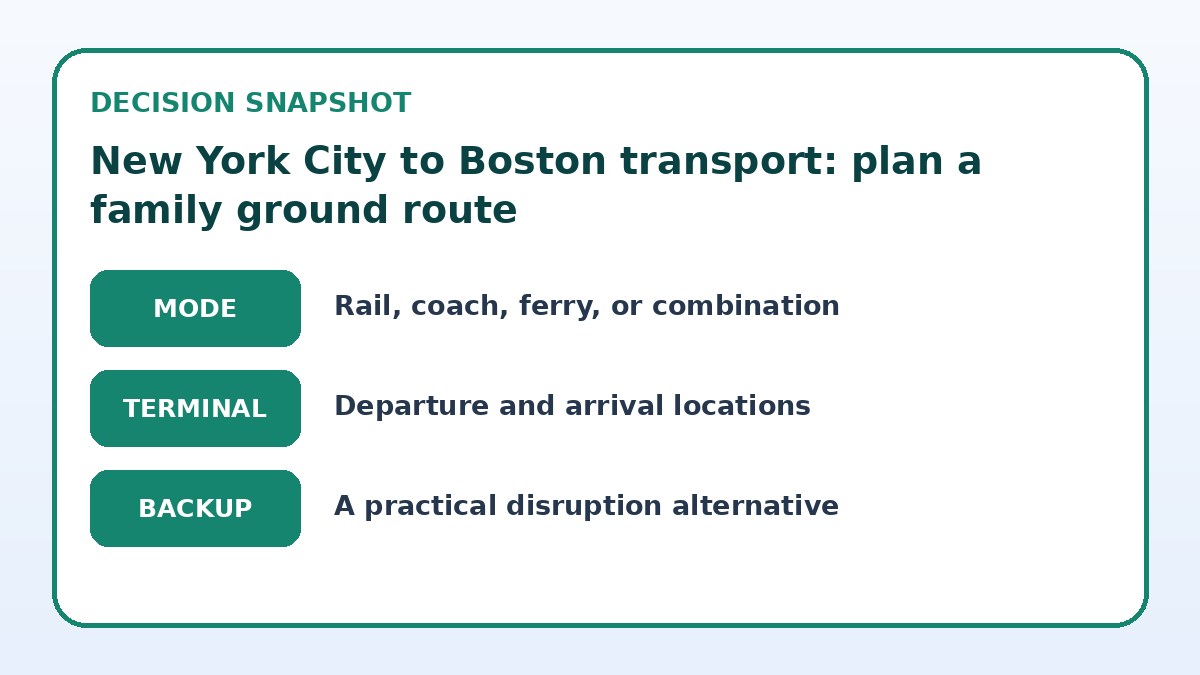
Choose the end-to-end journey plan
| Journey approach | Best for | Friction to check |
|---|---|---|
| Single-mode rail journey | Families prioritizing comfort, easier indoor transfers, and fewer vehicle changes | May require longer walks to city-center stations and fewer curbside pickup options |
| Direct coach (single operator) | Families who need simple curbside boarding and minimal station navigation | Can be more affected by road traffic and may offer less onboard space for moving around |
| Hybrid plan: rail trunk + short local coach or rideshare | Families balancing comfortable trunk travel with door-to-door practicality | Requires careful timing and separate booking checks for each leg |
| Flexible multi-operator plan with built-in alternatives | Families who want redundancy and multiple disruption backups | More complex to organize and may demand higher total buffer time |
Check live intercity options
Look beyond the ride itself and compare terminals, transfers, luggage, and arrival fit.
Terminal fit and luggage/transfer friction
Assess terminals for elevators, escalators, and short transfer corridors. Big train stations tend to have better elevator access and indoor waiting areas, which helps with children and luggage. Curbside coach terminals are often simpler: you step off the vehicle at street level and are usually closer to local taxis or rideshares. Ferry terminals can vary widely; some require stairs or long walks. When evaluating options, check whether luggage is stored by staff or needs to be lifted onto racks by you—this can be decisive with toddlers or heavy suitcases.
Plan transfers as if they’re the costliest part of the journey. Each additional transfer increases the chance of delays and lost time carrying bags and children. If a transfer involves moving between different transport hubs, add 20–60 minutes depending on urban traffic and public transit connections. If you’ll need to change from train to bus or vice versa, identify covered walkways, luggage trolleys, or elevator routes ahead of time. Also verify stroller policies—some providers allow gate-checking while others require collapsible strollers to be carried on board.
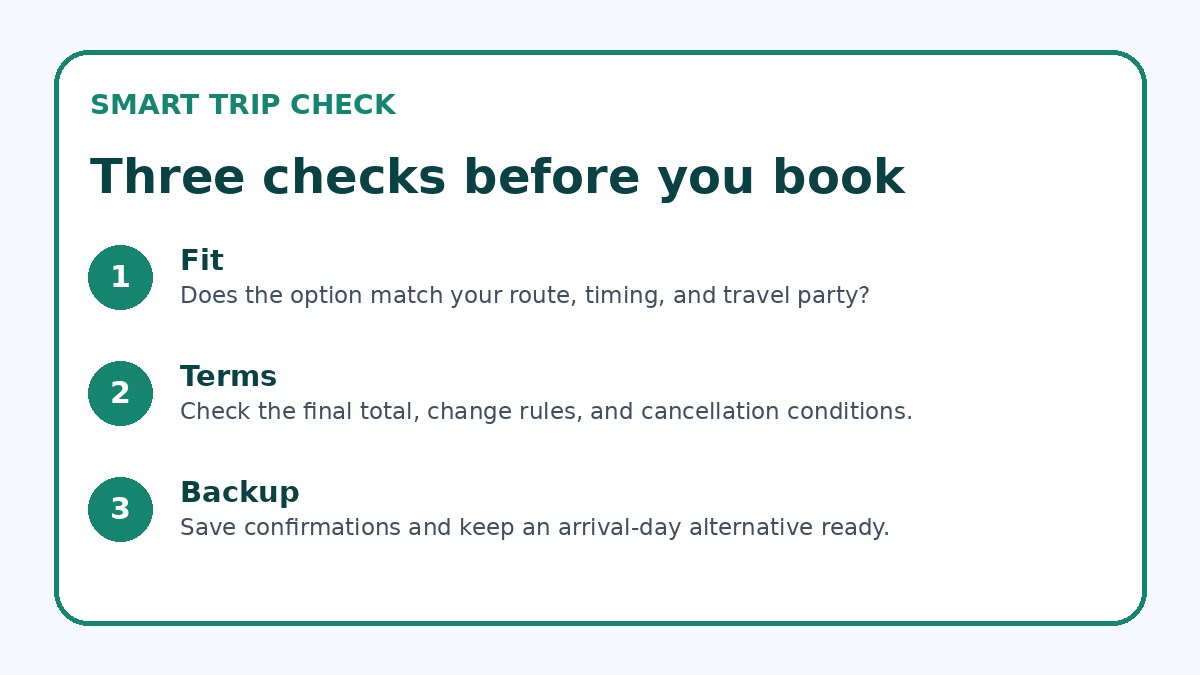
Timing flexibility: schedules, buffer time, and family rhythms
Families benefit from conservative time buffers. Build in extra time for bathroom breaks, snack stops, diaper changes, and bathroom queues at terminals. When comparing options, prefer departures that give you at least 30–60 minutes margin over the tight minimum transfer time, especially for morning rush-hour segments or when changing between different operators. Night travel might mean less traffic but fewer fallback options, so weigh whether a daytime departure with more alternatives is preferable.
Check ticket change and refund policies before you book so you know how easy it is to move plans when a child is sick or schedules shift. If flexibility is important, prioritize fares or providers that allow same-day changes or low-cost rebooking. For hybrid itineraries, ensure that each leg can be altered independently without voiding the rest of the plan. Keep copies of reservation numbers and an offline map of stations so that, if your phone battery dies, you can still find alternate routes or nearby services.
Compare the practical alternatives
Use the final page to confirm what is actually offered on your dates and save a workable fallback.
Intercity travel checklist
- Map door-to-door travel time from your NYC accommodation to the departure terminal and from arrival terminal to your Boston accommodation.
- Confirm elevator/escalator access and stroller handling at each terminal you’ll use and note the easiest routes.
- Compare change and refund policies for each leg; screenshot or save confirmation pages for quick reference.
- Choose departure windows that include at least 30–60 minutes buffer for transfers and child needs.
- Pack a grab-and-go family kit with snacks, medication, spare clothes, chargers, and entertainment for delays.
- Identify two backup options per leg: an alternate departure on the same mode and a different-mode contingency.
Disruption backup and practical on-the-ground contingencies
Create a two-level backup: first, an alternate service on the same mode within a few hours; second, a different mode that can get you to or near your destination the same day. For example, if your rail leg is canceled, know the nearby coach or rideshare options and one station where you could board a different line. Keep emergency contacts for family members, a local taxi app, and a list of accessible station amenities in case you need a longer hold. For longer delays, identify family-friendly rest areas, indoor play spaces, or nearby cafés where you can regroup.
Prepare a small travel kit with essentials—snacks, wipes, medications, spare clothes, chargers, and a lightweight blanket—and store it where an adult can grab it quickly. If you rely on connecting services operated by different companies, save each provider’s contact and rebooking rules on a single document. Consider travel insurance that covers missed connections if that gives you peace of mind, and verify the insurer’s definition of covered disruptions on their booking page. Trip.com can be used to compare current availabilities and conditions, but always confirm policy and schedule details on the provider’s official site before booking.
Rail & Intercity Transport questions travelers ask
How do I decide whether to take the train or a coach with kids?
Think in terms of door-to-door friction. If the train station is easy to reach from your NYC lodging and the Boston arrival puts you close to your destination, rail often wins for onboard space and the ability to move around. If curbside pickup or a shorter walk at either end is critical—especially with multiple suitcases or a stroller—a coach that boards and drops near neighborhood streets may be simpler. Also consider how each provider handles luggage and strollers, and whether you can change tickets if plans shift; verify these details on the provider’s booking pages before you buy.
What’s the simplest way to handle luggage and strollers on a multi-leg ground trip?
Minimize handoffs by consolidating luggage into a single check or choosing services that store bags under the vehicle. If that isn’t possible, use lightweight, collapsible strollers and a single carry bag with essentials so an adult can manage transfers quickly. Check whether stations have luggage trolleys or elevators on your transfer route and plan transfers that avoid stairs. Before booking, confirm each operator’s baggage and stroller policy on their official pages so you understand what’s allowed and how it’s handled at boarding and arrival.
What should I do if a scheduled leg is canceled while traveling with children?
Stay calm and prioritize the family’s immediate needs—shelter, food, and bathrooms. Locate the provider’s customer service desk or phone number and ask about the next available replacement service; if staff are unavailable, use a rideshare or local coach as a quick fallback. If you have a planned backup, implement it and inform anyone expecting you of the change. Keep a printed copy of reservations and identification handy—mobile connections can be unreliable at crowded terminals. For extended disruptions, seek indoor family-friendly spaces and, if needed, check rebooking rules on the provider’s site or your travel insurance policy.
Final decision note
For families traveling between New York City and Boston, the best plan balances comfort, minimal transfers, and realistic timing buffers. Start by mapping where you start and finish, then choose a trunk mode that minimizes complicated station-to-station moves. Factor in luggage and stroller handling, and build a two-level disruption backup for each leg. Hybrid approaches—rail for the main segment with short curbside connections at either end—often give the most practical door-to-door experience. Before you finalize bookings, verify terminal access, baggage policies, and rebooking rules on each provider’s official pages; use saved confirmations and a compact family kit to keep transitions smooth.
Continue planning
Check current options and final conditions
Use the provider page to confirm live availability, the final total, cancellation terms, and every condition that matters to your trip.
This evergreen planning guide was created with AI-assisted drafting and a structured quality review. It does not display live prices, schedules, availability, visa guidance, or provider rankings. Verify current details before booking. Some links are affiliate links; we may earn a commission at no additional cost to you.