If you’re traveling Tokyo to Fukuoka for a meeting, the practical question is simple: how do you balance faster schedules with baggage flexibility and low connection risk? For short domestic hops in Japan, decisions about checked bags, carry-on limits, and whether to accept a connection matter more than small fare differences. Start by fixing exact travel dates, meeting times, and whether you need to bring presentation materials or equipment that can’t go in a carry-on. That information determines whether you should prioritize direct flights, buy a flexible fare with checked-bag allowance, or accept a cheaper restricted fare and ship valuables separately. This guide lays out the route-versus-fare tradeoffs, how to reduce baggage and connection risk, and what to verify on airline booking pages before you click purchase.

See live routes for your exact travel day
Compare direct and connecting choices with the same baggage and traveler details.
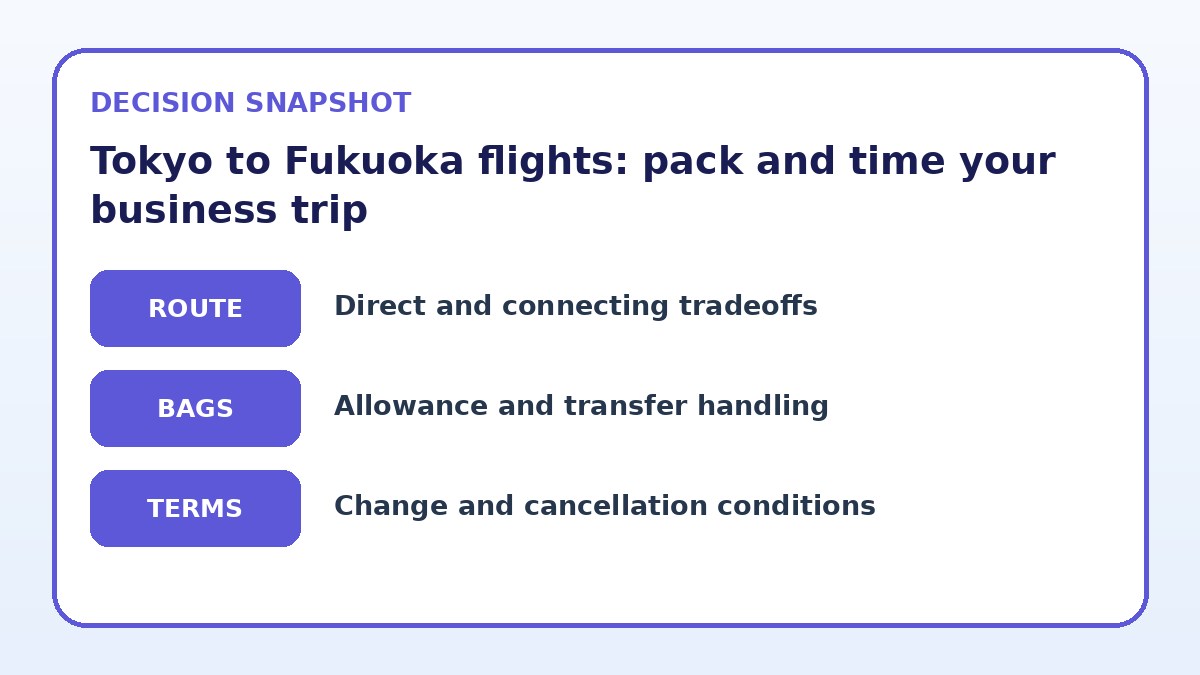
Routing: direct vs connecting and how it affects your day
On Tokyo to Fukuoka routes, the baseline decision is whether to take a direct flight or tolerate a connection. For a business traveler, a direct flight usually reduces schedule risk and often shortens total door-to-door time, especially when airport transfer times from your Tokyo location are considered. If a connection appears faster on a search results page, check the transfer airport, minimum connection time listed by the airline, and whether both flights are on the same carrier or alliance — single-ticket connections reduce the chance of missed connections affecting checked luggage.
Connections can offer greater schedule options or lower fares, but they introduce transfer steps where delays and baggage re-checks add stress. If you choose a connecting itinerary, build a buffer of at least the airline’s recommended minimum connection time plus an extra 30–60 minutes for domestic delays or terminal transfers in Tokyo or at the connecting airport. Before booking, verify baggage transfer guarantees and whether you will need to collect and re-check bags; if not stated clearly, call the airline or check their booking conditions to confirm.
Baggage and connection risk: reducing what can go wrong
Minimizing baggage risk starts with deciding what must travel with you. For fragile equipment, prototypes, or irreplaceable documents, keep them as carry-on if airline size rules allow. For bulkier items that require checking, opt for fares that include checked-bag allowances to avoid last-minute upgrades or multiple fees. If you might make a same-day return or need guaranteed baggage delivery, consider courier shipping for critical items and travel with a compact carry-on containing essentials and backup materials.
Check the airline’s baggage size, weight limits, and carry-on restrictions on the final booking page; these rules vary and change. Also verify how the airline handles transfer baggage on connecting itineraries — some low-cost or mixed-carrier fares require passengers to collect and re-check bags between flights. If your itinerary includes separate tickets, assume you will need to reclaim and re-check checked luggage unless the carriers explicitly offer through-checking. When in doubt, call the carrier; keep receipts and photos of checked items at drop-off for claims.
Compare flight-selection strategies
| Flight strategy | Best for | Risk to check |
|---|---|---|
| Direct, flexible fare with included checked bag | Travelers prioritizing schedule reliability and carrying bulky or essential equipment. | Higher fare and less potential savings compared with restricted tickets; book early for best schedule choice. |
| Direct, carry-on-only restricted fare | Solo travelers with light, compact gear who need the shortest door-to-door time at lowest fare. | Strict baggage limits and change fees can create risk if meeting times shift or extra items are needed. |
| Connecting itinerary with a transfer buffer | Travelers seeking more schedule options or lower fares while accepting some connection complexity. | Longer total travel time and higher baggage-transfer risk; requires careful check of through-check policies. |
| Mixed tickets or separate carriers to lower cost | Experienced planners willing to self-manage tight transfers for potentially better availability. | No through-check of luggage and minimal protection for missed connections; allow substantial ground-time buffers. |
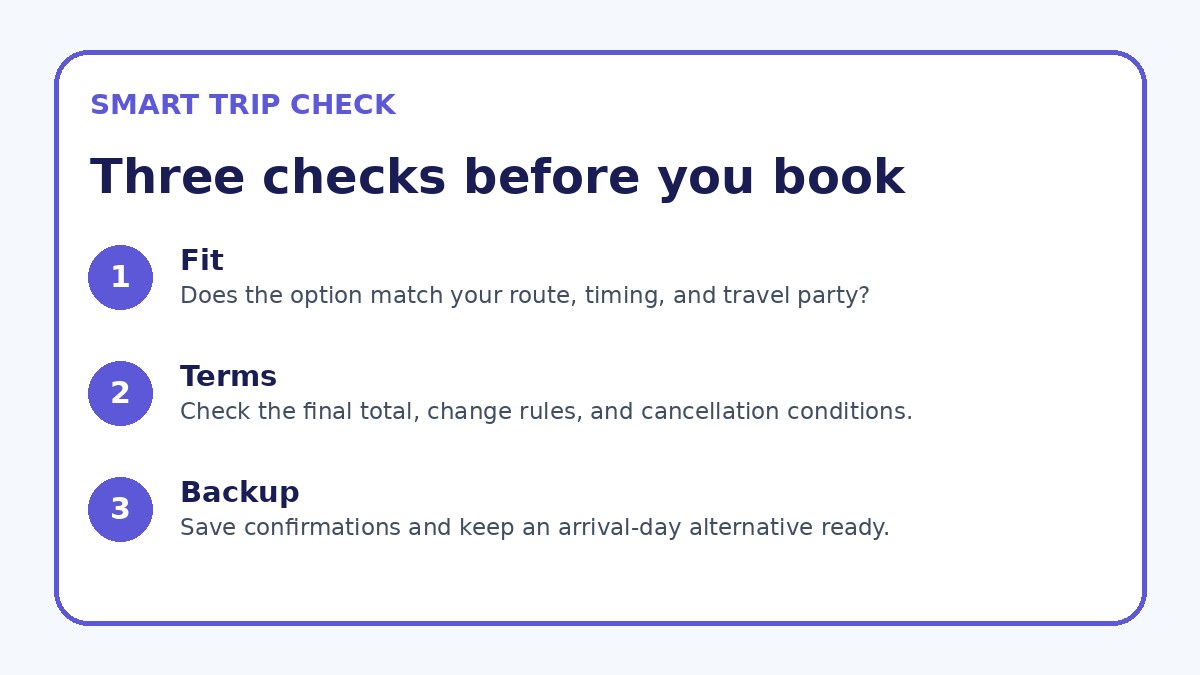
Recheck the complete itinerary
Confirm airports, connection handling, baggage, and change conditions before deciding.
Schedule fit: airport arrival windows and ground time planning
Plan arrival at your Tokyo departure airport with time for security queues, potential document checks, and boarding. For domestic flights in Japan, many business travelers arrive at the airport 45–75 minutes before departure for carry-on-only travel and 90–120 minutes if checking bags. If you have presentation setup, pre-flight briefings, or need time to print or copy materials, add another 30–60 minutes. Peak travel windows — early mornings and late afternoons on weekdays or holiday periods — can extend processing times, so verify local patterns for the specific airport you will use.
At Fukuoka, factor baggage claim, customs only if applicable, and transit from the airport to your meeting location. If your meeting is immediately after arrival, aim for at least 60–90 minutes after scheduled touchdown for direct flights and 90–150 minutes for connecting itineraries where luggage transfer or terminal changes are likely. Use conservative buffers when your meeting has little flexibility. If timing is tight, alternatives include carrying only a briefcase with everything needed or arranging a taxi to save transfer time compared with public transport.
Flight details to verify
- Confirm exact travel dates, departure airport in Tokyo, and meeting start time in Fukuoka before searching fares.
- Note the dimensions and weight of all items you plan to carry and check against the airline’s baggage rules on its booking page.
- Decide whether critical items will travel as carry-on or be shipped separately, and prepare protective packing or courier arrangements if shipping.
- When comparing fares, open and read the carrier’s fare rules for change fees, refundability, and included services before purchase.
- If choosing a connection or separate tickets, add at least 30–60 minutes to the carrier’s minimum connection time for safety.
- Save screenshots or PDFs of your booking conditions and baggage receipts; keep a copy accessible on your phone during travel.
Fare conditions: changeability, baggage, and what to verify before booking
When selecting a fare, compare change and cancellation rules, baggage inclusions, seat assignment costs, and boarding priority. Business travelers often benefit from fares that allow free changes or include a checked bag; these reduce the chance of scrambling if meetings shift. On the booking page, look specifically for the fare’s change fees, deadline for free changes if any, and what forms of identification or corporate discount codes are required to claim benefits. Remember that marketing summaries in search results can hide important restrictions — open the fare rules section on the airline’s final page.
Also confirm whether the fare is refundable or offers travel credits versus cash refunds, what evidence you need to change tickets under corporate policies, and whether the carrier will rebook missed connections on the same ticket. If you are comparing multiple providers or mixed-ticket itineraries, verify whether luggage is protected across segments. Finally, if you use an intermediary such as Trip.com to see availability, always cross-check crucial fare conditions and baggage rules on the airline’s final booking page before completing payment.
Flight Guide questions travelers ask
How early should I arrive at Tokyo airport for a domestic flight to Fukuoka with checked luggage?
For domestic Tokyo departures, aim to arrive earlier than you might assume: plan 90–120 minutes before departure if you are checking luggage and need to print materials or drop off equipment. This window gives time for bag drop, security checks, and any last-minute issues with boarding passes or corporate ticketing. If you’re traveling during a local peak time, add an extra 15–30 minutes. Always confirm the airline’s advised check-in time on the booking page and follow any corporate travel policy requirements.
Can I rely on airlines to transfer checked bags on connecting itineraries between Tokyo and Fukuoka?
Reliance depends on whether all segments are on the same ticket and carrier or their partners. If both legs are on a single ticket with the same airline or within an alliance, checked luggage is usually through-checked; however, some low-cost or mixed-carrier itineraries require bag collection and re-checking. Before booking, verify the baggage transfer policy on the airline’s final booking page or ask the carrier directly. If you have a tight schedule or critical items, prefer a single-ticket direct flight or plan to carry essentials onboard.
What’s the safest way to travel with fragile demo equipment for a meeting in Fukuoka?
Carry fragile demo equipment as a personal item or carry-on if it meets size limits; this keeps it under your control and avoids checked-bag handling damage. Use hard-shell cases, internal padding, and adhesive tags labeling contents fragile. If the item is oversized or too heavy, consider a specialist courier that offers insurance and tracking; arrange delivery to arrive before your meeting. Always verify carry-on dimensions on the airline’s booking page and prepare a backup plan—digital copies or a simpler demonstration—if the equipment is delayed or damaged.
Final decision note
For business travel Tokyo to Fukuoka, the quickest way to reduce risk is to make three concrete choices before searching fares: fix your meeting time and flexibility, inventory what must travel on your person, and decide the minimum acceptable buffer for airport and transfer times. With those decisions in hand, compare direct versus connecting options while focusing on fare rules that include checked baggage or allow changes. Verify all baggage dimensions, transfer policies, and change/cancellation rules on the airline’s final booking page before payment. If you want a quick comparison of availability, Trip.com can be a place to view options, but always confirm the carrier’s terms directly. A small extra buffer in packing and timing will protect your schedule and let you focus on the meeting itself.
Continue planning
Check current options and final conditions
Use the provider page to confirm live availability, the final total, cancellation terms, and every condition that matters to your trip.
This evergreen planning guide was created with AI-assisted drafting and a structured quality review. It does not display live prices, schedules, availability, visa guidance, or provider rankings. Verify current details before booking. Some links are affiliate links; we may earn a commission at no additional cost to you.