Short answer: for most business travelers staying inside Kaohsiung city, driving rarely improves productivity; rent a car only if your schedule includes multiple off-center meetings, out-of-city day trips, or heavy gear. This article gives the practical decision: when driving helps, which fuel and mileage rules matter to your expense report, and exactly what to verify before you click reserve. You’ll get a quick compare of four mobility strategies, a breakdown of common rental contract language to watch for, pickup and return friction points that can waste billable time, and a fallback plan using taxis and public transport. The goal is a defensible, auditable rental choice that keeps travel time predictable and expense claims clear.
Decide whether driving truly improves your Kaohsiung trip
Start by mapping every appointment, meeting location and hotel on a single map and timing routes during the meeting windows. Kaohsiung’s MRT and metrobus network covers the central business and tourist areas efficiently; when meetings cluster around the harbor, Asia New Bay, Sanduo or the central business districts, public transit plus a short taxi trip cuts the uncertainty of parking and city traffic. Also consider meeting start and end flexibility — if your agenda is tight and you need door-to-door control, a rental can reduce wait times caused by taxi availability during off-peak hours or late evenings.
Balance the productivity gains of having a car against the administrative overhead: fuel receipts, mileage logs, and vehicle inspections add time to your travel day. If most legs are under 30 minutes by transit, driving is rarely worth it. Conversely, if your schedule includes visits to Kaohsiung Science Park, rural suppliers outside the city, or same-day cross-city site checks, a rental can keep you on schedule and reduce reliance on local drivers who may not speak your language.
Decide whether driving earns its place
| Mobility strategy | Best for | Cost or friction to check |
|---|---|---|
| Rent a car (self-drive) | Itineraries with several off-MRT site visits or equipment transport in one day. | Adds fuel, mileage and insurance paperwork plus potential downtown parking delays. |
| Hotel or app-based taxis | Single-city, central meetings with unpredictable arrival times or late finishes. | Can be slower during peak demand and harder to expense as a consolidated charge. |
| Public transit plus on-demand taxis | Tight urban schedules where cost predictability and avoiding parking matter most. | Less control for rural or multi-site days and may require more walking between stops. |
| Rental with professional driver | Groups needing door-to-door service, multilingual drivers, or local navigation expertise. | Higher direct cost and potential scheduling dependency on the driver’s availability. |
Check live rental choices only after the route test
Use the exact driver, dates, pickup point, and return plan to compare current conditions.
Fuel and mileage rules: what to find on the booking page
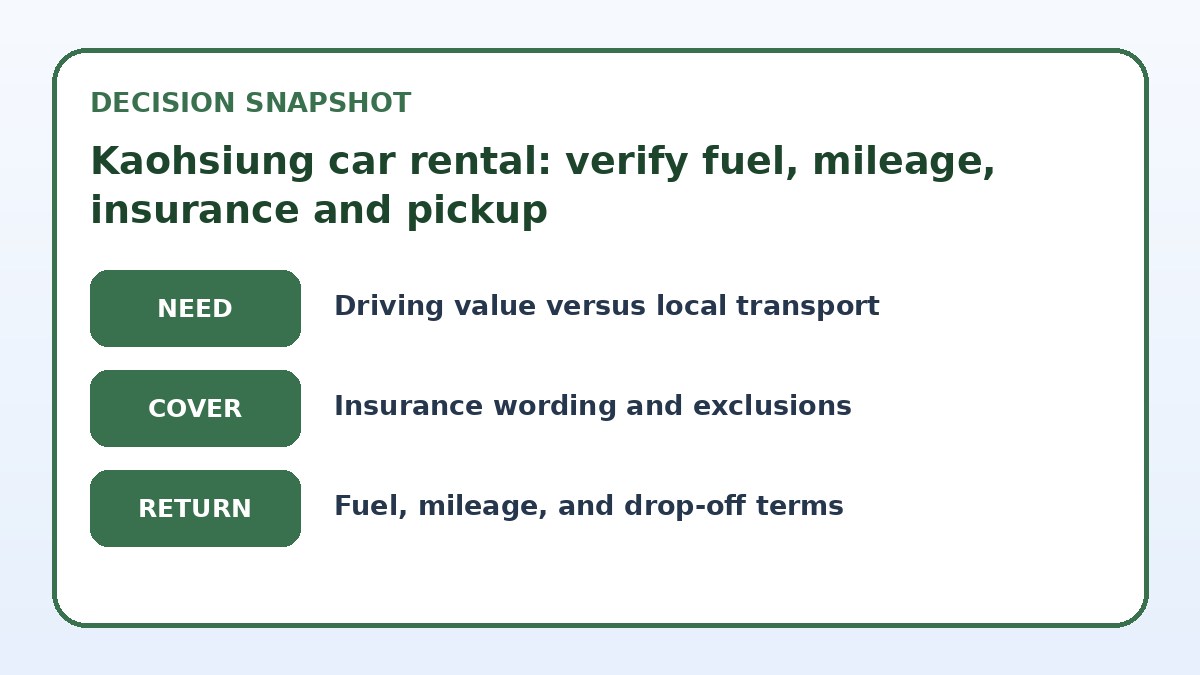
The contract language around fuel and mileage directly affects expense reporting. On the provider’s final booking page, verify whether fuel is charged by a refuel-before-return policy, a pre-purchase (full-to-empty) option, or full-to-full requirement. Note exactly how fuel is measured at return (gauge reading versus official refueling receipt) and whether the company charges an additional refueling service fee or administration fee. For pre-paid fuel, check whether unused fuel is refunded or forfeited — that impacts whether prepay is a convenience or a hidden cost.
Mileage allowance is the second major variable: look for daily or total-kilometer limits, the per-kilometer surcharge beyond the allowance, and whether urban congestion or toll detours count toward limits. Some contracts offer unlimited kilometers for a higher daily rate; others restrict long-distance day trips. For business claims, record odometer readings at pickup and return and save photos; the rental provider’s final page should show how they document odometer readings and what evidence they accept in disputes.
Compare the full rental conditions
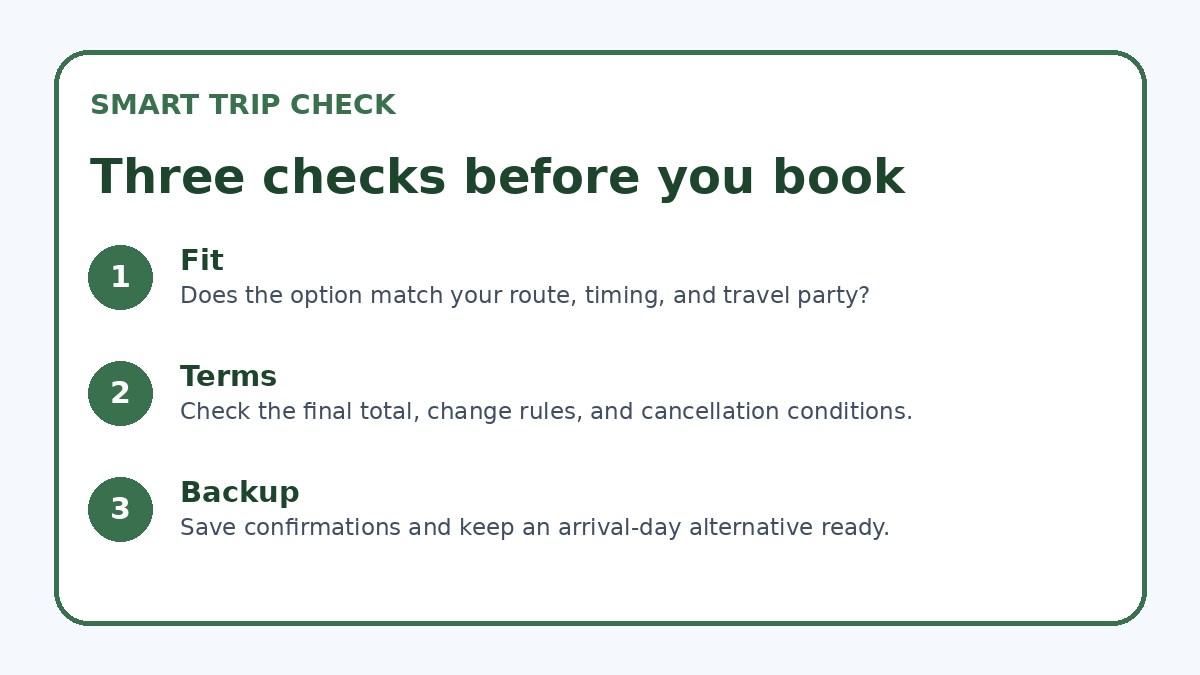
Confirm insurance wording, exclusions, deposit, fuel, mileage, and return terms on the final page.
Insurance wording and pickup/return friction to avoid surprises
Insurance descriptions can be deceptively similar while leaving important gaps. On the booking page, read the exact coverage limits for collision damage waiver (CDW), loss damage waiver (LDW), and third-party liability. Confirm whether CDW has a deductible or excess amount that your company will reimburse and whether additional driver names are permitted without extra premiums. Also verify cross-border restrictions if you have meetings in outlying counties; some policies exclude travel across certain administrative boundaries or onto specific types of roads.
Pickup and return logistics are frequent hidden costs for business travelers. Check whether the rental desk is inside the airport terminal or off-site with a shuttle. Off-site pickups add variable shuttle wait time and can cost billable minutes. Confirm after-hours return procedures, where to leave keys, and how the company documents fuel level and damage at drop-off. Photograph the vehicle and note the fuel gauge and odometer at pickup to avoid disputes; the booking page should describe the inspection process and provide contact numbers for immediate reporting.
Car rental terms to verify
- Map all meeting and hotel addresses and estimate transit times during scheduled windows to justify renting or not.
- On the booking page, copy the exact wording about fuel policy: full–full, prepay, charges for missing fuel, and refund rules.
- Record and photograph odometer and fuel gauge at pickup and return; save timestamps and inspection forms for expense claims.
- Confirm mileage limits and per-kilometer fees, or select an unlimited-kilometer option if your itinerary includes long day trips.
- Copy the insurance clauses: deductible amounts, liability caps, additional driver rules, and any geographic or road-type restrictions.
- Verify pickup/return location and hours, shuttle needs, after-hours drop-off process, and local emergency contact numbers.
Non-driving fallback and when to choose alternatives
Have a clear fallback to avoid being stranded without a plan. For central Kaohsiung days, combine MRT routes with short taxi legs: use the MRT for predictable travel times between hubs and taxis for first/last mile or late-night trips. Rideshare-like services and local taxi apps operate widely; compare surge patterns during evening conferences and events. If you must transport materials, book a commercial courier for bulky items instead of upsizing your rental just for one leg.
When multiple team members travel together, weigh a single rental versus reimbursing taxis for separate legs. Also consider hiring a driver-for-hire through a corporate travel agency if navigating local roads or parking is likely to cost time or language resources. Whatever fallback you choose, document expected costs and timelines in your itinerary so approvers can compare the operational value of a rental versus alternative mobility with confidence.
Car Rental & Road Trip questions travelers ask
Do I need to return fuel at the same level when renting in Kaohsiung?
Policies vary by provider. Some require returning the tank to the same level (full-to-full), others offer a pre-purchase option where you buy fuel ahead and return empty, and some apply a refueling charge if you don’t refill. Always check the company’s final booking page for the exact policy, the unit they use for measurement, and whether they accept a local fuel receipt as proof. Photograph the gauge at pickup and drop-off to prevent disputes.
How strict are mileage limits and how should I track them for expense claims?
Mileage limits can be daily or total for the rental period and often carry a per-kilometer surcharge if exceeded. To protect your expense claim: note the odometer reading at pickup and return, photograph it, and keep these images with the rental agreement and fuel receipts. If your itinerary likely exceeds limits, choose an unlimited-kilometer option or negotiate a higher allowance and get that confirmed in writing on the booking page.
What insurance wording should I verify before approving a business rental?
Look for explicit terms covering collision damage waiver (CDW) or loss damage waiver (LDW), any excess/deductible amounts, and third-party liability limits. Verify whether the CDW removes the excess or only reduces it, and whether additional drivers, cross-border travel, or commercial use (like carrying samples) are excluded. Ask the rental provider to show the clause that allows you to add corporate insurance or a credit-card provided coverage, and save that confirmation from the booking page for your records.
Final decision note
For business travel in Kaohsiung, drive only when the itinerary has clear, repeated out-of-transit legs, heavy equipment movement, or strict time windows that public transport can’t meet. If you rent, focus your due diligence on fuel policy wording, mileage allowances, insurance deductibles, and pickup/return friction — those items create most expense disputes. When in doubt, plan a fallback using MRT plus taxis or a driver-for-hire and document the cost comparison in your travel authorization. Before you finalize any booking, verify the exact policy language on the provider’s final page and keep photographic evidence of odometer and fuel levels at both ends.
Continue planning
Check current options and final conditions
Use the provider page to confirm live availability, the final total, cancellation terms, and every condition that matters to your trip.
This evergreen planning guide was created with AI-assisted drafting and a structured quality review. It does not display live prices, schedules, availability, visa guidance, or provider rankings. Verify current details before booking. Some links are affiliate links; we may earn a commission at no additional cost to you.