If you’re traveling to Dubai with extra luggage, deciding whether to rent a car hinges less on daily transport and more on pickup and return logistics. Practical questions—where you collect the vehicle, how much luggage fits in the contracted vehicle, whether equipped child seats or roof boxes are permitted, and how return inspections treat crowded trunks—can add time, cost, or stress to arrival and departure. In many Dubai itineraries driving adds flexibility for day trips or distant hotels, but only if the pickup and return process is straightforward and the rental company’s terms clearly allow your luggage plan. This article gives the practical answer up front: rent a car only if the pickup location, vehicle allowance, and return inspection terms explicitly accommodate your extra bags; otherwise use alternatives detailed below. After the summary you’ll find tradeoffs, what to look for in booking terms, pickup/return friction points, and mobility comparisons to help you choose.

Route value: when driving adds real benefit
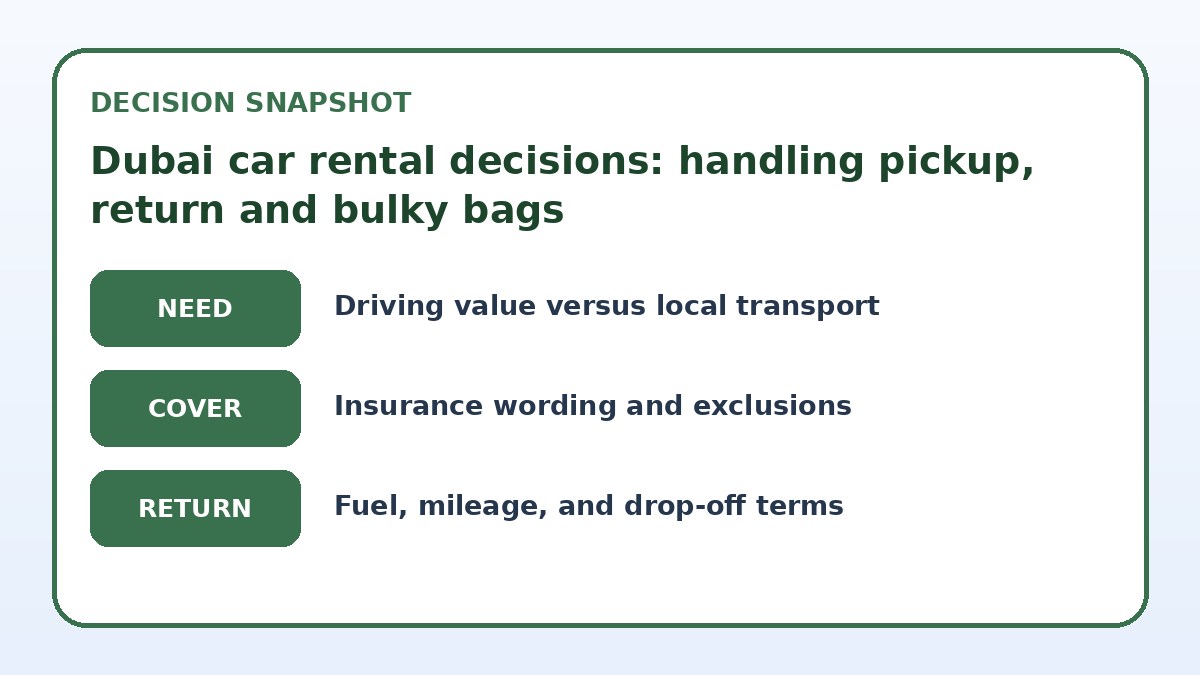
Decide whether driving actually improves your Dubai itinerary by weighing destinations, luggage volume, and timing. Driving is most valuable when you plan day trips beyond Dubai’s metro-connected areas—desert drives, Abu Dhabi, or coastal routes where public transit is slow or indirect. If your hotels are scattered across different suburbs or you’re visiting multiple sites in one day with bulky gear (sports equipment, photography cases, musical instruments), a car can save repeated taxi fares and scheduling delays. Think in terms of door-to-door convenience: will the car let you carry your kit without multiple transfers or oversized-item fees on other transport?
Conversely, if you’re staying centrally—Marina, Downtown, or the Creek area—and most activities are within well-served metro and taxi zones, the marginal value of a car falls. Dubai traffic and paid parking can offset the benefit, but that’s secondary to the pickup/return problem: if collecting and returning the vehicle with bulky bags costs hours or exposes you to extra inspection charges, those hidden costs can outweigh any on-road convenience. Use the route value test: if driving saves significant transfers or unlocks places you can’t easily reach otherwise, it’s worth pursuing; otherwise consider alternatives.
Decide whether driving earns its place
| Mobility strategy | Best for | Cost or friction to check |
|---|---|---|
| Rental car with airport pickup | Travelers needing private mobility from arrival and returning directly to the airport | May face long queues, strict inspection, and luggage-fit uncertainty at pickup and return |
| Rental car with off-airport delivery | Those who want a quieter handover and help loading bulky items at a private meet point | May require a short transfer to the lot and depends on provider meeting services and schedules |
| Private airport transfer or taxi | Groups with extra luggage who want guaranteed assistance loading and unloading | Less flexible for day trips; cost can rise for long or multi-stop itineraries |
| Public transport plus luggage-forwarding | Travelers prioritizing hassle-free inspections and minimal vehicle responsibility | Adds coordination and delivery lead time; not ideal for immediate or remote-destination travel |
Check live rental choices only after the route test
Use the exact driver, dates, pickup point, and return plan to compare current conditions.
Insurance wording and coverage pitfalls
Read insurance and damage liability sections with luggage in mind. Standard collision-damage waivers and third-party liability cover the car, not unsecured loose items or damage to luggage caused by improper storage. Some policies exclude damage caused by carrying oversized items or by roof-rack use without provider permission. Verify whether theft cover applies when items are left in the vehicle and whether there are stipulations about hidden storage or overloaded trunks. For high-value items, consider separate travel insurance that explicitly covers checked equipment or items stored in rental vehicles.
When comparing add-ons, distinguish between damage excess reduction and actual coverage for belongings. A fee that reduces your excess on the vehicle won’t necessarily replace lost or damaged luggage. Ask providers how they handle claims for items damaged during loading or that fall out of luggage compartments at return inspection. On the final booking page, confirm exact wording for exclusions, roof-box permissions, and whether the provider requires pre-approval for non-standard cargo—these specifics determine how safe it is to transport extra bags in your rented car.

Compare the full rental conditions
Confirm insurance wording, exclusions, deposit, fuel, mileage, and return terms on the final page.
Pickup and return friction: what creates delays and charges
Pickup friction often arises from airport counter queues, vehicle inspection steps, and the need to load bulky bags into a car type that doesn’t comfortably fit them. Know whether the rental company requires an in-person pre-drive inspection, whether you can document existing scratches or dents with photos, and whether airport-to-vehicle transfers are handled by provider shuttles that can be crowded with luggage. If the provider offers meet-and-greet delivery to an airport curb or a baggage claim meet point, that can significantly reduce handling time—but you must confirm that the agent can help load heavy or awkward items.
Return friction centers on inspection procedures and after-hours drop-off. Some companies require you to present the vehicle for a supervised inspection; others accept key-drop but retain the right to charge for damage noted later. If your trunk is packed at return, the agent may request you empty it to check the interior, slowing the process and risking fees if items obstruct the inspection. Confirm whether they charge for excessive cleaning or overloaded cargo, ask about late-return inspection timeframes, and confirm where to leave documentation or photos if you use an unattended return option.
Car rental terms to verify
- Before booking, confirm trunk dimensions and permitted roof-rack or roof-box options in the vehicle description or provider terms.
- Ask the provider how they perform pickup and return inspections and whether you can document the vehicle condition with time-stamped photos.
- Verify in writing whether theft and luggage damage are covered by rental insurance or require separate travel insurance.
- If picking up at the airport, check the exact counter location and typical shuttle or walk time from the terminal to the car lot.
- Confirm the provider’s after-hours return procedure and whether unattended key-drop could trigger later charges.
- When booking, request confirmation that staff will assist with loading oversized items and note any extra handling fees.
Non-driving fallback: when to use alternatives
If pickup/return terms don’t clearly accommodate your luggage, choose a non-driving fallback. Airport-to-hotel private transfer services can handle bulky luggage: drivers assist with loading and unloading and often provide larger vehicles suited to gear. Shared airport transfers and taxis are flexible for immediate city transfers but confirm upfront about luggage fees or space limitations. For intercity travel, a combination of coach or private shuttle services offers predictable handling for large items without the inspection and insurance concerns of a rental car.
Ridesharing or local taxi apps provide point-to-point convenience with no inspection at departure or return, but be explicit about the number and size of items when you request a vehicle. Luggage-forwarding services are another option when you want to minimize what you carry between transport legs: they pick up and deliver your bags separately, letting you travel light. Choose a fallback based on how much assistance you need with loading and whether you prefer to avoid any vehicle inspection at the end of your stay.
Car Rental & Road Trip questions travelers ask
Will a rental car’s trunk usually fit sports or musical equipment without extra fees?
Trunk capacity varies widely by vehicle category and the provider’s definition of allowed cargo. Many compact and mid-size cars handle a couple of suitcases but not bulky sports equipment or large instrument cases. Providers sometimes allow roof-racks or roof-boxes for an extra fee but require explicit permission and properly rated accessories. Always compare stated trunk dimensions, ask whether the provider supplies roof equipment, and verify any additional charges or insurance implications on the booking confirmation page.
How do providers typically handle damage claims related to luggage during return inspection?
Most providers note existing damage during the initial inspection and expect the vehicle to be returned in a similar state. If luggage causes interior scratches, stains, or tears, those can be recorded as damage and billed to you. The outcome depends on documented pre-rental condition, whether items obstructed inspection, and the provider’s claims procedures. To protect yourself, take comprehensive photos at pickup and return, keep inspection checklists, and get written confirmation of any pre-existing interior issues.
What should I verify on the final booking page before confirming a Dubai car rental?
On the final booking page, confirm pickup location and hours, permitted driver list, exact vehicle class or trunk dimensions, roof-rack availability and costs, insurance inclusions and exclusions, excess amounts, and the provider’s return inspection and after-hours drop-off policy. Also check whether curbside meet-and-greet, shuttle transfers, or loading assistance are offered. If any luggage-related detail is unclear, request written confirmation from the provider; Trip.com can be used to compare current availability but always verify terms on the rental supplier’s final page.
Final decision note
Travelers with extra luggage should treat Dubai car rental decisions as logistical projects, not routine bookings. The single deciding factor is whether pickup and return terms explicitly accommodate your bags and related handling—if they do, driving can unlock flexibility for day trips and remote stays. If terms are ambiguous or inspection procedures are strict, choose alternatives that guarantee assistance and remove vehicle-inspection risk. Always verify trunk capacity, roof equipment permissions, insurance exclusions, and the provider’s exact pickup/return procedures on the final booking page before committing. With those checks done, you’ll avoid surprises and know whether driving truly improves your trip.
Continue planning
Check current options and final conditions
Use the provider page to confirm live availability, the final total, cancellation terms, and every condition that matters to your trip.
This evergreen planning guide was created with AI-assisted drafting and a structured quality review. It does not display live prices, schedules, availability, visa guidance, or provider rankings. Verify current details before booking. Some links are affiliate links; we may earn a commission at no additional cost to you.