If you’re heading from Taipei to Kaohsiung, the practical decision is less about speed alone and more about how stations and terminals fit into your door-to-door plan. Choose a high-speed rail (HSR) or conventional train if you want fast city-to-city connections with simple transfers; choose intercity coach for direct hotel-to-hotel drops near bus terminals; or mix modes when your accommodation or schedule demands it. This article focuses on planning the transfers at each end—which station or terminal to aim for, how to manage luggage and onward connections, and what to do if your chosen link is delayed or canceled. Read on to compare the transfer friction, timing flexibility, and end-to-end practicality of the main approaches so you can pick the option that suits your luggage, mobility, and arrival/departure locations.
Choosing between HSR, conventional rail, and coach
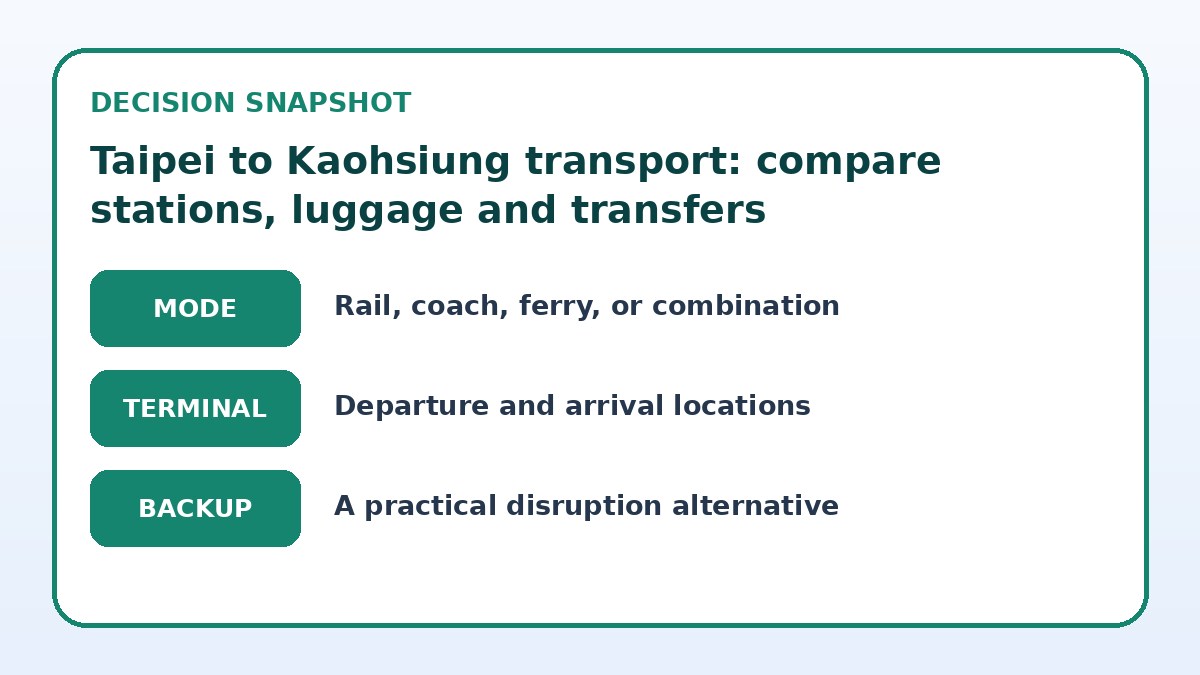
Start by mapping where you need to be in each city rather than picking a mode by speed alone. High-speed rail (HSR) links Taipei and Kaohsiung via large terminals that are easy to reach from central neighborhoods and often integrate with local metro lines or shuttle buses. Conventional trains (TRA) stop at multiple city stations, which may place you closer to a particular neighborhood or hostel. Intercity coaches typically serve dedicated bus terminals and can be advantageous if your hotel is near that terminal or if you want a single-seat transfer with luggage stored onboard. Compare door-to-door time by adding transfer times, waiting, and first/last-mile travel rather than just the in-vehicle travel time.
Also consider frequency and flexibility: coaches can offer direct routes without transfers between some neighborhoods, while rail services tend to have regular scheduled departures throughout the day. If your schedule is tight or non-refundable, higher-frequency services reduce the risk of missing a connection. If you travel with bulky luggage or mobility devices, check how each terminal handles loading and whether there are step-free routes from platform to street. Finally, if you plan to use local metro or rideshares at either end, choose the station that simplifies that onward leg rather than the fastest intercity option in isolation.
Choose the end-to-end journey plan
| Journey approach | Best for | Friction to check |
|---|---|---|
| High-speed rail (HSR) to main HSR station | Travelers prioritizing short in-vehicle time and easy metro links at major terminals. | Larger stations may require longer walks and handling crowded concourses with luggage. |
| Conventional rail (TRA) to local city station | Those who need to arrive near a specific neighborhood or want lower terminal walking distance. | More stops and potentially longer journey times compared with HSR; verify platform accessibility. |
| Intercity coach to central bus terminal | Visitors seeking single-seat trips with dedicated luggage storage and direct terminal drops. | Terminal-to-hotel connections may add taxi or metro time if the bus terminal isn’t centrally located. |
| Mixed-mode: combine train and local coach or taxi | Travelers matching schedules to specific hotels or attractions not served directly by one mode. | More transfers increase disruption risk and require careful timing and luggage planning. |
Check live intercity options
Look beyond the ride itself and compare terminals, transfers, luggage, and arrival fit.
Terminal fit and on-the-ground transfer friction
Terminal fit means how well a station’s layout, exits, and local transport links match your real arrival and departure points. Large HSR stations usually have clear signage, multiple exits linked to metro lines, and taxi ranks—but they can be busy and require walking across concourses. Smaller TRA stations might be closer to older neighborhoods but can lack elevators or escalators, increasing friction if you have heavy bags. Bus terminals often concentrate services and waiting areas but can be farther from metro lines. Before you book, check station maps and nearby public transport connections to avoid an extra taxi ride that erodes any time or cost advantage.
Think about luggage handoff: is there porter service, wide lifts, or only stair access between platforms and exits? If you rely on public transit, look for step-free transfer routes between platform, ticketing, and the metro. If you prefer taxis, identify the official taxi ranks and expect to queue during peak arrival windows. For late-night arrivals verify that your onward options (metro, buses, or shared-ride services) are operating; otherwise a pre-booked airport-style transfer or a hotel shuttle may be your practical fallback.
Timing flexibility and planning your connection windows
When planning, build realistic buffers for ticket collection, security lines, and navigating large terminals. Even with frequent services, allow at least 20–40 minutes for changing between a long-distance platform and a local metro or bus, more if you’re unfamiliar with the station layout. If you have strict check-in or tour times at your destination, choose a departure that leaves comfortable slack for unexpected delays. Travel later in the day can be affected by commuter peaks in both cities, so avoid scheduling a tight transfer during morning or evening rush hours if possible.
For single-seat journeys like some coaches, the barrier to missed connections is lower because you won’t need to change vehicles; however you trade that for fewer departure times. If you’re comparing direct versus connecting options, tally the worst-case delay for each leg and the minimum safe transfer time at each terminal to decide which risk profile you prefer. Keep a mobile, printable copy of your booking and station exit maps so you can reroute quickly if the station layout or signage confuses you.
Compare the practical alternatives
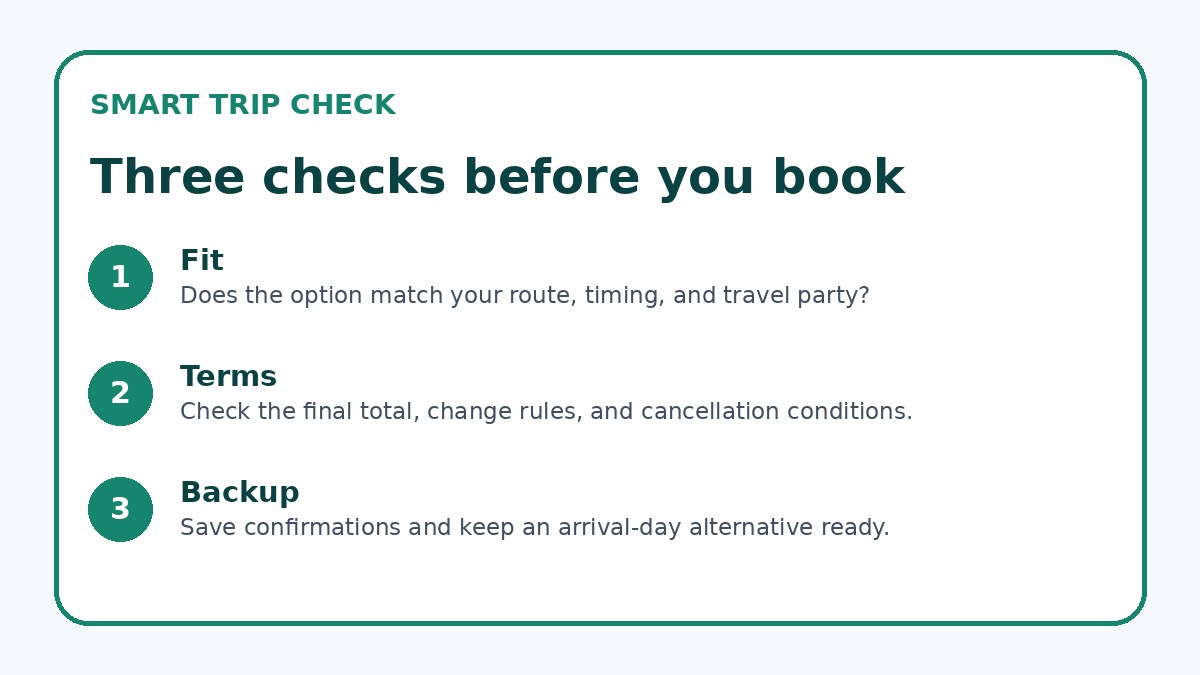
Use the final page to confirm what is actually offered on your dates and save a workable fallback.
Intercity travel checklist
- Identify the exact station name and preferred exit near your hotel and save a station map screenshot to your phone.
- Confirm step-free routes and elevator locations if you travel with heavy luggage, a pushchair, or mobility aid.
- Book a flexible ticket or choose a service with multiple daily departures to make room for unexpected delays.
- Note official taxi ranks and rideshare pick-up points at both arrival and departure stations before you travel.
- Share your planned arrival station and a secondary meeting point with your hotel or pickup contact.
- Keep the transport operator’s customer service number and a backup route (coach or taxi) saved for quick rebooking.
Disruption backups and last-mile practicalities
Plan at least two fallback options: a later scheduled service on the same mode, an alternate mode that serves the same corridor, and a taxi or rideshare route. For instance, if your HSR is delayed or sold out, a conventional TRA service or an intercity coach can often get you to the same city with a different terminal. Identify which nearby station or terminal offers these alternatives and how long a taxi or metro transfer would take between them. If you rely on pre-booked ground transfers or hotel shuttles, get the provider’s contact details and their instructions for late arrivals.
Communicate contingency plans with anyone meeting you at the destination or with your accommodation. Share likely arrival stations and a secondary meeting point near a recognizable station exit or landmark. If you have time-sensitive commitments in Kaohsiung, consider booking a flexible ticket or leaving an intentionally larger buffer when you plan to disembark. Lastly, check live availability and conditions on the provider’s final booking page before you buy; Trip.com can be used as one place to compare options, but verify schedules and entry rules directly with the transport operator once you’re ready to book.
Rail & Intercity Transport questions travelers ask
Which station should I aim for in Taipei if my hotel is in Xinyi or near Taipei 101?
If your accommodation is in the Xinyi / Taipei 101 area, prioritize stations with simple metro connections rather than only the fastest intercity option. HSR terminals and some TRA stations connect to the MRT network; pick the station that gives you a one-seat metro ride or a short taxi to Xinyi to avoid extra transfers. Before you book, check the station’s metro line map and the walking route from the station exit to your hotel. If you prefer to avoid transfers entirely, find coach services or direct taxi routes and compare door-to-door time rather than just in-vehicle duration.
How much time should I allow between arriving in Kaohsiung and meeting someone at the hotel?
Allow a buffer that covers time to disembark, collect luggage, and travel from the platform to the street—typically at least 30–60 minutes for major stations, more if unfamiliar or during peak periods. If you must make a short appointment or check-in by a fixed time, choose an arrival that leaves extra slack, and communicate your planned station and exit to the person meeting you. For late-night arrivals confirm whether your hotel provides a shuttle or whether you should pre-book a taxi to avoid waiting without public transit options.
If my chosen train or coach is delayed, how do I replan quickly?
First, check whether the operator allows ticket changes or rebooking and what nearby departures are available. Identify an alternate terminal or mode — for example, a later HSR, a conventional train, or an intercity coach — and estimate the taxi or metro transfer time between terminals. If you need immediate onward travel, be ready to grab a taxi and have pay or digital payment ready. Keep the provider’s customer service contact accessible and use local transport apps or maps to compare real-time connections; if needed, reach out to your hotel to update arrival plans or request a late check-in.
Final decision note
Planning Taipei to Kaohsiung transport well means thinking beyond ride time to the transfer reality at each terminal. Match the station to your actual start and end points, account for luggage and accessibility, and build realistic buffers for transfers and peak crowds. Choose the mode that minimizes door-to-door friction: HSR for fast city-center links with metro access, TRA for neighborhood-level drop-offs, coaches for single-seat convenience, or a mix when needed. Before booking, verify schedules and station maps on the operator’s final booking page and save a fallback plan so a delay won’t derail your itinerary.
Continue planning
Check current options and final conditions
Use the provider page to confirm live availability, the final total, cancellation terms, and every condition that matters to your trip.
This evergreen planning guide was created with AI-assisted drafting and a structured quality review. It does not display live prices, schedules, availability, visa guidance, or provider rankings. Verify current details before booking. Some links are affiliate links; we may earn a commission at no additional cost to you.