For business travelers moving between Mexico City and Puebla, the practical answer is: pick the mode that minimizes door-to-door friction for your schedule, luggage and meeting time, then build a timing buffer and a clear backup plan. The main choices are private car or taxi transfer, intercity coach, and any available rail or shared shuttle combinations; each differs in where it picks you up and drops you off, how much handling your luggage requires, and how reliably it meets strict meeting schedules. Start by mapping exact origination and destination addresses, then compare options by total travel chain time (including transfers) rather than just the in-vehicle leg. Plan for traffic variability, arrival buffer at your meeting, and a contingency option you can activate without spending hours rebooking. Below are decision criteria, terminal and luggage considerations, timing tactics, and practical backups to get you to that meeting on time and with less stress.
Choosing between car transfer, coach, rail, and shuttles
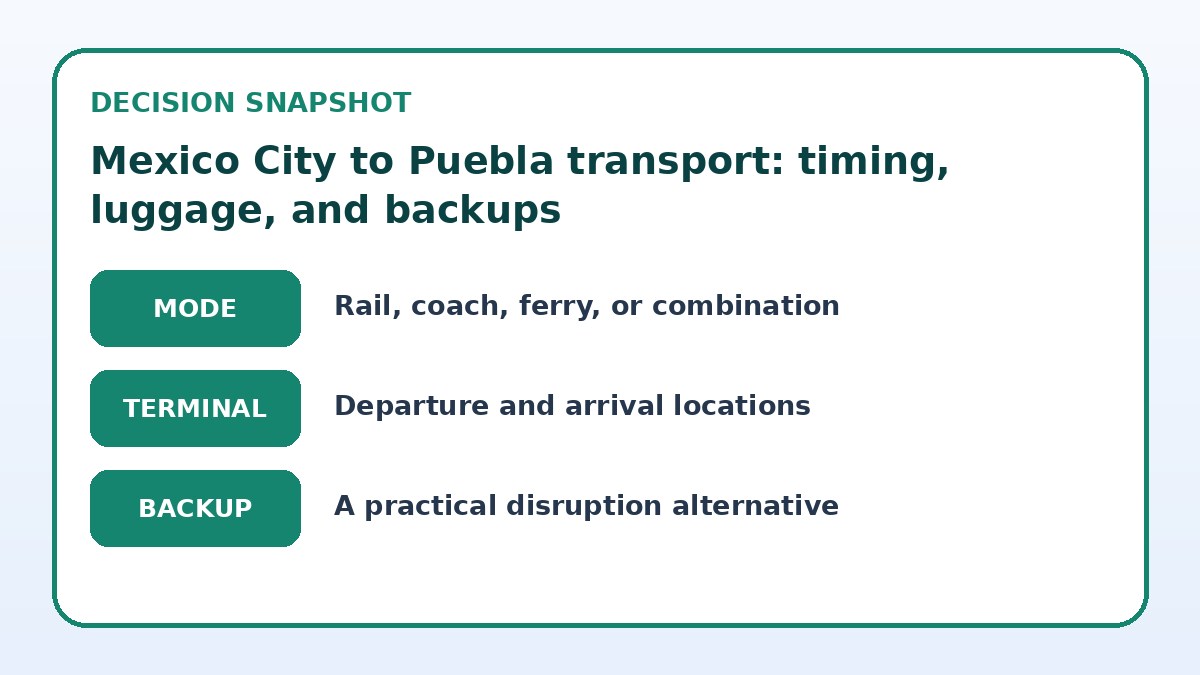
When deciding a mode, evaluate the entire door-to-door chain rather than just vehicle travel time. A private car or prebooked transfer usually starts at your hotel or office and drops you at the meeting address, reducing physical transfers and time spent handling luggage. Intercity coach services often run from fixed terminals; they can be comfortable and frequent but require a transfer to and from each terminal that may add taxi time and uncertainty. If a rail option exists, compare station locations to your start and end points: if stations are out of the way, the total chain may be longer despite faster track speeds.
Shuttle or shared-ride services can be a middle ground: they may be cheaper than private transfers and more direct than large-terminal coaches, but they sometimes involve intermediate stops that complicate timing. For business travel, prioritize predictability and low transfer count; it is often worth paying a little more for a transfer that guarantees door-to-door pickup and delivery. When comparing, list addresses, check typical transfer rides to and from terminals, and time each segment to understand the real total travel window you are committing to.
Choose the end-to-end journey plan
| Journey approach | Best for | Friction to check |
|---|---|---|
| Private door-to-door transfer | Direct pickup/drop, minimal luggage handling, fixed schedules | Typically higher cost but lower transfer friction and simpler logistics |
| Intercity coach from main terminal | Frequent departures and predictable vehicle-level comfort | Requires last-mile taxi or shuttle to final address, adding uncertainty |
| Shared shuttle or point-to-point shuttle | Balanced price and direct routing for moderate luggage | May include intermediate stops that affect strict meeting times |
| Self-drive or rental car | Maximum schedule control and last-mile flexibility | Driver responsibility, parking, and potential urban traffic complexity |
Check live intercity options
Look beyond the ride itself and compare terminals, transfers, luggage, and arrival fit.
Terminal fit and luggage handling
Terminal fit matters for the business traveler: does the service pick up at your hotel door, at a curbside lane, or at a distant bus or rail station? Fixed terminals require planning for check-in, potential security queues, and last-mile onward travel. If you have carry-on only, a short walk with a rolling bag may be acceptable; with larger suitcases or presentation materials, prioritize options offering baggage handling or curbside pickup to avoid juggling bags through terminals and taxis.
Ask whether transfers include loading help and where drivers will meet you on arrival—street-level, a station concourse, or a designated bay. For coach and rail, verify if luggage is stored under the vehicle and whether you must wait at a claim area. For private transfers, confirm maximum luggage allowances and vehicle size, especially for teams traveling together or carrying equipment. When booking, always re-check pick-up/drop-off instructions on the provider’s final booking page and save the contact number for on-the-day questions.
Timing flexibility and scheduling your workday around travel
Build your schedule around realistic travel windows. Start by estimating the travel chain and add a conservative buffer for traffic and delays—this matters most in weekday morning and late-afternoon rush hours. If you have an immovable meeting, plan to arrive at least 30–45 minutes early to allow time for finding the meeting room, a quick refresh, and any registration or security formalities. Business travelers should consider whether the outbound option allows an easy return should meetings overrun, or whether you need to prebook a round-trip transfer with flexible timing.
If you rely on public-terminal services, choose departures that leave you margin to recover from unexpected hold-ups, and avoid tight connections that require hopping between different providers within a short time. Consider starting earlier the first time you take a new route so you learn actual transfer times. Keep calendar comments with agreed windows and include contact names and phone numbers for your driver or agent. When possible, pick a travel option that gives you work-friendly time onboard—stable internet, space to set up a laptop, and power—so you can make productive use of transit time.
Compare the practical alternatives
Use the final page to confirm what is actually offered on your dates and save a workable fallback.
Intercity travel checklist
- Map exact start and end addresses and estimate door-to-door travel times for each option.
- Confirm where each service loads and unloads, and identify the short walk or taxi needed at each end.
- Prebook a transfer with a clear pickup window or reserve the earliest reliable coach and note its terminal details.
- Save contact details for your driver, operator, and a local taxi company for a quick backup.
- Pack essential meeting materials in carry-on so a delayed checked bag won’t disrupt the agenda.
- Share expected arrival time and a live-check-in plan with meeting hosts and colleagues.
A realistic disruption backup and day-of communications
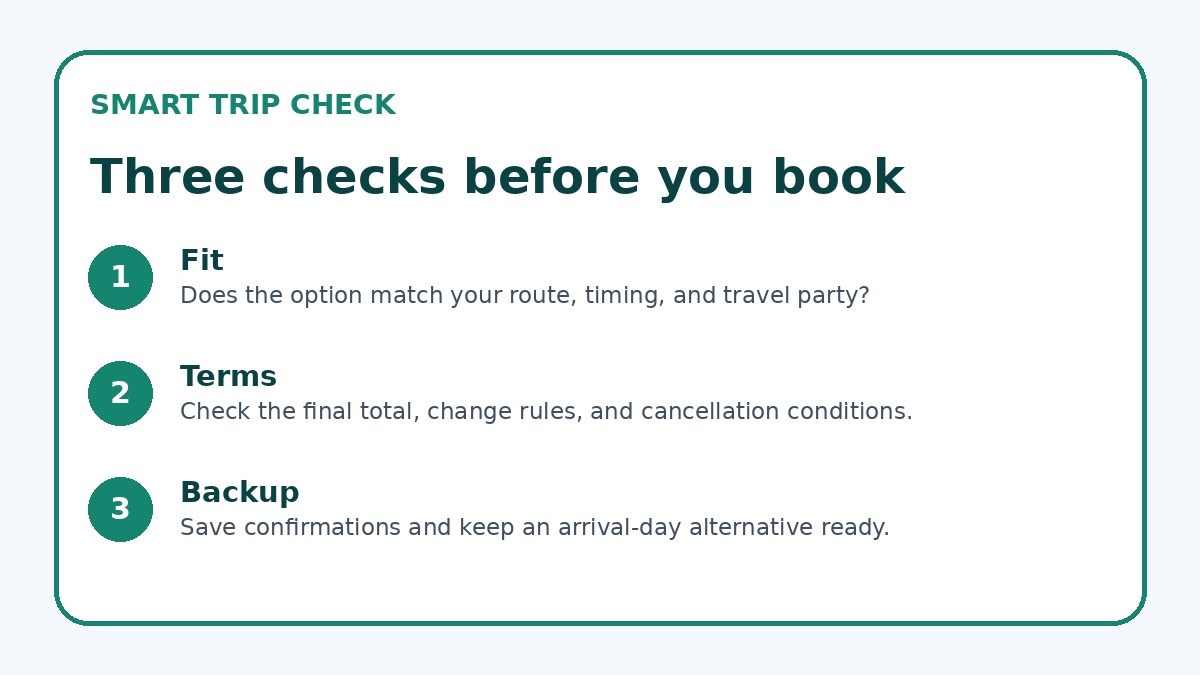
A practical backup plan is a pre-identified, bookable alternative you can activate quickly: this could be a ride-hail contact saved in your phone, the next coach or shuttle departure with confirmed space, or a local taxi operator you have used before. Keep these alternatives ready and know their typical pickup points and costs so you can decide without delay. If your main booking has a cancellation policy, understand whether same-day rebooking is straightforward or if you should purchase a flexible ticket for peace of mind.
On travel day, communicate expected arrival times with colleagues and meeting hosts, and set check-in points with your driver or agent. Share live-tracking links if offered, or send brief SMS updates at key stages—departure, halfway, and when near the destination. Carry printed and digital copies of booking confirmations and key addresses, and ensure your mobile data plan or local eSIM is operational; poor connectivity makes managing backups far harder. Trip.com can be used as an option to compare current availability, but always verify final terms on the provider’s booking page before committing.
Rail & Intercity Transport questions travelers ask
What is the fastest way to get from Mexico City to Puebla for a morning meeting?
Speed depends on where you start and where the meeting is in Puebla. A private transfer that picks you up at your hotel and drops you at the meeting address minimizes transfers and walking time, often making it the fastest door-to-door choice despite variable road traffic. If you prefer public services, choose an early coach that gives you margin for last-mile travel; verify terminal locations and add a traffic buffer. Always check the provider’s final booking page for pickup details and real-time departure options before planning your meeting arrival time.
How much time should I allow for last-mile transfers once I arrive in Puebla?
Allow at least 20–45 minutes for last-mile transfers depending on where a bus or train drops you and how close your meeting is to the terminal. If the service drops you directly in the central business area, the last-mile may be a short taxi or walk. From outlying terminals, factor in time for baggage retrieval, finding a licensed taxi or rideshare, and navigating local streets. For critical meetings, plan to arrive at the final building 30–45 minutes early to handle reception, check-in, and any prep.
How do I choose between booking a private transfer and using an intercity coach?
Decide by weighting door-to-door time, luggage needs, and schedule certainty. Choose a private transfer if minimizing transfers and handling luggage smoothly are top priorities and you need direct pickup and drop-off. Use an intercity coach if you prefer potentially lower cost and frequent departures, and if you have light luggage and a reliable last-mile plan. Compare total chain time for each option and confirm pickup/drop instructions on the provider’s final page before booking; that confirmation tells you whether the coach or transfer truly fits your schedule.
Final decision note
Business travel between Mexico City and Puebla is less about the in-vehicle speed than how the journey fits your schedule, luggage, and meeting needs. Focus on door-to-door logistics: choose the option that reduces transfers, secures reliable pickup and drop-off points, and leaves room for traffic and check-ins. Prepare a realistic timing plan, pack strategically for quick arrival, and keep a clearly defined backup ready to activate. Verify pick-up and drop-off details on booking pages, save provider contacts, and communicate expectations with hosts. With those steps you’ll convert a potentially stressful travel day into a predictable, manageable part of your work itinerary.
Continue planning
Check current options and final conditions
Use the provider page to confirm live availability, the final total, cancellation terms, and every condition that matters to your trip.
This evergreen planning guide was created with AI-assisted drafting and a structured quality review. It does not display live prices, schedules, availability, visa guidance, or provider rankings. Verify current details before booking. Some links are affiliate links; we may earn a commission at no additional cost to you.