Choose between train, long-distance coach, or a mixed approach (rail plus local transfer) based on how many bags you have, how mobile you need to be, and how much terminal handling you’re willing to accept. For most travelers with heavy or bulky baggage, rail offers a roomy cabin and easier onboard storage; coaches can be simpler door-to-door if you can load and unload at terminals; and combining rail for the long haul with a private transfer at either end minimizes repeated handling. This article gives the practical answer up front—pick the option that minimizes transfers and luggage handling—and then explains the tradeoffs, how to evaluate terminals and vehicles for luggage fit, how to schedule your day, and a concrete backup plan for common disruptions. Always verify baggage rules, onboard storage limits, and station addresses on the operator’s booking page before you finalize.
Choosing rail, coach, ferry, or a mixed plan
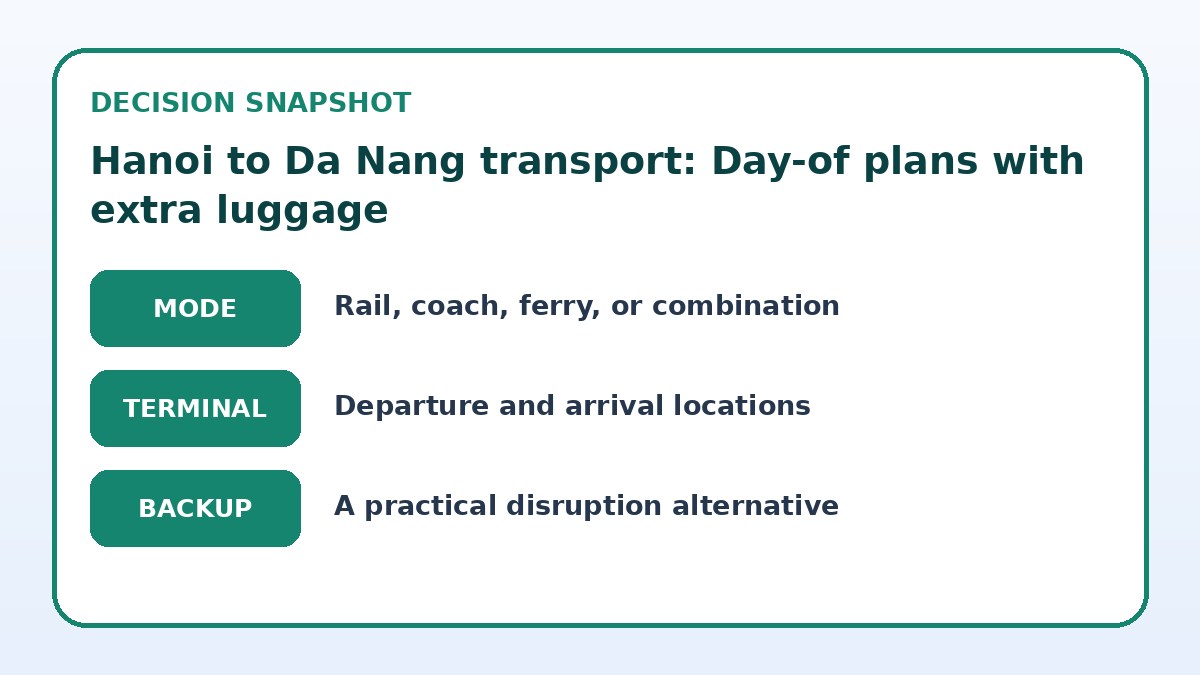
Decide by ranking what costs you most: repeated transfers, walking distance through terminals, or the risk of a missed connection. Trains typically have dedicated luggage areas and a flat, stable ride that suits heavy cases; coaches often load bags into underfloor compartments which requires lifting but can be seamless when a single coach carries you door-to-door. Ferries are not a primary option on the Hanoi–Da Nang corridor but can factor into mixed itineraries elsewhere; if including any ferry legs, check vehicle size limits and ramp logistics. A mixed plan—train for the main distance and a hired car for first and last mile—reduces luggage handling even if it requires coordinating two bookings.
When comparing options, list the terminals and address their luggage pinch points: long stairways, narrow station entrances, or distant drop-off points. If you have exceptionally large or many bags, prioritize options with step-free loading or staff assistance. Also consider the practicalities of door-to-door: how far is the station from your accommodation, and will a local taxi or a prebooked transfer accept all your bags? That final mile often determines whether a theoretically faster mode actually saves time overall when you have extra luggage.
Choose the end-to-end journey plan
| Journey approach | Best for | Friction to check |
|---|---|---|
| Direct train plus single transfer at origin or destination | Minimizing repeated handling and using level platform access | May require longer walk or paid transfer to reach central stations |
| Direct coach door-to-door with underfloor loading | Simple single-vehicle journey with curbside pickup | Lifting heavy bags into compartments and variable terminal facilities |
| Mixed: long-distance rail plus prebooked car for first/last mile | Reducing luggage moves while keeping the comfort of rail travel | Requires coordinating two bookings and exact timing buffers |
| Flexible multi-departure plan with a booked disruption transfer | Travelers valuing schedule resilience and rapid contingency switches | Higher potential cost and planning complexity for backups |
Check live intercity options
Look beyond the ride itself and compare terminals, transfers, luggage, and arrival fit.
Terminal fit and luggage-transfer friction
Inspect terminals before travel day, either online or in person if you have time. Look for step-free access, elevators, staffed luggage desks, and sheltered pick-up lanes. Trains often use central stations with platforms and level access, while coach stations can vary widely—some are modern hubs, others are simple roadside terminals. Note where loading occurs: underfloor bays for coaches require lifting each bag up and down, while train aisles and luggage racks allow sliding cases into place but may need corridor carrying. If you must move bags between vehicles, factor in the number of stairs and the typical queue at ticket gates.
On the travel day, reduce friction by staging your luggage: put essential items in a small daypack and lock or strap the rest for secure handling. Use luggage tags with both your phone number and the address of your final stop. If you expect staff assistance, confirm availability with the operator before you travel; many stations can assign porters or offer paid help but policies and staffing change. If you’ll transfer between modes, choose stations with short transfer distances or prebook a local car that meets your bag count to avoid multiple handoffs.
Timing flexibility and scheduling realistic arrivals
For travelers with heavy luggage, build extra time into every stage: arrival at the origin terminal, boarding, potential customs or ticket checks, and unloading at arrival. Allowing an additional 30–60 minutes beyond a typical recommendation protects you from slow baggage drops and elevator waits. When possible, pick early departures to avoid peak-hour crowds at stations and roads; that often results in less frantic loading and more space for luggage in vehicles and platforms. If you must catch a same-day onward connection, keep a larger buffer between scheduled arrival and your next departure.
If you can be flexible about departure times, look for services that reduce transfers rather than shaving minutes off total travel time. A slightly later train that goes directly to a central station may beat a faster coach that forces a metro ride and multiple lifts. Also consider how time of day affects traffic for road transfers—midday or early afternoon transfers tend to face lighter congestion than rush hours. Finally, confirm terminal opening hours for check-in and baggage handling as some facilities close earlier than the advertised departure times.
Compare the practical alternatives
Use the final page to confirm what is actually offered on your dates and save a workable fallback.
Intercity travel checklist
- Measure and photograph every large bag; confirm dimensions and weight against the operator’s baggage policy on the booking page.
- Prebook or reserve a transfer vehicle sized for all luggage to remove the need for multiple short taxis.
- Pack a clear daypack with essentials, travel documents, and one change of clothes to avoid opening checked bags.
- Label every bag inside and out with your phone number and final accommodation address.
- Arrive at your origin terminal early to secure loading space and ask staff about assistance or porter services.
- Keep digital and printed confirmations, plus a backup contact at your arrival address, in an easily reachable place.
A simple disruption backup for luggage-heavy travelers
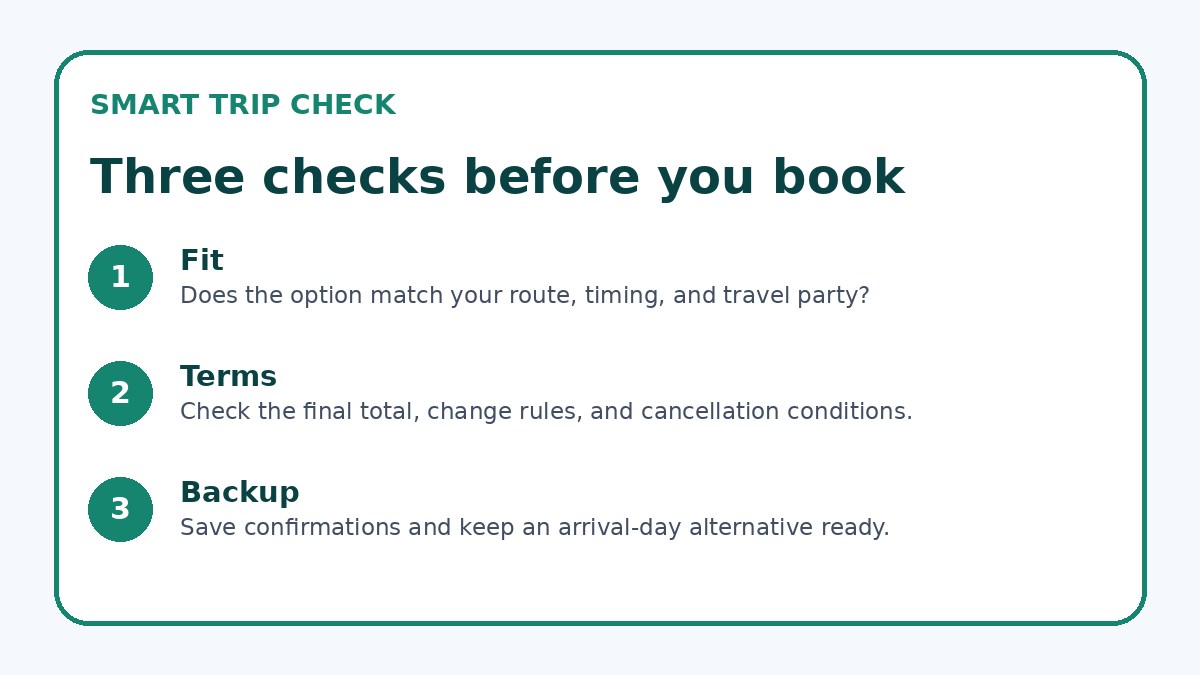
Create a one-page contingency plan for the travel day: an alternate departure time or provider, a pre-vetted local transfer that will accept all your bags, and a contact at your accommodation who can receive or store luggage if you arrive early or late. Keep digital copies of bookings and receipts easily accessible so you can swap bookings quickly with minimal time lost. Consider purchasing a flexible ticket or a refundable transfer option if you anticipate changes; when policies are unclear, check the provider’s final booking page for exact baggage allowances and change/cancellation rules before committing.
On the day, if a primary service is disrupted, move to your backup that minimizes extra handling—even paid direct transfers are often cheaper than multiple small moves or the cost of lost time. If you must split your group or leave some bags with a trusted hotel or station storage, label items clearly and photograph them. If you use third-party booking sites such as Trip.com to compare availability, verify baggage rules and terminal pickup points on each operator’s official confirmation page rather than relying solely on aggregator summaries.
Rail & Intercity Transport questions travelers ask
How many large suitcases can I practically take on a Hanoi to Da Nang trip without paying extra?
Practical limits depend on the mode of transport and the operator’s baggage rules. Trains often accommodate multiple large suitcases in racks or dedicated areas, but space is finite and bulky items may block aisles. Coaches store luggage underfloor; you can typically fit several pieces but must lift each one and coordinate retrieval at stops. The right approach is to check the carrier’s baggage allowance on the final booking page and, if unclear, ask the operator directly. For heavy or numerous items, plan a transfer vehicle that can carry everything in one go to avoid repeated handling.
Can I leave luggage at Hanoi or Da Nang stations while I explore before departure or after arrival?
Many major stations offer luggage storage, but availability, size limits, opening hours, fees, and insurance vary. Don’t assume oversized or irregular items will be accepted. If you plan to store bags, verify the station’s storage service on the operator’s or station’s official page before you travel, note the exact opening and closing times, and keep valuables and travel documents with you. Alternatively, consider leaving large items with your hotel if their policy allows early drop-off or late collection—this often reduces risk and walking with heavy bags.
What’s the most time-efficient way to manage a missed connection when I have heavy luggage?
Prioritize an option that keeps your bags on as few vehicles as possible. If your booked service is missed, aim for the next single-vehicle alternative (a later direct train or a coach) rather than piecing together multiple short hops that require extra loading and unloading. If no suitable public service exists soon, a prebooked point-to-point transfer may be faster even if costlier. Have your contingency contact and payment method ready, and request staff assistance for luggage handling to avoid delays while you arrange the alternative.
Final decision note
On the Hanoi to Da Nang corridor, the best travel day plan for passengers with extra luggage balances the least handling with realistic door-to-door timing. Choose the option that keeps your bags on one vehicle for the longest leg, confirm baggage policies and terminal logistics on the operator’s booking page, and prebook a transfer sized for all your luggage for the first or last mile if needed. Build time buffers, stage your essentials in a small daypack, and prepare a simple disruption backup so a cancelled or late service doesn’t force multiple lifts and long walks. With those steps, you’ll reduce physical strain and uncertainty on the travel day and arrive at your Da Nang destination with your luggage intact and your plans intact.
Continue planning
Check current options and final conditions
Use the provider page to confirm live availability, the final total, cancellation terms, and every condition that matters to your trip.
This evergreen planning guide was created with AI-assisted drafting and a structured quality review. It does not display live prices, schedules, availability, visa guidance, or provider rankings. Verify current details before booking. Some links are affiliate links; we may earn a commission at no additional cost to you.