For a solo traveler deciding between Seoul and Taipei, the core choice is simple: pay more for schedule convenience or accept stricter fare conditions and connections for lower cost and greater flexibility. Start by deciding whether you value fixed departure times and a short airport-to-airport itinerary, or whether you need a ticket that can be changed or canceled easily. That route-versus-fare tradeoff will determine whether you search primarily for direct flights, timed connections, or multi-airline itineraries with lower base fares. Before you shop, gather exact travel dates, any must-arrival windows, how much checked baggage you’ll carry, and whether you’ll risk tight connections. This article explains how to compare routing, baggage and connection risk, schedule fit, and fare conditions, and gives concrete decision approaches solo travelers can use when they check live availability on an airline or aggregator site such as Trip.com.
See live routes for your exact travel day
Compare direct and connecting choices with the same baggage and traveler details.
Routing: direct versus connecting options
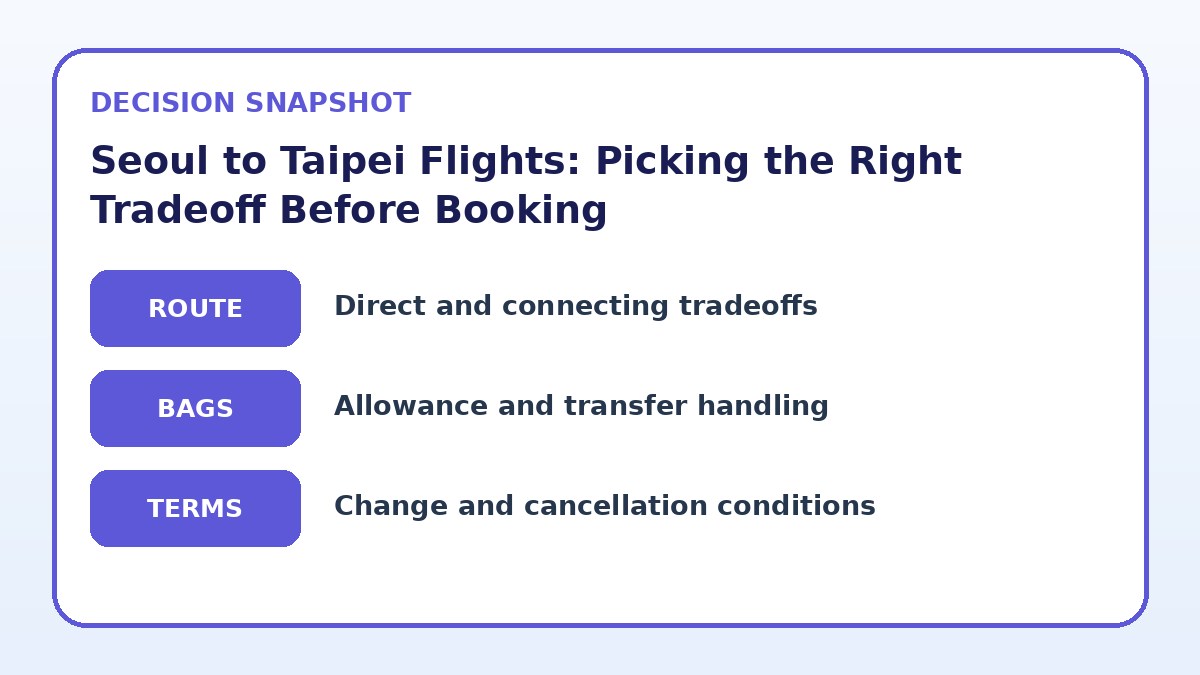
Compare direct and connecting routes by writing down your hard constraints first: arrival window, max travel time, and whether you need a same-day return. Direct flights from Seoul-area airports to Taipei-area airports reduce the number of moving parts, which matters for solo travelers who prioritize simplicity and minimal airport navigation. If direct services exist for your dates, they usually save ground logistics and reduce the chance of a missed connection. However, direct flights can be less frequent at off-peak hours and sometimes are sold as non-refundable economy fares with limited changeability. Note that ‘direct’ in booking systems can still mean a technical stop, so verify whether there is an actual plane change on the provider’s details page.
paragraphs_1_2_note_else_breakline_ensure_validity_1_2_nonempty_1_2_3_4_5_6_7_8_9_10_11_12_13_14_15_16_17_18_19_20_21_22_23_24_25_26_27_28_29_30_31_32_33_34_35_36_37_38_39_40_41_42_43_44_45_46_47_48_49_50_51_52_53_54_55_56_57_58_59_60_61_62_63_64_65_66_67_68_69_70_71_72_73_74_75_76_77_78_79_80_81_82_83_84_85_86_87_88_89_90_91_92_93_94_95_96_97_98_99_100_101_102_103_104_105_106_107_108_109_110_111_112_113_114_115_116_117_118_119_120_121_122_123_124_125
Baggage, connection risk and single-ticket advantages
A single-ticket itinerary issued by one carrier or alliance typically includes baggage through-check and protection for missed connections, which is a major convenience for solo travelers who prefer lower stress. When you book separate tickets—two legs on different carriers to save money—you assume responsibility for transferring checked bags and rechecking them, and the second carrier will not be obligated to rebook you if an earlier delay causes you to miss the connection. Carefully read the final booking page to confirm whether checked baggage is included, transfer rules apply, and if the itinerary is protected in the event of delay. If baggage or connection protection is essential, filter search results for single-carrier or alliance itineraries and verify the ticketing policy on the airline's confirmation page.
If you do choose separate tickets for a lower fare, build in generous connection time at the transfer airport and plan to travel with carry-on only when possible. Leaving extra time between flights reduces stress and gives you flexibility to handle immigration or terminal changes, but it lengthens your overall journey and may add hotel or lounge costs during long layovers. For transfers inside the same airport, check whether you must pass immigration or can transfer sterile-zone to sterile-zone, and verify terminal transfer options in advance. Always confirm on the providers’ booking pages whether baggage transfer and recheck are required for separate-ticket itineraries.
Compare flight-selection strategies
| Flight strategy | Best for | Risk to check |
|---|---|---|
| Direct nonstop flight, refundable or flexible fare | Solo travelers who prioritize schedule certainty and minimal connection stress | Higher fare cost and fewer low-cost options compared with connecting itineraries |
| Direct nonstop, basic nonrefundable fare | Solo travelers on a fixed date who want the shortest travel time at lower cost | Limited change or cancellation options and restricted baggage/seat benefits |
| Connecting single-ticket itinerary with an airline alliance | Travelers balancing lower fares with baggage-through-check and rebooking protection | Longer total journey time and potential for delays impacting connections |
| Separate tickets or multi-carrier low-fare strategy | Price-focused solo travelers willing to self-manage transfers and risk | No protection for missed connections and likely need to recheck bags between carriers |
Recheck the complete itinerary
Confirm airports, connection handling, baggage, and change conditions before deciding.
Schedule fit: timing, sleep, and solo-traveler needs
Consider your personal tolerance for travel fatigue and the local time difference when choosing a flight time. A morning departure might be best if you want to arrive with an afternoon to settle in, whereas overnight flights can maximize daytime hours but may disrupt sleep for some travelers. For solo travelers who rely on public transport or want to avoid late-night arrivals, prioritize flights that land during daytime or when ground transport is operating. Check the final provider pages for exact departure and arrival airports, and verify local transport options and operating hours rather than relying on third-party summaries.
If you have commitments at your destination—meetings, tours, or hotel check-in windows—choose an itinerary with a realistic buffer for immigration, baggage claim, and transit to your accommodation. When comparing options, add at least 60–90 minutes to published arrival times for planning purposes if you need to clear immigration or pick up checked baggage. Solo travelers with mobility needs or carrying heavy gear should prefer slightly longer buffers. Confirm whether the flight is nonstop or requires a terminal change and verify the minimum connection times and whether the airline provides assistance on the booking confirmation.
Flight details to verify
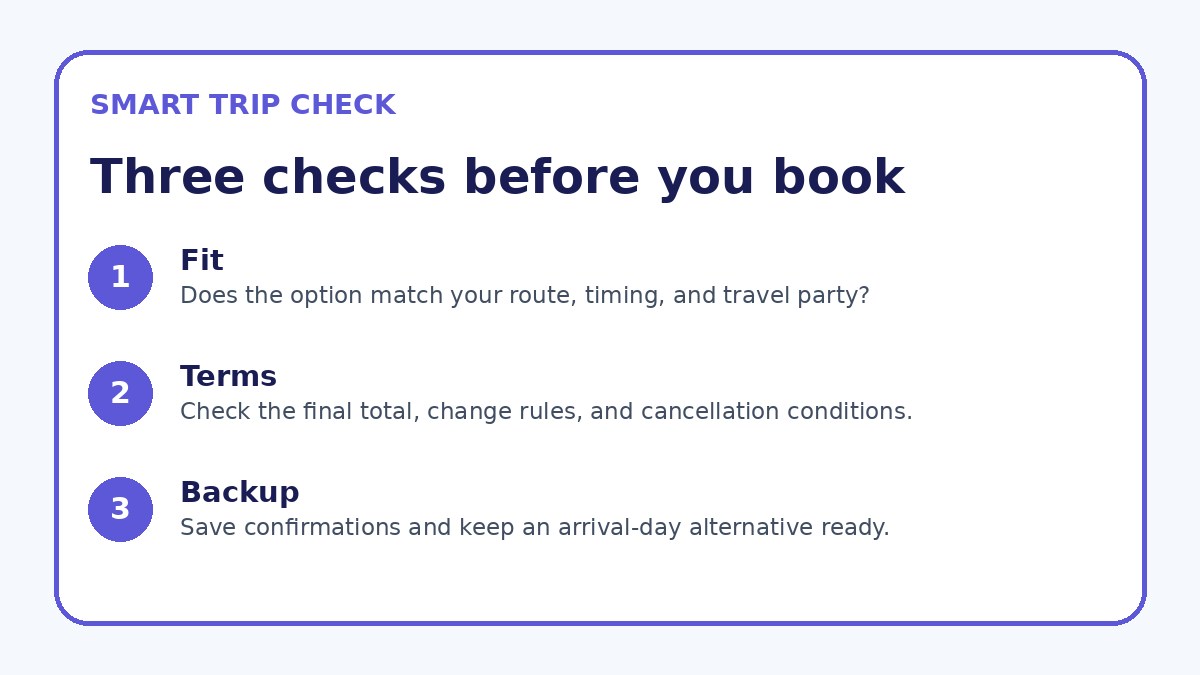
- Confirm exact travel dates, full traveler name as on passport, and passport validity before searching flights.
- Decide whether you require daytime arrival or specific onward transport and write down acceptable arrival windows.
- Filter search results for single-ticket itineraries if you want checked baggage through-check and missed-connection protection.
- Open the airline’s final booking page to read the full fare rules: change fees, refundability, and baggage allowances.
- If considering separate tickets, plan at least two extra hours for transfers and aim to travel with carry-on only where possible.
- Save screenshots of the booking confirmation and the fare rules page, and note the ticketing carrier and record locator.
Fare conditions and change/cancellation tradeoffs
Fare class terms determine how easy it is to change or cancel your ticket, and those rules can sway the decision for a solo traveler who values flexibility. Basic economy-style fares typically restrict changes, seat selection, and carry-on baggage; higher fare classes or refundable tickets offer better change or cancellation terms but at a higher base cost. Always check the fare rules on the airline’s or booking site's final confirmation page to see change fees, refundability, and whether taxes are refundable. If you need to make a change, doing so through the original seller usually preserves protections; check who issued the ticket before you book.
Consider travel insurance that covers trip interruption or cancellation if your plans might change, but don’t assume insurance replaces flexible fare conditions for last-minute schedule adjustments. Some credit cards include travel protections that interact with airline change rules; verify those benefits on your card issuer’s site. For short 2–4 day trips where schedule certainty matters, the premium for flexible fares may be worth it for solo travelers who cannot risk missing a time-sensitive obligation. On the booking page, verify whether ancillary services such as seat selection and extra baggage can be added at a later date and what fees apply.
Flight Guide questions travelers ask
Is a direct flight always the most convenient option from Seoul to Taipei for a solo traveler?
Direct flights reduce the number of variables—fewer terminals, no plane changes, and usually faster overall travel time—which often makes them more convenient for solo travelers. However, convenience depends on your schedule needs and fare flexibility. A direct low-cost fare may come with restrictive change rules or limited baggage allowances that reduce convenience if your plans are uncertain. Always compare the itinerary’s total door-to-door time, the fare conditions on the airline’s booking page, and whether included baggage and seat selection meet your needs before deciding.
How much connection time should I allow if I choose a connecting itinerary?
Allow more buffer than the airline minimums when you’re booking as a solo traveler, especially if your connection requires changing terminals or passing immigration. A practical rule is to add at least 60–90 minutes beyond published minimums for international transfers that involve immigration or baggage reclaims. For same-airline, single-ticket connections inside a single terminal, the minimums may be adequate, but check the carrier’s recommended connection time on the booking page and consider your personal pace and whether you need time to collect and recheck baggage.
What should I verify on the booking page to avoid surprises with baggage and refunds?
On the airline or seller’s final booking page, confirm whether checked baggage is included in your fare, the exact weight and dimension limits, and whether baggage will be through-checked on connections. Also read the fare rules for change and cancellation fees, refund eligibility, and any deadlines for free name corrections. If you’re adding ancillary items like seat selection or extra legroom, check whether those are refundable if you later change flights. If anything is unclear, use the carrier’s contact options to get written confirmation before you complete payment.
Final decision note
Solo travelers between Seoul and Taipei should start their search by clarifying whether schedule certainty or ticket flexibility is the priority. Direct flights simplify the journey and lower the number of potential failure points, while flexible or refundable fares protect you if plans shift. Single-ticket connecting itineraries offer a middle ground—usually lower cost than fully flexible fares but with baggage-through-check and rebooking protections that reduce risk. If you chase separate-ticket savings, accept the additional self-management burden and build in generous buffer time. Prepare exact dates and traveler details, review fare rules on the provider’s final booking page, and consider using an aggregator like Trip.com to compare live availability before you buy.
Continue planning
Check current options and final conditions
Use the provider page to confirm live availability, the final total, cancellation terms, and every condition that matters to your trip.
This evergreen planning guide was created with AI-assisted drafting and a structured quality review. It does not display live prices, schedules, availability, visa guidance, or provider rankings. Verify current details before booking. Some links are affiliate links; we may earn a commission at no additional cost to you.