Practical answer up front: if you value speed, simplicity, and less chance of missing connections, pick a direct Dubai to Doha flight when available. If you need a cheaper fare, more schedule choices, or must travel on a routed itinerary because of departure times or airline availability, a single-connection option can make sense. First-time visitors should balance total door-to-door time, transfer complexity, baggage transfer rules, and airport terminals. Also check whether your connection requires an overnight stop, a separate airport transfer, or a visa. Below I explain how to weigh travel time, cost, reliability, and comfort, then give decision criteria and a short checklist so you can compare options before booking.
How to compare total travel time and convenience
When comparing options, look past headline flight durations and check total door-to-door time. That includes travel to the airport in Dubai, recommended check-in and security time, the scheduled block time, layover length on connecting itineraries, and onward travel from the arrival airport in Doha. For first-time visitors, allow extra buffer for unfamiliar terminals and signage. Short direct flights often win on convenience because they remove the transfer step, but the difference can be small if a connecting itinerary has a long and comfortable layover at a convenient airport.
Also weigh the quality of the connection: a long, stress-free connection in a major transfer hub lets you rest, use lounges, and may be preferable to a cramped direct flight scheduled at an awkward hour. Conversely, short connections increase the risk of missing a tight onward flight and could require running between gates. Check minimum connection times listed by the airlines or airports, and remember that if you book two separate tickets you may be treated as two independent journeys with no protection for missed connections.
Cost tradeoffs and booking strategies
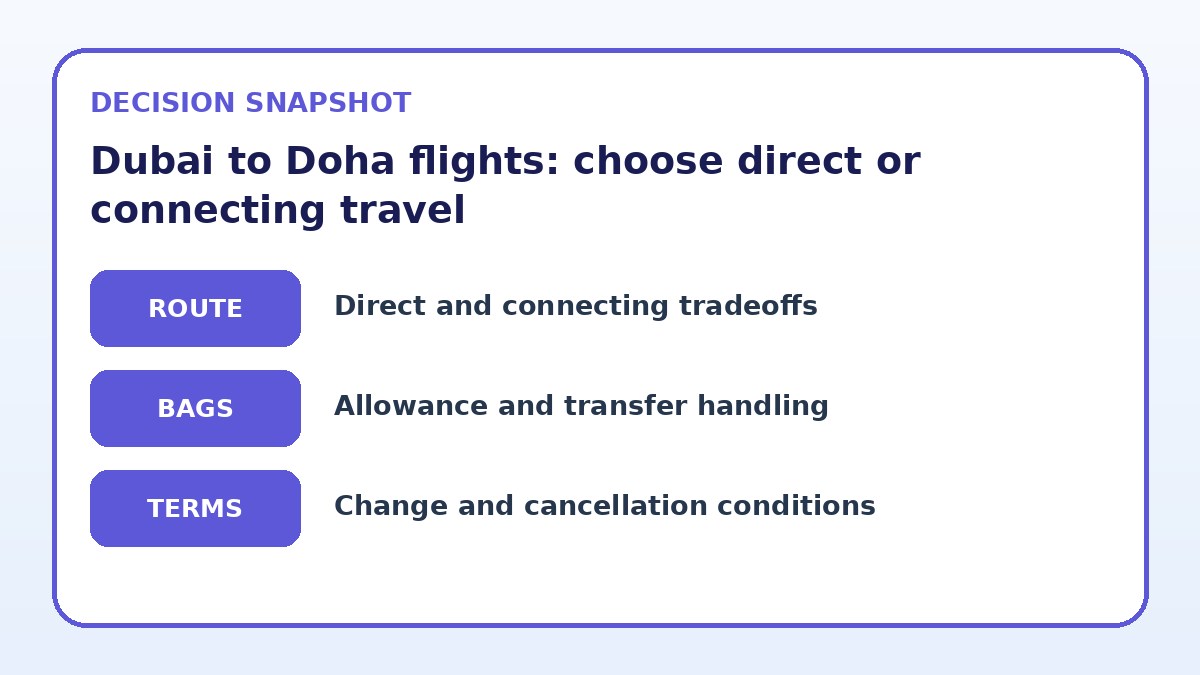
Direct flights can be more expensive per seat because they are simpler to operate and preferred by business travelers. Connecting itineraries sometimes show lower base fares or more flexible multi-airline routing, but they can include higher taxes, fees, or baggage charges depending on carriers and ticketing rules. When comparing fares, read the final booking page carefully to see total price, baggage allowance, seat selection fees, and refund or change policies before you commit.
If price is a primary concern, compare single-ticket itineraries that include connections (a single ticket usually protects you if the first leg is delayed) versus separate one-way purchases. Use filters on booking platforms to compare nonstop, one-stop, and multi-stop journey durations and total travel times. Trip.com can be used as one place to compare current availability and conditions, but always verify the fare rules and final itinerary on the airline’s or travel agent’s final booking page to confirm baggage transfer, transfer times, and change/cancellation terms.
| Approach | Best for | Tradeoff to check |
|---|---|---|
| Direct flights | Travelers prioritizing speed, simplicity, and lower connection risk | Can be more expensive and offer fewer schedule choices |
| Single-ticket connecting flights | Those balancing cost savings with some protection for delays | Longer total travel time but usually baggage through-checked |
| Separate tickets (independent legs) | Flexible itineraries or using multiple low-cost carriers to save money | No protection for missed connections and baggage recheck needed |
| Planned long layovers | Travelers who want cheaper fares and a chance to rest or sightsee | Increases total trip duration and may require entry formalities at the transfer point |

Comfort, amenities, and baggage considerations
For short international hops, comfort may hinge on aircraft type, seat pitch, and whether you have lounge access during a connection. Direct flights reduce the number of takeoffs and landings, and you won’t have to deplane and re-clear security at a transfer airport. For connecting routes, check whether ground transfers are required between terminals or airports, how long those transfers take, and whether lounge access or airport facilities are available during layovers.
Baggage rules are crucial: a single-ticket itinerary usually checks bags through to the final destination, while separate tickets often require reclaiming and rechecking luggage. If you have special items—sports gear, excess baggage, or fragile goods—confirm with the airline how those will be handled on connecting itineraries. Also verify whether carry-on allowances differ between carriers on a multi-carrier connection; differences can force unexpected gate-checking or fees.
Before you book
- Compare total door-to-door time for direct versus connecting itineraries, not just airborne minutes.
- Confirm baggage transfer rules on the airline’s final booking page and whether through-check is included.
- Check minimum connection times and whether transfers require terminal changes or airport commutes.
- Verify visa or transit requirements for any country where you will connect or pass through immigration.
- Compare final fare breakdowns, including taxes, carrier fees, seat/meal costs, and change/cancellation terms.
- Decide on acceptable connection buffer (minimum safe layover) and add extra time for unfamiliar airports.
Risk management: delays, missed connections, and visas
Direct flights generally reduce exposure to the risks of missed connections and delay cascades. When you book a connection on a single ticket, the operating carriers typically accept responsibility for missed connections caused by delays under their control, offering rebooking or hotel accommodation if they provide it under their rules. If you assemble your journey from separate tickets, you lose that protection and should allow larger buffers or buy travel protection.
Also check transfer visa requirements for any country where you change planes. Some connections require transit visas even when passengers do not pass immigration, or when you must change airports. Verify visa and entry rules for any transfer point and the time needed to clear security and immigration. Always check the final airline booking page and official government or embassy resources for up-to-date visa guidance before traveling.
Frequently asked questions
Is a direct Dubai to Doha flight always the fastest option?
Generally, direct flights are the fastest air option because they avoid layovers and extra ground time. However, speed is about door-to-door time: a direct flight at an awkward hour or from a far terminal could end up slower than a well-timed connecting option. Also consider airport transfer time in Dubai and Doha, security wait times, and how close your accommodations are to the airport. Compare full journey times and schedules, not just airborne duration, before booking.
How do I handle baggage and checked luggage on connecting itineraries?
If both legs are on a single ticket, most carriers will check your bags through to the final destination, but you must confirm this on the airline’s booking page. For separate tickets, expect to collect and recheck luggage at the connection point, which increases required connection time. Also check if carriers involved have differing baggage allowances, which might result in additional fees or gate-checking. When in doubt, contact the airline or agent shown on your final booking page to verify baggage handling.
What should I do if my connecting flight is delayed or I miss my connection?
If both flights are on the same ticket and a delay causes a missed connection, the operating carrier(s) typically rebook you on the next available flight, though exact policies vary; verify rebooking and accommodation rules on the airline’s booking page. If you hold separate tickets, you are usually responsible for missed connections and any resulting costs. Consider travel insurance that covers missed connections, and allow generous layover buffers when booking separate tickets to reduce this risk.
Final planning note
Choosing between direct and connecting Dubai to Doha flights comes down to your priorities: direct routes reduce complexity and travel time, while connections can expand schedule options and sometimes lower the fare. First-time visitors should focus on total door-to-door time, baggage rules, and the protection offered by single-ticket itineraries. Always verify baggage transfer and connection rules on the final airline booking page, check visa or transit requirements for any transfer point, and build in an extra buffer if you’re unfamiliar with the airports. Use the checklist above to compare realistic options and pick the route that matches your comfort level, schedule, and budget.
Continue planning
Check current options and final conditions
Use the provider page to confirm live availability, the final total, cancellation terms, and every condition that matters to your trip.
This evergreen planning guide was created with AI-assisted drafting and a structured quality review. It does not display live prices, schedules, availability, visa guidance, or provider rankings. Verify current details before booking. Some links are affiliate links; we may earn a commission at no additional cost to you.