
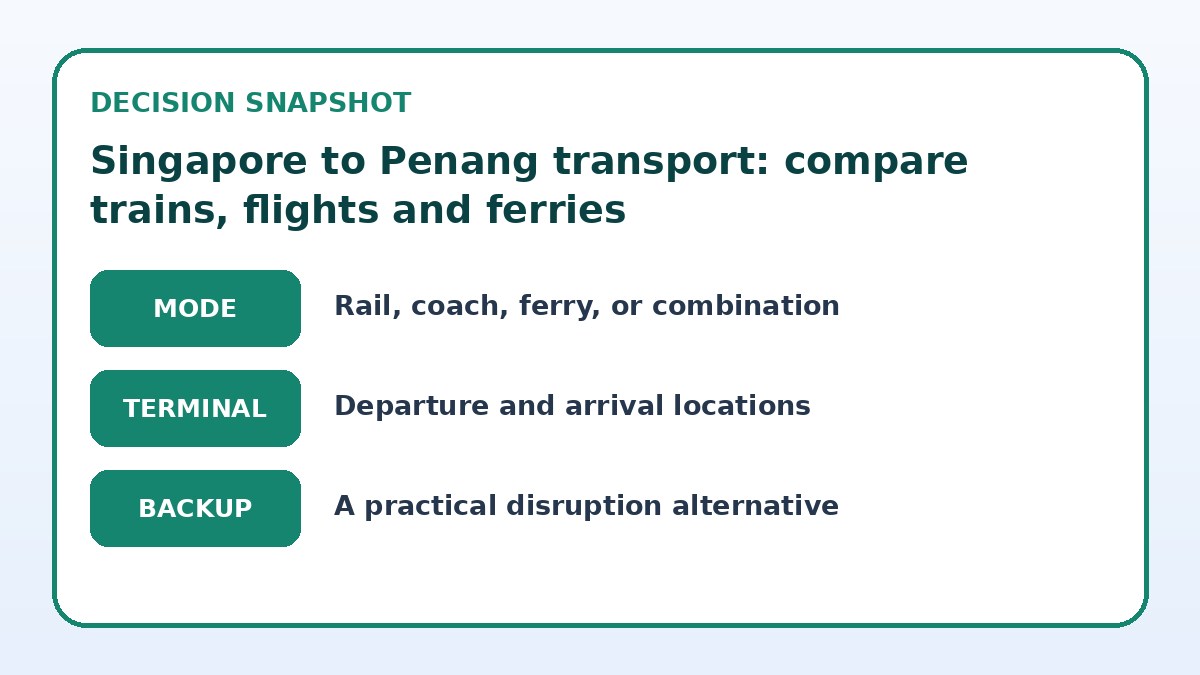
If you're traveling from Singapore to Penang for business, prepare the travel day so it supports your meeting schedule rather than complicating it. Decide whether you need the fastest door-to-door time, minimal airport fuss, or a predictable in‑country schedule; each choice changes when you should leave, what to pack in your carry-on, and which backups to arrange. This article gives direct practical actions to complete before departure, followed by tradeoffs so you can match options to your priorities. Focus on departure and arrival logistics, how to verify schedules and connections, what to pack for a productive day en route, and which local checks to do for a smooth arrival. If you want current availability or to compare schedules, you can check a booking site such as Trip.com, but always confirm final times and baggage allowances on the provider’s official booking page before you finalize plans.
Choose the transport approach that matches your meeting priorities
Business travelers commonly choose between fast air travel, overland routes that reduce airport time, or mixed options prioritizing reliability. Identify whether your top priority is minimizing total travel time, avoiding long check-in or immigration processes, or reducing the chance that a single delay will derail your entire day. For example, a faster overall journey may require earlier departure windows and tighter connection margins; a more conservative plan accepts additional transit time to leave room for delays and to protect critical meetings.
To decide, list non-negotiables for the day: meeting start time, whether you must arrive fresh or can work en route, and acceptable arrival windows. Use those constraints to compare options. When evaluating specific services, confirm whether they are direct or involve transfers, and when transfers exist, check typical connection buffers and how changes are handled. Avoid assuming every listing is direct; treat any offer with a transfer as needing an extra cushion on your calendar.
Verify timetable, check-in rules, and what to confirm on the provider page
Schedules, check-in times, and baggage rules change frequently, so always verify critical details on the carrier or operator’s official booking page before you book. Specifically check the departure and arrival points (airports, train stations, or ferry terminals), the earliest recommended check-in or boarding time, and any documentation required at boarding. If the journey includes an international border or domestic transfer, confirm where and how baggage is handled and whether you need to reclaim and recheck bags during a connection.
When comparing options, pay attention to how each provider handles delays and rebooking. On the official provider page, find the stated policy for missed connections, change fees, and refunds. If you’re using a third-party aggregator for comparison, use it to shortlist options but always click through to the operator’s final page to accept terms and understand what will happen if your schedule changes. For peace of mind, note customer service channels you can reach from the road.
| Approach | Best for | Tradeoff to check |
|---|---|---|
| Fly with minimal connections | When door-to-door time matters and you're flexible with early departures | More airport procedures and potential for tight transfer windows if connections are needed |
| Overland and ferry mix | When avoiding airports or preferring lower chance of long check-in delays | Usually longer total travel time and more changes to coordinate |
| Conservative plan with extra buffer | Critical meetings where arriving on time is essential | Leaves less time for on-site work and may require earlier departures |
| Flexible same-day backup options | Travelers who need contingency for delays or last-minute meeting moves | Can increase cost and administrative complexity of the trip |
Prepare your carry-on and digital kit to work smoothly on the move
For a productive travel day, pack a focused carry-on that keeps essential work items accessible and protects them from typical transit issues. Include a compact charger bank, universal travel adapter if needed, noise-cancelling earphones for calls, and a lightweight laptop or tablet with an encrypted copy of sensitive documents. Keep printable or offline copies of meeting briefs and local contact details in case connectivity is poor, and place chargers and cables in an easily reachable pocket to avoid opening your main bag at every checkpoint.
Also prepare your digital communications: set an out-of-office message with clear availability windows, pre-schedule messages if crossing time zones, and ensure your mobile plan supports data in Malaysia or that you have a plan to get local connectivity on arrival. If you rely on video calls, test the device camera, mic, and VPN ahead of departure. A small travel router or portable hotspot can be useful when public Wi‑Fi is unreliable, but verify local restrictions and network security practices before using public networks.
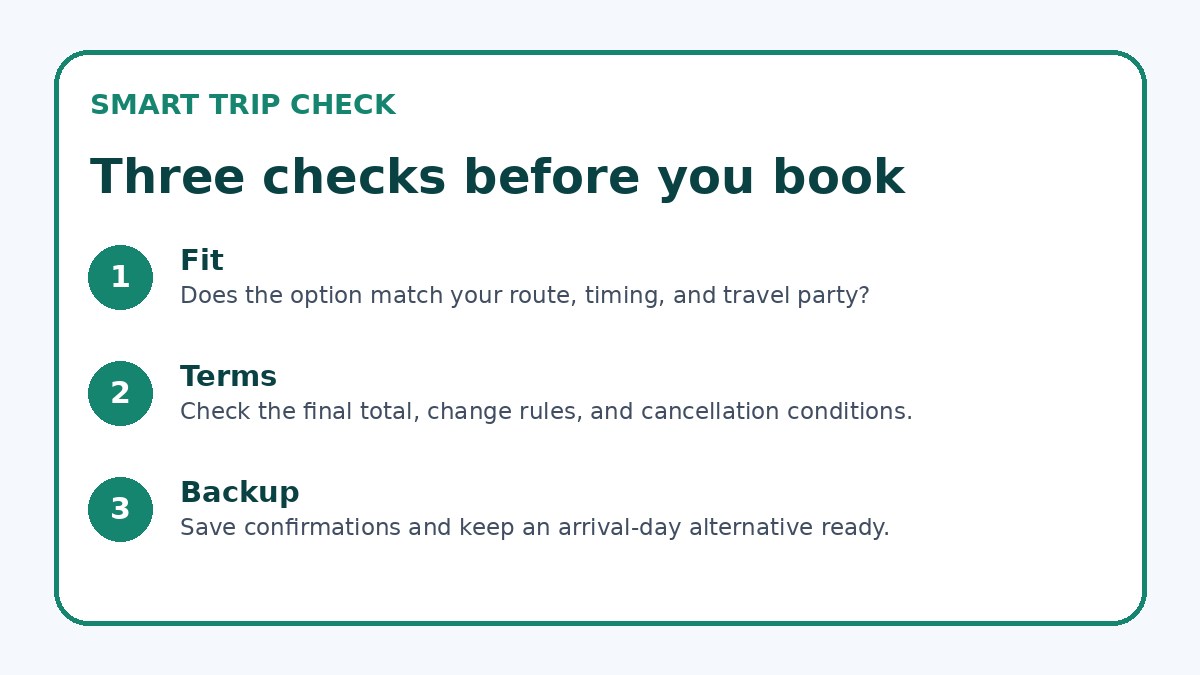
Before you book
- Confirm departure and arrival points and whether the service is direct or requires transfers on the provider’s official booking page.
- Save and test your mobile connectivity plan: roaming, eSIM, or plan to buy a local SIM/hotspot on arrival.
- Pack a carry-on with chargers, headset, essential documents, printed meeting briefs, and a change of shirt in a waterproof pouch.
- Pre-arrange or bookmark two reliable ground transport options from your arrival point to the meeting venue.
- Inform the meeting organizer of your expected arrival window and share a local contact or tracking link if available.
- Note carrier rebooking and delay policies from the operator’s terms so you can act quickly if plans change.
Arrival and same-day contingencies in Penang for business travelers
Plan ground transport from the arrival point to your meeting location before you land. Identify at least two reliable options—pre-booked car, local taxi app, or a reputable ride service—and keep estimated travel times handy with extra buffer for traffic. Have the meeting address in the local language ready to show a driver, and save a local contact number in both your phone and in a written note in case of confusion. If customs or immigration are likely to add time, factor that into your transfer booking.
Prepare a short contingency plan for common issues: a delayed arrival, a lost bag, or a last-minute venue change. That plan can include notifying the meeting party immediately with a realistic new ETA, arranging a private workspace via hotel day-use or co-working short term access, and having local assistance contacts such as your hotel concierge or a trusted local colleague. When finalizing bookings, confirm cancellation and change policies so you can adapt quickly without unexpected penalties.
Frequently asked questions
Should I prioritize the fastest travel time or the most reliable schedule when going from Singapore to Penang for business?
It depends on your tolerance for risk and how critical the meeting time is. Prioritize fastest travel if you need minimal door-to-door time and can accept tighter connection margins. Choose reliability (longer buffers, fewer transfers) if the meeting has little flexibility or if you cannot reschedule easily. For important events, build additional recovery time into your itinerary—arrive earlier than necessary, or plan a contingency local workspace—and verify rebooking policies on the carrier’s official page so you understand options if delays occur.
Can I work effectively on the travel day between Singapore and Penang, and what gear helps?
Yes, you can be productive if you set up for mobile work. Bring a compact laptop or tablet with offline copies of crucial documents, a power bank and compact charger, noise-cancelling earphones for calls, and any necessary VPN or security tools installed and tested. Pre-download presentations and confirm video-call software works without high-bandwidth connections. If uninterrupted time is essential, schedule focused work segments during predictable portions of the journey and avoid relying entirely on public Wi‑Fi for confidential meetings.
What should I verify on the booking page before I finalize my transport from Singapore to Penang?
On the operator’s official booking page, confirm exact departure and arrival locations, whether the service is direct or includes transfers, the recommended check-in or boarding time, and baggage allowances. Check change, cancellation, and missed-connection policies and find contact numbers for support. If your journey involves crossing a border or reclaiming bags, verify where and when to collect and recheck luggage. Use the booking page as the definitive source for rules that affect your ability to make that day’s meetings.
Final planning note
A well‑planned travel day from Singapore to Penang for business reduces stress and preserves meeting readiness. Start by deciding whether speed, simplicity, or reliability is your priority, then verify schedules and rules on the provider’s official pages before booking. Prepare a compact, work-ready carry-on and confirm ground transport and contingency options for arrival. Communicate realistic arrival windows to your hosts and note rebooking policies so you can adapt if delays occur. If you want to compare current options, an aggregator such as Trip.com can help shortlist choices, but finalize details and terms with the transport operator before you commit.
Continue planning
Check current options and final conditions
Use the provider page to confirm live availability, the final total, cancellation terms, and every condition that matters to your trip.
This evergreen planning guide was created with AI-assisted drafting and a structured quality review. It does not display live prices, schedules, availability, visa guidance, or provider rankings. Verify current details before booking. Some links are affiliate links; we may earn a commission at no additional cost to you.