If you’re traveling solo between Busan and Jeju, the quickest practical answer is to prioritize which matters more for your trip: schedule flexibility (multiple departure windows and easy change/cancellation options) or convenience (minimal transfers and easy access to your lodging from the arrival airport). Decide first whether fixed timing (tour bookings, ferries, or day plans) forces a tight schedule; if so, choose flight options with more frequent departures and flexible change policies. If accessibility on arrival or a shorter ground transfer matters more, favor flights that land at the airport nearest your Jeju destination or that have simpler onward connections. Below you’ll find clear tradeoffs, what to compare on booking pages, and a checklist to help you book confidently. Remember to verify final seat availability, baggage rules, and change/cancellation terms on the airline or booking platform before paying.
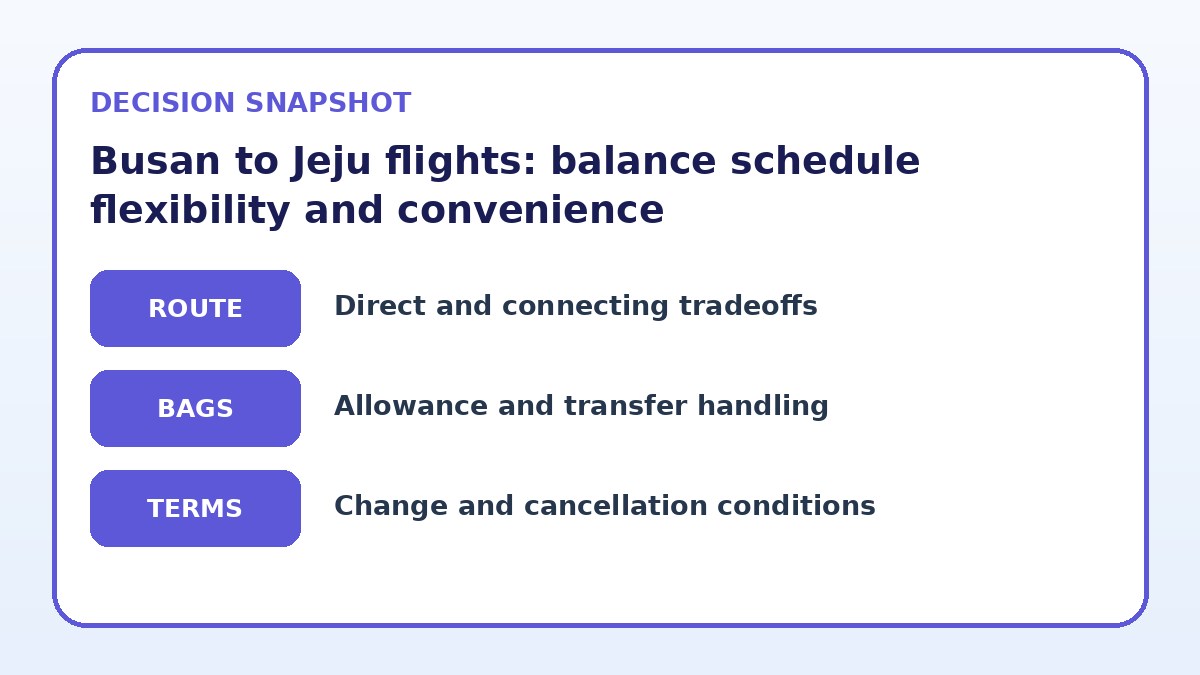
See current options before you compare the details
Availability and final conditions change. Open Trip.com now or keep reading for the practical comparison.
Start by defining your tolerance for schedule risk
Solo travelers should explicitly decide how much schedule uncertainty they can accept. If you have a fixed event—an evening ferry, a guided hike, or a tour departure—your tolerance for delays is low and you should lean toward options with frequent departures and flexible change policies. Frequent departures reduce the chance that one canceled or delayed flight wrecks your plans, while flexible fare rules make it easier to move to another flight without excessive fees. When evaluating flexibility, think beyond the single ticket: check alternative flights the same day and how easy it would be to rebook on short notice.
If your itinerary is loose—several days in Jeju with local transport and no time-sensitive bookings—you can accept a less flexible ticket in exchange for a more convenient airport arrival or a lower total travel burden. Consider the extra time or cost to reach your accommodation from each possible arrival airport and whether an earlier or later arrival slot adds meaningful rest or sightseeing time. Make a simple plan B for delays: know the next three flights out, note customer-service channels to contact, and keep extra time in your schedule for unforeseen adjustments.
Weigh convenience: airport access and ground connections
Convenience often means fewer transfers and a shorter ground transfer at each end. On the Jeju route that typically means prioritizing flights landing closest to your hotel, ferry terminal, or activity start. Think about the available ground options: taxis, rental cars, buses, or shuttle services. For solo travelers especially, ease of navigation and safety at arrival hours matters: a direct taxi ride after a late flight might be worth a slightly higher fare, while an early morning arrival might favor cheaper public buses that reduce cost but add time.
Also factor in the departure airport in Busan—how long it takes to get there from where you’re staying and the reliability of transit options. If reaching a more convenient flight requires an earlier wake-up and an extra transfer, that reduces the perceived convenience. Balance these practicalities by mapping the door-to-door journey for each candidate flight: travel time to the airport, recommended check-in or arrival buffer, estimated wait times, and the ground transfer to your Jeju destination. That total journey time is the real measure of convenience.
| Approach | Best for | Tradeoff to check |
|---|---|---|
| Frequent departures with flexible change rules | Travelers with time-sensitive plans or tight connections | May cost more or offer fewer direct convenience features at arrival |
| Single preferred departure with minimal ground transfer | Travelers prioritizing quick arrival at their destination | Less flexibility if delays or cancellations force rebooking |
| Connecting itineraries with longer layovers | Those willing to trade time for potentially lower fares or specific departure times | Higher risk of missed connections and more complicated recovery |
| Direct flights at off-peak times | Solo travelers who value simplicity and fewer transfers | Fewer schedule options and possibly limited support if issues occur |
Ready to check the option that fits your plan?
Use your exact dates and traveler details so the provider page can show the current total and conditions.
How to compare fares, policies, and connection risk
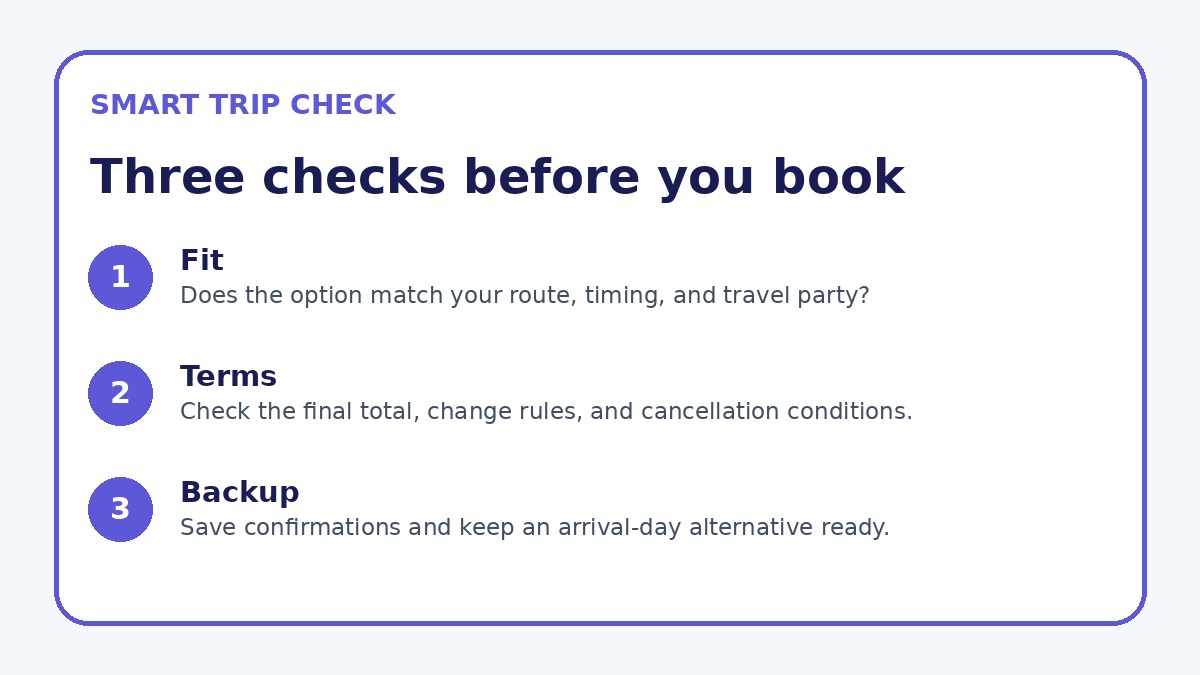
When comparing options, don’t treat fare alone as the deciding factor. Look at the fare class and the associated change/cancellation rules, baggage allowance, and whether seats can be selected in advance. For solo travelers, the ability to change a flight without large penalties is often worth a modest premium. On booking pages, verify the exact change fee, any fare difference obligations, and how refunds are handled. If details on the provider’s page are unclear or use unfamiliar codes, contact customer service to confirm before booking.
Also compare connection risk: if options include indirect routes or multi-leg itineraries, understand how long layovers are and what protections exist if an earlier leg is delayed. Direct flights minimize this risk but may be less frequent. If choosing a connecting itinerary, make sure the minimum connection time is realistic for the terminal transfers involved, and check whether the segments are on the same ticket or separate bookings—same-ticket connections typically offer better protection if an airline must rebook you after a delay.
Before you book
- Decide whether schedule flexibility or arrival convenience is your primary priority and write it down before searching.
- Map door-to-door travel time for at least three candidate flights, including ground transfer and check-in buffers.
- Open the airline’s official booking page to confirm change/cancellation policies, baggage allowances, and seat selection rules.
- Check whether itinerary segments are on the same ticket; prefer same-ticket connections for better recovery protection.
- Confirm ground transport options and hours at Jeju arrival (taxi, bus, shuttle, rental pickup) and plan for late arrivals.
- Save screenshots or PDFs of fare rules and booking confirmations, and note customer-service contact methods for rebooking.
Practical booking steps and day-of-travel tips
Before you book, compile the essentials: preferred time window, acceptable total door-to-door time, how much you’ll pay for extra convenience, and the minimum change/cancellation flexibility you need. Use that list to filter options on airline or aggregator pages. If you compare on Trip.com or similar sites, use those results to shortlist flights, then open the airline’s official booking page to confirm rules and to finalize purchase. Keep screenshots or PDFs of fare rules and the reservation confirmation; solo travelers benefit from having quick-reference documentation if issues arise.
On travel day, build in buffer time for ground transfers and possible security queues, and travel with digital and physical copies of identification and booking confirmations. For late arrivals in Jeju, verify night transport availability or prebook a taxi if you prefer not to search for a ride on arrival. If you plan to rent a car, confirm pickup hours and bring your license documents in the format the rental provider requires. Finally, keep flexibility in your schedule back home to avoid cascading stress if a flight change becomes necessary.
Frequently asked questions
Should I pick the earliest flight from Busan to Jeju to maximize sightseeing time?
An early flight can increase daytime on arrival, but only if the additional travel stress and earlier wake-up are worth it. Balance the extra sightseeing minutes against the need to reach the departure airport on time—early flights usually require earlier transfers and may involve operating at less convenient transit times. Also consider whether your accommodation allows early drop-off of luggage and whether local attractions will be open. If flexibility is important, compare early and mid-morning flights along with their change policies before choosing.
How much connection time should I allow when a flight itinerary includes a transfer?
Connection time depends on whether transfers occur within the same terminal, require baggage recheck, or involve movement between different airports. For same-airport, same-terminal connections, a 60–90 minute window can be sufficient in many cases, but add buffer for delays. If you must change terminals, re-clear security, or collect and recheck baggage, allow extra time—often 2 hours or more. Check the airline’s recommended minimum connection time and verify on the booking page whether the segments are protected under one reservation.
What are the best ways to verify ticket flexibility and avoid surprises at booking?
Read the fare rules shown during booking and on the final confirmation page carefully: they list change fees, refundability, and whether changes require paying any fare difference. Don’t rely solely on summary labels—click through to the detailed policy and, if unclear, contact the airline’s customer service for clarification. Keep evidence of the stated rules (screenshots or PDFs). If you use a third-party site, double-check the airline’s own page before payment so you know you’re booking under the rules presented by the operating carrier.
Final planning note
For solo travelers between Busan and Jeju, there’s no one-size-fits-all choice: pick the option that matches how you handle uncertainty and how important a quick, low-effort arrival is to your trip. If your plans are time-sensitive, favor flights with many daily departures and flexible change policies; if comfortable with fixed timing, favor flights that reduce ground transfers and simplify arrival. Always compare total door-to-door time, verify fare rules on the airline’s booking page, and save booking details in case you need to rebook. Using an aggregator like Trip.com can help you compare options quickly, but confirm final rules and availability on the carrier’s site before paying.
Continue planning
Check current options and final conditions
Use the provider page to confirm live availability, the final total, cancellation terms, and every condition that matters to your trip.
This evergreen planning guide was created with AI-assisted drafting and a structured quality review. It does not display live prices, schedules, availability, visa guidance, or provider rankings. Verify current details before booking. Some links are affiliate links; we may earn a commission at no additional cost to you.