
If you travel to Cebu on business, price alerts are a powerful tool—when used with clear rules they save time and reduce regret. The practical answer: set 2–3 targeted alerts (one for preferred flight times or nonstop options, one for hotel categories and a third for a flexible alternative), decide in advance the acceptable fare range and cancellation flexibility, and wait for alerts that match those exact conditions before booking. Use a short decision checklist: does this meet your schedule, does it allow changes, and can your company policy approve it? This approach separates discovery from decision, stopping impulse clicks when an appealing notification arrives. The rest of the article explains how to craft alerts for Cebu specifically, what tradeoffs you’ll make on flexibility versus price, and the verification steps to follow on the provider’s final booking page so your trip goes smoothly.
See current options before you compare the details
Availability and final conditions change. Open Trip.com now or keep reading for the practical comparison.
Build targeted alerts for Cebu travel deals
Start by narrowing what you want to see. For flights, set alerts for your ideal time ranges (early morning outbound, late evening return) and whether you’ll accept one connection or require nonstop. For hotels, focus alerts on neighborhood, room category, and whether breakfast or flexible cancellation is needed. Narrow alerts reduce distracting notifications and help you spot meaningful movement in fares or rates. If your company has preferred partners or a corporate rate program, include those chains or booking channels in separate alerts so you can compare corporate options with public prices.
Use two tiers of alerts: primary alerts tuned to your first-choice schedule and accommodations, and secondary alerts for acceptable alternatives (different hotels or slightly different flight times). Label or name these alerts so you can tell at a glance what you’re seeing in the alert text. Many tools let you anchor alerts to a date range rather than fixed dates—use that only if your travel dates are flexible. Remember: more precise alerts mean fewer false positives and fewer impulse booking temptations.
Set decision rules to prevent impulse purchases
Impulse booking happens when a good price appears and you haven’t decided what you’ll compromise on. Avoid this by writing a short decision rule before you turn alerts on. The rule should include a maximum fare or nightly rate you’ll accept, acceptable number of connections, minimum seat or room type, and how much change or cancellation flexibility you require. Add an approval step if you need manager sign-off—make that part of your rule so you don’t buy before corporate approval.
Turn the rule into a simple checklist you carry in your phone notes: ‘Fare ≤ X, 1 stop max, refundable within 24–48 hours, corporate card accepted, calendar free.’ When an alert arrives, run it through that checklist. If it fails any item, archive the alert and set a brief watch window in case conditions change. This formalizes the pause between seeing a deal and booking, reducing the emotional rush that leads to regret.
| Approach | Best for | Tradeoff to check |
|---|---|---|
| Immediate booking on alert | Travelers with fixed, non-negotiable dates and no approval steps | Risk of poor fare rules or inability to change if plans shift |
| Wait-and-review with a fixed decision window | Most business travelers balancing savings and policy approval | Potentially missing a narrow price dip if demand spikes quickly |
| Book flexible/refundable fares when small premium applies | Those with moderate chance of date changes or client-driven meetings | Paying more up front to avoid higher rebooking costs later |
| Use corporate travel coordinator for final buy | Travelers with complex itineraries or strict expense controls | Slower booking process and possible reduced access to flash deals |
Ready to check the option that fits your plan?
Use your exact dates and traveler details so the provider page can show the current total and conditions.
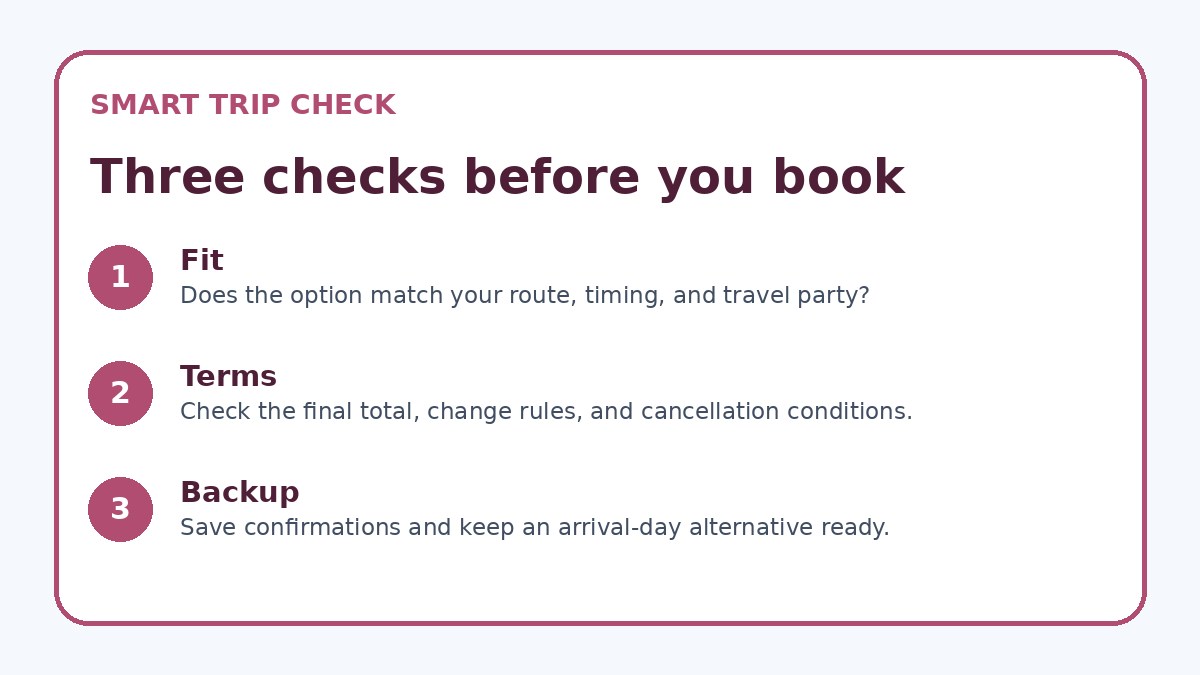
Compare flexibility versus savings for business trips
Business travelers often trade a bit of price for schedule certainty or change flexibility. When an alert shows a lower fare or rate, compare the saving to the potential cost of a schedule change later—lost productivity, missed meetings, or expensive last-minute rebookings. Check whether the fare allows date changes, what change fees apply, and whether any travel insurance or corporate policy reimburses those fees. For hotels, prefer refundable or flexible rates if your meetings are not locked down; nonrefundable savings are only worthwhile when dates are fixed.
Create a quick cost-impact calculation: estimate the likelihood of a date change (low/medium/high), multiply by a conservative estimate of rebooking costs, and compare that to the immediate saving. If the expected rebooking exposure exceeds the saving, choose the more flexible option. This clear comparison helps you choose rationally instead of chasing the lowest number shown in a headline alert.
Before you book
- Name each alert by travel dates, route, and preferred class so you can identify relevance at a glance.
- Write a one-line booking rule listing maximum fare, allowed connections, and required cancellation flexibility.
- When an alert triggers, pause for a fixed review interval (e.g., one hour) and consult your calendar or travel manager.
- Before purchase, click through to the supplier’s checkout and verify fare class, change fees, baggage rules, and final total.
- If booking on behalf of your company, confirm corporate card acceptance and whether central billing or IATA numbers are required.
- Save the confirmation and a screenshot of fare rules, then forward both to your travel manager or expense system immediately.
Verify details on the final booking page
Alerts are discovery tools; the booking page is the authoritative source for fare rules and hotel policies. Always verify what the alert promised: exact travel times, connection durations, baggage allowance, seat selection fees, fare class, and cancellation or change penalties. For hotels, confirm room type, included amenities, breakfast, taxes, and whether the listed rate requires any prepayment. If you use a corporate account or central billing, verify the booking channel accepts that arrangement before payment.
When provider-specific facts matter, check the cancellation policy dates and any nonrefundable clauses on the vendor’s confirmation screen. If you relied on a third-party alerting tool or metasearch, click through to the airline or hotel page—or your corporate booking tool—to confirm all conditions. You can optionally cross-check availability on Trip.com to see alternate presentation of the same rates, but always finalize based on the supplier’s booking terms shown at checkout.
Frequently asked questions
How many price alerts should I set for a single Cebu trip?
For a typical business trip, set two to three alerts: a primary alert for your ideal flight times and hotel standard, a secondary alert for acceptable alternatives (different time windows or nearby neighborhoods), and an emergency alert for last-minute flexibility or significant price drops. This gives you enough coverage to spot meaningful changes without drowning in notifications. If your dates are fixed, tighten alerts to exact dates; if flexible, use a narrow date range and be explicit about connections and refundability in each alert’s criteria.
What if an alert shows a price lower but the fare is nonrefundable?
Treat nonrefundable savings as contingent on date certainty. Before switching, estimate the chance you’ll need to change plans and the likely rebooking cost. If the probability multiplied by the potential rebooking cost exceeds the saving, the nonrefundable fare isn’t worth it. Another option is to purchase the slightly higher flexible fare or add travel protection if your company permits it. Always confirm reimbursement policy with your employer for change fees and unused tickets before choosing a nonrefundable option.
Can I rely on metasearch alerts or should I use airline/hotel direct alerts?
Metasearch alerts are convenient because they compare many channels, but they can omit specific fare rules shown only at the supplier’s checkout. Use metasearch or aggregator alerts for initial discovery, then always click through to the airline or hotel booking page to confirm conditions before committing. If your company uses a managed travel platform, set parallel alerts there and follow company booking approval steps. You may optionally cross-check listings on Trip.com, but finalize based on the supplier’s terms on the booking page.
Final planning note
Price alerts are a practical asset for business travel to Cebu when paired with clear decision rules and verification steps. The discipline is simple: make alerts precise, set a compact rule for what you will accept, and stop to verify supplier terms before payment. Balancing flexibility and savings means quantifying the risk of date changes and comparing that exposure to the immediate discount. Use corporate channels when required, keep records of fare rules and confirmations, and treat alerts as prompts to act rationally instead of emotionally. That routine preserves your time, reduces expense headaches, and keeps your Cebu trips predictable and professional.
Continue planning
Check current options and final conditions
Use the provider page to confirm live availability, the final total, cancellation terms, and every condition that matters to your trip.
This evergreen planning guide was created with AI-assisted drafting and a structured quality review. It does not display live prices, schedules, availability, visa guidance, or provider rankings. Verify current details before booking. Some links are affiliate links; we may earn a commission at no additional cost to you.