If you have a flight to catch after meetings in Busan, plan the return trip to Gimhae International Airport with clear priorities: punctuality, predictable time, and a backup. For most business travelers that means choosing a transfer method based on where you finish your day, how many people or pieces of luggage you have, and whether you need work time en route. This guide gives the quick decision you need first, then shows how to compare options, verify provider details, and build a simple backup plan so you leave Busan with time and peace of mind. Read the practical recommendation up front, then use the tradeoffs to tailor the plan to your schedule and corporate travel rules.
See current options before you compare the details
Availability and final conditions change. Open Trip.com now or keep reading for the practical comparison.
Immediate recommendation for busy schedules
For a business traveler focused on minimizing risk, the straightforward choice is to secure a reserved ride that guarantees a pickup time aligned with your flight check-in requirement. A reserved transfer or private car reduces variability from train connections, last-mile taxi waits, or luggage handling. When you book, set the pickup with a buffer that reflects your company’s minimum recommended airport arrival time and the usual traffic patterns for the corridor between your meeting location and the airport. This upfront certainty simplifies expense reporting and gives you a dedicated workspace en route if needed.
Reserving a transfer also lets you control pickup details: a confirmed meeting point, a driver who understands meeting-room exit times, and space for all luggage. If a private car isn’t within policy or budget, choose a scheduled airport shuttle that serves your neighborhood and confirm that its timetable aligns with your departure window. Whatever option you pick, write the provider’s contact and the booking reference into your calendar invite so you can adjust quickly if a meeting runs late or a colleague needs to join.
Comparing the main transfer approaches
There are practical tradeoffs between metro plus airport rail, scheduled airport buses, taxis or rideshares, and reserved transfers or private cars. Metro and regional rail are the most predictable for central locations with fixed timetables and fewer traffic delays, but they require walking, transfers, and luggage handling. Scheduled airport buses are straightforward and often drop at terminal entrances, but you must align with their timetable. Taxis and rideshares give door-to-door convenience with variable travel time depending on traffic; they are flexible but less predictable during peak hours.
Reserved transfers and private cars offer the highest predictability and door-to-door service, which many business travelers prefer despite higher cost and the need to book in advance. When deciding, weigh the cost against the value of guaranteed timing and the ability to work undisturbed. For mixed teams or tight meeting schedules, the reduced stress and reliable capacity can justify the spend. Always ask whether the provider allows a short waiting time without penalty and what happens if your flight is delayed or your meeting overran, then verify those terms on the booking page.
| Approach | Best for | Tradeoff to check |
|---|---|---|
| Metro/Train plus shuttle | Travelers near stations who prioritize cost and schedule predictability over door-to-door service | Requires transfers and luggage handling; less convenient with heavy bags or tight schedules |
| Scheduled airport bus | Those who prefer a simple, terminal-drop service with set departure times | Must align with fixed timetables and may require walking to the bus stop |
| Taxi or rideshare | Flexible, last-minute departures and door-to-door convenience for individual travelers | Travel time depends on traffic; less predictable during peak congestion |
| Reserved transfer or private car | Business travelers who value guaranteed pickup time, privacy, and space for luggage | Higher cost and requires advance booking and clear pickup instructions |
Ready to check the option that fits your plan?
Use your exact dates and traveler details so the provider page can show the current total and conditions.
Timing, traffic, and backup planning
Traffic patterns around Busan vary by time of day and location; early mornings and evenings can see heavier congestion on arterial roads. For business travelers, build at least a 30–60 minute buffer for road travel beyond the provider’s stated journey time when you need to be at the airport by a fixed check-in deadline. If you rely on trains or buses, add time for walking between stations and ticket queues. Keep a live traffic or transit app handy on departure day, but do not depend on a single route — plan an alternate path or a different transfer mode in case of unexpected delays.
Create a simple backup: if your primary transfer is a scheduled shuttle, save a taxi or rideshare option you can summon on short notice and note its expected pickup points near your meeting location. If you used a reserved car, confirm the provider’s late policy and the driver’s phone number so you can renegotiate pickup when necessary. For teams, appoint one person to monitor time and coordinate the transfer so others can finish work without constant clock-watching. A written plan reduces the scramble when meetings run long.
Before you book
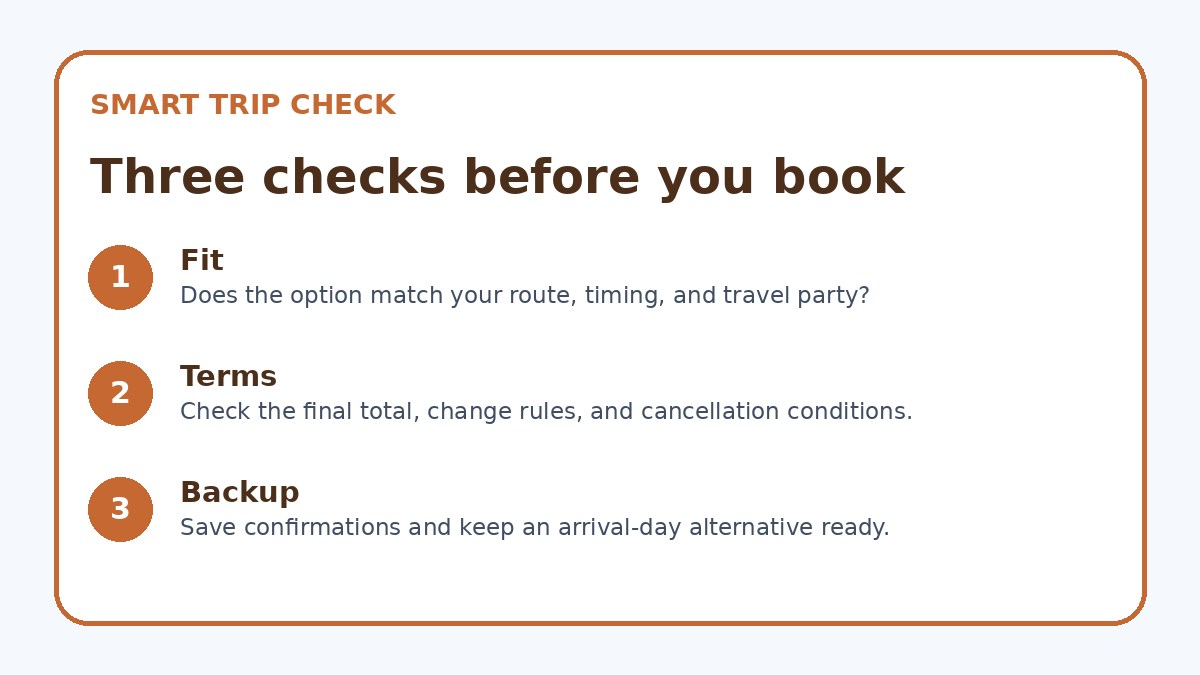
- Confirm your flight check-in and boarding deadlines and calculate the reverse time you must leave your meeting location to meet them.
- Decide whether door-to-door convenience or predictability of schedule matters more, then shortlist two transfer modes that match that priority.
- Check the provider’s pickup point details, allowed wait time, luggage policy, and driver contact on the final booking page before payment.
- Book the primary transfer with a realistic buffer and reserve a secondary option (taxi, rideshare, or later shuttle) in case of delays.
- Add the transfer booking reference and driver phone number to the calendar invite and share it with colleagues or your assistant.
- Confirm corporate reimbursement rules and ensure the transferred service provides an acceptable invoice or electronic receipt.
What to verify before you book
Before you finalize any Busan airport transfer, confirm the essentials on the provider’s final booking page: pickup location and allowed wait time, luggage allowances, cancellation and change rules, and contact methods for driver updates. Do not assume services include meeting-room pickup; some require a public pickup point. Check whether the reservation includes flight monitoring or automatic adjustment for delays, and if not, make a plan to update the provider manually. For corporate travelers, compare how the provider handles invoicing and electronic receipts with your expense policies.
Also verify the vehicle type and capacity if traveling with equipment or several colleagues; a sedan differs from an MPV or van, and some services list passenger counts separately from luggage capacity. If you plan to work on the journey, ask about average mobile signal quality or whether drivers will stop at convenient places for a quick call. If you need to compare current options and availability, Trip.com can be used as one place to review offerings, but always confirm final terms on the operator’s own page before booking.
Frequently asked questions
Should I book a private transfer or rely on public transit from central Busan?
Choose private transfers when your schedule can’t tolerate delay, you have heavy luggage, or you need a quiet workspace en route. Public transit is reliable from central areas with good station access and can be faster during heavy road traffic, but it requires transfers and extra handling. Compare the total door-to-door time, transfer walking distance, and how much buffer your itinerary allows. Whichever you pick, verify the provider’s pickup or departure details on the final booking page and have a backup plan.
How much buffer time should I leave between the end of a meeting and my flight?
Industry practice varies by airline and destination, but for road travel from Busan city center to the airport you should plan a buffer that covers travel variability, queuing, and security. For most business travelers a conservative approach is to build extra time beyond minimum check-in rules — typically 30–60 minutes more for road options and 15–30 minutes for rail-based routes. Tailor this buffer to whether you travel with checked luggage, need corporate approval windows, or might run late from the meeting.
What information should I keep handy during my return transfer?
Keep the driver’s phone number, the booking reference, pickup location details, and alternate transfer contacts readily available. Save route screenshots or station plans if you are taking rail or shuttle services and note where buses stop relative to terminal entrances. Keep a digital and printed copy of any receipt or voucher required for corporate reimbursement. If traveling with colleagues, share the plan and designate one coordinator to handle changes so others can focus on finishing up meetings.
Final planning note
Planning the Busan airport transfer for a business trip means choosing what you value most—predictability, cost efficiency, or door-to-door convenience—and then confirming the details that affect timing. Reserve a transfer when guaranteed pickup and workspace matter, rely on rail or scheduled buses when timetables and cost control win out, and keep a taxi or rideshare as a flexible backup. Before booking, verify pickup points, waiting policies, luggage allowances, and invoicing on the provider’s final page so there are no surprises. A little upfront confirmation and a simple backup plan will help you leave Busan on schedule and with one less thing to worry about.
Continue planning
Check current options and final conditions
Use the provider page to confirm live availability, the final total, cancellation terms, and every condition that matters to your trip.
This evergreen planning guide was created with AI-assisted drafting and a structured quality review. It does not display live prices, schedules, availability, visa guidance, or provider rankings. Verify current details before booking. Some links are affiliate links; we may earn a commission at no additional cost to you.