Short answer: for most couples traveling between Rome and Florence, the high-speed train is the most practical mix of comfort, predictability, and city-center connectivity. It minimizes transfers, leaves you free to relax or talk during the journey, and drops you directly into both city centers—handy when one or both of you want to step out with luggage and start exploring. That said, ‘most practical’ depends on your priorities: privacy and scenic drives favor renting a car; strict time constraints or a tight onward connection might make flying worth checking; and travel-savvy couples might prefer a slower regional train or an overnight plan to stretch budget or sightseeing. Below I’ll explain tradeoffs, what to compare when booking, and a checklist so you can decide quickly and confidently.
See current options before you compare the details
Availability and final conditions change. Open Trip.com now or keep reading for the practical comparison.
Why trains are usually the practical default for couples
For many couples the train hits the right balance: you board in city centers, sit together in a relaxed carriage, and exit close to hotels, restaurants, and attractions. Trains remove the stress of airport check-in windows, long security queues, and the extra taxi or shuttle at each end, which makes timing and logistics simpler for two people carrying suitcases or a daypack and a camera.
Trains also make conversation and planning easier—no cramped single-aisle flight, no constant navigation for the driver, and no need to split attention between driving and sightseeing. When you compare options, look beyond advertised trip time to total door-to-door time including getting to and from stations, luggage handling, and the ease of onward transfers at each end.
When a car is the better option for privacy and detours
A rental car can be the best choice if your couple’s priorities are privacy, flexibility, and the ability to stop for countryside views, wineries, or small towns along the way. Driving lets you set your own schedule, take scenic routes in Tuscany, and carry extra gear—useful if you’re bringing cyclists’ bikes or multiple pieces of baggage that would be costly on other services.
However, driving brings responsibilities: find out if your accommodation in Florence has parking or whether you’ll need to park outside the historic center and walk. Verify current ZTL (limited traffic zone) rules, parking permits, and any local restrictions on the final booking pages; these rules change and can carry fines if ignored. Factor in fuel, tolls, and time spent finding parking when comparing total trip cost and convenience.
| Approach | Best for | Tradeoff to check |
|---|---|---|
| High-speed train | Couples wanting city-center-to-city-center travel with minimal transfers | Less opportunity for private stops and dependence on train schedules |
| Rental car | Couples prioritizing privacy, scenic detours, or flexible timing | Parking, ZTL rules and driving responsibility add time and potential extra cost |
| Flights | Couples with strict time constraints tied to airport connections | Airport transfers and security can erase time savings; baggage rules vary |
| Regional/slow trains or bus | Couples on a budget who enjoy a slower travel pace and local scenery | Longer travel time and potentially less frequent departures |
Ready to check the option that fits your plan?
Use your exact dates and traveler details so the provider page can show the current total and conditions.
When flying might make sense—and why to check carefully
Flying can look attractive if you have a very tight schedule, a connecting international flight that aligns better with airports, or an unusual timetable. But flights rarely take you from city center to city center; add the time for airport transfer, check-in, security, and the possibility of waits or delays before assuming flying will save time overall.
If you consider flights, compare total door-to-door times and the hassle of two airport transfers. Always verify baggage allowances, transfer options at each airport, and how much extra time you’ll need for ground transport. Check flight routing carefully—direct versus connecting—and read the carrier’s booking page for the latest baggage and transfer policies before you commit.
Before you book
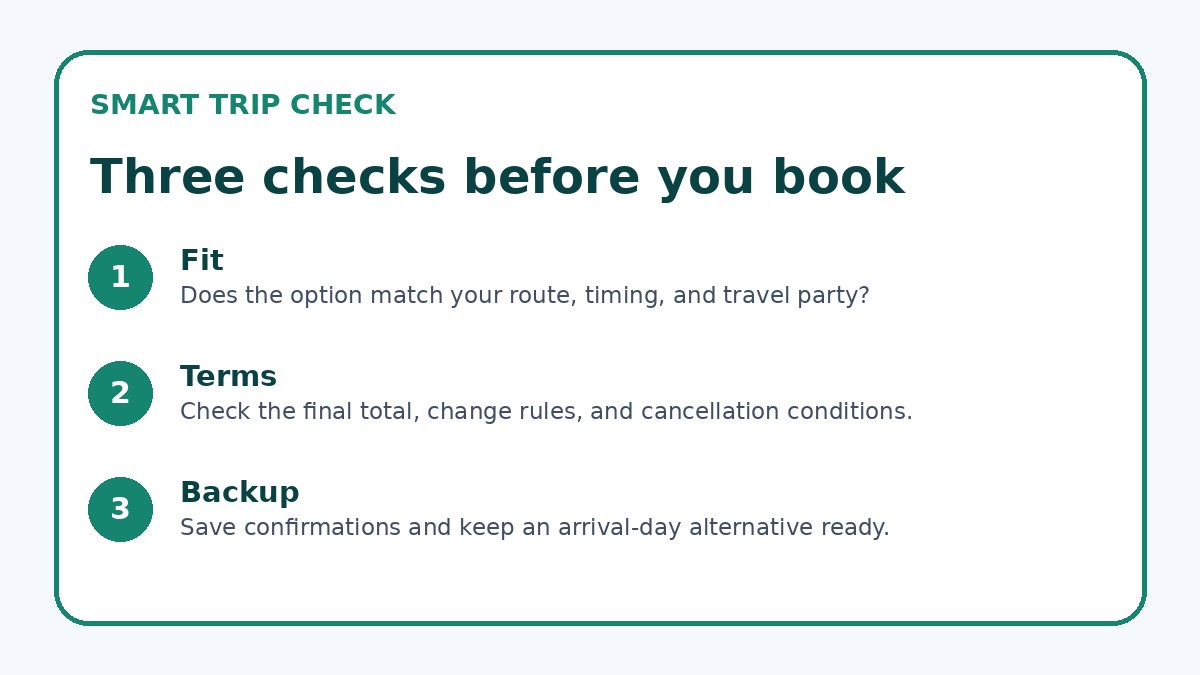
- Confirm total door-to-door time for each option, including transfers to stations or airports and expected local transport at both ends.
- Check baggage rules and seat-assignment options on the provider’s final booking page so you know costs, carry-on limits, and if you can sit together.
- If renting a car, verify ZTL boundaries, parking availability at your Florence accommodation, and whether your license or additional driver requirements apply.
- Compare the final price including taxes, tolls, parking, and potential shuttle or taxi fares rather than just the headline fare.
- For flights, check whether the itinerary is direct or connecting and confirm minimum connection times and terminal transfer time when relevant.
- Read recent travel or station advisories from official sources and, if using an aggregator like Trip.com, use it only to compare current availability and then verify details on the provider’s page.
Other practical considerations couples shouldn’t overlook
Luggage needs, mobility, and the kind of shared experience you want should guide the decision. If either partner has mobility constraints, trains often provide easier aisle access, space to move about, and less walking between terminals. For leisurely couples on a relaxed schedule, the extra time of driving or a scenic regional train can add to the trip rather than feeling like a cost.
Cost comparisons must include less obvious items: parking fees, potential ZTL fines, taxi or shuttle fares, and luggage fees on flights. Before booking, use provider pages to confirm baggage rules and seat-assignment options—small differences can change convenience significantly for two people traveling together.
Frequently asked questions
How do I compare total door-to-door time between train, car and plane?
Add the time to reach the departure point, the advertised journey time, and the time needed at arrival to reach your accommodation. For trains, include the walk or transfer to the station and any wait time for boarding; for cars, include time to pick up and return the rental and estimated parking time; for flights, include check-in, security, potential delays, baggage claim and transfers from the airport. Calculating all these elements gives a realistic comparison; don’t judge options by in-air or on-track time alone.
Can couples always sit together on trains or flights between Rome and Florence?
Seating policies differ by operator and fare class. Many trains let you choose seats when you book or reserve them for an extra fee; some regional services have open seating. Airlines and low-cost carriers may or may not reserve adjacent seats without an additional charge. Always check the booking page for seat allocation rules before purchasing, and consider reserving seats in advance if sitting together is important to you.
What luggage and parking rules should we double-check before choosing a rental car?
Confirm the rental company’s policies on luggage size, additional drivers, and any charges for extra equipment like child seats or roof racks. On the Florence end, check whether your hotel or apartment provides on-site parking or if you’ll need to leave the car outside the historic center and walk; researching ZTL restricted zones is essential because driving into them without authorization can lead to fines. Verify all these details on the rental contract and your accommodation’s information page before booking.
Final planning note
For most couples making the Rome to Florence trip, the high-speed train is the practical default: simple logistics, city-center access, and a relaxed shared journey. If your priorities tilt toward privacy, scenic flexibility, or carrying bulky gear, a rental car can be the better choice—just plan for parking and local traffic rules. Flying is a niche option that can work when airport connections dictate timing, but always compare total door-to-door time and baggage rules. Use the checklist above to align the choice with your couple’s priorities, and verify schedules, seat policies, and luggage rules on each provider’s booking page (or compare availability on Trip.com as a first step). That way you’ll pick the option that feels easiest, most enjoyable, and least stressful for both of you.
Continue planning
Check current options and final conditions
Use the provider page to confirm live availability, the final total, cancellation terms, and every condition that matters to your trip.
This evergreen planning guide was created with AI-assisted drafting and a structured quality review. It does not display live prices, schedules, availability, visa guidance, or provider rankings. Verify current details before booking. Some links are affiliate links; we may earn a commission at no additional cost to you.