
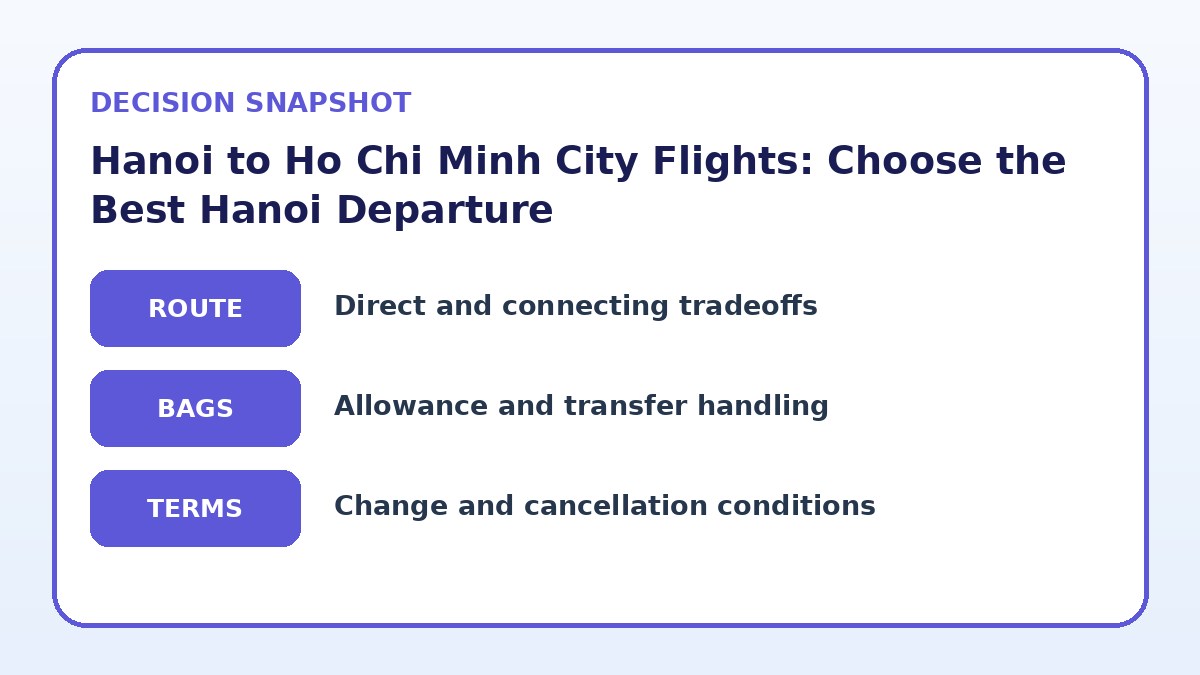
If you’re flying from Hanoi to Ho Chi Minh City with more than the usual carry-on, choose your departure airport based on baggage handling convenience, ground access, and how strict airlines are about checked luggage. The practical choice isn’t always the closest terminal to your hotel — it’s the airport that reduces transfers, limits handling steps for heavy bags, and gives clear, simple baggage rules at the ticket counter. Before booking, compare how each Hanoi airport connects to city transport, how long check-in and security lines tend to be, and whether your carrier’s baggage policy and extra-baggage fees are straightforward. Verify final baggage allowances, oversize rules, and any contact details on the airline or booking page you’ll use; those specifics change frequently and matter most at check-in.
See current options before you compare the details
Availability and final conditions change. Open Trip.com now or keep reading for the practical comparison.
Why airport choice matters when you have extra luggage
Extra luggage multiplies every friction point during a trip: transfers, check-in, security, and any short-term storage you might need. Each time bags are moved between vehicles, dropped off at counters, or placed on luggage carts, there’s more time, effort, and possibility of delays or misrouting. For Hanoi to Ho Chi Minh City travelers, reducing the number of times bags change hands is the most practical objective — that often means choosing an airport with straightforward check-in counters, fewer inter-airport transfers, and easy access to the ground transport that fits your luggage load.
Beyond physical effort, different airports and airlines treat checked and oversized bags differently: check-in desks might be busier, special-handling lanes may exist or not, and airport layout impacts how far you must wheel heavy suitcases. If you have items like sports equipment or musical instruments, those considerations become more important because some airports and carriers require advance notice or special processing. Plan for the route that cuts handling steps and lets you complete most baggage tasks once — at departure — rather than juggling them in transit.
Compare ground access and total travel time, not just distance
A nearby airport can feel convenient until you factor in peak-hour traffic, limited parking, or complex public-transit routes that force multiple transfers with heavy bags. When deciding between Hanoi departure points, estimate door-to-door travel time using the transport modes you’ll actually use: taxi, ride-share, private transfer, or rail. Include time for parking or shuttle waits if you plan to leave a vehicle, and add buffer time for checking oversized baggage. A slightly farther airport with simpler, more reliable taxi or private-transfer access can be the faster and less stressful option for travelers with bulky luggage.
Also consider luggage-friendly features of the final leg: does the chosen airport have covered walkways, elevators, or baggage carts that are easy to access? These small conveniences add up when you have several heavy bags. If you expect to arrive at the airport by public transit with transfers, weigh whether it’s worth paying more for a direct taxi or meet-and-greet service that will save lifting and negotiating stairs or crowded platforms. The practical choice reduces lift count and streamlines the route from your door to the check-in counter.
| Approach | Best for | Tradeoff to check |
|---|---|---|
| Choose the closest airport to your hotel | Minimizing travel distance and taxi expense to departure point | May mean more transfers, fewer baggage services, and longer time handling luggage overall |
| Choose the airport with better baggage handling services | Reducing physical effort through porters, carts, and assisted check-in | Could increase ground travel time and cost from your lodging |
| Choose an airport with simpler layout and fewer terminal transfers | Faster curb-to-gate flow and fewer steps carrying luggage | Smaller airports may have limited flight choices or higher fares |
| Pick an airport that enables checked-through connections | Avoiding bag reclaim and re-check during connections | Requires confirming carrier interline policies and may limit carrier choice |
Ready to check the option that fits your plan?
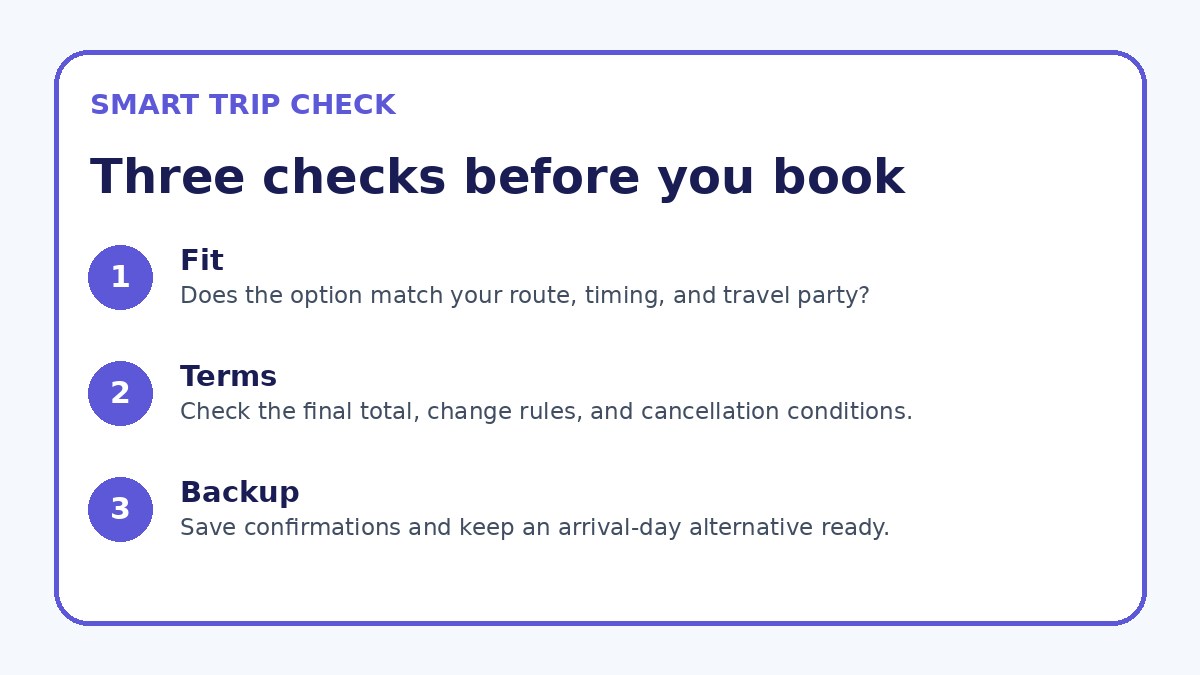
Use your exact dates and traveler details so the provider page can show the current total and conditions.
Baggage rules and check-in options to verify before booking
Airline baggage allowances, overweight and oversize charges, and the availability of advance-paid extra baggage vary by carrier and fare class. Always check the final baggage rules on the airline or booking provider’s page you intend to use — these are the authoritative sources for dimensions, weight limits, and how fees are applied. If you’re booking through an agent or an aggregator for comparison, confirm the same details on the airline’s site before you finalize payment because some providers display simplified summaries that can omit surcharges for unusual items.
Also verify check-in options that matter to heavy-luggage travelers: curbside check-in, priority luggage lanes, or the ability to pre-pay and tag excess bags online. If curbside drops or dedicated assistance are offered, they can save considerable effort. If you’ll connect through another city, check whether your bags are checked through to the final destination or whether you must reclaim and re-check them; even the possibility of an intermediate bag pick-up changes how practical a departure airport will be for you.
Before you book
- Confirm the airline’s checked baggage weight, size limits, and fees on the airline’s official booking or support page before you pay.
- Estimate door-to-door time from your accommodation to each Hanoi airport using the transport mode you will actually use (taxi, transfer, public transit).
- Ask the airline or airport whether curbside check-in, porter service, or special-assistance lanes are available and how to request them.
- If your trip involves a connection, confirm whether your luggage is checked through to the final destination or must be claimed and rechecked.
- Measure and weigh your bags at home to know which items might trigger oversize or overweight charges and consider redistributing weight.
- Compare total trip factors — ground cost, handling steps, and baggage policy — not just the headline flight time or ticket price.
Practical tradeoffs: cost, convenience, and airport services
Choosing the most practical departure airport for heavy luggage often involves tradeoffs between direct ground convenience and airport services that ease handling. A smaller terminal may have quicker curb-to-counter service but less seating or fewer luggage carts. A larger airport might offer baggage assistance, more check-in staff, and paid porter services but could mean longer walking distances or bus shuttles between terminals. Think about which tradeoff you want: fewer handling steps and simpler transfers, or more on-site services that reduce manual effort once you arrive at the terminal.
Another common tradeoff is cost versus effort. A private transfer to a better-equipped airport can be more expensive than public transit to a closer one but will likely reduce lifting and the stress of juggling bags on multiple connections. If budget is tight, plan to travel off-peak, bring collapsible luggage that fits carry-on rules where possible, or arrange for baggage pickup and delivery services that move bags ahead of you and relieve you of handling them at airports.
Frequently asked questions
Do I need to arrive earlier at the airport if I have extra or oversized baggage?
Yes. Arriving earlier gives you time to handle check-in, security, and any special processing for oversized or heavy items. Airlines and airports may require additional documentation or manual handling for items like sports gear or musical instruments; that can add time. Also factor in potential queues at specialized counters and any measurements or inspections staff might perform. Check the airline’s recommended arrival window for passengers with checked or oversized luggage and add an extra buffer for busy travel periods.
Can I pre-pay for extra baggage or reserve space for oversized items in advance?
Many airlines let you pre-purchase additional baggage allowance online or reserve space for oversized items, but the availability and rules differ by carrier. Pre-paying often costs less than paying at the airport and can simplify check-in. However, confirm the exact dimensions, declared weight, and any required documentation on the airline’s booking page before you pay. If booking through a third party, verify the airline’s site too, since third-party summaries can omit item-specific restrictions.
If I choose a departure airport with fewer direct flights, how do I compare connecting options for baggage safety?
When direct flights are limited, compare routes by counting baggage touchpoints: direct service means fewer handoffs; connecting itineraries may require reclaiming and re-checking bags depending on carrier agreements. Look at the number of connections, minimum connection times, and whether the same carrier or partner carriers handle both segments. Verify on the airline’s site whether checked bags are transferred automatically and whether protective handling for oversized items is offered. Prefer itineraries with checked-through baggage policies to reduce manual handling.
Final planning note
For Hanoi to Ho Chi Minh City travelers with extra luggage, the most practical departure airport is the one that reduces handling steps, simplifies check-in, and matches your ground-transport realities rather than simply being the closest. Start by checking airline baggage rules on the carrier’s final booking page, estimate door-to-door times for each airport using your actual transport options, and factor in on-site services like curbside check-in or porter assistance. If you must connect, confirm whether bags are checked through to avoid reclaiming them. Compare total effort and risk — fewer lifts and transfers usually make a slightly longer taxi worth the investment for a low-stress trip.
Continue planning
Check current options and final conditions
Use the provider page to confirm live availability, the final total, cancellation terms, and every condition that matters to your trip.
This evergreen planning guide was created with AI-assisted drafting and a structured quality review. It does not display live prices, schedules, availability, visa guidance, or provider rankings. Verify current details before booking. Some links are affiliate links; we may earn a commission at no additional cost to you.