If your family is deciding between a direct Amsterdam to Rome flight and a connecting itinerary, start by asking three simple questions: how much stress can kids tolerate, how many luggage or seat needs do you have, and how rigid are your travel dates? Direct flights usually cut total travel-day time and the number of transitions, which helps younger children and grandparents stay rested. Connecting options can lower fares and open different time windows, but they add complexity: transfers, possible re-checks, and the risk of missed connections. This guide shows the practical tradeoffs families should weigh, how to compare options side by side, and which details to verify on airline and booking pages before clicking purchase. Use it to match the flight choice to your family’s tolerance for change, budget flexibility, and on-the-ground logistics in Amsterdam and Rome.
See current options before you compare the details
Availability and final conditions change. Open Trip.com now or keep reading for the practical comparison.
Comfort and convenience: why direct flights often win for families
For families, the biggest value of a direct flight is predictability. Fewer takeoffs and landings, no intermediate gate changes, and no risk of missing a tight connection all reduce anxiety and physical strain. Parents of infants or toddlers often prefer fewer transitions because managing car seats, strollers, and diaper bags through one airport is simpler. Direct flights also mean one security and one boarding process, which is especially helpful when juggling children, snacks, and entertainment without repeated disruptions.
That convenience isn’t just about calmer kids—it affects the whole travel day. A single flight reduces cumulative waiting times and the need to coordinate transfer transport, which can matter if you’re fitting the trip around naps or evening routines. For multigenerational travel, the fewer times older relatives must stand in lines or walk long terminal distances, the better. Still, direct service may depart at less convenient hours or cost more; the decision is whether those tradeoffs are worth the smoother travel experience.
Price and schedule flexibility: where connecting options make sense
Connecting itineraries often appear when airlines and hubs offer more routing combinations; that can mean lower fares or options that match your family’s preferred departure or arrival times. If your schedule is flexible and you want to lower the base fare, a one-stop itinerary may save money or free budget for better seats, extra baggage, or a nicer hotel in Rome. Connections can also open travel windows not served directly, like early morning or late evening arrivals that suit your itinerary better.
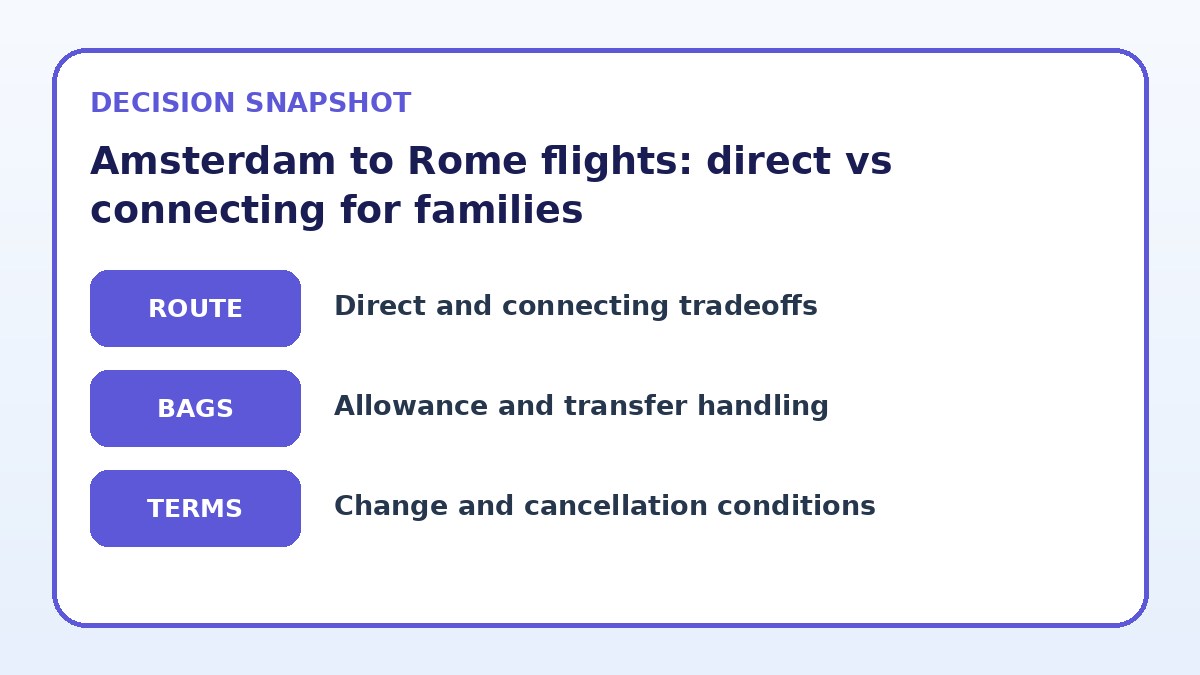
However, those savings come with operational complexity. Layovers add time and require transfers that may include changing terminals, re-checking bags, or moving between airports in some rare cases. Families should compare door-to-door travel time, not just airborne hours, and check minimum connection times, especially if you have to collect and re-check hold luggage. Always confirm transfer details on the airline’s final booking page and consider whether the saved money compensates for the added hassle and potential for delay.
| Approach | Best for | Tradeoff to check |
|---|---|---|
| Direct flights | Families prioritizing simplicity, fewer transitions, and shorter door-to-door time | Often fewer schedule choices and sometimes higher fares or inconvenient departure times |
| Single-connection itineraries | Families balancing cost savings and reasonable transfer complexity | Requires managing layovers, potential terminal changes, and slightly increased risk of disruption |
| Multi-stop or mixed-ticket routes | Travelers seeking lowest fares or specific schedule matches who accept complexity | Higher chance of missed connections, separate baggage rules, and more stressful travel days |
| Flexible-ticket connecting options | Families needing changeable plans or medical and mobility accommodations | Flexibility often comes with higher base fares or stricter rules on seat availability |
Ready to check the option that fits your plan?
Use your exact dates and traveler details so the provider page can show the current total and conditions.

Decision criteria: how to compare direct and connecting options
Set a few family-specific priorities before comparing flights: acceptable total travel time, maximum number of connections, baggage needs, and who needs special assistance. Create a simple matrix listing each itinerary’s departure and arrival times, total travel time from door-to-door, number of transfers, estimated layover durations, and whether baggage is through-checked. For families with car seats or oversized gear, confirm if the connection requires reclaiming luggage. If traveling with an infant, check whether bassinet seats are offered and how seat assignments are handled on each segment.
Also factor in airport logistics: in Amsterdam, how long does ground transport take to Schiphol from your accommodation? In Rome, which airport (Fiumicino or Ciampino) suits your final destination best? Longer ground transfers can erase any airborne time savings from a direct flight. Finally, examine the flexibility of tickets—can you change legs without heavy penalties? For connecting itineraries with separate tickets, consider adding buffer time or purchasing through-checked options to avoid the risk and stress of missed connections.
Before you book
- Compare door-to-door travel time for each itinerary, including ground transfers to and from airports in Amsterdam and Rome.
- Verify baggage rules and whether checked bags are through-checked on each connection on the airline’s final booking page.
- Confirm seat assignments, bassinet availability, and stroller policies for each flight segment before booking.
- Check minimum connection times and terminal transfer details for each connecting airport involved in your itinerary.
- Decide how much buffer time you need between flights based on children’s routines and mobility needs.
- If booking separate tickets, add extra layover time and consider travel insurance that covers missed connections.
Practical tips for families on the day of travel
On travel day, pack a clear carry-on bag per child with essentials—snacks, medicines, a change of clothes, charging cables, and favorite small toys. Arrive early to give yourself time for family check-in needs, stroller gate-checking, and security lines. If you have a transfer, map the connection before you fly and note terminal maps and minimum connection times from the airline. If you expect tight connections or need assistance, request meet-and-assist or early boarding when available; airlines list these services on their booking pages and at airport desks.
If you choose a connecting itinerary, build in buffer time between flights when possible and keep everything you’ll need for the first few hours in carry-on rather than checked baggage. For direct flights, confirm if early or late departures conflict with nap or bedtime routines and adjust plans accordingly. Finally, check and re-check on the airline or booking site for seat assignments, carry-on limits, and confirmed bassinet availability; these operational details can change, so the final provider page is the authoritative source before booking.
Frequently asked questions
Is a direct flight always the least stressful option for children and older relatives?
Not always. Direct flights reduce the number of transitions, which often lowers stress, but other factors matter: departure and arrival times relative to nap or sleep schedules, total door-to-door time including ground transfers, and seat comfort. If a direct flight departs at an awkward hour or forces a long drive to the airport, a connecting option with a better schedule might actually be less disruptive. Evaluate the whole travel day rather than just the number of flight segments when choosing for children or elderly family members.
How much layover time should a family allow when choosing a connecting itinerary?
There’s no single rule—safe layover time depends on the airports involved, whether you must change terminals, and if you need to reclaim and re-check baggage. For simple same-airline transfers at Schiphol or a compact hub, 60–90 minutes can work for experienced travelers; families often want at least 90–120 minutes for a less rushed experience. If you must change airports or re-check bags, build much more time. Always confirm the airline’s recommended minimum connection times and then add extra buffer for family needs.
If I find a cheaper connecting ticket with different airlines, what should I check before buying?
Carefully verify whether the airlines allow through-checked baggage and whether the booking is protected by a single reservation or two separate tickets. With separate tickets, you may need to collect and re-check bags and won’t have automatic protection if the first flight is delayed. Check transfer terminals and minimum connection times, change and cancellation policies, and whether you can secure seats together. Trip.com can show current availability, but confirm all operational details—baggage, seat assignments, and protection—on each airline’s final booking page before you commit.
Final planning note
Choosing between direct and connecting Amsterdam to Rome flights for a family comes down to balancing stress, time, and cost. Direct flights simplify the travel day and reduce the chance of disruption, which matters most for young children and less-mobile relatives. Connecting options can save money and offer more schedule flexibility, but they demand careful planning around layovers, baggage rules, and connection logistics. Decide by listing your family priorities—sleep schedules, baggage needs, and willingness to manage transfers—then compare door-to-door times and confirm operational details on the carrier’s booking page before purchase. With deliberate comparison and a few buffers, you can pick the itinerary that keeps your family calm and ready to enjoy Rome.
Continue planning
Check current options and final conditions
Use the provider page to confirm live availability, the final total, cancellation terms, and every condition that matters to your trip.
This evergreen planning guide was created with AI-assisted drafting and a structured quality review. It does not display live prices, schedules, availability, visa guidance, or provider rankings. Verify current details before booking. Some links are affiliate links; we may earn a commission at no additional cost to you.