First decision after landing: start by choosing transport that fits both your party size and the luggage volume you actually have on arrival. If you’re a small group (2–6 people) with oversized bags, instruments, or bike boxes, a regular tram or metro trip will be awkward even if it’s cheap; door-to-door options remove that stress. In the first hour after landing you should confirm where the driver will meet you, how much luggage the vehicle can take, and whether a single vehicle will hold everyone and everything. This short guide gives a direct recommendation up front, then walks through tradeoffs, what to verify before booking, and how to handle late or disrupted arrivals so you don’t get stuck in the wrong part of the city with too many bags.
Check options for your arrival details
Use your flight, luggage, party size, and accommodation address to compare current choices.
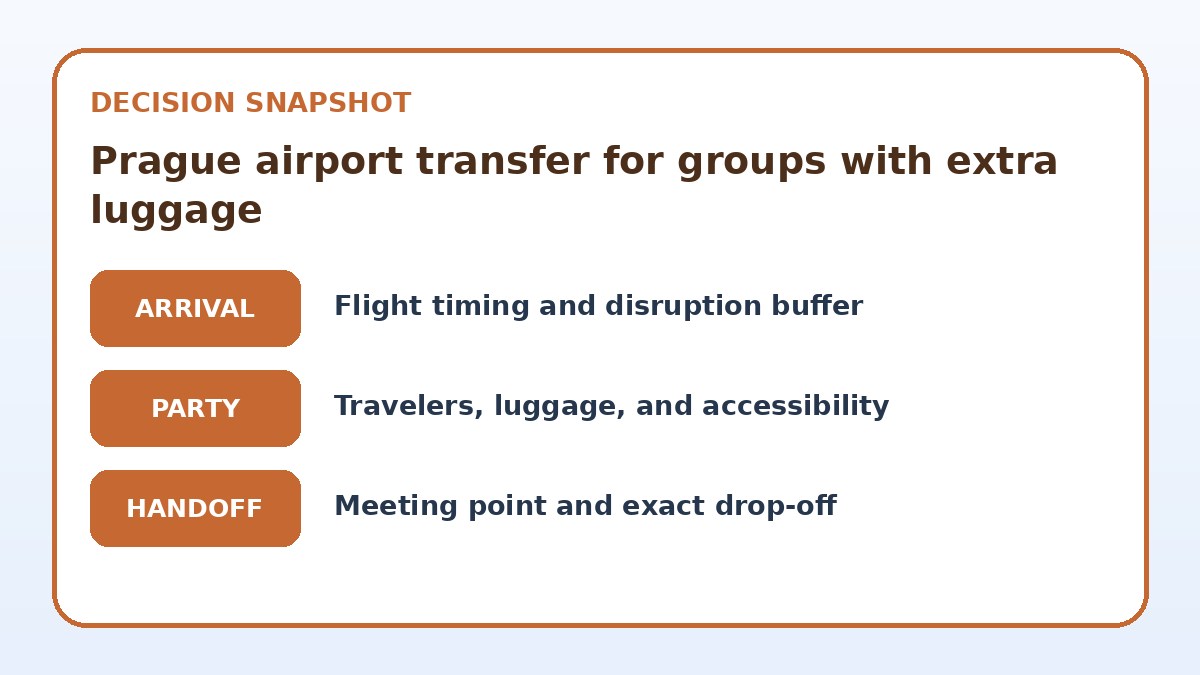
Luggage and party size: matching vehicle to what you actually have
Count suitcases, carry-ons, and any oversized items before you shop for transfers. A group of three with six checked bags and two golf bags needs a different vehicle than a group of five with five soft cases. When an operator lists capacity as a passenger number, ask separately about luggage capacity—passenger seats and trunk volume are not the same. Measure or estimate the largest dimension of anything awkward (ski bag, bike box) and compare to the provider’s stated cargo space or vehicle model.
Decide whether you prefer all travellers and bags in one vehicle or accept splitting into two smaller cars. One-vehicle transfers simplify meeting points and unloading but require a larger van or minibus. Splitting can be cheaper and faster through traffic but increases the number of terminal-to-door movements, coordination, and the chance a delayed flight leaves part of the group waiting. For comfort and fewer steps with heavy luggage, single-vehicle private transfers usually save time and hassle.
Arrival details to have ready
- Count and photograph every bag and oversized item; note dimensions and approximate weight to share with transfer providers.
- Ask a quoted provider to confirm exact vehicle model and luggage capacity in writing before you book.
- Get the driver’s name, vehicle registration, and local contact number; save them in a group chat and on paper.
- Agree on a precise airport meeting landmark and a backup rendezvous point, and share a photo of that spot with the group.
- Check your accommodation’s drop-off rules and the nearest legal curbside point for larger vehicles, then communicate that to the driver.
- Plan extra buffer time for passport control and baggage reclaim; choose a transfer option that allows flexible rebooking or reasonable wait time.
Late or disrupted arrivals: pre-plan for delays and missed connections
Choose a transfer option with clear policies on driver waiting time and rebooking for late arrivals. Flights into Prague can be delayed, and baggage reclaim times vary; confirm whether the driver’s wait time starts from touchdown, scheduled arrival time, or baggage collection. If you expect potential disruption, opt for a provider that allows flexible rebooking or provides a phone contact for last-minute coordination so the driver knows whether to wait, meet you at arrivals, or relocate.
If your inbound schedule is tight or involves connections, build extra buffer into arrival-to-departure planning. For groups, a missed transfer without a backup plan can multiply cost and stress. Consider booking an option that includes a meet-and-greet inside the arrivals hall or at a defined airport landmark—this reduces the time lost trying to locate one another. Keep the driver’s local contact and a copy of the booking confirmation accessible on multiple devices in case someone’s phone dies.
Match the transfer to your arrival
| Arrival approach | Best for | Detail to verify |
|---|---|---|
| Private car or minivan pickup | Small groups wanting door-to-door service and single-vehicle convenience with lots of luggage | Higher cost than public transport and requires verifying luggage capacity in advance |
| Shared shuttle or shared transfer | Budget-conscious travellers with manageable large items who accept fixed routes and possible stops | May require transfers between vehicles or delays; limited space for oversized items unless reserved |
| Taxi from the airport rank | Flexible, immediate departures when you can fit luggage into a standard trunk or multiple cars | Unpredictable trunk space for bulky or many items; may need two taxis and more coordination |
| Public transit (bus and metro) | Low-cost option for those with compact, easily carried luggage and experience with transit | Crowded vehicles, stairs, and transfers make it impractical with large or heavy baggage |
Make the meeting plan clear
Check the final pickup instructions, waiting conditions, and exact drop-off coverage.
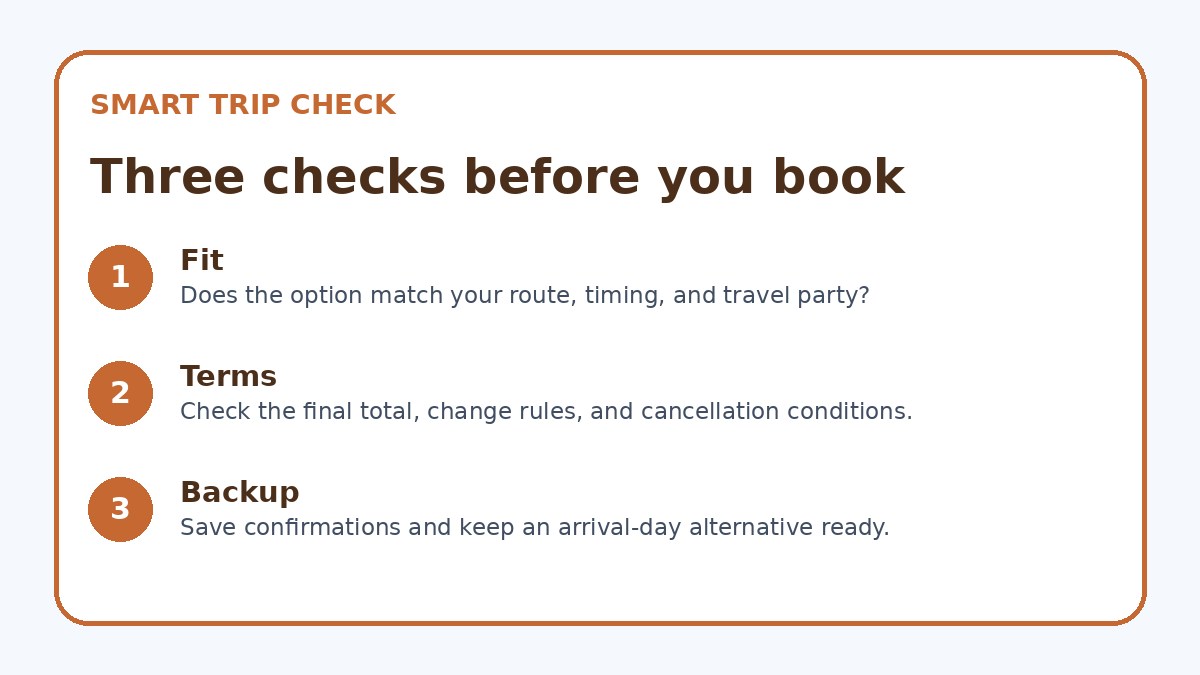
Meeting-point clarity: where to meet and how to communicate
Agree on the precise pickup point before you land; ‘Arrivals hall’ is too vague. Prague’s airport has terminals and numbered exits and recognizable landmarks (buses, taxi ranks, information desks). Ask the transfer provider to specify a meeting landmark, an exit number, or a distinct sign the driver will hold. For private transfers, request the driver’s name and mobile or messaging contact, and confirm whether they will display your name on a sign—this is particularly useful when language or crowding could cause confusion.
Use a backup plan if your group splits during disembarkation: nominate one person to collect bags and relay positions to the driver while others wait at the agreed landmark. If you’ll rely on local mobile networks, ensure all phones have roaming or an offline communication plan. Photograph the pickup spot on arrival so anyone unfamiliar with Prague airport can find it, and share the photo and written directions with each traveler before landing to speed the meetup.
Drop-off fit at destination: door-to-door vs curbside and local access
Not every Prague address has easy curbside access for larger vehicles—old streets, pedestrian zones, or hotel loading restrictions can complicate drop-off. Confirm with your accommodation whether a minivan or minibus can approach the entrance and whether there are restrictions on stopping time. If the property is inside a pedestrian-only area, ask about the closest legal drop-off point and whether staff will assist with luggage from there to the door.
Factor in stairs, elevators, and distance from the curb to the room if you have heavy or fragile baggage. If mobility or security is a concern, request porter service or a ground-floor room to minimize internal transfers. For short-term parking while unloading, check whether the driver is permitted to stay briefly or must move the vehicle immediately; this affects whether you can handle multiple large bags without rushing.
Airport Transfer & Local Mobility questions travelers ask
Can a single private minivan handle three travellers and lots of luggage for a Prague airport transfer?
Possibly—but don’t assume. Vehicle passenger capacity and luggage volume are listed separately by some operators; a model that seats five may have limited trunk space. Before booking, ask for the specific van model and whether it can carry your number of large bags, bike boxes, or ski bags without folding seats. If the provider cannot confirm, consider reserving a larger minibus or two cars. Also check whether the transfer price changes if extra luggage occupies a seat or requires roof storage.
What if my flight is delayed—will the transfer wait or charge me extra?
Policies vary, so verify the provider’s rules before you finalize a booking. Some services include a complimentary waiting window from scheduled arrival time; others start the clock at touchdown or baggage reclaim. Ask how much free wait time is included, what happens if you contact them to say you’re delayed, and whether there are additional fees for long delays or rebooking. Keep the driver’s direct contact and your booking reference handy during the flight to communicate changes quickly.
Is it worth using a shared shuttle instead of booking a private transfer for luggage-heavy groups?
A shared shuttle can be economical, but only if it explicitly reserves space for your large items and the route matches your destination. Shared services that allocate luggage space per booking are workable for bulky bags; those that operate on a first-come, first-served trunk basis can cause problems. Consider how many stops the shuttle will make, whether you’ll need to transfer vehicles, and how comfortable you are handling heavy items at each stop. For minimal handling and faster door-to-door travel, private transfers tend to be more reliable with lots of luggage.
Final decision note
When arriving in Prague with a small group and extra luggage, make your first choices around vehicle capacity, meetup clarity, and flexible handling of delays. If convenience and reduced handling are priorities, a private car or minivan that clearly states luggage capacity is usually the most straightforward option. If saving money matters, confirm reserved luggage space on a shared shuttle or be ready to split into multiple taxis. Whatever you choose, document the driver’s contact details, the pickup landmark, and your accommodation’s drop-off policy before you land. If you want to compare current availability while planning, consider checking options on Trip.com but verify vehicle specifications and wait-time terms directly on the provider’s booking page.
Continue planning
Check current options and final conditions
Use the provider page to confirm live availability, the final total, cancellation terms, and every condition that matters to your trip.
This evergreen planning guide was created with AI-assisted drafting and a structured quality review. It does not display live prices, schedules, availability, visa guidance, or provider rankings. Verify current details before booking. Some links are affiliate links; we may earn a commission at no additional cost to you.