If you’re traveling to Gyeongju with children and a lot of luggage, prioritize an airport transfer that minimizes walking, waiting, and complicated connections. For most families a private car or pre-booked shuttle that delivers you door-to-door, allows child seats, and has space for strollers and suitcases will be the least stressful choice. Budget-conscious families may combine public transport with a short taxi for the final leg, but that adds handling and time. Before booking, compare vehicle size, child-seat options, luggage allowances, pick-up processes, and cancellation terms. When a provider’s details could change, check their final booking page for seat and luggage policies, exact pick-up points, and any infant/child safety-seat requirements.
See current options before you compare the details
Availability and final conditions change. Open Trip.com now or keep reading for the practical comparison.
Choosing the right transfer type for families
You’ll usually have three practical choices: private airport transfer (private car or van), shared shuttle, and public transport combined with a taxi. Private transfers let you control timing, avoid multiple stops, and store bulky suitcases without juggling bags on stairs or platforms. Vans can fit several large suitcases and a stroller but require a bit more space for child seats. Shared shuttles are cheaper than private vehicles but add stops and waiting time that can be hard with tired children. For families with infants or toddlers, the ability to install a dedicated child seat safely is a major decision factor.
Public transport—train or local bus—can be efficient where it’s direct, but it often requires extra handling of luggage and navigating from the station to your accommodation. If you want to save money but still keep convenience, combine a train or bus with a short taxi for the final segment; book a taxi capable of carrying suitcases or contact your accommodation to ask about arrival logistics. Whatever you pick, confirm pickup and drop-off points, the expected total trip time window, and whether the provider will help with heavy bags or require you to handle them yourself.
Packing and equipment strategy for easier transfers
Travel light where possible: choose soft-sided bags that compress into trunks, and bring a collapsible stroller that folds quickly. Put essentials—snacks, diapers, a change of clothes, medication, and a basic entertainment kit—in a carry-on backpack so you can access them without always opening checked luggage. If you have more than two large suitcases, consider shipping bulky items ahead or renting baby equipment locally to reduce what you must handle at the airport. Label bags clearly and keep a list of contents for easier unpacking.
Bring simple tools that speed transfers: luggage straps, a lightweight folding cart if you expect to move several suitcases, and zip pockets for travel documents and passports. For child safety, a travel-approved car seat or a portable booster that fits the vehicle you’ll use can save you from relying on the provider’s inventory; confirm compatibility on the booking page. Small comforts like familiar snacks and a favorite toy ease transitions during longer rides, while a spare outfit in the carry-on handles spills and unexpected delays.
| Approach | Best for | Tradeoff to check |
|---|---|---|
| Private car or van transfer | Families wanting door-to-door service with heavy luggage and minimal handling | Higher cost and must confirm vehicle size and child-seat rules in advance |
| Shared shuttle | Budget-conscious families who tolerate extra stops and slightly longer travel time | Less privacy, possible multiple stops, and limited luggage space per booking |
| Public transport + taxi | Families comfortable with short walks who want lower fares and flexible schedules | More luggage handling and potential challenges with strollers or many bags |
| Self-drive rental | Families planning a longer regional itinerary who want flexibility at destination | You’re responsible for driving, parking, and child-seat installation; compare car size carefully |
Ready to check the option that fits your plan?
Use your exact dates and traveler details so the provider page can show the current total and conditions.
Practical arrival tips at Gyeongju for families
Plan your arrival time relative to nap and meal schedules: avoid late-night or very early pickups when children are tired and services may be limited. If your flight is delayed, inform the transfer company as soon as possible and reconfirm the pick-up point shown on your booking confirmation. Have a printed or screenshot copy of the booking confirmation with the provider’s phone number and a local contact number for your accommodation. If traveling by public transport, locate the closest taxi stand or bus stop in advance so you don’t have to search on arrival.
At the airport or station, ask staff for assistance with heavy items—many airports offer porter services or luggage carts that make moving several suitcases manageable. If you’re collecting rental equipment or arranging a hotel shuttle, clarify the meeting point and any extra charges for oversized or additional bags. During busy periods, expect longer waits for taxis; pre-booked transfers typically reduce that uncertainty. When in doubt about provider policies on child seats or luggage surcharges, check the final booking page before you travel and bring a printed copy of those terms.
Before you book
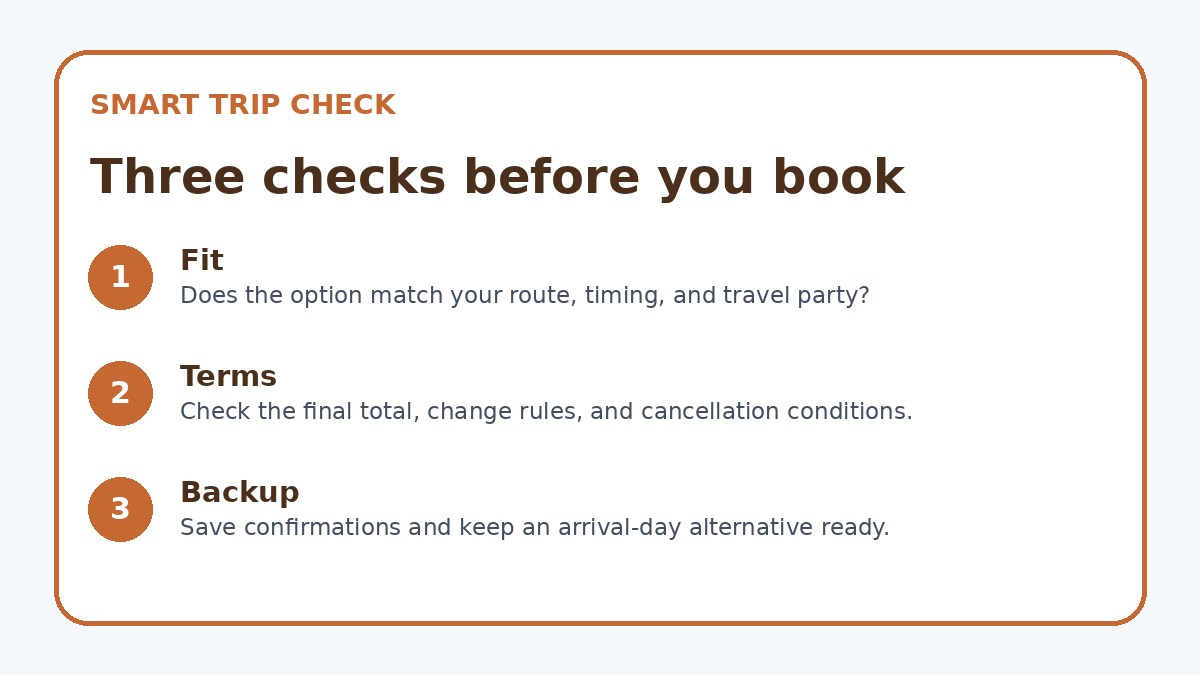
- Confirm the transfer vehicle’s luggage capacity and number of suitcases allowed on the provider’s booking page.
- Verify child-seat availability, size/age limits, and whether the driver installs the seat or you must provide one.
- Screenshot or print your booking confirmation showing pickup point, provider phone number, and cancellation terms.
- Pack a carry-on with snacks, medications, spare clothes, and entertainment to reduce stress during transfer.
- Measure stroller and boxed items to ensure they fit the vehicle or to arrange alternative storage in advance.
- Arrange a contingency plan (local taxi number or hotel shuttle) in case your booked transfer is delayed or canceled.
How to compare and book transfers safely
When comparing providers, focus on clear, comparable details: vehicle type and capacity, child-seat options and any associated fees, luggage allowances, pickup logistics, and the provider’s policy on delays and refunds. Don’t rely solely on general claims—open the final booking page to confirm what’s included, how many pieces of luggage fit, and any age or weight limits for seats. If a provider mentions child seats, verify whether they supply the seat or if you must bring your own; if they supply seats, confirm the size or standard used.
Use reviews and parent forums for practical insights, but cross-check facts on the provider’s site. Consider calling the provider directly if you have unusual needs—multiple strollers, oversized sports equipment, or children with mobility considerations. Trip.com can be used once as a place to compare availability and conditions, but always verify key terms such as pickup location, cancellation rules, and exact vehicle specification on the supplier’s booking page before confirming.
Frequently asked questions
Can I bring a full-size stroller and multiple suitcases in a standard transfer vehicle?
Many standard cars have limited trunk space; a full-size stroller plus multiple suitcases may not fit. When booking, look for vehicle descriptions that list luggage capacity or choose a van-size vehicle for more room. If the provider’s site doesn’t state dimensions, contact them directly and give exact bag sizes. As an alternative, consider a compact or umbrella stroller and consolidate suitcases, or pre-book a larger vehicle to avoid last-minute rearrangements at the airport.
Do I need to request a child seat when I book a transfer to Gyeongju?
If you need a child seat, request it explicitly during booking and check whether the provider supplies one or if you must bring it. Different countries and providers have varying age and weight recommendations; the booking page should specify limits and any extra fee. If the booking page lacks this detail, contact the supplier before confirming. Bringing your own certified travel seat can be safer if you have concerns about availability or compatibility, but confirm whether it fits into the chosen vehicle.
Is it better to pre-book a transfer or find a taxi on arrival?
Pre-booking gives certainty about vehicle size, child-seat provision, and pickup logistics—useful with children and heavy luggage. Finding a taxi on arrival may work if you travel light and are flexible, but it can involve more waiting and uncertainty about suitable vehicles. If you consider arriving without a reservation, identify trusted taxi ranks or your hotel’s recommended transfer service ahead of time. For last-minute options, have contact details ready and be prepared to request a larger vehicle if needed.
Final planning note
Traveling to Gyeongju with children and luggage is manageable with the right planning: choose a transfer that matches your family’s size and needs, confirm child-seat and luggage policies on the supplier’s booking page, and pack strategically to simplify handling. Private transfers reduce carrying and waiting, while public transport can work with careful last-mile planning. Always verify pick-up points, vehicle dimensions, and the provider’s policy on delays before you finalize a booking. With a few practical checks and a clear contingency plan, your family’s arrival will be calmer and you’ll be ready to enjoy Gyeongju sooner.
Continue planning
Check current options and final conditions
Use the provider page to confirm live availability, the final total, cancellation terms, and every condition that matters to your trip.
This evergreen planning guide was created with AI-assisted drafting and a structured quality review. It does not display live prices, schedules, availability, visa guidance, or provider rankings. Verify current details before booking. Some links are affiliate links; we may earn a commission at no additional cost to you.