
Practical answer first: when you arrive in Singapore with extra luggage, prioritize hotels next to an MRT station with elevators and step-free routes, or properties within short taxi rides of Changi Airport or major bus interchanges. This reduces the time and effort spent moving bags, avoids multiple transfers, and keeps first and last-mile logistics simple. Beyond proximity, check whether the hotel offers luggage drop before check-in, accessible lifts to the street, and clear instructions for luggage-friendly routes from the nearest transport node. When comparing properties, verify ground-floor access, stair-free entry, and the exact walking route from the station on a map or the hotel’s directions page before you book.
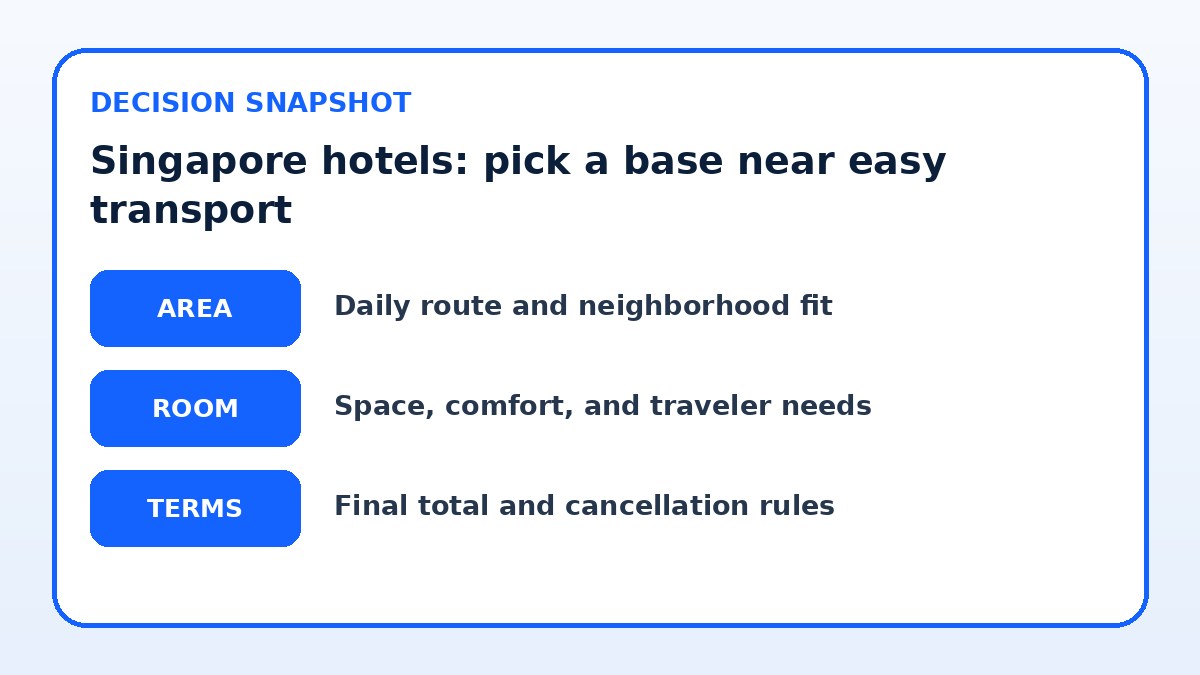
See current options before you compare the details
Availability and final conditions change. Open Trip.com now or keep reading for the practical comparison.
Which transport links matter most for luggage-heavy trips
For travelers with large or numerous suitcases, not all transport links are equal. The MRT (Mass Rapid Transit) is often the fastest way around Singapore, but the deciding detail is whether a station has lifts, barrier-free exits, and short platform-to-street walks. Some stations involve long stairs, narrow footbridges, or long underground passages that become frustrating when you’re handling bulky bags. Airport links and dedicated shuttle services reduce walking and transfers—useful for airport transfers—but remember to confirm where the shuttle stops relative to the hotel entrance.
Taxis and ride-hailing are simple for door-to-door trips and can be faster late at night or when you have heavy luggage, but traffic and surge pricing are considerations. If you plan to use buses, inspect the nearest bus stop layout and whether there are level kerbs or ramps; some stops require short walks over uneven surfaces. Ultimately, prioritize reduced walking distance, elevator access, and direct routes over theoretical speed when you’ll be moving bags often.
How to evaluate a hotel’s arrival and departure logistics
Start with the hotel’s published arrival instructions: look for explicit notes on nearest station exits, which exit numbers to use, and whether there is step-free access. Many hotels include a map with walking time estimates; but for luggage-bearing travelers, convert walking time to distance and number of stairs instead. Use street-view imagery to confirm sidewalks, ramps, and the presence of steps between the pavement and the hotel entrance. If the hotel lists a drop-off point or covered porte-cochère, that’s a major convenience for rainy days and heavy baggage.
Next, contact the hotel directly with specific questions: can they hold luggage before check-in, do they provide trolleys for guest use, and is the main entrance accessible without stairs? When you contact them, note precisely what the staff says and save any confirmation. If the hotel recommends a particular station exit or taxi rank, verify that suggestion on a map app. Remember that small conveniences—like a wide lift or staff assistance—can turn a difficult transfer into a straightforward one, so don’t assume these details are standard.
| Approach | Best for | Tradeoff to check |
|---|---|---|
| Hotel next to an MRT interchange | Frequent sightseeing with minimal taxi use | May require short station navigation and crowds during peak times |
| Hotel near Changi Airport or airport line | Easy arrival/departure with heavy luggage | Usually farther from central attractions, adding extra city travel |
| Budget hotel farther from transit but with luggage storage | Lower nightly cost while keeping bags off your feet | More last-mile walking or taxi fares for each trip |
| Hotel with 24-hour reception and covered drop-off | Late arrivals and wet-weather transfers | May be pricier and located on busier streets that complicate loading |
Ready to check the option that fits your plan?
Use your exact dates and traveler details so the provider page can show the current total and conditions.

Neighborhood choices: tradeoffs between transport convenience and other priorities
Central areas like Marina Bay, Orchard, and Bugis put you close to multiple MRT lines and numerous taxi ranks, which is valuable when you’re handling luggage. These districts often have hotels with luggage storage, 24-hour receptions, and direct station access. The tradeoff is that central locations can be pricier and busier, and some hotel entrances sit on crowded pavements that make immediate street loading trickier. If budget is a concern, compare the savings of a slightly farther hotel against the time and effort the extra walking will cost you.
Staying near Changi Airport or along the Tanah Merah/East Coast corridor reduces airport transfer stress but may add time to city-center sightseeing. Suburban hotels near larger bus interchanges or MRT interchanges like Jurong East or Paya Lebar give good regional access but often require an extra transfer to reach tourist clusters. Decide whether you value single-transfer simplicity (stay closer to the airport or a direct line) or lower nightly rates with more frequent short transfers. For multi-stop itineraries with lots of luggage movement, fewer transfers usually win.
Before you book
- Confirm the nearest MRT station name and exit number, then check street view to count stairs and ramps on the route to the hotel.
- Ask the hotel whether they hold luggage before check-in, provide trolleys, and can assist with baggage at arrival and departure.
- Save an offline map screenshot showing the walking route from the station or airport shuttle stop to the hotel entrance.
- Verify the hotel entrance is step-free or has a ramp; if not, arrange for a taxi drop-off directly at the front door.
- Pack one wheeled suitcase designed for urban kerbs and a smaller day bag to avoid juggling multiple large pieces.
- If arriving late, confirm 24-hour reception or get written late-check-in instructions and a phone contact from the hotel.
Booking checks and last-mile tips before you finalize
Before you click Book, verify several living details on the hotel page and map: the exact station exit number, whether the hotel entrance is on a raised kerb, the presence of lift access from platform to street, and whether the property confirms luggage storage. If any of these items are unclear, send a direct message to the hotel asking for a simple photo of the walking route from the station to the front door. If they cannot provide this, plan for a taxi from the station or airport instead of trying to navigate unclear pedestrian routes with suitcases.
On arrival day, prepare by saving the hotel’s map screenshot and the recommended route offline, and note local taxi ranks or ride-hail pickup points. Carry at least one high-quality wheeled suitcase that handles curbs and pavement well, and bring compact packing aids so you can keep hands free for door handles and tickets. If you expect to transfer multiple times during your trip, consider booking the same hotel for consecutive nights around heavy-luggage segments to avoid repeated check-ins and transfers.
Frequently asked questions
Is it better to stay near an MRT station or close to Changi Airport with heavy luggage?
If your trip centers on city sightseeing, staying near an MRT station with lifts and short exits minimizes repeated taxi fees and walking. However, for short trips or when you prioritize a stress-free arrival and departure—especially with oversized suitcases—staying near Changi Airport or an airport line stop cuts transfer complexity. Compare your itinerary: if you’ll be in Singapore for several days of city travel, MRT proximity likely wins; if you arrive late or leave early with bulky baggage, an airport-adjacent option is worth considering.
How can I judge station-to-hotel walking difficulty before booking?
Use the hotel’s written directions and map, then cross-check with a map service and street-view images to inspect sidewalks, stairs, and curb heights. Look for documented station exit numbers and whether lifts are shown on the station map. If the route appears to include long staircases, narrow underpasses, or uneven pavement, contact the hotel for a photo or choose a different property. Also ask whether the hotel recommends a taxi pick-up point for guests with luggage.
Are taxis and ride-hailing always the safer choice with extra luggage?
Taxis and ride-hailing provide door-to-door convenience and reduce walking, which is especially useful late at night or in heavy rain. But they can be slower in peak traffic and occasionally require a short walk to a pickup point in busy areas. Compare expected travel time, road congestion for your arrival hour, and whether the hotel has an easy drop-off zone. For repeated short trips inside the city, a hotel near accessible MRT service often beats taxis for predictability and cost-effectiveness.
Final planning note
For travelers carrying extra luggage in Singapore, the best single decision is to prioritize minimized handling: choose a hotel with a short, step-free route to an MRT station with lifts or a straightforward taxi/airport shuttle drop-off. Scout the route using the hotel’s directions, street view, and a direct message to the property to confirm lift access, luggage storage, and drop-off points. Balance neighborhood convenience against walking distance and transfer count—fewer transfers usually mean a calmer trip. Before you book, verify the specific station exit, step-free access, and the hotel’s luggage policies on the provider’s final booking page; Trip.com can be one place to compare current availability but always confirm details with the hotel.
Continue planning
Check current options and final conditions
Use the provider page to confirm live availability, the final total, cancellation terms, and every condition that matters to your trip.
This evergreen planning guide was created with AI-assisted drafting and a structured quality review. It does not display live prices, schedules, availability, visa guidance, or provider rankings. Verify current details before booking. Some links are affiliate links; we may earn a commission at no additional cost to you.