
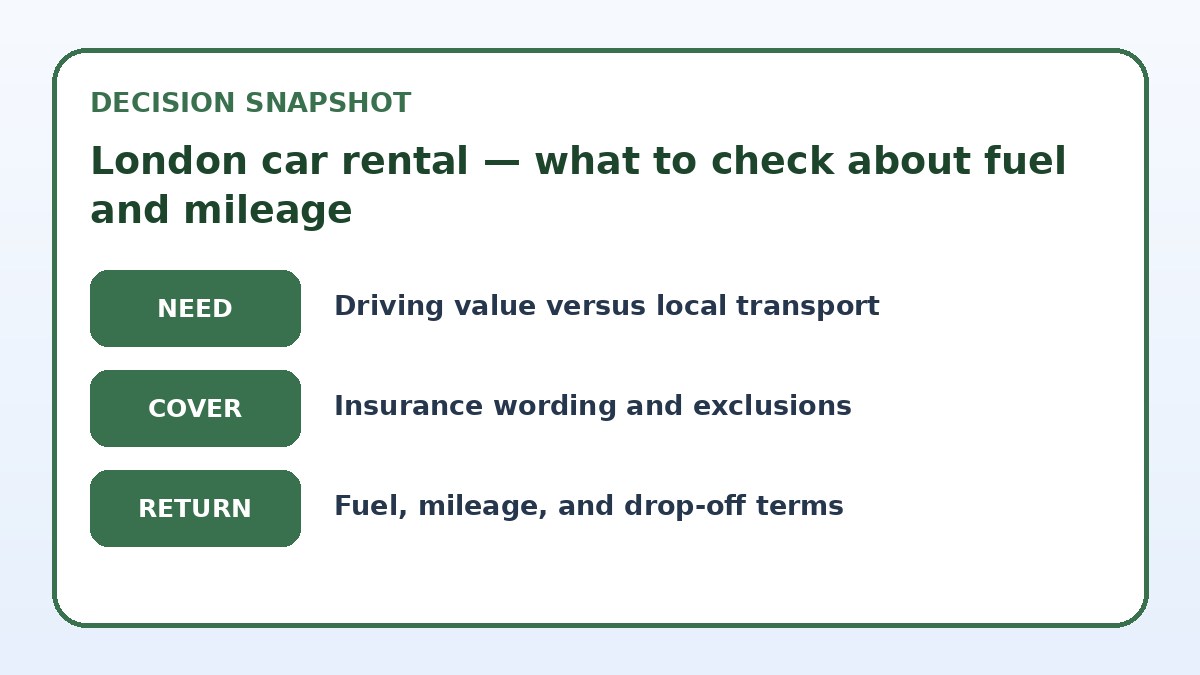
If you’re renting a car in London for business, check the fuel policy and mileage allowance first — these two items usually change the effective cost and flexibility of any reservation. Look for whether the car comes with a full tank and requires you to return it full, or whether the agency offers prepaid or ‘same-to-same’ refuelling options. Also confirm whether daily mileage is capped or unlimited, and whether excess mileage is charged per mile or per kilometer. These rules affect route planning, meeting scheduling, and whether a rental makes sense compared with public transport or taxis. Read the provider’s final booking page and rental contract carefully to verify fuel, mileage, and any damage-waiver terms; when in doubt, call the rental company to get the exact wording.
See current options before you compare the details
Availability and final conditions change. Open Trip.com now or keep reading for the practical comparison.
How fuel policies work and what to verify
Fuel policies vary: common approaches are full-to-full (you pick up full, return full), full-to-empty or prepaid fuel, and provider-refuelled return where the company tops up and charges you. For business travelers, full-to-full is usually the fairest if you can refuel locally before return, but it requires time and a receipt may be necessary. Prepaid fuel can save a trip to the petrol station but often refunds are not issued for unused fuel, so it’s only efficient for high-mileage users. On the provider’s final booking page and the rental agreement, look for exact language about whether you must present a fuel receipt, if fuel is charged by litre or by a flat administrative fee, and whether any refuelling service includes additional handling charges.
Also verify when the fuel measurement is taken — at the handover odometer and fuel gauge reading — and how discrepancies are handled. Ask how the provider records the tank level at collection: some companies photograph the gauge or log it in the contract; others might rely on staff notes. If you need to leave the car early or return it after hours, check the company’s procedure for noting fuel level to avoid surprise charges. For multinational teams, confirm whether invoices and fuel-charge explanations will be provided in English and the currency you need for expense reporting.
Understanding mileage allowances and extra-mile charges
Mileage rules can be per-day, per-week, or unlimited. Per-day or capped total mileage is common on shorter business hires; long-term rentals are more likely to offer unlimited mileage but may still exclude certain vehicle categories. When mileage is capped, the supplier usually charges a fixed rate per excess mile or kilometer; confirm the exact unit and rounding rules. For trips that include out-of-London meetings or airport runs, estimate total miles conservatively and compare the excess-mile charge against the cost of alternatives like trains or taxis.
Check how mileage is recorded: some contracts specify that the odometer reading at collection and return is the basis, while others use electronic telematics. If the car has telematics, determine whether the provider uses GPS-tracked distance and if that affects privacy or expense reporting. For corporate renters, ask whether your company’s rental agreement or corporate rate alters the mileage allowance or excess charges. Always get the excess-mile rate in writing on the final booking page before you confirm the reservation.
| Approach | Best for | Tradeoff to check |
|---|---|---|
| Full-to-full fuel policy | Travelers who can refuel near drop-off and want lowest fuel cost | Requires time to refuel and risk of missing a convenient station before return |
| Prepaid fuel (no-return refuelling) | Busy schedules that prioritise time over precise fuel costs | Often non-refundable for unused fuel, potentially wasting money on short trips |
| Unlimited mileage | Multi-stop business trips or long-day itineraries around and outside London | May raise the base rental rate or be limited to certain vehicle classes |
| Capped mileage with excess-per-mile | Short, predictable commutes within city limits with clear distance planning | Unexpected trips can generate substantial per-mile charges difficult to estimate |
Ready to check the option that fits your plan?
Use your exact dates and traveler details so the provider page can show the current total and conditions.

Tradeoffs: convenience, cost predictability, and time
Prepaid fuel or pay-on-return options give different mixes of convenience and cost control. Prepaying avoids the need to refuel before returning and can save time at the end of a busy day, but you may lose money if you don’t use the full tank. Returning full is cheaper if you can plan a convenient stop near the drop-off point; otherwise, refuelling fees charged by the rental company are usually higher. For short London meetings where time is tight, also weigh the time cost of finding a petrol station and potential queues against the monetary difference.
Mileage caps reduce costs for suppliers but can add unpredictable expenses for travelers who don’t carefully plan routes. Unlimited mileage is simpler for door-to-door client visits across the city and suburbs, but vehicles with unlimited mileage may come at a higher daily base rate or be limited to certain vehicle classes. Also consider non-fuel costs tied to driving in London — parking fees, congestion charges, and time lost in traffic are not covered by fuel policies but will affect the overall value of renting a car for business.
Before you book
- Read the final booking page to identify the exact fuel policy wording and whether fuel is charged per litre, gallon, or as a flat fee.
- Confirm the mileage allowance (daily or total) and record the excess-mile rate in the currency you’ll expense.
- Ask whether the odometer or telematics/GPS data determines mileage and whether that data will appear on your invoice.
- Plan return logistics: map nearby petrol stations to the drop-off location and note opening hours for after-hours returns.
- Photograph the fuel gauge and odometer at pickup and again at return; keep fuel receipts and the rental contract for expense reports.
- If corporate billing or an account rate applies, verify any modified fuel or mileage rules on the company agreement before confirming the booking.
Practical checks before you book and at pickup
Before booking, read the full fuel and mileage language on the provider’s final booking page and rental terms. Confirm whether the price shown includes any fuel options, whether the excess-mile rate is specified per mile or per kilometre, and how refuelling charges are calculated. If the reservation is through a corporate account or third-party site, verify whether company policies modify the default fuel or mileage rules. If key terms are unclear, call the rental desk and ask for the exact fees that would apply to your planned itinerary, and request that any verbal confirmations be added to the reservation.
At pickup, check the fuel gauge and odometer together with the agent and ask them to annotate the contract or take a timestamped photo showing levels and readings. Carry a copy of the booking terms on your phone or as a printout that highlights fuel and mileage clauses. Keep all receipts if you refuel on your own; if you return the car after hours, follow the company’s documented return procedures and take your own photos to avoid disputes. If you need extra flexibility for urgent meetings, consider adding a mileage or fuel option when you book so the rules are clear and the cost predictable.
Frequently asked questions
What if I return the car with less fuel than it had at pickup?
Most companies will charge you for refuelling if you return below the agreed level — either by topping up at a company rate or charging a fixed administrative fee. The amount charged can be higher than local pump prices, and contracts differ on whether they charge by litre or a flat service fee. To avoid surprise charges, confirm how return-level shortfalls are billed on the provider’s final booking page, keep any refuelling receipts, and, if possible, refuel near the drop-off to present a receipt as proof.
Does mileage include detours like traffic or GPS-calculated extra miles?
Mileage is typically measured by the vehicle’s odometer or telematics, which records actual distance driven, including any detours or deviations caused by traffic. GPS-tracked systems may calculate route distance differently, and some companies use telematics to log distance rather than relying solely on the odometer. If your route may include significant detours, ask the rental company how they measure miles and whether telematics affects billing. Get that method written into the booking confirmation or the rental contract.
Should I choose prepaid fuel to save time on a tight business schedule?
Prepaid fuel can save time at the end of meetings by removing the need to refuel before return, which is useful when you’re short on time. However, prepaid options rarely refund unused fuel, so if you expect to use significantly less than a full tank the option may cost more than refuelling yourself. Compare the estimated unused fuel loss with the value of saved time, and check the supplier’s refund and documentation policy on the final booking page before selecting prepaid fuel.
Final planning note
For business travel in London, fuel and mileage rules can change the practical cost and convenience of renting a car more than the headline daily rate. Make decisions based on your itinerary: return-full works if you can plan a convenient fill-up; prepaid fuel saves time but can waste money if underused; unlimited mileage avoids surprises on long or multi-stop days but may raise the base price. Always verify the exact wording on the provider’s final booking page or rental contract, photograph odometer and fuel levels at handover, and keep receipts for expense claims. If you want to compare current availability and specific terms quickly, you can check providers on sites such as Trip.com, but rely on the rental company’s booking page for the definitive rules.
Continue planning
Check current options and final conditions
Use the provider page to confirm live availability, the final total, cancellation terms, and every condition that matters to your trip.
This evergreen planning guide was created with AI-assisted drafting and a structured quality review. It does not display live prices, schedules, availability, visa guidance, or provider rankings. Verify current details before booking. Some links are affiliate links; we may earn a commission at no additional cost to you.