
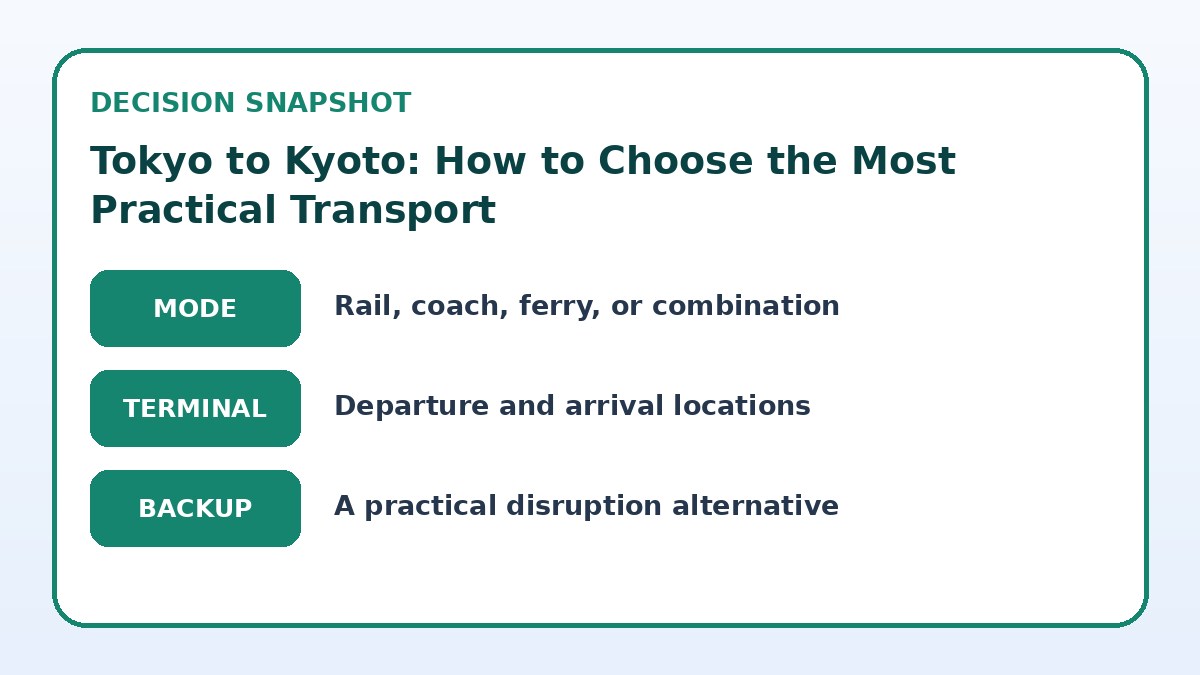
The most practical way for most solo travelers to go from Tokyo to Kyoto is the Shinkansen (bullet train) when you value predictability, frequent departures, and a smooth city-center-to-city-center transfer. If your priority is saving cash and you have time flexibility, highway buses and slower local trains can cut costs but add travel time and complexity. Flying is rarely practical for solo door-to-door travel between Tokyo and central Kyoto because airports sit outside city centers and require extra transfers. Choosing the right option comes down to balancing how much you value time, comfort, luggage simplicity, and schedule flexibility. Below I give a clear recommendation up front, then walk you through the tradeoffs and specific checks to make before you book so you can pick the choice that fits your trip rhythm.
See current options before you compare the details
Availability and final conditions change. Open Trip.com now or keep reading for the practical comparison.
Why the Shinkansen is the practical default
The Shinkansen (bullet train) usually stands out as the practical default for solo travelers because it combines speed, predictability, and a city-center arrival. Trains run frequently throughout the day, which means you can book a flexible plan without being forced onto a single departure. Stations in Tokyo and Kyoto are in central locations with straightforward onward connections by subway, local trains, or short taxis, which reduces the stress of arriving at remote airports or complex bus terminals. That central-to-central movement simplifies luggage handling and minimizes total door-to-door travel time compared with options that require long transfers.
For decision-making, think in terms of total trip experience rather than headline travel time: how many transfers will you manage alone, will you be carrying bulky luggage, and do you need guaranteed seating? Shinkansen offers reserved and unreserved seating, and the onboard environment is quiet and safe for solo passengers. If you value reliability and fewer moving parts in your itinerary, the Shinkansen typically wins. Still, this recommendation depends on your tolerance for cost and whether you already hold a rail pass or prefer a deeper budget approach.
When buses or local trains make more sense
Highway buses and slower local or limited-express trains become practical when cost-saving is a top priority or when your schedule includes overnight travel. Buses often depart from central Tokyo terminals and can arrive at different points around Kyoto; overnight rides let you save on a night's accommodation and travel while you sleep. Local trains and limited-express options can be rewarding if you want to see more of the countryside or stop at towns along the way, and they pair well with certain regional rail passes. Both choices require acceptance of longer travel times and potentially multiple transfers.
If you pick a bus or local train, check boarding and arrival locations carefully, because some terminals are not adjacent to major hotels or subway stations. Confirm luggage allowances and whether you need to reserve a seat in advance for popular departures. For local trains, identify convenient transfer points and platform layouts if you have heavy luggage; solo travelers benefit from planning transfers in advance to avoid last-minute scrambling. These lower-cost approaches work best if you prioritize budget or discovery over speed.
| Approach | Best for | Tradeoff to check |
|---|---|---|
| Shinkansen (bullet train) | Solo travelers prioritizing speed, predictability, and central arrivals | Higher fare relative to buses and some local trains |
| Highway bus (day or overnight) | Budget-minded travelers who accept longer total travel time | Longer trips, potential discomfort, and varied arrival locations |
| Local and limited-express trains | Travelers who want scenic stops or use regional rail passes | More transfers and longer journey planning required |
| Air travel | Those connecting to flights or needing specific flight timing | Extra ground transfers and check-in time reduce practicality |
Ready to check the option that fits your plan?
Use your exact dates and traveler details so the provider page can show the current total and conditions.
Why flying is usually lower on the practical list
Flying between Tokyo and Kyoto can be misleadingly appealing because flight time itself is short, but the overall practicalities often undermine that advantage. Airports (such as Tokyo’s main airports and the airports nearest Kyoto) sit outside the city center, so you must factor in time and cost for ground transfers to and from each airport. Check-in, security, and potential delays add variability, and solo travelers carrying luggage face more transfer steps than with a direct train. When you compare options, assess total door-to-door time and not just airborne minutes.
There are scenarios where flying becomes reasonable: if you find a tightly timed itinerary connecting to another domestic or international flight, or if you must travel during periods when rail capacity is constrained and flight connections line up better with your schedule. Before booking, verify baggage allowances, the required arrival time ahead of departure, and the cost and duration of ground transfers on the airline’s booking page. For most solo travelers focused on city-center convenience and minimal logistics, rail options will often be more practical.
Before you book
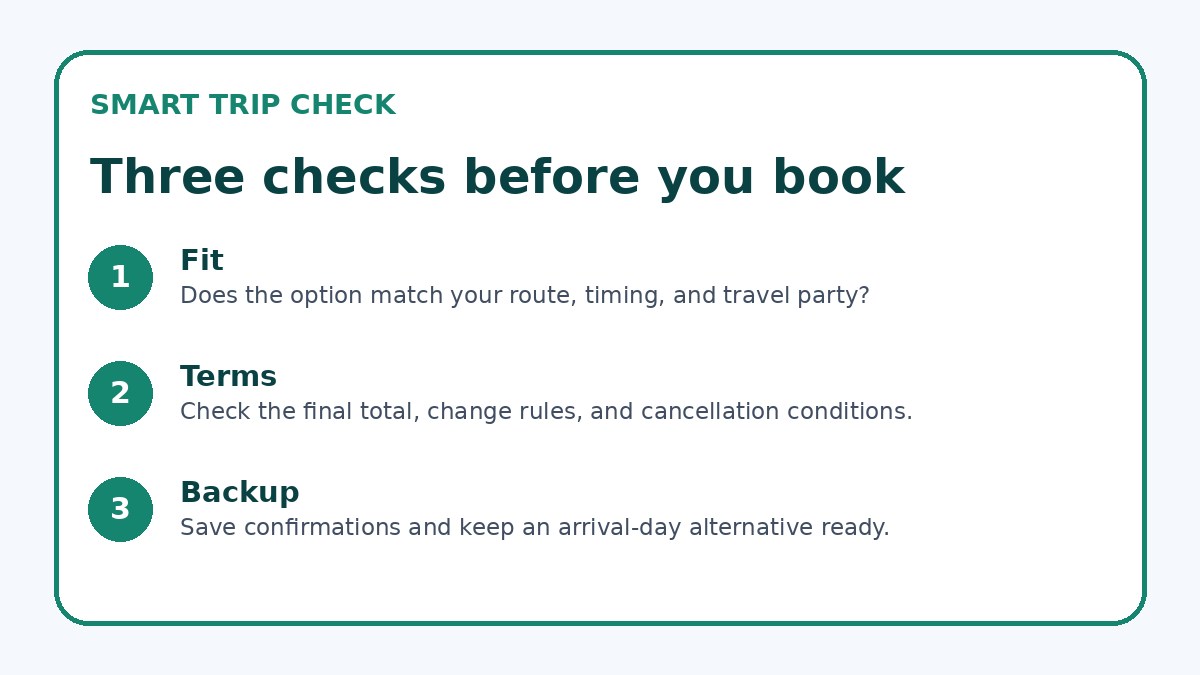
- Compare total door-to-door time for each option, including transfers and ground transport to and from stations or airports.
- Confirm luggage rules and easy storage options for your chosen mode; note size and quantity restrictions and whether reservations include baggage.
- Check seat reservation requirements and book reserved seats if you want guaranteed seating, especially for peak travel periods.
- Verify exact departure and arrival locations on the provider’s booking page—terminal names and station exits matter for onward connections.
- If cost is critical, compare full trip costs including transfers and overnight accommodation savings when evaluating overnight buses.
- If using a rail pass or discount ticket, confirm compatibility and whether you must reserve seats separately before travel.
How to decide: four practical criteria
Use four straightforward criteria to decide: total door-to-door time, number of transfers, luggage handling, and schedule flexibility. Total door-to-door time includes how long it takes to reach the departure point (airport or station), waiting time, the journey itself, and transfers at the destination. Solo travelers aiming for low-stress logistics should weight fewer transfers and central arrivals more heavily. Luggage concerns matter: if you travel light, buses or local trains become more workable; if you have large suitcases, the Shinkansen or direct services reduce carrying effort.
Schedule flexibility matters for both comfort and contingency. If you need to be in Kyoto at a specific time, prioritize options with frequent, reliable departures. If you have flexible arrival windows, a cheaper overnight bus or slower rail can be attractive. Before you commit, check the latest timetables and seat availability on official provider sites or on a site like Trip.com, and always verify baggage rules, reservation requirements, and the exact location of departures and arrivals on the provider’s booking page.
Frequently asked questions
Is the Shinkansen the fastest door-to-door way to travel from Tokyo to Kyoto?
The Shinkansen typically offers the fastest city-center-to-city-center journey because trains depart frequently and arrive at central stations. However, fastest door-to-door depends on where you start and end inside each city. If your origin or destination is close to an airport, or if you have a timed flight connection, a plane could be competitive. Always add transfer time to and from airports, and compare total travel time rather than just the in-transit segment. Verify schedules and platform or terminal details on the provider’s booking page before finalizing.
Can I save money by taking a bus instead of the Shinkansen?
Yes, buses often cost less than the Shinkansen, especially for overnight services that also save a night’s accommodation. Keep in mind the tradeoff: buses take significantly longer and may arrive at terminals that require extra transfers to reach central Kyoto. If you travel light and accept the extra time, buses are economical. For a simple comparison, calculate the total cost including onward transfers and any savings from not paying for a night’s lodging, and confirm seat reservation policies on the bus operator’s booking page.
How should a solo traveler handle luggage on these routes?
For solo travel, aim to minimize cumbersome luggage. The Shinkansen has overhead space and some trains offer dedicated luggage areas, which simplifies handling. Buses can have hold compartments for large bags but require retrieving luggage at stops, and some budget buses have stricter size limits. If using local trains with transfers, consider luggage delivery services or smaller bags to avoid managing heavy items on stairs and platforms. Always verify baggage allowances and any required advance declarations on the carrier’s booking page before traveling.
Final planning note
For most solo travelers, the Shinkansen will be the most practical choice when you value a predictable, comfortable, and centrally routed journey between Tokyo and Kyoto. If saving money or wanting a slower, more scenic trip ranks higher, highway buses or regional train combinations provide viable alternatives but demand more planning and longer travel time. Flying usually only makes sense when it fits into a larger flight itinerary or when specific timing outweighs extra transfers. Use the checklist above to compare total door-to-door time, transfers, luggage arrangements, and reservation needs, and verify the final details on the provider’s booking page — you can also check current availability on Trip.com as an additional comparison tool.
Continue planning
Check current options and final conditions
Use the provider page to confirm live availability, the final total, cancellation terms, and every condition that matters to your trip.
This evergreen planning guide was created with AI-assisted drafting and a structured quality review. It does not display live prices, schedules, availability, visa guidance, or provider rankings. Verify current details before booking. Some links are affiliate links; we may earn a commission at no additional cost to you.