
If you’re flying from Busan to Jeju on business, prioritize a carry-on-only plan and arrive at the airport with a clear buffer for check-in and security. A compact wheeled bag that fits airline cabin-size rules keeps you flexible: you skip hold-baggage waits, reduce risk of missed connections, and move faster through Jeju’s terminals. That said, some meetings or multi-day trips force checked luggage. This guide tells you how to decide whether to check a bag, how much extra time to allow at Gimhae (Busan) and Jeju depending on the baggage choice, and which provider details to verify before you book. You’ll get short tradeoffs, comparison approaches for direct versus connecting itineraries, and a practical checklist to use before heading to the airport.
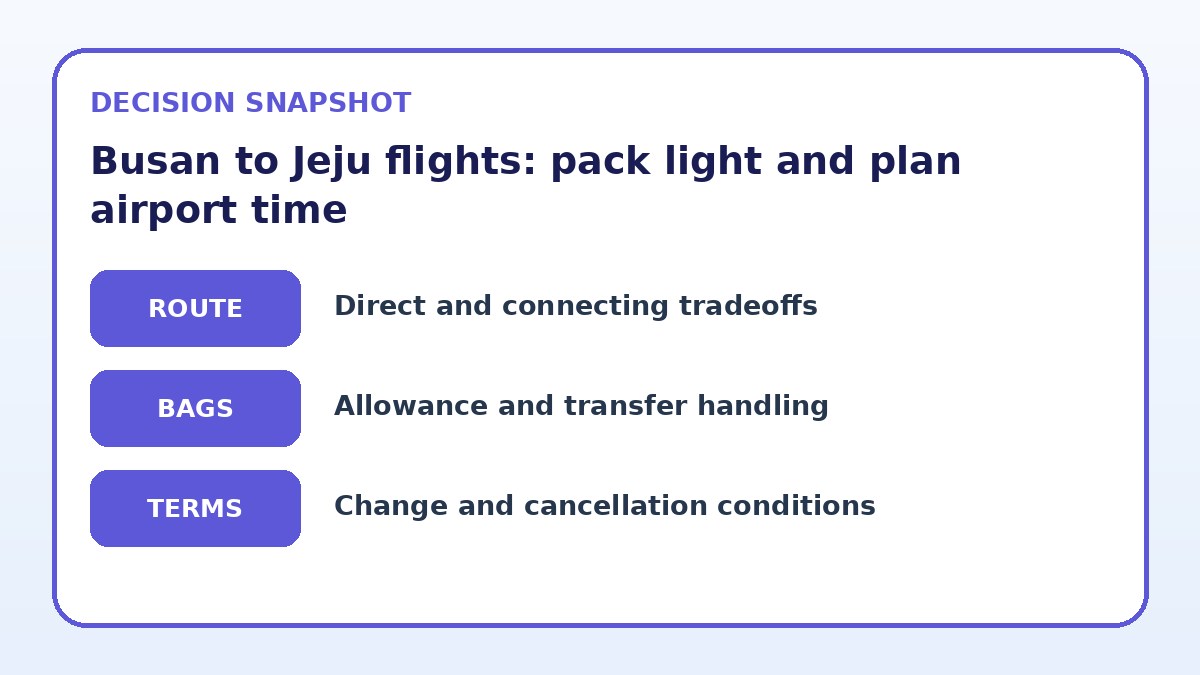
See current options before you compare the details
Availability and final conditions change. Open Trip.com now or keep reading for the practical comparison.
Deciding between carry-on only and checked luggage
Start by mapping the length and formality of your business trip. If you need only a suit, a laptop, and one change of clothes, a carry-on that meets the airline’s cabin dimensions will usually get you through faster: you skip baggage claim and can leave the airport as soon as you land. Factor in what you’ll do on arrival—if your meeting requires garments that crease or you need samples, a checked bag may still be necessary. For multi-day trips where you want to bring shoes, promotional materials, or multiple outfits, plan for a single checked item rather than several smaller bags to simplify handling.
Consider the hidden time costs of checked luggage. Even when checked bags arrive quickly, waiting at baggage claim can add 10–30 minutes or more, and if your flight is tight with a morning meeting, that delay compounds the risk. Also weigh the risk of lost or delayed bags—business travelers who can operate with essentials in a carry-on reduce disruption. Before deciding, check the airline’s published carry-on dimensions and allowed items; policies vary and the final booking page is the authoritative source for current size and weight limits.
How much airport time to allow at Busan and Jeju
For carry-on-only travelers, arrive at the airport with enough time to complete security and reach your gate comfortably. A practical baseline is 45–60 minutes before departure to handle ticketing kiosk needs, security lines, and any last-minute changes at the departure gate. If you need to drop a bag at a counter on the day of travel, add 20–30 minutes. Peak morning and evening windows—when business travelers cluster—can increase wait times for security and service desks; observe your usual rush-hour patterns and add buffer accordingly.
If you’re checking baggage, plan to arrive earlier—typically 75–90 minutes before departure—to allow for check-in, bag drop, and security. Early morning flights sometimes open check-in earlier, while late-night services may have different staffing; don’t assume uniform service hours. On arrival in Jeju, remember that collecting checked luggage and transferring to taxis or car rental counters will add time before you reach a meeting. For critical appointments, build in an extra 30–45 minutes beyond the minimum recommended arrival times to absorb small delays without missing obligations.
| Approach | Best for | Tradeoff to check |
|---|---|---|
| Carry-on only | Short trips with tight schedules and someone who values speed and flexibility | Limits what you can bring; careful packing and compliant bag dimensions required |
| One checked bag | Multi-day trips needing extra clothing or materials without juggling multiple bags | Adds wait at baggage claim and small risk of delay or misrouting |
| Direct flight | Minimizing touchpoints and reducing risk of missed connections | May force an inconvenient departure/arrival time relative to meetings |
| Connecting flight with long layover | Flexible schedules where earlier or later travel windows matter | Longer total travel time and more moving parts to manage |
Ready to check the option that fits your plan?
Use your exact dates and traveler details so the provider page can show the current total and conditions.

Comparing direct and connecting flight options
Direct flights between Busan and Jeju are usually the fastest and involve fewer touchpoints where delays can cascade, which benefits travelers with checked luggage or tight itineraries. When direct options are available, compare total door-to-door time rather than flight time alone. If a direct flight’s schedule forces an uncomfortable departure or arrival relative to your meeting times, weigh whether an earlier connecting itinerary might still be a better choice despite the transfer complexity.
For connecting routes, prioritize longer connection windows if you have checked baggage or if you’re unfamiliar with the transfer airport. Short connections magnify the chance of missing a connection and ending up on later flights or separated from your luggage. Read the airline’s minimum connection time guidance and confirm whether you’ll need to change terminals or clear security again. Always verify connection handling policies on the carrier’s final booking page—especially responsibility for rechecking bags and assistance if you miss the connection.
Before you book
- Confirm carry-on dimensions and weight limits on the airline’s final booking or policy page before packing.
- Check-in online and download a mobile boarding pass to avoid counter lines when traveling with carry-on only.
- If checking luggage, drop it as soon as check-in opens and note the airline’s baggage cut-off times.
- Allow 45–60 minutes at the airport for carry-on-only departures; add 30–45 minutes if you’re checking bags.
- Plan connections with an extra buffer beyond the minimum transfer time when checked luggage or tight windows are involved.
- Pack a small outfit and essentials in your personal item in case checked luggage is delayed or rerouted.
Practical baggage organization and airport behavior
Pack your carry-on with the items you’ll need immediately on arrival: a clean shirt, charging cables, essential documents, and any medication. Use packing cubes or compression organizers to keep suits and shirts neater and to make security checks quicker. Place electronics and liquids where they’re easy to remove at security; having a small, labeled pouch for chargers and adaptors reduces fumbling at the gate and can save time between meetings.
At the airport, prioritize queue strategy and timing: check-in online and use mobile boarding passes to skip counters when possible, join the security line for priority or business class if eligible, and keep digital copies of itinerary and meeting details. If you must check bags, drop them as early as allowed to reduce stress about cutoffs. Finally, build in a post-arrival routine—change into meeting clothes or press garments at the airport restroom or lounge if time allows—so you arrive at meetings composed and on time.
Frequently asked questions
How early should a business traveler arrive at Busan (Gimhae) airport for a domestic flight to Jeju?
Recommended arrival depends on baggage choice: for carry-on only, arriving about 45–60 minutes before departure is often sufficient to complete security and gate procedures. If you plan to check a bag, increase that to roughly 75–90 minutes to allow for check-in and bag drop. Adjust these baselines for peak travel periods, early-morning rush hours, or if you need to visit airline service counters. Always verify the airline’s stated check-in and baggage drop cut-off times on the final booking page before you travel.
Can traveling with only a carry-on save time at Jeju on arrival?
Yes—arriving with only a carry-on removes the need to wait at the baggage claim, which can save 10–30 minutes or more depending on how quickly checked luggage is offloaded. It also reduces risk if your schedule is tight because you can head straight to meetings or onward transport. However, this assumes your carry-on meets the airline’s cabin-size and weight limits; double-check those rules on the carrier’s booking information and pack essentials in a personal item in case of any bag-handling issues.
What should I verify on the airline booking page before finalizing Busan to Jeju travel?
On the airline’s final booking or policy page confirm three things: exact carry-on dimensions and weight allowances, checked baggage rules including allowances and cut-off times, and check-in/security opening times for your flight. If your itinerary includes connections, read the carrier’s transfer policies and whether they will assist with missed connections or rebooking. If you’re comparing options, Trip.com can be used to view current availability but always use the airline page for the definitive baggage limits and timing rules.
Final planning note
For most business travelers on the Busan to Jeju route, traveling carry-on only and planning to arrive 45–60 minutes before departure blends speed with reliability. When checked luggage is necessary, add more buffer time both at Gimhae and after arrival in Jeju to accommodate baggage drop and claim. Choose direct flights to minimize touchpoints if schedule timing aligns with your commitments; choose connections only when the timing advantage outweighs transfer complexity. Before you complete any booking, verify baggage dimensions, weight limits, and check-in cut-offs on the airline’s final booking page to avoid last-minute surprises and to keep your trip running smoothly.
Continue planning
Check current options and final conditions
Use the provider page to confirm live availability, the final total, cancellation terms, and every condition that matters to your trip.
This evergreen planning guide was created with AI-assisted drafting and a structured quality review. It does not display live prices, schedules, availability, visa guidance, or provider rankings. Verify current details before booking. Some links are affiliate links; we may earn a commission at no additional cost to you.