If you need to be productive and presentable when you arrive in Budapest, the practical decisions you make the morning of departure matter more than the in-ride comfort. Start by deciding whether you want a rail journey, coach, private transfer, or a hybrid (train plus taxi) based on terminal fit, luggage friction, and how much guaranteed time you need after arrival. For most business trips between Vienna and Budapest an intercity train balances reliability and the ability to work en route; coaches and private cars trade speed predictability against door-to-door simplicity. This guide gives a concise decision framework: compare door-to-door timing, transfer effort, luggage handling, and a clear disruption backup so you can choose and book with confidence. It also outlines what to verify on booking pages — platform access, luggage allowances, station transfer options, and refund/change terms — because those details change more often than the route itself.

Choosing the mode: rail, coach, private transfer, or hybrid
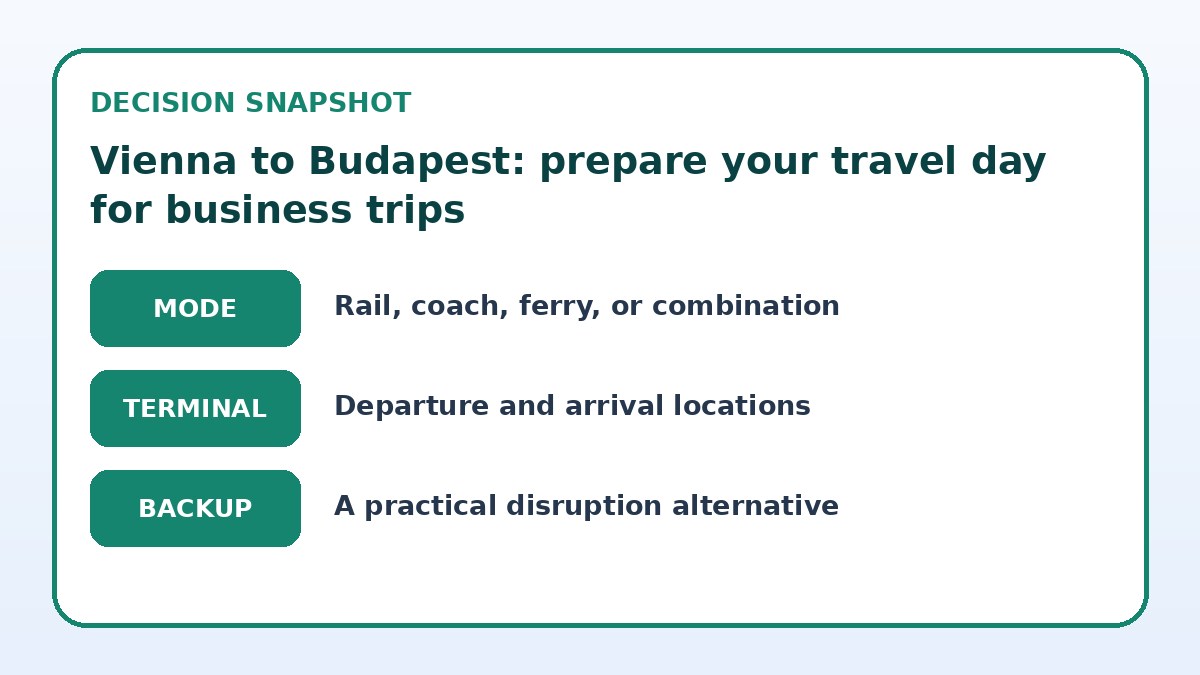
Start by matching your priorities to the mode. Trains usually let you work comfortably and avoid road congestion unpredictability, while coaches can be cheaper but add boarding and luggage constraints. Private transfers remove local logistics and deliver a clear door-to-door time estimate, useful for airport-like punctuality needs. A hybrid approach — train between city centers plus a short taxi at either end — can combine onboard productivity with minimal last-mile hassle.
To pick between these options, think about absolute punctuality needs (presentations, meetings), luggage volume, and how you prefer to use travel time. If you must be ready to walk into a meeting on arrival, prioritize door-to-door reliability and plan extra time for unexpected delays. If you can work during the trip and arrival flexibility is acceptable, prioritize modes with onboard Wi‑Fi and comfortable seating, and use the saved margin for transfers or a more central arrival point.
Choose the end-to-end journey plan
| Journey approach | Best for | Friction to check |
|---|---|---|
| Door-to-door private transfer | Travelers prioritizing guaranteed arrival time and minimal transfers | Higher cost and potential road delay exposure, but minimal handling and clear timing |
| Direct intercity train (city-center to city-center) | Those who want to work en route with predictable central arrival | Requires a short station transfer at each end and seat/space variability |
| Coach service | Budget-conscious travelers with flexible arrival windows | Longer boarding times, stricter luggage rules, and possible roadside stops |
| Hybrid (train plus prebooked taxi) | Travelers balancing onboard productivity with low transfer friction | More steps to coordinate but often faster door-to-door than train-only |
Check live intercity options
Look beyond the ride itself and compare terminals, transfers, luggage, and arrival fit.
Terminal fit and luggage/transfer friction
Assess how each terminal integrates with your departure and arrival addresses. A station closer to your hotel or meeting venue reduces last-mile transfer time and stress. Look at typical transfer options: direct tram or metro lines, short taxi rides, or pedestrian routes. Also consider luggage: trains typically have more forgiving luggage areas, while coaches may constrain bag size or require gate check-in. For private cars, confirm trunk space when booking so large cases won’t delay boarding.
When you evaluate transfer friction, imagine the worst-case small delays: crowded taxis, elevator outages at stations, or a missed platform announcement. Choose arrival stations with straightforward exits and reliable onward transit. If your schedule is tight, prioritize modes and arrival points that minimize transfers or allow you to prebook the final taxi. Note on booking pages whether a service includes step-free access or dedicated assistance if you need it — these details affect how quickly you can move from vehicle to destination.
Timing flexibility and productive travel windows
Estimate door-to-door time rather than just ride duration. Include check-in or boarding time, possible traffic near departure or arrival, and the time needed to freshen up and prepare for meetings. If you need a fixed arrival time, build in a healthy buffer and choose options with multiple departures so you can move your booking or take the next service if something goes wrong. If flexibility is greater, you can use later departures to reduce early-morning stress and possibly reduce transfer costs.
Think about how you will use travel time. If you plan to work, pick a seat with a table or reliable power and a stable connectivity option. For concentrated prep time, a private transfer or a quieter first-class train carriage may be worth the extra coordination. Also plan when you’ll dress and freshen up: bring a small garment bag or use a quick-stop restroom strategy at the station to avoid arriving flustered. Consider scheduling a brief arrival buffer to allow for quick recharging of devices or a rapid outfit touch-up.
Compare the practical alternatives
Use the final page to confirm what is actually offered on your dates and save a workable fallback.
Intercity travel checklist
- Confirm your preferred arrival station’s exact name and the shortest transit option to your meeting or hotel.
- Prebook or block a return taxi or rideshare for the arrival window if you need guaranteed last-mile timing.
- Pack a compact grooming kit and a spare shirt in your carry-on for quick touch-ups on arrival.
- Download or screenshot booking confirmations and cancellation/change rules from the carrier’s final booking page.
- Bring a multi‑port charger and a short adapter to top up devices during short transfer windows.
- Set an alternate departure plan (earlier train or private transfer) and note contact details to activate it quickly.
Disruption backup and what to verify before booking
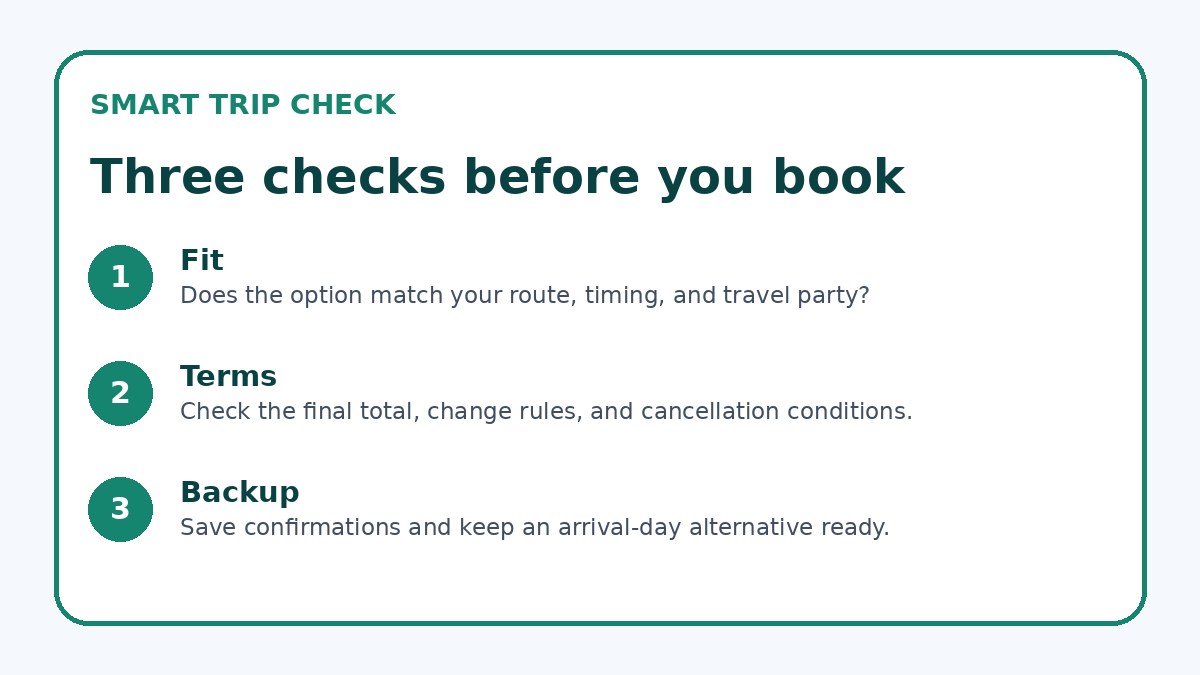
Your disruption plan should be a single, executable fallback that you can act on quickly. Choose an alternate departure (earlier or later) and a different mode if feasible — for example, an earlier train or a private taxi that can be called if all trains are affected. Make sure you know the refund and change terms on your booking page, whether seat reservations are exchangeable, and any penalties for last-minute changes. Keep contact details for customer service, and, if possible, a local number for a taxi or private transfer provider.
Before you finalize any booking, verify key operational details on the provider’s final booking page because these change frequently: exact station names and platforms, luggage policies, check-in/boarding requirements, seat reservation rules, and the fine print on changes or cancellations. If you rely on Trip.com for comparisons, use it only to view current availability and then confirm directly with the carrier for the latest terms. Save screenshots of confirmations and the relevant policy text so you can present them quickly if you need to change plans.
Rail & Intercity Transport questions travelers ask
Is taking an intercity train the best option for working during the Vienna to Budapest trip?
Trains generally offer the best combination of stable space and the ability to work en route, with room for a laptop and often more relaxed luggage rules than coaches. If onboard productivity is critical, choose a service with table seating and verify Wi‑Fi and power availability on the booking page; bring a mobile hotspot or ensure your phone plan supports roaming data if you need consistent connectivity. If absolute punctuality on arrival is more important than uninterrupted work time, a private transfer may be a better fit despite less workspace.
How much time should I allow for station transfers and boarding when planning a business schedule?
Plan door-to-door time using a conservative buffer: include travel to the departure station, at least 20–30 minutes for station navigation and boarding, and expected transit from arrival station to your meeting venue. If you’re unfamiliar with the stations or carrying lots of luggage, add extra minutes for moving between platforms or arranging a taxi. For tight schedules, choose earlier departures or a private transfer to reduce the number of variables you need to manage on the day.
What should I verify on the carrier’s booking page before I finalize a Vienna to Budapest reservation?
Check exact departure and arrival station names, platform access or check-in requirements, luggage size and quantity allowances, seat reservation rules, and the carrier’s change or cancellation policy. Confirm whether assistance with heavy luggage or step-free access is available if needed. If you are comparing options, you can view availability on Trip.com but always confirm these operational details on the carrier’s own booking pages before relying on them for a business schedule.
Final decision note
For a business traveler, the Vienna to Budapest trip is less about which vehicle you choose and more about how you manage door-to-door time, transfers, and contingencies. Decide whether you prioritize a predictable arrival time, uninterrupted work time, or minimal transfer hassle, then pick the mode and arrival station that match that priority. Prebook last-mile transport if your schedule is tight, verify luggage and boarding rules on the carrier’s final booking page, and set one clear disruption backup you can activate quickly. With those choices made and a few actionable checks completed, you’ll turn a routine intercity trip into a dependable, productive travel day.
Continue planning
Check current options and final conditions
Use the provider page to confirm live availability, the final total, cancellation terms, and every condition that matters to your trip.
This evergreen planning guide was created with AI-assisted drafting and a structured quality review. It does not display live prices, schedules, availability, visa guidance, or provider rankings. Verify current details before booking. Some links are affiliate links; we may earn a commission at no additional cost to you.