If you’re booking Seoul to Bali flights, the practical decision often comes down to an airport-versus-fare tradeoff: choose the most convenient Seoul departure airport and pay a bit more, or aim for the cheapest routing and accept extra connections or transfers. For first-time visitors, convenience—less transfer stress, clearer baggage handling, and reliable schedules—usually beats shaving off a small amount on fare. That said, some fare-savvy itineraries route through other hubs or require a domestic transfer inside South Korea, which changes baggage and connection risk. Before you search live fares, have exact travel dates, the number and ages of travelers, and whether you need flexibility or checked bags. This guide gives a direct recommendation up front, then walks you through routing, baggage and connection risk, schedule fit, and fare conditions so you can make a confident, practical booking choice.

See live routes for your exact travel day
Compare direct and connecting choices with the same baggage and traveler details.
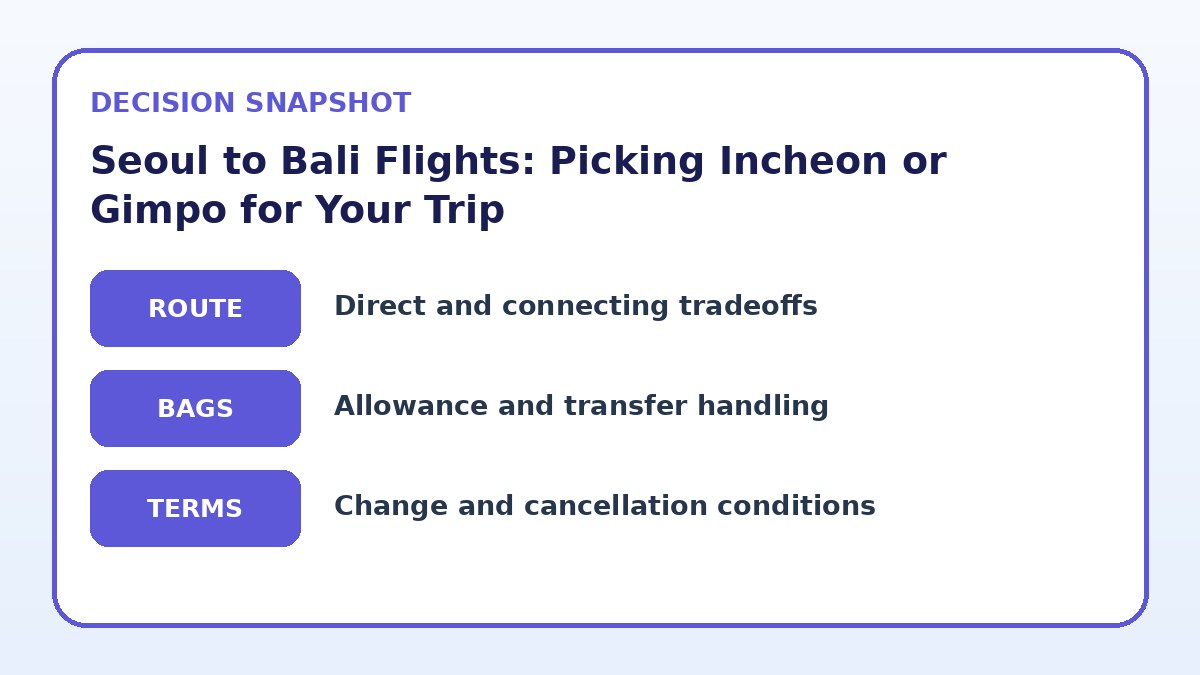
Routing: direct options, one-stop choices, and domestic transfers
For Seoul to Bali routes you’ll commonly see direct or one-stop international options, and on occasion multi-leg itineraries that require a domestic connection between Seoul airports. Direct or one-stop flights that depart from Incheon (the main international hub) typically keep your journey within the same airport and ticketing system. That reduces the number of transfers and simplifies check-in and baggage through-checking if the carrier or alliance offers a single-ticket itinerary. When evaluating routing, always check whether the itinerary is a single ticket (through-checked baggage) or separate tickets that force a self-transfer between airports or airlines.
If an itinerary routes through another international hub, note the layover length and whether you must change terminals or pass immigration. Some cheaper options require you to fly into one Seoul airport and out of another on the return or to book separate domestic flights to reach the international departure airport—this adds time, cost, and complexity. Before booking, list the full door-to-door time for each routing option, including transfers between Seoul airports, and compare that against the fare difference to decide if the savings are worth the extra hassle.
Baggage and connection risk: what to check on the booking page
Baggage rules and whether bags are checked through to Denpasar (Bali) are critical for first-time travelers. On a single-ticket itinerary, checked baggage is often checked through to your final destination, but on itineraries made of separate tickets you’ll usually collect and re-check luggage, which adds time and the risk of missed connections. Always verify the booking page for explicit language about through-checked baggage, size and weight allowances, and whether fees apply per segment. If the booking page is ambiguous, contact the carrier or the booking platform for confirmation before paying.
Connection risk is about missed flights and what happens afterward. Short layovers increase the chance that a delay causes a missed connection, and if you hold separate tickets, you may have no protection. Check whether the carrier promises minimum connection time and whether missed connections are rebooked at no extra charge. When in doubt, prefer itineraries that remain on one ticket and depart from Incheon to reduce transfers. If you must take separate tickets, build plenty of buffer time and know who will cover rebooking or additional costs if a delay breaks your connections.
Compare flight-selection strategies
| Flight strategy | Best for | Risk to check |
|---|---|---|
| Depart from Incheon on a single-ticket itinerary | Travelers prioritizing simplicity, through-checked baggage, and fewer transfers | May be slightly more expensive or require longer ground transit from central Seoul |
| Depart from Gimpo with a domestic transfer to a hub | Those with time to handle domestic connections and seeking certain regional connections | Adds transfer time and baggage re-checking risk if tickets are separate |
| Choose the cheapest multi-ticket routing regardless of airport | Very price-sensitive travelers willing to manage extra complexity and risk | Higher chance of missed connections, no guaranteed rebooking, and extra local costs |
| Pick a one-stop international hub itinerary from either Seoul airport | Travelers balancing price and convenience with acceptable layover lengths | Layovers extend total trip time and may require terminal changes or immigration stops |
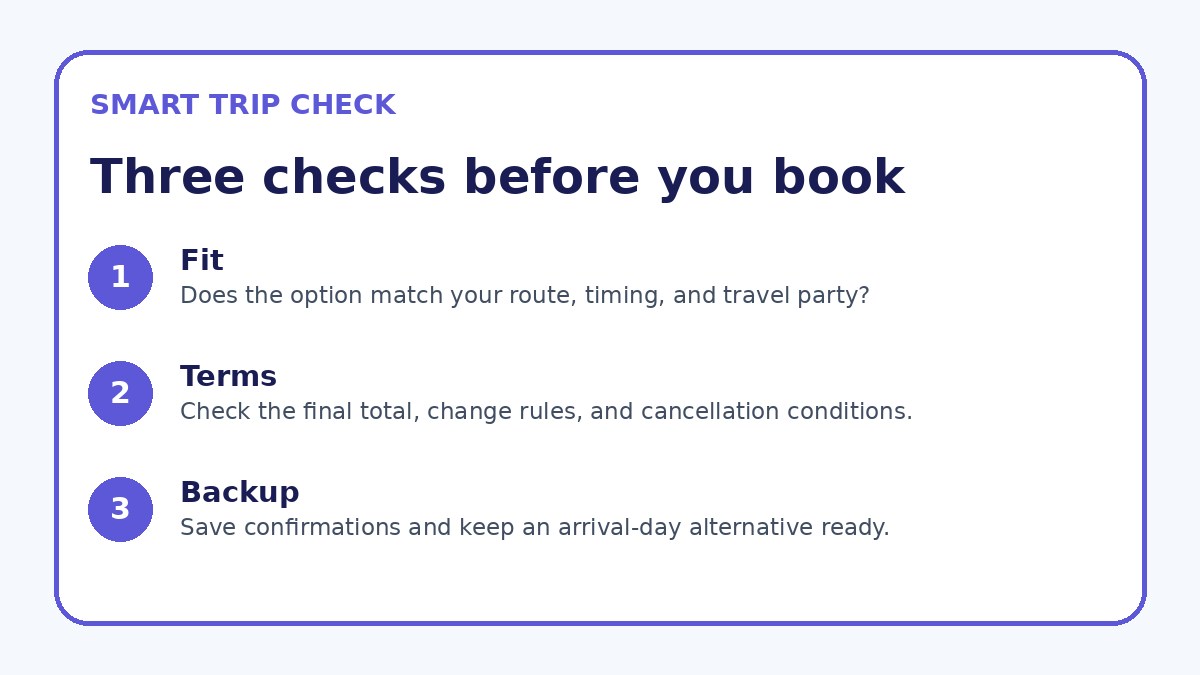
Recheck the complete itinerary
Confirm airports, connection handling, baggage, and change conditions before deciding.
Schedule fit: arrivals, departures, and your travel rhythm
Schedule fit means matching flight times to your energy levels, arrival time in Bali, and onward plans. Red-eye departures might save a day but can leave you exhausted on arrival; midday flights may fit better with daytime transfers and public transport. When comparing Seoul airports, look beyond departure times to consider Seoul traffic and transfer time to the airport: Incheon typically requires a longer surface transfer from central Seoul than Gimpo, so factor taxi or rail time into your plan. For families or travelers with tight layover windows, smoother single-airport itineraries often trump a small fare advantage.
Also check total journey timing: an itinerary with a longer overall travel time but simpler logistics can be less stressful than the cheapest option that requires multiple transfers or an overnight stop. If you have fixed plans in Bali—tours, accommodation check-in times, or meetings—prioritize arrival windows that let you settle in comfortably. Make a schedule matrix listing departure airport, flight times, transfer needs, and arrival windows to compare how each option affects the start of your Bali stay.
Flight details to verify
- Confirm your exact travel dates, number of travelers and ages, and passport details before searching fares.
- Compare total door-to-door travel time for each itinerary, including transfer time to the departure airport.
- Verify on the booking page whether your checked bags are through-checked to Bali or must be re-collected.
- Read the fare rules for refunds and change fees, and save a screenshot of the final terms and conditions.
- If tickets are separate, add at least three extra hours between connections or rebook as a single-ticket option.
- Check Trip.com or another live booking site for current availability, then verify final conditions on the carrier’s page.
Fare conditions: refunds, rebooking and the small print
Fare conditions determine how flexible your ticket will be if plans change. Lower-priced fares often come with restrictions: nonrefundable tickets, change fees, or limited rebooking options. When choosing between Seoul airports, confirm whether the fare you see includes checked baggage and whether change and cancellation terms differ by fare class. On the booking confirmation page, verify the exact refundability, rebooking fees, and the carrier’s policy for schedule changes. If you need flexibility—e.g., traveling with young children or uncertain dates—paying a little more for a flexible fare can save stress later.
Also check who issues the ticket: a single carrier, a marketing/operating split, or separate tickets across carriers. If an airline changes flight times, carriers usually provide remedies only for tickets they issued. For itineraries involving partnerships or separate tickets, read the provider’s terms about recovery options after schedule changes or cancellations. Before committing, screenshot or save the fare rules and the final purchase page so you can reference the terms if an adjustment is needed after booking.
Flight Guide questions travelers ask
Is it always better to fly out of Incheon when traveling from Seoul to Bali?
Not always, but Incheon is usually the more practical choice for international flights because it offers more direct and single-ticket options that reduce transfers and baggage handling. For first-time visitors who prefer fewer logistics to manage, Incheon lowers the likelihood of self-transfers and separate-ticket complexity. However, if a well-timed itinerary from Gimpo saves you significant travel time overall or eliminates overnight layovers, it can be the better option. Confirm whether your itinerary is on one ticket and whether baggage is checked through before choosing.
How should I handle baggage when my Seoul to Bali trip uses separate tickets?
When flights are booked on separate tickets, plan to collect checked baggage at the arrival airport, clear any required immigration, and re-check bags for the next flight. That means allowing extra time for baggage claim and recheck, as well as additional costs if the second carrier charges for checked luggage. If you can, rebook as a single-ticket through the same carrier or alliance to enable through-checked baggage. If single-ticket options aren’t available, build ample buffer time between flights and confirm baggage procedures with both carriers before departure.
What specific things should I verify on the final booking page before I pay?
On the final booking page, verify airport codes and terminals for both departure and arrival, whether baggage is included and through-checked, exact fare rules for changes and cancellations, and whether the itinerary is issued on a single ticket. Also check total travel time and layover durations, and confirm any seat assignment or special-service requests. If the page doesn’t clarify these points, contact the carrier or booking platform to get written confirmation. Save a copy or screenshot of the fare conditions and booking summary for reference after purchase.
Final decision note
For most first-time visitors, departing from Incheon minimizes transfers, simplifies baggage handling, and lowers connection risk—making it the most practical default for Seoul to Bali flights. Gimpo can work when a specific itinerary offers a clear time advantage, but that usually requires careful verification of baggage rules and transfer logistics. Always prepare exact travel dates, traveler details, and your tolerance for transfer risk before comparing fares. Compare total journey time, connection complexity, and fare conditions—not just the headline price—and verify the final terms on the carrier’s booking page or a live site like Trip.com before completing payment.
Continue planning
Check current options and final conditions
Use the provider page to confirm live availability, the final total, cancellation terms, and every condition that matters to your trip.
This evergreen planning guide was created with AI-assisted drafting and a structured quality review. It does not display live prices, schedules, availability, visa guidance, or provider rankings. Verify current details before booking. Some links are affiliate links; we may earn a commission at no additional cost to you.