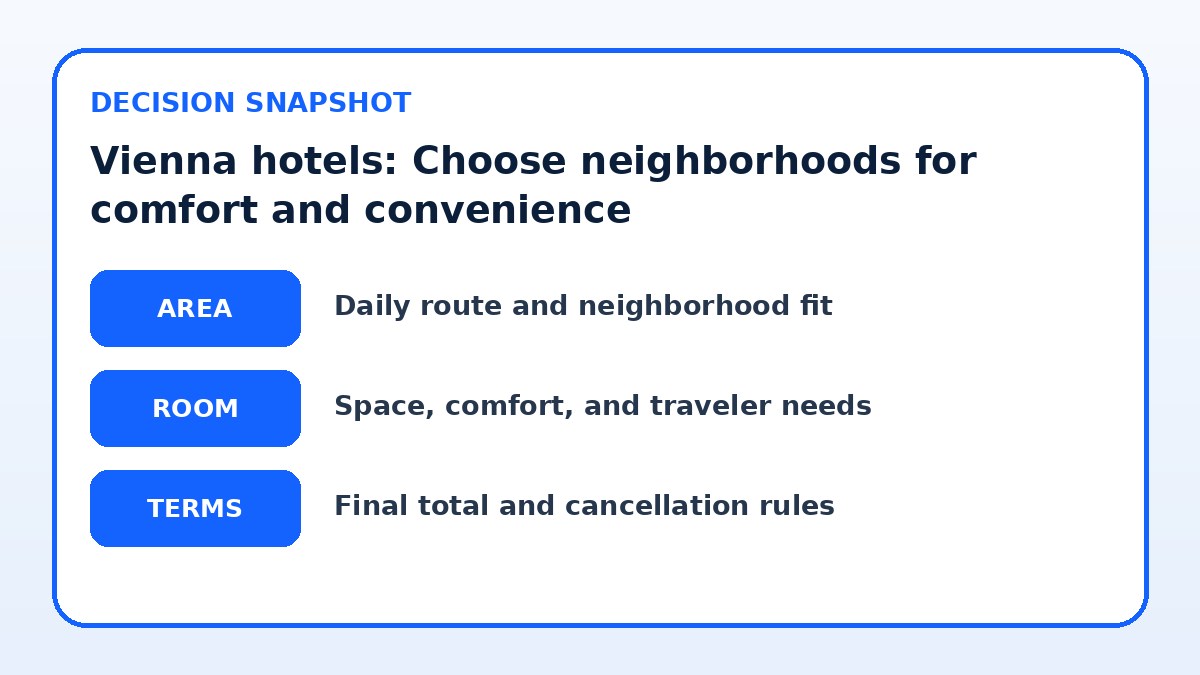
Practical answer first: pick the smallest-area tradeoff that matches your daily rhythm — stay in Innere Stadt or close to the Ring if you prioritize walkable sightseeing and evening safety, or choose Neubau/Neubau-Kern and Mariahilf for better-budget or boutique-room comfort with quick tram or U-Bahn hops; Favor Landstraße or the Prater area if you want easier airport/train links and quieter, roomier nights. That single choice — central compactness versus slightly outer neighborhoods with better rooms — shapes daily friction and the type of hotel you should filter for. Below I explain how to evaluate neighborhood fit, estimate the real daily route friction of your likely plans, translate room and solo-traveler needs into concrete hotel features to filter, and which booking terms to confirm before you commit. By the end you'll be able to shortlist one area and a handful of hotel must-checks before opening live inventory.
Check live stays in the areas that fit
Use your dates and party size to compare current rooms after you narrow the neighborhood fit.
Neighborhood fit: choose by daily priorities
Start by mapping a typical day instead of choosing by a single attraction. If mornings will be museum-heavy (Belvedere, Kunsthistorisches) and evenings will be concerts or the Staatsoper, the Innere Stadt or neighborhoods adjacent to the Ring keep walking times minimal and make late returns easy. For solo travelers who prefer lively cafés and independent shops, Neubau and Mariahilf put you close to creative neighborhoods with boutique hotels and smaller guesthouses. The practical decision is which seconds you want to save each day: 10–20 minutes of transit add up and affect whether you can squeeze in an extra museum, a long lunch, or a late performance.
If your itinerary includes day trips that start early or arrive late, factor transit links into your neighborhood choice. Landstraße offers a straightforward connection to the main train station (Wien Mitte) and S-Bahn links, while districts around Prater and Messe offer easier car or taxi access for longer transfers. Neighborhood names can mean different things to different booking sites, so check a map and a public-transport app to confirm where a hotel actually sits relative to the U-Bahn or key tram lines; avoid assuming proximity solely from a neighborhood label.
Choose an area-selection strategy
| Area approach | Best for | Tradeoff to check |
|---|---|---|
| Central historic (Innere Stadt / Ring) | Maximum walkability to main sights and simplified evenings | Smaller rooms and higher noise levels; fewer large bathrooms for the same budget |
| Creative districts (Neubau / Mariahilf) | Boutique hotels, cafés, and an energetic solo-traveler scene | Slightly farther walking distances to some historic sights; short tram/U-Bahn rides needed |
| Transit-linked (Landstraße / Prater) | Easier airport/train links and quieter, roomier hotels | Less immediate historic charm; may require a short metro or tram ride to center |
| Outer residential rings | Better value for larger rooms, longer stays, and quieter nights | Increased daily transit time and more planning for late-night returns |
Daily-route friction: transit, time of day, and safety
Evaluate the kind of friction that matters most to you: cumulative walking time, number of transfers, or late-night return complexity. For solo travelers, fewer transfers at night reduce stress, especially when carrying luggage or after long performances. The U-Bahn network is straightforward but not every line runs equally late; trams are frequent and pleasant but slower. If you plan to use taxis at night, check general local taxi options and confirm whether the area has regular ranks or whether rides might require a phone app — a detail to verify on your taxi provider's page rather than relying on hotel claims.
Consider noise and light levels at different times of day. Central streets near tourist venues stay lively late; if you need deep sleep or a quiet workspace in the room, look for hotels with soundproofing, courtyard-facing rooms, or located one block from main avenues. Many boutique hotels list soundproof windows or quiet rooms in the facilities section — verify that the specific room category provides these features. Small details like blackout curtains, a fridge, and an uncluttered desk can turn a compact urban room into a comfortable solo base.
Now compare like with like
Keep the same dates, guests, room needs, and cancellation preferences while you compare the final choices.
Room and party needs: what solo travelers should prioritize
Be explicit about the room features that matter to you and translate them into booking filters. If you work from the room, prioritize a firm desk, reliable Wi‑Fi (read recent reviews for speed), and accessible power outlets. For privacy and sleep quality, request a courtyard or upper-floor room, and confirm soundproofing. If you prefer to socialize but sleep alone, pick hotels with a lobby, shared lounge, or evening events to meet other travelers. Small rooms in central hotels are common, so if you need space to unpack or a larger bathroom, search one ring outward or for boutique hotels that advertise larger suites.
Single-occupancy practicalities often get overlooked: check bed type descriptions so you get a full bed rather than a narrow single, and read the property’s language about single occupancy and any extra-bed rules. Verify whether breakfast is included and whether it’s served in a spacious dining room or as a takeaway option, which affects morning comfort. For safety and convenience, confirm the presence of 24-hour reception, in-room safe, and secure luggage storage on arrival or departure days — all details you should check on the hotel’s booking page before you finalize.
Hotel booking check before payment
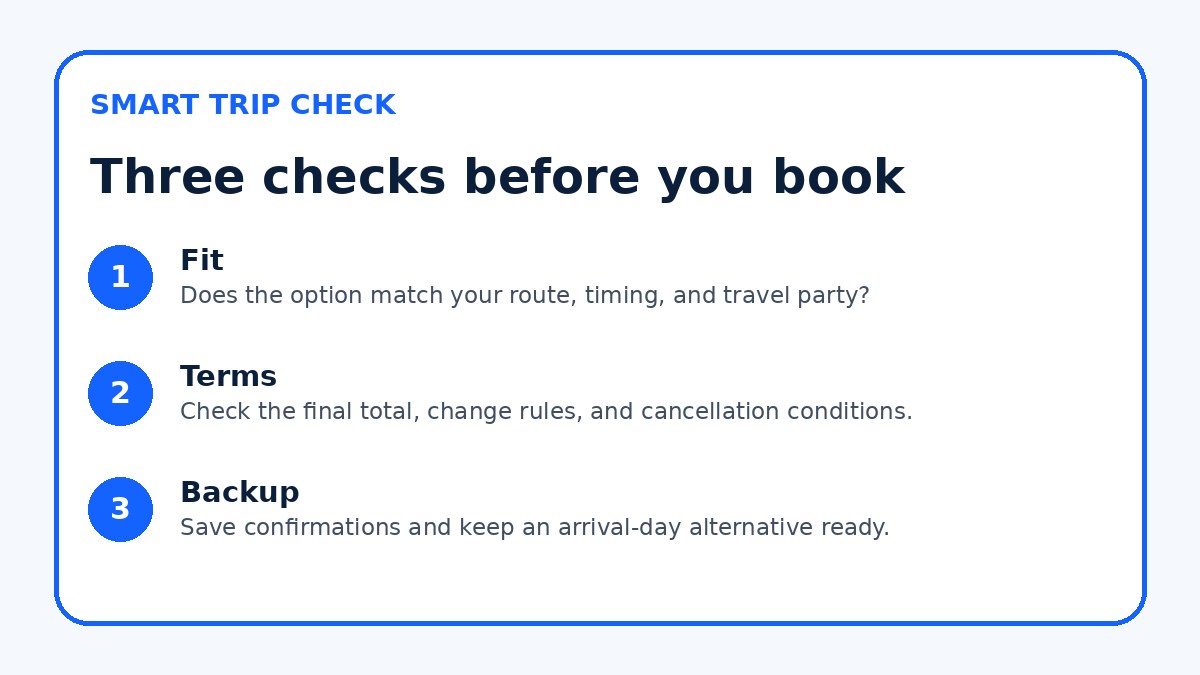
- Map your planned daytime stops and check walking times from the hotel address to at least three priority sites.
- Filter hotels by room size, bed type, and ‘soundproof windows’ or courtyard-facing rooms before opening inventory.
- Confirm the cancellation policy, arrival instructions, and any extra fees directly on the hotel’s booking page.
- Message the property to confirm 24-hour reception or late check-in if your arrival time is after 9 PM.
- Read recent guest comments for Wi‑Fi reliability and actual noise conditions for the booked room category.
- Take screenshots of room details, the listed amenities, and the cancellation terms after booking.
Booking terms and final checks before you commit
Before you open live inventory, list the non-negotiables: free cancellation window, clear single-room bed information, included amenities (Wi‑Fi, breakfast), and whether photos match the booked room category. On the provider’s booking page, verify the exact room size, bed type, floor, and any extra charges for single occupancy or city taxes. If you’re comparing multiple options at once, use the same booking date range and room category filters so you compare apples to apples. If you use Trip.com to check availability, remember it is one aggregator; always confirm the final terms on the hotel’s own page when possible.
Also confirm arrival and departure logistics: check how the hotel describes transfer services, luggage hold policies, and late-check-in procedures. If arrival is late at night or you need an early departure, message the property to confirm arrangements and receive a written reply to save confusion. Finally, save screenshots of the booking terms and cancellation policy after purchase; these are the details you will need if plans change. Doing these checks before clicking reserve reduces the chance of an unpleasant surprise on arrival.
Hotel Guide questions travelers ask
Is it better for a solo traveler to stay in the Innere Stadt or a nearby neighborhood?
It depends on daily priorities. Innere Stadt puts major museums, opera houses, and historic streets within easy walking distance, which reduces transit stress and makes late evenings simpler. However, rooms there are often smaller and noisier. Nearby neighborhoods like Neubau or Landstraße offer quieter nights and larger rooms for the same budget while still keeping the center a short tram or U‑Bahn ride away. Decide whether you value saving minutes each day or having more comfortable in-room space; either choice can work well for solo travel.
How can I judge whether a hotel’s photos reflect the actual room I’ll get?
Photos often show a property’s best room category. Check the room category name and size listed on the booking page and compare it to the photo caption. If the listing is unclear, message the hotel asking for a photo of the exact room category you intend to book or request a room number type in writing. Also read recent reviews that mention the room type; guests frequently note when they received a smaller or different layout than pictured. Always confirm specifics on the hotel’s official page before finalizing.
What are the most useful transit checks for picking a neighborhood in Vienna?
Look for proximity to a U‑Bahn station (especially lines U1, U2, U3 for cross-city convenience) and major tram routes that serve central corridors. Check how many transfers you’d need for your typical day and whether those transfers are quick stairs or long platform walks. Verify last-train times if you expect to return late, and confirm taxi or rideshare availability in the area. Use a transit map to verify the hotel’s claimed location against station icons rather than relying on neighborhood names alone.
Final decision note
Choosing a Vienna hotel as a solo traveler comes down to one decision: save daily time by staying central, or trade a few transit minutes for a larger, quieter room. Start by drafting a realistic daily plan and mapping walking and transit times, then shortlist neighborhoods that match your rhythm. Translate your solo needs into must-have room filters — bed type, soundproofing, workspace, and 24-hour reception — and verify them on the hotel’s live booking page before you reserve. With those checks done you’ll be able to open live inventory and confidently pick a specific hotel, knowing whether you prioritized convenience or in-room comfort.
Continue planning
Check current options and final conditions
Use the provider page to confirm live availability, the final total, cancellation terms, and every condition that matters to your trip.
This evergreen planning guide was created with AI-assisted drafting and a structured quality review. It does not display live prices, schedules, availability, visa guidance, or provider rankings. Verify current details before booking. Some links are affiliate links; we may earn a commission at no additional cost to you.